


Only 5% to 10% of traders actually pass a prop firm challenge.

Sarah Collins
استراتيجي تداول ·  Australia
☕ 11 دقائق قراءة
ما ستتعلمه:
- 1How Prop Firm Advertising Really Works (It's Not What You Think)
- 2Australian Rules vs. Marketing Hype: What's Actually Legal?
- 3Decoding the Ad Numbers: Fees, Splits, and Success Rates
- 4Massive Red Flags in Prop Firm Ads (I've Ignored Them All)
- 5Prop Firms vs. ASIC Brokers: An Advertising Smackdown
- 6So, Should You Even Bother? A Frank Assessment
- 7Your Action Plan: How to Vet a Prop Firm Ad
- 8The Final Word: Advertising Sells Dreams, Trading Demands Reality
Only 5% to 10% of traders actually pass a prop firm challenge. Yet, their advertising makes it seem like a guaranteed path to riches. I've seen traders blow over $4,200 on repeated challenge fees, chasing a dream sold to them by slick marketing. In Australia, these firms operate in a regulatory grey area, which means their advertising isn't held to the same standards as your bank or a licensed broker. This guide isn't about how to pass a challenge. It's about how to not get conned by the advertising first.
Prop firm advertising isn't selling you a trading account. It's selling you a lottery ticket, where the house always wins. Their business model is genius, and brutally simple: they collect evaluation fees from thousands of hopeful traders. Since over 90% fail, that fee revenue is pure profit. The advertising is designed to obscure this.
You'll see claims like "Trade with $100,000 of our capital!" or "Keep 90% of profits!" What they don't highlight is the tiny print: the 10% daily loss rule, the 5% maximum drawdown, the profit target you must hit before a single withdrawal. The goal is to make the reward seem enormous and the risk (your one-time fee) seem trivial. I fell for this early on. I saw an ad for a "$50,000 challenge" and thought, "For a $300 fee, that's a steal." I blew the account in three days trying to hit the aggressive target. That $300 was just the first of many tuition fees.

Warning: If an ad focuses solely on the potential payout and downplays the strict trading rules, it's a red flag. The rules are where you will lose.
The most effective prop firm advertising preys on two emotions: the desire for validation ("I'm good enough to be funded") and the desperation to escape the cycle of blowing your own small account. They position themselves as the gateway, not mentioning they're the gatekeeper designed to keep you out.
Here's the critical bit most traders miss: prop firms in Australia typically don't need an Australian Financial Services License (AFSL). They're not managing your money; you're paying for an evaluation service to trade their capital. This puts them outside ASIC's direct oversight for product advice. But - and this is a huge but - they are absolutely governed by the Australian Consumer Law (ACL).
The ACL bans misleading or deceptive conduct. This is the law that should protect you from the worst of the advertising hype. A firm can't claim "90% of traders get funded" if the real number is 5%. They can't promise "risk-free" trading when you're paying a non-refundable fee. The problem is enforcement. The ACCC can't monitor every Facebook ad or YouTube promo.
The use Loophole
This is a major selling point in their ads. ASIC capped use for retail clients at 1:30 for major forex pairs. Prop firms, however, can offer 1:50, 1:100, or even more. Their ads scream "HIGHER use!" as a benefit. What they don't say is that higher use is a faster way to hit your daily loss limit and fail the challenge. It's a double-edged sword that most new traders impale themselves on. I learned this the hard way using 1:100 on a EUR/USD trade; a 10-pip move against me felt like a sledgehammer because my position was way too big.
So, while their service might be legal, the advertising often flirts with the line of the ACL. It's up to you to read between the lines.

💡 نصيحة وينستون
If an ad makes your heart race with excitement, close it. Good trading opportunities are found in boring, detailed rulebooks, not in thrilling sales copy.
“Only 5% to 10% of traders actually pass a prop firm challenge. Yet, their advertising makes it seem like a guaranteed path to riches.”
Let's translate the advertising into reality. You need to look at three numbers: the fee, the split, and the hidden statistic.
1. The Evaluation Fee: This is their main revenue stream. Ads show account sizes from $10k to $200k. The fee scales up. A $5,000 account might cost $49, while a $200,000 account costs $1,200+. Think of this not as an investment, but as a consumption item - like buying a ticket to a theme park ride. It's gone once you hit the buy button. The average trader spends over $4,200 on multiple attempts. That's a serious chunk of capital you could have used for your own position size calculator-backed live account.
2. The Profit Split: "Up to 90% for you!" is standard. Some even advertise 100%. This is often the most honest part of the ad. The catch? You have to make it to payout first. That split is meaningless if you can't navigate the challenge rules.
3. The Success Rate: This is the number they never advertise. Industry insiders know it's between 5% and 10%. Only 2-7% of those get consistent payouts. This means for every 100 people clicking that shiny ad, maybe 5 will get funded, and 1 or 2 will make it a career. When you see a prop firm ad, mentally stamp "95% FAILURE RATE" across it. That changes how you view the offer.

Example: You see an ad for a $100,000 account for a $500 fee. They have 10,000 challenge buyers per month. Monthly fee revenue: $5,000,000. If a 5% pass rate, 500 traders get funded. The firm's risk is now on those 500 accounts. Their model is built on the $4.75 million from the 9,500 who failed.
After 12 years and losing money to more than a few of these schemes, here's my personal checklist of advertising red flags.
- "Instant Funding" or "No Challenge": This is a relatively new, dangerous trend. It bypasses the evaluation, which sounds great. But it usually means insane rules, like a 3% maximum drawdown or profit targets that force reckless trading. The firm has zero proof you can trade. Their risk is higher, so their rules will be designed to cut you off at the knees at the first sign of a loss. I tried one in 2023. The "instant" $25k account had a 2% daily loss limit. I was stopped out on a single bad XAU/USD (gold) trade during London volatility. Account gone in hours.
- Testimonials with Crazy Returns: "Mike made $50,000 in his first month!" This is the worst kind of advertising. It encourages the exact high-risk, lottery-style trading that will destroy most accounts. Sustainable professional trading is about consistent 2-5% monthly returns, not home runs.
- Vague or Overly Complex Rules: If the ad doesn't clearly link to a simple, one-page rule sheet, be wary. If the rules need a 20-minute YouTube video to explain, they're designed to be tripwires. Look for simple, clear metrics: a maximum daily loss, a maximum overall drawdown, a minimum trading day count.
- Pressure to "Act Now": "Limited time offer! Fee is 50% off!" This is classic marketing 101, but in trading, it's toxic. It makes you buy based on FOMO, not on a rational assessment of whether their program fits your swing trading or scalping strategy.
A good firm's ad will feel boring. It will emphasize risk management, rules, and trader education. The flashy ones are selling a dream, not a sustainable opportunity.
“Think of the fee not as an investment, but as a consumption item - like buying a ticket to a theme park ride. It's gone once you hit the buy button.”
Let's compare what's being advertised. This table cuts through the noise.
| Feature | Prop Firm Ad Says | ASIC-Regulated Broker (e.g., Pepperstone, IC Markets) Reality | The Truth for You |
|---|---|---|---|
| Capital | "Trade $100,000 of our money!" | You trade your own money, starting from $0 (Fusion) or $200 (ICM). | Prop firm capital is a loan with strings. Broker capital is yours, with full control. |
| use | "Access 1:100 use!" | Max 1:30 for major forex (ASIC rule). | Higher use = higher risk of a margin call. 1:30 is plenty for most. |
| Fees | "One-time evaluation fee." | Spreads, commissions, maybe overnight fees. | The prop fee is a sunk cost. Broker costs are per-trade and transparent. |
| Primary Goal | Get you to pay a challenge fee. | Get you to trade actively (they profit from spread/commission). | The broker's incentive aligns with your survival. The prop firm's incentive is often your failure. |
| Payouts | "Keep 90% of profits!" | You keep 100% of your profits (and losses). | 90% of something is better than 100% of nothing... but only if you can make it to payout. |
The broker model is straightforward. You win, they win. You lose, they still win on the spread. The prop firm model is conflicted. If you fail the challenge, they win your fee. If you pass and become consistently profitable, they start sharing their capital with you. Their advertising is designed to hide this fundamental conflict.
💡 نصيحة وينستون
Add up all the challenge fees you're considering. Now ask: 'What edge could I buy or develop with this money instead?' Often, the answer is a better education.
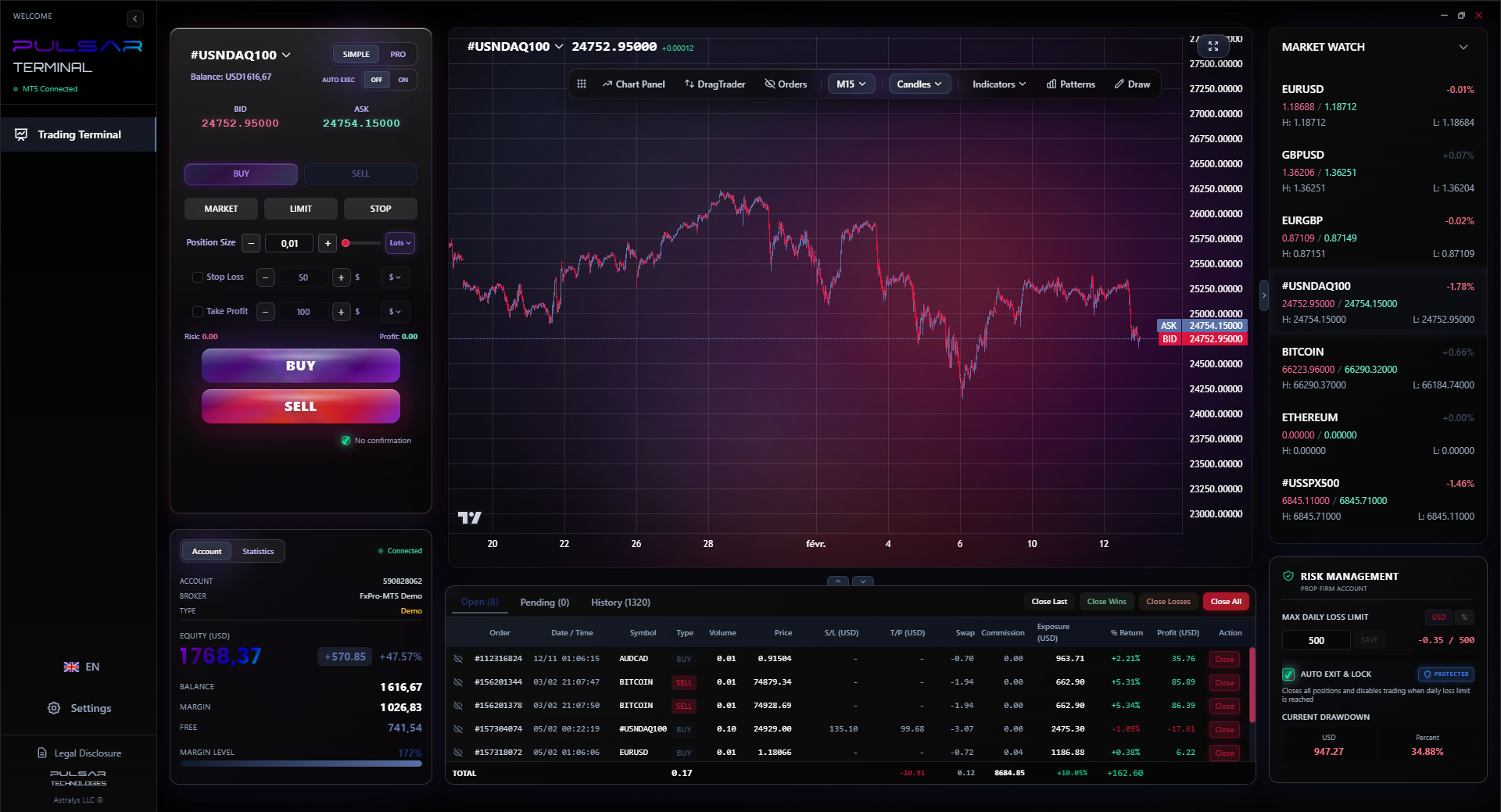
Managing the strict daily loss limits of a prop firm challenge is where most fail; Pulsar Terminal's prop firm daily loss protection feature automates this, cutting all positions the moment your daily loss threshold is hit, removing emotion from the equation.
Pulsar Terminal
أداة MT5 الشاملة: أوامر سحب وإفلات، متعدد TP/SL، تريلينج ستوب، تداول الشبكة، Volume Profile وحماية البروب فيرم. يستخدمها أكثر من 1000 متداول يومياً.
Maybe. But not because of the advertising. You should consider it only if you treat it as a costly, high-stakes exam, not a funding solution.
Think of the fee as tuition for a brutally honest test of your trading system and psychology. The strict rules (daily loss, max drawdown) are actually fantastic training wheels. They teach you discipline most retail traders never learn. If you can pass, it proves you can trade under pressure with real consequences (losing the fee).
Here’s my advice: Don't use a prop firm challenge to learn how to trade. Use it to validate that you already know how to trade. You should have at least 6 months of consistent, documented profitability on a demo or small live account using a clear plan. Your plan must include precise entries, exits, and a position size calculator. You should know your win rate, average risk/reward, and maximum expected drawdown.
Only then, with a proven system, should you look at a challenge. And when you do, ignore the advertising. Go straight to their rules document. Pick the firm with the most realistic, trader-friendly rules (e.g., reasonable drawdown, no silly time limits), not the one with the flashiest promo video. A firm like XM or Exness might offer a better environment to build your skills first.

Pro Tip: Before paying a cent, paper trade their exact rules for a full month. Use their stated profit target, daily loss limit, and minimum trading days. If you can't pass on paper, you won't pass with real money. This one step will save you thousands.
“The most valuable capital you will ever trade is your own.”
When you see an ad, follow this drill. Don't click "Buy Now."
- Find the Rules: Navigate away from the sales page. Find the "Terms," "FAQ," or "Rules" section. Read every line. Understand the drawdown calculation (is it from starting balance or equity peak?), the daily loss limit, and the profit target.
- Research the Failure Rate: Google "[Firm Name] pass rate" or "[Firm Name] reviews." Look on independent forums, not the testimonials on their site. If no one is talking about payouts, only challenges, that's a sign.
- Check the Broker Link: Which broker do they use for live accounts? Is it a reputable name with tight spreads? Slippage and poor execution can kill a strategy that works elsewhere.
- Calculate the Real Cost: Add up the fee for the challenge + the fee for the "live" account if they charge one. How many months of profitable trading do you need to just break even on those fees?
- Contact Support: Ask a specific, technical question. "How is the trailing drawdown calculated on the two-step challenge?" If the response is slow or vague, imagine trying to get a payout from them.
This process turns you from a marketing target into an informed evaluator. It shifts the power back to you.
Prop firm advertising sells the finish line: the funded account, the payouts, the lifestyle. Trading is the grueling marathon to get there. The ads never show the 95% of runners who collapse before mile one.
I've been both the collapse and, eventually, the finisher. The difference wasn't a better prop firm ad. It was a better trading system, iron-clad discipline, and treating every dollar of risk as sacred. I used tools like the MACD indicator and RSI indicator not for magic signals, but as components of a broader, rules-based approach.
If you take one thing from this, let it be this: The most valuable capital you will ever trade is your own. Building that capital slowly, through disciplined risk management on a regulated broker's platform, is a more honest - and more controllable - path than gambling on challenge fees. The prop firm path can be a valid accelerator, but only after you've built the engine yourself. Don't let the advertising convince you they're selling the engine. They're just selling a very expensive, and often rigged, test track.
FAQ
Q1Are prop firms legal in Australia?
Yes, they are generally legal. They operate by having you pay for an evaluation service to trade their capital, which typically doesn't require an Australian Financial Services License (AFSL). However, their advertising must comply with the Australian Consumer Law, which prohibits misleading or deceptive claims.
Q2What's the real success rate for passing a prop firm challenge?
The real industry-wide success rate is brutally low, between 5% and 10%. Even fewer traders, around 2-7%, achieve consistent payouts. The advertising almost never mentions this statistic because their business model relies on the 90-95% who fail and pay the evaluation fee.
Q3Why do prop firms offer higher use than my ASIC broker?
ASIC caps use at 1:30 for major forex pairs for retail clients to protect them. Prop firms aren't bound by this retail client rule, so they use higher use (like 1:100) as a major advertising point. However, this increased use significantly raises your risk of quickly hitting the daily or maximum drawdown limits and failing the challenge.
Q4What's the biggest red flag in prop firm advertising?
"Instant funding" or "no challenge" offers are a major red flag. These often come with impossibly strict rules (like a 2-3% max drawdown) designed to quickly remove you from the program. A proper evaluation process, while tough, exists to prove you can manage risk.
Q5How much does the average trader spend on prop firm challenges?
Estimates suggest the average trader spends over $4,200 on multiple prop firm challenge attempts. This is money completely lost to fees, which could have been used as risk capital in a personal trading account with proper position sizing.
Q6Should I use a prop firm to learn how to trade?
Absolutely not. A prop firm challenge is a high-pressure exam, not a learning course. You should only attempt one after you have a proven, documented trading strategy that has been profitable over at least 6 months on a demo or small live account. Use it to validate skills you already have.
Q7What should I look for in the firm's rules document?
Look for clarity on three things: 1) Maximum Daily Loss (usually 3-5%), 2) Maximum Overall Drawdown (how it's calculated - from starting balance or peak equity?), and 3) Profit Target. Avoid firms with vague rules or "scaling" drawdowns that are hard to track.
درس البروفيسور وينستون
النقاط الرئيسية:
- ✓Real pass rates are 5-10%, not 90%.
- ✓Average spend exceeds $4,200 on failed attempts.
- ✓Higher use in ads means higher failure risk.
- ✓Instant funding offers have the worst rules.
- ✓Vet the rules document, not the promo video.
ما مدى فائدة هذا المقال؟
انقر على نجمة للتقييم
رؤى التداول الأسبوعية
تحليلات واستراتيجيات أسبوعية مجانية. بدون رسائل مزعجة.
عن المؤلف
Sarah Collins
استراتيجي تداول
استراتيجية تداول مقيمة في لندن مع 12 عاماً من الخبرة في الأسواق المالية. محللة سابقة في شركة وساطة في حي المال بلندن. تغطي أزواج الجنيه الإسترليني والأسواق الأوروبية والتداول المنظم من FCA.
التعليقات
تحذير من المخاطر
ينطوي تداول الأدوات المالية على مخاطر كبيرة وقد لا يكون مناسبًا لجميع المستثمرين. الأداء السابق لا يضمن النتائج المستقبلية. هذا المحتوى لأغراض تعليمية فقط ولا ينبغي اعتباره نصيحة استثمارية. قم دائمًا بإجراء بحثك الخاص قبل التداول.
قد يعجبك أيضًا

Cara Trading Forex Sukses: 7 Prinsip dari Trader Profesional
Cara trading forex sukses dengan 7 prinsip trader pro: manajemen modal, disiplin, journal trading, backtest. Data nyata, bukan janji profit palsu.
Jam Trading Forex Terbaik untuk Trader Indonesia: Panduan Lengkap dengan Tabel Waktu
Panduan jam trading forex untuk trader Indonesia. Tabel 4 sesi dunia, jam emas 20:00-00:00, sesi mana yang harus dihindari. Data akurat + tips dari trader berpengalaman.
Top 5 Sàn Forex Uy Tín Nhất 2026: Review Jujur dari Trader Indonesia
Top 5 sàn forex uy tín 2026 untuk trader Indonesia. Review jujur: spread, deposit, withdraw, dukungan lokal. Exness, XM, IC Markets & lebih.
احصل على Pulsar Terminal
جميع هذه الحاسبات مدمجة في Pulsar Terminal مع بيانات حية من حساب MT5 الخاص بك.
احصل على Pulsar Terminal