


I was staring at the screen, my finger hovering over the sell button.

Sarah Collins
استراتيجي تداول ·  United Kingdom
☕ 10 دقائق قراءة
ما ستتعلمه:
- 1What Exactly Is a UK Prop Trading Firm? (It's Not What You Think)
- 2The Challenge Rules, Decoded and Demystified
- 3Picking Your Poison: How to Choose a UK Prop Firm
- 4My Blueprint for Actually Passing the Damn Challenge
- 5The Ugly Truth About Payouts, Taxes, and Reality
- 6Mistakes I've Made (So You Don't Have To)
- 7The Final Verdict: Is a UK Prop Firm Worth Your Time and Money?

I was staring at the screen, my finger hovering over the sell button. It was October 7th, 2022, just after the US Non-Farm Payrolls report. GBP/USD had spiked 80 pips in seconds. My prop firm account was up £1,200 on paper, but I knew the real test was about to start: the consistency rules. That's the moment you learn what these UK prop trading firms are really about. It's not just about making money. It's about playing their game, by their very specific, often frustrating, rules. Let's talk about how to win it.
Forget the fancy City offices you see in movies. A modern UK prop firm, for most retail traders, is an online evaluation company. You pay a fee, they give you a simulated account with pretend money. If you hit their profit targets without breaking their rulebook, they might give you a live account with real capital to trade. I say 'might' because that's the first reality check.
These firms aren't charities. They make money from your challenge fees, and from taking a cut of your profits if you graduate. The model is simple: lots of people try, most fail, the firm pockets the fees. The few who make it through and become consistently profitable are worth the risk for them. Your goal is to be in that tiny percentage.

Warning: Don't confuse these evaluation firms with traditional City prop shops like DRW or Optiver. Those hire salaried quants and have billions. The firms we're talking about, like The5%ers or FTMO clones operating here, are a different beast aimed at the retail crowd.
The UK's Financial Conduct Authority (FCA) watches this space, but it's a grey area. The firms are usually registered, but they're often facilitating trading on offshore platforms. Your protection is different from having a standard retail brokerage account. Always, and I mean always, check the FCA register before you hand over a penny.

This is where dreams go to die. Every firm has a rulebook designed to make you fail. Your job is to understand it better than they do.
Profit Target: The Obvious One
Most firms want 10% profit in 30 days. Sounds easy? On a £100,000 demo account, that's £10,000. The trap is the pressure. Traders start over-leveraging, taking stupid risks. I've blown challenges trying to hit a daily target, only to give back a week's work in one bad EUR/USD guide session.
Daily Loss Limit: The Silent Killer
This is the big one. It might be 5% of your starting capital, or 5% of your current high watermark. Let's say your limit is £5,000 on a £100k account. You have a bad morning and lose £3,000. You're now in 'defensive mode' for the rest of the day with only £2,000 of breathing room. This rule forces discipline, but it also means one major news event can end your challenge if you're not flat.
Maximum Drawdown: The Overall Trap
This is your total allowed loss from the account's starting balance or its peak. It's usually around 10%. If you start at £100,000, your max drawdown is £90,000. But here's the sneaky part: it's often tracked including open positions. If you're in a losing trade that hasn't hit your stop loss yet, that paper loss counts against your drawdown. I learned this the hard way in early 2020 holding a long XAU/USD guide position that went £8,000 against me overnight. Even though my stop was still £2,000 away, I woke up to a failed challenge email. The drawdown was breached on the floating loss.

Example: You have a £100k account with a 10% max drawdown (to £90k). You make £5k, so your balance is £105k. Your new drawdown level is now £94,500 (105k - 10.5k). Lose back to £94,501 and you're safe. Lose to £94,499 and you're out. They call this a 'trailing drawdown' and it's brutal.

💡 نصيحة وينستون
Your challenge fee is the cost of admission to a very strict school. If you fail, view it as tuition, not a loss. What did the market teach you that £200?

“The prop firm challenge is a test of discipline, not a test of your fancy harmonic pattern knowledge.”
Don't just go for the one with the flashiest ads. You need to dig into the terms like you're investigating a used car.
| Feature | What to Look For | Red Flag |
|---|---|---|
| Profit Split | 80% or more to you. Some go up to 90%. | Anything below 70%. They're taking too much for the risk you're carrying. |
| Challenge Fee | One-time, clear, and refundable upon passing. | Monthly 'subscription' fees on top of the challenge. Hidden admin costs. |
| Trading Rules | Clear, sensible daily loss limits. Reasonable minimum trading days. | 'No stop-loss' policies, or rules against specific strategies like scalping strategy. |
| Payout Frequency | Monthly or bi-weekly. First payout should be within 14 days of period end. | 'Quarterly' payouts or thresholds you must reach before withdrawing. |
| Platform | MT4/MT5 or a major platform you know. | Their own proprietary, clunky platform with terrible execution. |
Look for firms that use reputable brokers for their live accounts. I've had good execution experiences with firms that route trades through brokers like IC Markets review or Pepperstone review. It tells me they're not messing with the slippage.
The single most important question: How do they handle the 'verification' or 'live' account after you pass? Is it a proper live account in your name? Or is it just another simulated account where they mirror your trades? Get this in writing. The best firms give you a direct login to a live brokerage account. The worst keep you in sim and just pay you out of the fee pool.

I've passed a few, failed more. Here's what works.
Phase 1: The Grind (Days 1-10) Your only goal is survival. Don't even think about the profit target. Trade tiny. I'm talking 0.01 lots on a £100k account. Use a strict position size calculator every time. Your mission is to get a small, consistent green curve. Build a buffer of 2-3% above your starting balance. This buffer is your armor against the daily loss limit.
Phase 2: The Push (Days 11-20) Now you have a cushion. You can start aiming for the target. Increase size gradually, but never let a single trade risk more than 0.5% of your account. If your buffer is £3,000, you can afford to be more aggressive, but the daily loss rule is still king. This is where a solid swing trading plan beats frantic day trading.
Phase 3: The Coast (Days 21-30) If you've hit the profit target early, STOP. Seriously. Just stop trading. Most firms have a minimum trading day requirement (like 10 days). Hit that minimum, hit your target, and then walk away. The number of people who hit target in week two and then give it all back trying to be a hero... it's a cemetery of accounts. I was one of them in 2019. Hit 10% on day 14, got greedy, lost it all by day 19 trying to double it.

Pro Tip: Use boring indicators. A simple RSI indicator for overbought/oversold and a MACD indicator for trend confirmation on the 4H chart is often all you need. The challenge is a test of discipline, not a test of your fancy harmonic pattern knowledge.
💡 نصيحة وينستون
The daily loss limit isn't a target. It's a cliff edge. Your real daily limit should be half of what they state. That's your safety net.

“For every trader celebrating a payout, there are fifty licking their wounds and blaming the firm.”
You passed. Congratulations. Now comes the paperwork.
Payouts: They'll usually pay you via bank transfer, Wise, or cryptocurrency. Expect to wait 5-10 business days after the profit period ends. Your first payout will feel amazing. Then you'll realize they take their cut first.
Taxes: This is critical in the UK. The money you receive is income. It's not capital gains from your own ISA account. You are being paid a profit share, likely as a self-employed contractor. You need to declare this on your Self-Assessment tax return. HMRC doesn't care if the firm is based in Cyprus. The income landed in your UK bank account. Set aside at least 20-30% of every payout for your tax bill. I learned this the expensive way in my first funded year and got a nasty letter.
The Reality of 'Funding': That £100,000 account isn't yours. You can't withdraw it. You're trading the firm's capital, and they can pull the plug if you hit their risk limits. The psychological shift from demo to 'real' funded account is huge. Suddenly every pip definition feels heavier. The pressure to not lose the opportunity can make you freeze. The only cure is to stick to the same microscopic risk you used in the challenge. Treat the first three months of your funded account as Challenge 2.0.
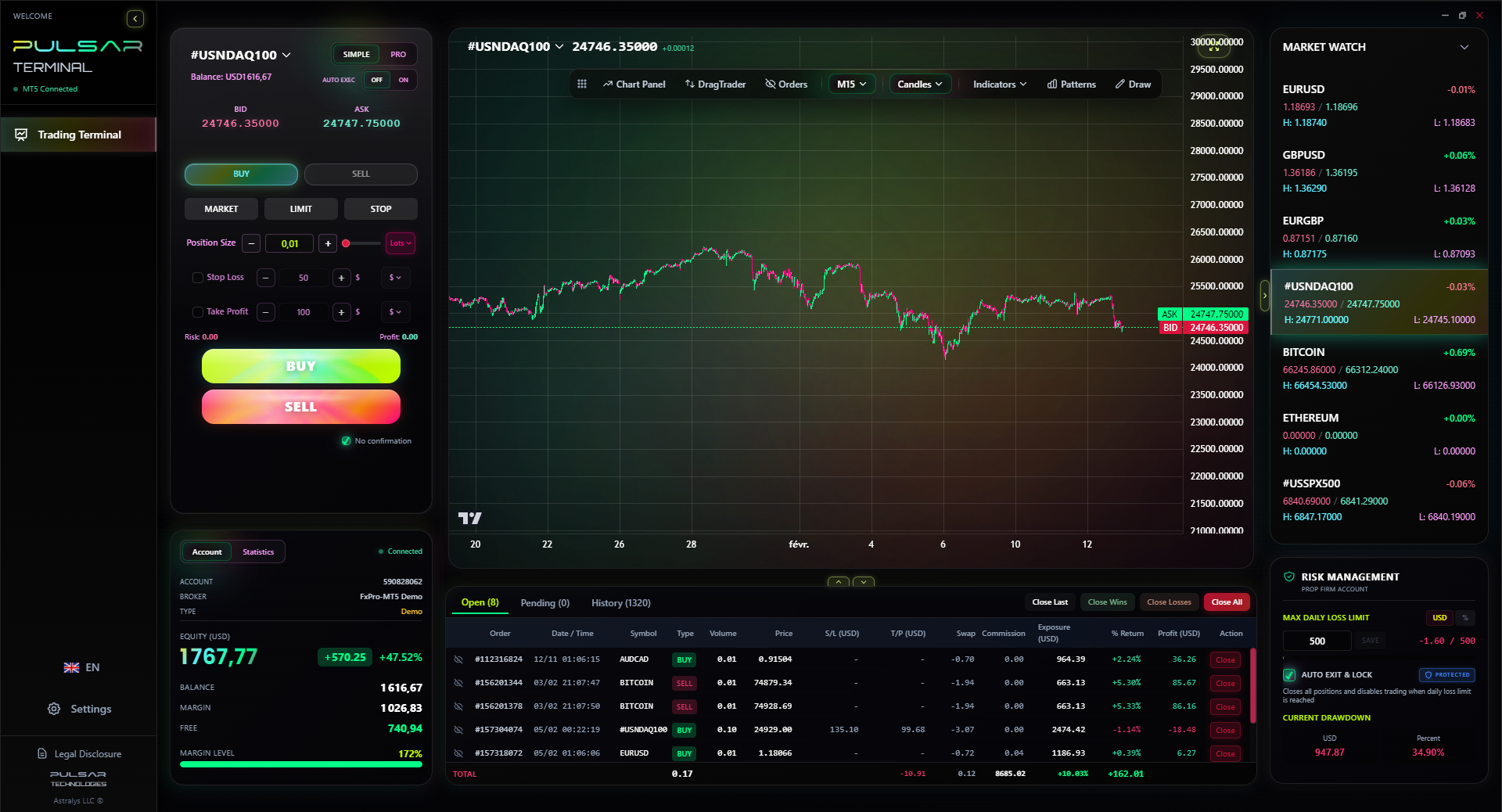
Managing multiple trades and strict daily loss limits under pressure is where most fail; Pulsar Terminal's drag-and-drop order management and visual risk dashboard on MT5 turn that chaos into a controlled process.
Pulsar Terminal
أداة MT5 الشاملة: أوامر سحب وإفلات، متعدد TP/SL، تريلينج ستوب، تداول الشبكة، Volume Profile وحماية البروب فيرم. يستخدمها أكثر من 1000 متداول يومياً.
Let's get vulnerable. Here's my hall of shame.
1. Chasing Losses After a Bad Day: Lost £2,000 by lunchtime? The daily loss limit says you have £3,000 left. The absolute worst thing you can do is try to make it back immediately. I did this. I revenge-traded, doubled my position sizes, and turned a £2k loss into a £4,900 loss in two hours, breaching the limit and failing. The rule is: if you hit 50% of your daily loss, walk away. Close the platform. The day is over.
2. Ignoring the Spread on News: I once entered a trade just before a high-impact news event to 'get a good price'. The spread definition widened from 1 pip to 25 pips instantly. I was down £250 the second my order filled, before the price even moved. That ate half my daily buffer. Trade after news, not before.
3. Over-diversifying: You don't need to trade 10 instruments. Find two or three you understand inside out. For me, it's EUR/USD and the FTSE. Trying to trade AUD/JPY because you saw a signal online is a recipe for confusion and losses.
4. Not Planning for the Weekend Gap: You're long GBP/USD on Friday night. Something happens over the weekend. It opens Monday 100 pips lower. That loss hits your drawdown immediately. Either close all positions before Friday close, or ensure they're so far in profit that a gap won't hurt you. A weekend gap caused my first-ever margin call back in my retail days, and the principle is the same here.
💡 نصيحة وينستون
When you get funded, request your first three payouts immediately, even if they're small. It proves the firm can and will pay. Trust, but verify.

“If you hit 50% of your daily loss limit, walk away. Close the platform. The day is over.”
It depends entirely on you.
Yes, if:
- You have a proven, disciplined strategy but lack capital.
- You treat the challenge fee as a serious educational cost, not a lottery ticket.
- You have the mental fortitude to follow rules that feel artificially restrictive.
- You need the structure and accountability that the firm's rules provide.
No, if:
- You're still figuring out your strategy. Use a demo account first, for months.
- You think this is a get-rich-quick scheme. It's the opposite.
- You can't afford to lose the challenge fee. If £200 is a lot of money to you, you'll trade scared and fail.
- You hate rules. This entire process is about conforming to a system.
For me, it was worth it. The structure forced a level of discipline I didn't have trading my own small account. The first £850 profit share I received (from a firm similar to XM review in their model) validated my skills in a way a demo account never could. But it's a tough road. For every trader celebrating a payout, there are fifty licking their wounds and blaming the firm. Be the one who understands the game.

FAQ
Q1Are prop trading firms legal in the UK?
Yes, but it's complex. The evaluation firms themselves are usually legal entities, but they often partner with offshore brokers to execute trades. They should be registered with the FCA for anti-money laundering purposes. However, the 'funded account' you receive may not be FCA-protected in the same way a UK retail trading account is. Always verify the firm's regulatory status directly on the FCA register.
Q2How much does it cost to try a prop firm challenge in the UK?
Challenge fees typically range from £100 to £500. This is often a one-time fee for a specific account size (e.g., £150 for a £50,000 challenge). Some firms offer cheaper 'mini' challenges. Remember, this fee is usually non-refundable if you fail, but some firms may offer a free retry or discount if you fail narrowly.
Q3Can I use automated trading or EAs in a prop firm challenge?
You must check the firm's specific rules. Many allow EAs, but some prohibit them entirely. Others allow them but may have rules against 'grid' or 'martingale' systems. If your strategy relies on an EA, make this your first question before buying a challenge. Using a banned method will get you disqualified instantly.
Q4What's the biggest mistake traders make in prop firm challenges?
Overtrading to hit the profit target too quickly. They increase position size dramatically after a few wins, then a single normal losing trade wipes out a week's progress and breaches a loss limit. Patience and microscopic risk management in the first half of the challenge are non-negotiable.
Q5Do UK prop firms teach you how to trade?
Generally, no. They are evaluators, not educators. Some might offer basic webinars or articles, but their primary business is assessing your existing skills. You are expected to come to them with a strategy. If you need training, seek it elsewhere first before spending money on a challenge.
Q6How are payouts taxed for UK traders?
Payouts are typically treated as self-employed trading income (or possibly as miscellaneous income). You must declare them on your Self-Assessment tax return. The income is added to your other earnings, and you pay Income Tax and National Insurance Contributions on the profit. Keep detailed records of all payouts.
درس البروفيسور وينستون
النقاط الرئيسية:
- ✓Treat the challenge fee as tuition, not a lottery ticket.
- ✓Your real daily loss limit is 50% of the stated limit.
- ✓Use a position size calculator for every single trade.
- ✓Hit your profit target early? Stop trading immediately.
- ✓Set aside 30% of every payout for your tax bill.
ما مدى فائدة هذا المقال؟
انقر على نجمة للتقييم
رؤى التداول الأسبوعية
تحليلات واستراتيجيات أسبوعية مجانية. بدون رسائل مزعجة.
عن المؤلف
Sarah Collins
استراتيجي تداول
استراتيجية تداول مقيمة في لندن مع 12 عاماً من الخبرة في الأسواق المالية. محللة سابقة في شركة وساطة في حي المال بلندن. تغطي أزواج الجنيه الإسترليني والأسواق الأوروبية والتداول المنظم من FCA.
التعليقات
تحذير من المخاطر
ينطوي تداول الأدوات المالية على مخاطر كبيرة وقد لا يكون مناسبًا لجميع المستثمرين. الأداء السابق لا يضمن النتائج المستقبلية. هذا المحتوى لأغراض تعليمية فقط ولا ينبغي اعتباره نصيحة استثمارية. قم دائمًا بإجراء بحثك الخاص قبل التداول.
قد يعجبك أيضًا

Cara Trading Forex Sukses: 7 Prinsip dari Trader Profesional
Cara trading forex sukses dengan 7 prinsip trader pro: manajemen modal, disiplin, journal trading, backtest. Data nyata, bukan janji profit palsu.
Jam Trading Forex Terbaik untuk Trader Indonesia: Panduan Lengkap dengan Tabel Waktu
Panduan jam trading forex untuk trader Indonesia. Tabel 4 sesi dunia, jam emas 20:00-00:00, sesi mana yang harus dihindari. Data akurat + tips dari trader berpengalaman.
Top 5 Sàn Forex Uy Tín Nhất 2026: Review Jujur dari Trader Indonesia
Top 5 sàn forex uy tín 2026 untuk trader Indonesia. Review jujur: spread, deposit, withdraw, dukungan lokal. Exness, XM, IC Markets & lebih.
احصل على Pulsar Terminal
جميع هذه الحاسبات مدمجة في Pulsar Terminal مع بيانات حية من حساب MT5 الخاص بك.
احصل على Pulsar Terminal