


Everyone's selling you a dream about remote forex trader jobs.

Olumide Adeyemi
رائد التداول في غرب أفريقيا ·  Nigeria
☕ 10 دقائق قراءة
ما ستتعلمه:
- 1What 'Remote Forex Trader Jobs' Really Mean (It's Not What You Think)
- 2The Prop Firm Route: Your Ticket to a 'Remote Job'
- 3Going Solo: Trading Your Own Capital
- 4The Hidden Costs: Taxes, Fees, and Nigerian Regulations
- 5The Real Skills You Need (It's Not Just Chart Patterns)
- 6Spotting Scams and Finding Legit Opportunities
Everyone's selling you a dream about remote forex trader jobs. You've seen the Instagram posts: laptops on beaches, luxury cars, captions about 'financial freedom.' Let me be straight with you - most of that is pure fantasy designed to sell you a course. The reality of making a living from forex in Nigeria is different. It's possible, yes, but it's a serious business, not a get-rich-quick scheme. I've been trading from Lagos for over a decade, and I'll walk you through what remote forex trader jobs actually look like, how much you can realistically make, and the traps you must avoid.
When Nigerians search for 'remote forex trader jobs,' they're usually imagining a salaried position. A company hires you, gives you a desk (metaphorically), and pays you a monthly salary to trade their money. That model exists globally in hedge funds, but it's incredibly rare to find as a true 'remote job' for a beginner in Nigeria.
What you're actually looking at are three main paths:
- Trading Your Own Capital: This is the most common. You're self-employed. Your 'job' is managing your own trading account from your room in Abuja or a co-working space in Lagos. Your income is 100% dependent on your profits, minus losses. There's no boss, no salary, and no guaranteed paycheck.
- Trading for a Prop Firm: This gets closer to the 'job' idea. You pass a trading challenge for a proprietary trading firm. They then give you a funded account to trade. You keep a large split of the profits (usually 70-90%). This is currently the hottest path for Nigerians seeking remote forex trader jobs, but the challenges are tough.
- Affiliate Marketing/Signal Selling: Let's be honest, a huge chunk of the 'traders' you see online aren't making money from trading. They're making money by selling you something: a course, a signal service, or referring you to a broker. This is a sales job, not a trading job.
I started on path #1 back in 2014. I saved up ₦300,000 (about $750 at the time), deposited with an international broker, and blew it all in 4 months. My mistake? I treated it like a side hustle, not a job. I had no schedule, no risk management, and I was chasing the 'remote dream' instead of building a skill. A real remote forex trading job requires the discipline of a real job.

Warning: Any 'remote forex trader job' ad that promises a guaranteed salary for beginners is almost certainly a scam. They'll ask for 'training fees' or make you deposit your own money first. Legitimate prop firms charge a one-time challenge fee, but they don't hire you as a salaried employee upfront.

💡 نصيحة وينستون
A 'remote job' in trading is a misnomer. You're building a one-person asset management firm. Your first hire should be your inner risk manager, and they're a strict, boring accountant.
“The reality of making a living from forex in Nigeria is a serious business, not a get-rich-quick scheme.”
This is where the action is for Nigerians right now. Proprietary trading firms have opened up a legitimate path to trade large capital without risking your life savings. Here's how it works:
You pay a one-time fee (anywhere from $50 to $500) to take a trading challenge. The challenge has strict rules: a profit target (e.g., 10% in 30 days), a maximum daily loss (e.g., 5%), and a maximum overall loss (e.g., 10%). If you pass, you get a funded account. Trade it well, and you get a profit split.
The Numbers You Need to Know
Let's use a typical example. Say you pass a $100,000 challenge.
- Profit Target: You might need to make $10,000 (10%) without violating any risk rules.
- Profit Split: You keep 80% of what you make. So, if you make a 2% profit ($2,000) in your first month on the funded account, you get a payout of $1,600.
- Scaling: Many firms increase your account size after consistent profits. That $100,000 account can grow to $200,000 or more.
I passed a $50,000 challenge with a firm in 2021. The fee was $299. It took me two attempts. The first time, I hit a 7% profit but blew past the daily loss limit on one bad trade during an NFP news event. The second time, I used a strict scalping strategy with tight stops and passed. My first payout was $1,150 on a 3% monthly gain. It felt like a real paycheck.

Pro Tip: When choosing a prop firm, look for one with a clear scaling plan and a reasonable drawdown rule. The 'maximum daily loss' is your biggest enemy. Use a position size calculator religiously to ensure you never get close to it. A 5% daily loss limit means on a $100k account, you can only lose $5,000 in a day. One oversized trade can end your 'job' instantly.
The key here is that passing the challenge requires professional-grade discipline. It's not about being a genius; it's about not being an idiot. This is the closest thing to a remote forex trader job with structure.
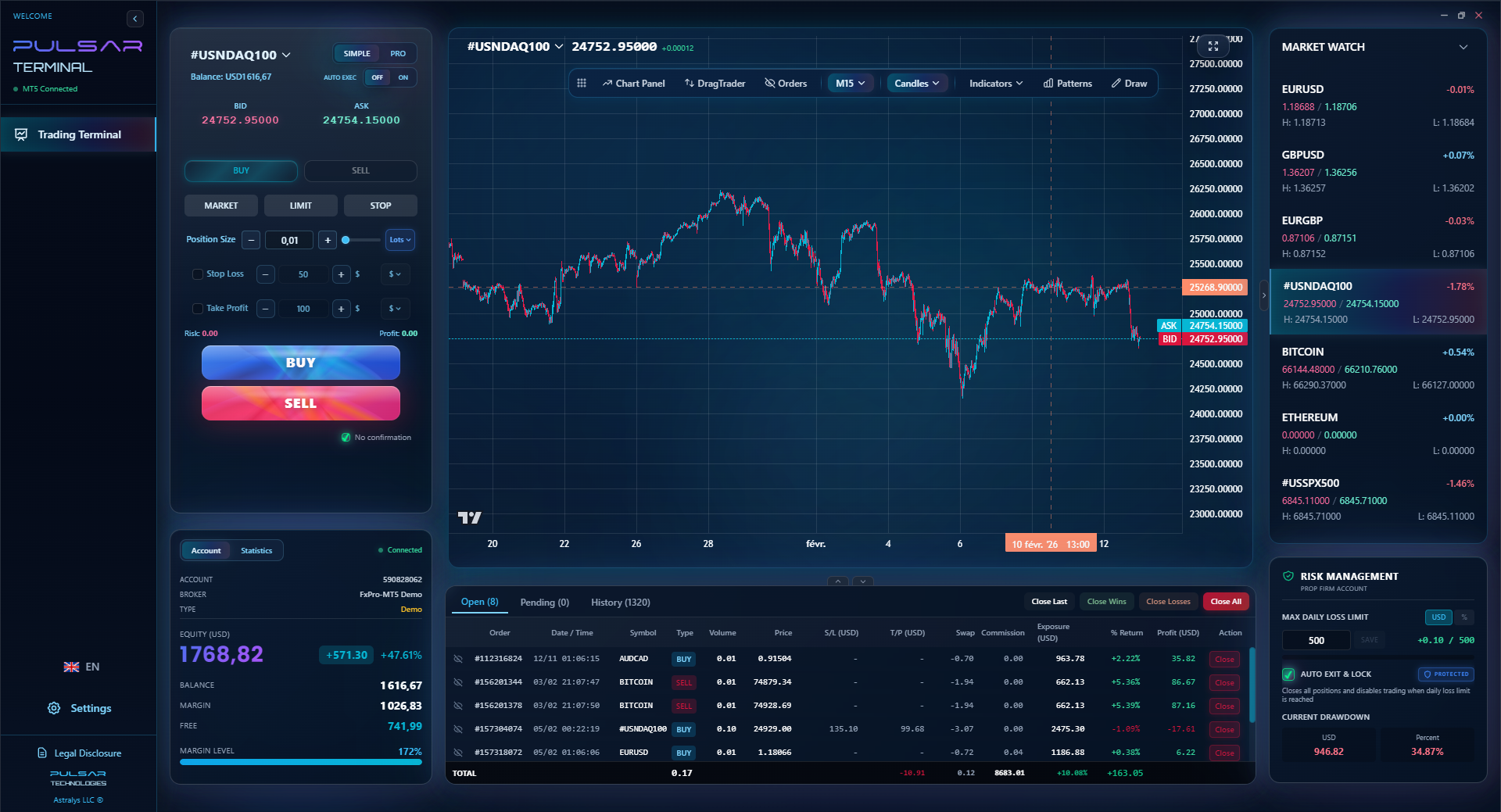
Managing the daily loss limit for a prop firm is a constant pressure, but tools like Pulsar Terminal can automate the hard stops to keep you safe.
Managing the daily loss limit for a prop firm is a constant pressure, but tools like Pulsar Terminal can automate the hard stops to keep you safe.
Pulsar Terminal
أداة MT5 الشاملة: أوامر سحب وإفلات، متعدد TP/SL، تريلينج ستوب، تداول الشبكة، Volume Profile وحماية البروب فيرم. يستخدمها أكثر من 1000 متداول يومياً.
“Passing a prop firm challenge requires professional-grade discipline. It's not about being a genius; it's about not being an idiot.”
This is the purest form of a remote forex trader job. You are the CEO, risk manager, and trader. Your income is directly tied to your performance. Let's talk real numbers for Nigeria.
Startup Capital:
- Micro Lots: You can start with as little as $10 (₦15,000). But honestly, with that amount, you're just practicing. Transaction costs (spreads) will eat you alive.
- Serious Starter Capital: To actually generate meaningful income, you need a buffer. I recommend a minimum of $500 (₦750,000) as a starting point for a standard account. This lets you trade mini lots (0.1 lots) and withstand normal drawdowns without a margin call.
Realistic Income Expectations: A consistently profitable trader might aim for a 5-10% return per month. That's aggressive but possible. Let's do the math:
- Account: $1,000 (₦1.5M)
- Monthly Return (5%): $50 (₦75,000)
- Monthly Return (10%): $100 (₦150,000)
See the issue? To replace a decent Nigerian salary of, say, ₦300,000 per month, you'd need a $3,000 account earning 10% monthly. That's why building capital is the first, hardest part of this 'job.' Most people fail because they're undercapitalized and take wild risks to try and make life-changing money from a small account.
My Experience: I funded my first serious account with ₦500,000 in 2015. My goal was to make 5% a month (₦25,000). Some months I did. Many months I didn't. It took me two years of grinding, saving my profits, and adding more savings from a part-time job to grow that account to a point where the returns could cover my bills. There were no beach photos during those years.
You'll need to master a strategy, whether it's swing trading EUR/USD or using the MACD indicator for day trades. This is a skill-based profession.
💡 نصيحة وينستون
If you can't explain your edge in one sentence - 'I fade overextensions on the 15M chart when RSI is above 80' - you don't have a strategy. You have a hope.
“To replace a salary of ₦300,000 per month, you'd need a $3,000 account earning 10% monthly. That's why building capital is the first, hardest part.”
This is the boring part everyone ignores until it bites them. Running your remote forex trader job as a business means understanding the costs.
1. Trading Costs:
- Spreads: This is the difference between the buy and sell price. On major pairs like EUR/USD, you can find spreads from 0.0 pips (with a commission) to 1.5 pips on commission-free accounts. On a 1-lot trade, a 1-pip spread costs you $10 immediately. It adds up.
- Commissions: Some brokers, like IC Markets, charge a commission (say $3.50 per lot) but give you raw spreads near 0.0 pips. This is often cheaper for active traders.
- Swap Rates: Holding positions overnight costs or earns you interest. On XAU/USD (gold), it can be significant.
2. Nigerian Taxes: The Federal Inland Revenue Service (FIRS) considers trading profits as capital gains. You are liable to pay a 10% Capital Gains Tax on your net annual profits. If you make ₦1,000,000 profit in a year, you owe ₦100,000 in tax. Very few traders account for this, but if you want this to be a legitimate job, you must. Keep detailed records of all your trades.
3. Regulations: Forex trading is legal in Nigeria. The SEC and CBN are the main bodies. However, the retail space is poorly regulated. There is no Nigerian regulator specifically licensing and protecting retail forex brokers. This is crucial. It means when you open an account with an international broker like Exness, IC Markets, or XM, you are relying on their home country's regulation (CySEC, ASIC, etc.). Do your due diligence. Never use an unregulated 'bucket shop' that's just targeting Nigerians.

Example: Let's say you make 100 trades in a month, each for 0.1 lots on EUR/USD. If your average spread is 1.2 pips, your total spread cost is: 100 trades * 0.1 lots * 1.2 pips * $1 per pip = $120 in costs. That's ₦180,000 gone before you even make a profit. This is why choosing a broker with tight spreads matters.
“To replace a salary of ₦300,000 per month, you'd need a $3,000 account earning 10% monthly. That's why building capital is the first, hardest part.”
To succeed in remote forex trader jobs, you need a businessperson's mindset. Technical analysis is maybe 30% of the battle.
1. Risk Management: This is your #1 skill. It means never risking more than 1-2% of your account on a single trade. It means knowing where your stop loss is before you enter. It's boring, but it's what keeps you employed. I learned this the hard way by losing 40% of my account on one poorly thought-out gold trade. 2. Emotional Discipline: Trading alone from home is psychologically tough. You'll face fear, greed, and frustration. You need a trading plan and the discipline to follow it, even when you want to revenge trade after a loss. 3. Record Keeping: You must journal every trade. Entry, exit, reason, emotional state. This is how you diagnose your mistakes and improve. My journal showed me I lost money on 70% of my trades entered after 10 PM Lagos time. I stopped trading late at night, and my results improved immediately. 4. Continuous Learning: The market changes. Strategies that worked last year may not work now. You need to stay curious and adapt.
Tools like the RSI indicator can help identify opportunities, but they won't save you from poor discipline. The job is 80% managing yourself, 20% managing the trade.
💡 نصيحة وينستون
Your annual tax bill is the best report card. If you don't have one, you're not running a business; you're gambling and hoping the FIRS doesn't notice.
“Your real remote forex trader job will be built on quiet, consistent work, not viral moments.”
The 'remote forex jobs' space is flooded with fraud. Here’s how to protect yourself.
Red Flags of a Job Scam:
- 'Guaranteed' Salary or Profits: Nothing is guaranteed in trading.
- You Pay a 'Refundable' Deposit: They ask for ₦50,000 to 'access the company's trading software.'
- Vague Job Description: They don't explain the challenge process or the profit split clearly.
- Pressure to Act Fast: 'Only 5 spots left!'
- Unrealistic Returns: 'Make 50% monthly with our AI robot.'
Where to Find Legitimate Paths:
- Reputable Prop Firms: Research firms with long track records and transparent rules. Look for reviews from actual funded traders, not just affiliates.
- Established International Brokers: Brokers like Pepperstone don't offer jobs, but they offer the legitimate platforms and tools you need to build your own business. They often have educational resources.
- Networking: Connect with serious Nigerian traders on forums or professional groups. Real opportunities are often shared word-of-mouth, not in flashy ads.
The bottom line? If it sounds too good to be true from someone flashing cash on social media, it is. Your real remote forex trader job will be built on quiet, consistent work, not viral moments.
FAQ
Q1Can I really get a salaried remote forex trading job in Nigeria?
It's extremely rare for a company to hire a beginner trader on a salary. The standard model is either trading your own capital (self-employment) or passing a prop firm challenge to trade their capital for a profit split. Think of it as becoming a freelance professional, not a salaried employee.
Q2How much money do I need to start trading forex remotely?
You can technically start a micro account with as little as $10 (₦15,000), but it's just for practice. To treat it seriously as a potential income source, a minimum of $500-$1000 (₦750,000-₦1.5M) is more realistic. This allows for proper risk management without being wiped out by a few losing trades.
Q3Do I have to pay tax on my forex trading profits in Nigeria?
Yes. The FIRS considers trading profits as capital gains, subject to a 10% tax on your net annual profits. You are responsible for declaring this income and paying the tax. Keep detailed records of all your trades for the year.
Q4Are prop firm challenges worth the fee?
They can be, but only if you are already a disciplined, profitable trader on a demo or small live account. The challenge tests consistency and risk management under pressure. If you're still learning the basics, you'll likely lose the challenge fee. Treat it as a professional certification exam, not a lottery ticket.
Q5What's the biggest mistake new remote traders make?
Undercapitalization and over-use. They start with too little money, then use extremely high use (like 1:1000) to try and make big returns quickly. This magnifies losses and usually leads to a blown account. Start small, use low use (1:10 or 1:20), and focus on growing your skill and account steadily.
Q6Which brokers can Nigerians use for remote trading?
Nigerians primarily use internationally regulated brokers. Some popular and reputable options that accept Nigerian clients include XM, Exness, IC Markets, Pepperstone, and AvaTrade. Always verify the broker's regulation (like ASIC or CySEC) before depositing any money.
درس البروفيسور وينستون
النقاط الرئيسية:
- ✓Remote trading is self-employment, not a salaried job.
- ✓Start with at least $500 to learn seriously.
- ✓You owe 10% capital gains tax on profits.
- ✓Prop firms offer capital but demand iron discipline.
- ✓90% of 'job' ads are affiliate marketing in disguise.
ما مدى فائدة هذا المقال؟
انقر على نجمة للتقييم
رؤى التداول الأسبوعية
تحليلات واستراتيجيات أسبوعية مجانية. بدون رسائل مزعجة.
عن المؤلف
Olumide Adeyemi
رائد التداول في غرب أفريقيا
أحد أنشط معلمي تداول الفوركس في نيجيريا. 8 سنوات من الخبرة في التداول من لاغوس. متخصص في استراتيجيات رأس المال المنخفض وتحديات شركات البروب للمتداولين الأفارقة.
التعليقات
تحذير من المخاطر
ينطوي تداول الأدوات المالية على مخاطر كبيرة وقد لا يكون مناسبًا لجميع المستثمرين. الأداء السابق لا يضمن النتائج المستقبلية. هذا المحتوى لأغراض تعليمية فقط ولا ينبغي اعتباره نصيحة استثمارية. قم دائمًا بإجراء بحثك الخاص قبل التداول.
قد يعجبك أيضًا

Cara Trading Forex Sukses: 7 Prinsip dari Trader Profesional
Cara trading forex sukses dengan 7 prinsip trader pro: manajemen modal, disiplin, journal trading, backtest. Data nyata, bukan janji profit palsu.
Jam Trading Forex Terbaik untuk Trader Indonesia: Panduan Lengkap dengan Tabel Waktu
Panduan jam trading forex untuk trader Indonesia. Tabel 4 sesi dunia, jam emas 20:00-00:00, sesi mana yang harus dihindari. Data akurat + tips dari trader berpengalaman.
Top 5 Sàn Forex Uy Tín Nhất 2026: Review Jujur dari Trader Indonesia
Top 5 sàn forex uy tín 2026 untuk trader Indonesia. Review jujur: spread, deposit, withdraw, dukungan lokal. Exness, XM, IC Markets & lebih.
احصل على Pulsar Terminal
جميع هذه الحاسبات مدمجة في Pulsar Terminal مع بيانات حية من حساب MT5 الخاص بك.
احصل على Pulsar Terminal