


Let's be honest, we've all seen those Instagram ads.

David van der Merwe
متداول الأسواق الناشئة ·  South Africa
☕ 9 دقائق قراءة
ما ستتعلمه:
Let's be honest, we've all seen those Instagram ads. The guy leaning on a Lambo, the private jet shot, all claiming to be a 'richest forex trader' from right here in SA. It's mostly nonsense. The real story of wealth in our market is quieter, more disciplined, and frankly, more interesting. I've been trading for over a decade, and I've seen fortunes made and lost. Today, I'm cutting through the hype to show you the actual profiles, strategies, and hard numbers behind successful South African traders, and what you can realistically take from their journeys.
Forget the social media gurus. The truly successful forex traders in South Africa aren't usually the loudest voices. They fall into a few distinct categories.
First, you have the institutional veterans. These are guys who cut their teeth at major banks or asset managers in Sandton. They understand liquidity, central bank flows, and have connections you and I don't. Their 'wealth' often comes from high salaries and bonuses, not just personal trading accounts. They might run a proprietary trading desk or a hedge fund now.
Then there are the disciplined retail pros. This is the category most aspiring traders should look at. They've built significant capital over 5-10 years through consistent, rule-based trading. I know a guy in Cape Town who started with R50,000 and, through pure swing trading discipline, turned it into a portfolio worth over R8 million. He still drives a Toyota, by the way. His edge isn't a secret indicator; it's risk management and patience.
Finally, there's the educator-entrepreneur. Some of the most recognizable 'rich trader' names have indeed made money from trading, but a substantial portion of their current wealth comes from building businesses around trading: signal services, educational academies, and broker partnerships. There's nothing wrong with this if they're transparent, but it's crucial to understand the difference between trading income and business income.

Warning: Be deeply skeptical of anyone whose primary evidence of wealth is flashy possessions. In the age of rentals and debt, it proves nothing about trading skill. The real pros often have quiet, financial wealth.

💡 نصيحة وينستون
A 'rich' trader's most valuable asset isn't their bank balance, it's their journal. The lessons logged there compound faster than money.
“The real pros often have quiet, financial wealth.”
After meeting and observing dozens of successful traders here, I can tell you they share habits, not magical systems.
Risk Management is Their Religion This is non-negotiable. They never risk more than 1-2% of their capital on a single trade. A R1 million account? That's a R10,000-R20,000 max risk per trade. They use stop losses religiously. I learned this the hard way early on. In 2015, I got cocky on a USD/ZAR short and didn't place a stop. I watched a R15,000 loss balloon to R48,000 before I puked the position. That single mistake took me months to recover from psychologically. They all have a story like that, which is why they're so fanatical about it now. Using a position size calculator is as routine as checking the chart.
They Specialize You won't find them jumping from crypto to indices to exotic forex pairs all in one day. Many successful SA traders focus heavily on USD/ZAR and EUR/USD, maybe adding one or two other majors. They know the personality of their chosen pairs - how they react to SA political news, load-shedding announcements, or global risk sentiment. They become experts in a narrow field.
They Treat It Like a Business This means keeping a detailed trading journal. It means having defined working hours, even if they trade from home. It means calculating their 'salary' based on profits and not blowing it all each month. Their edge is often operational excellence, not predictive genius.

Pro Tip: Your goal shouldn't be to find a 100% win-rate strategy. Your goal should be to build a process so strong that a 40% win-rate can still make you money over time. That's what the pros have done.
“Your edge is often operational excellence, not predictive genius.”
Trading here isn't like trading in London or New York. Our local context creates unique challenges and opportunities that the 'richest forex traders' navigate masterfully.
The ZAR is a Wild Animal Pairs like USD/ZAR and EUR/ZAR are highly volatile. They can move 200-300 pips on a political speech or a Moody's report. This volatility is a double-edged sword. It offers great profit potential but can trigger a margin call in minutes if you're over-leveraged. The FSCA's 30:1 use cap for retail traders is actually a blessing in disguise for the ZAR pairs. The pros use even less use on these - often 10:1 or 15:1 max.
Brokerage and Costs Matter More With smaller average account sizes compared to the Global North, costs eat into profits faster. Successful traders are careful about their broker choice. They look for tight spreads, fair commissions, and reliable execution. A 2-pip spread on USD/ZAR versus a 5-pip spread makes a massive difference over 100 trades. Many use international brokers with strong reputations like Pepperstone or IC Markets for their raw ECN accounts, even while staying compliant with SA tax laws.
Local Knowledge is an Edge Understanding the timing of Eskom announcements, budget speeches, or SARB MPC meetings is a tangible edge for a local. A pro might flat their ZAR positions before a major announcement, while an overseas trader holds through the chaos.
“Your edge is often operational excellence, not predictive genius.”
Let's get specific. The theoretical strategies in American books often need tweaking for our liquidity and volatility.
Price Action & Key Levels
This is the bedrock. Drawing support and resistance on the daily and weekly charts, then trading the reactions. USD/ZAR respects technical levels surprisingly well, often because large corporate hedging orders are placed there. I've personally had great success buying USD/ZAR near 18.00 and selling near 19.00 over the past few years, treating it like a range-bound pair until a fundamental shock breaks it.
Momentum Trading with Confluence
This is where a tool like the MACD indicator or the RSI indicator comes in, but not in isolation. The pros use them for confluence. For example, waiting for price to break a key weekly resistance, then entering on the retest with the RSI showing bullish momentum (not overbought). They're not buying just because the RSI is below 30.
News & Event-Driven Plays
This is for the more experienced. Trading the SARB interest rate decision is a classic. The strategy isn't to guess the hike/no-hike, but to trade the volatility after the news. Often, the initial spike is overdone. Setting orders 50 pips above and below the pre-news price to catch a reversal can be effective. I made R9,200 on one such play in November 2023, catching a 180-pip reversal on GBP/ZAR after the MPC announcement.

Example: Let's say you have a R100,000 account. You identify a setup on EUR/USD with a stop loss 25 pips away. With a 1% risk rule, you can risk R1,000. If your broker's spread is 0.8 pips and each pip is worth R75 on your position size, your total risk from entry to stop is (25 pips + 0.8 pips) * R75 = R1,935. That's over your risk limit! You need to reduce your lot size. This math is what separates the pros from the blown accounts.
💡 نصيحة وينستون
If you can't explain your edge in one sentence, you don't have one. Complexity is the enemy of execution.
“The ZAR is a wild animal. Respect it or it will eat you.”
You don't need a Bloomberg Terminal, but you do need more than just a basic MT4 chart.
Advanced Charting Platforms: MetaTrader 5 is becoming the standard for serious traders because it allows for more depth of market analysis. The real edge comes from tools that plug into it. The pros use software for advanced order management. Think about a tool that lets you set a multi-level take-profit order easily, or automatically moves your stop to breakeven when a trade is in profit by a certain amount. This removes emotion and executes their plan flawlessly.
Economic Calendars: They use them religiously, filtering for high-impact events for the ZAR, USD, and EUR.
Trade Journaling Software: A spreadsheet works, but dedicated software helps analyze performance metrics: win rate, average win vs. average loss, profitability by day of week, by pair. They find their personal weaknesses in the data.
Reliable Internet & Power Backup: This is a uniquely South African tool. A UPS and a good LTE/5G router are part of the professional setup. Losing power during a trade is not an acceptable risk.
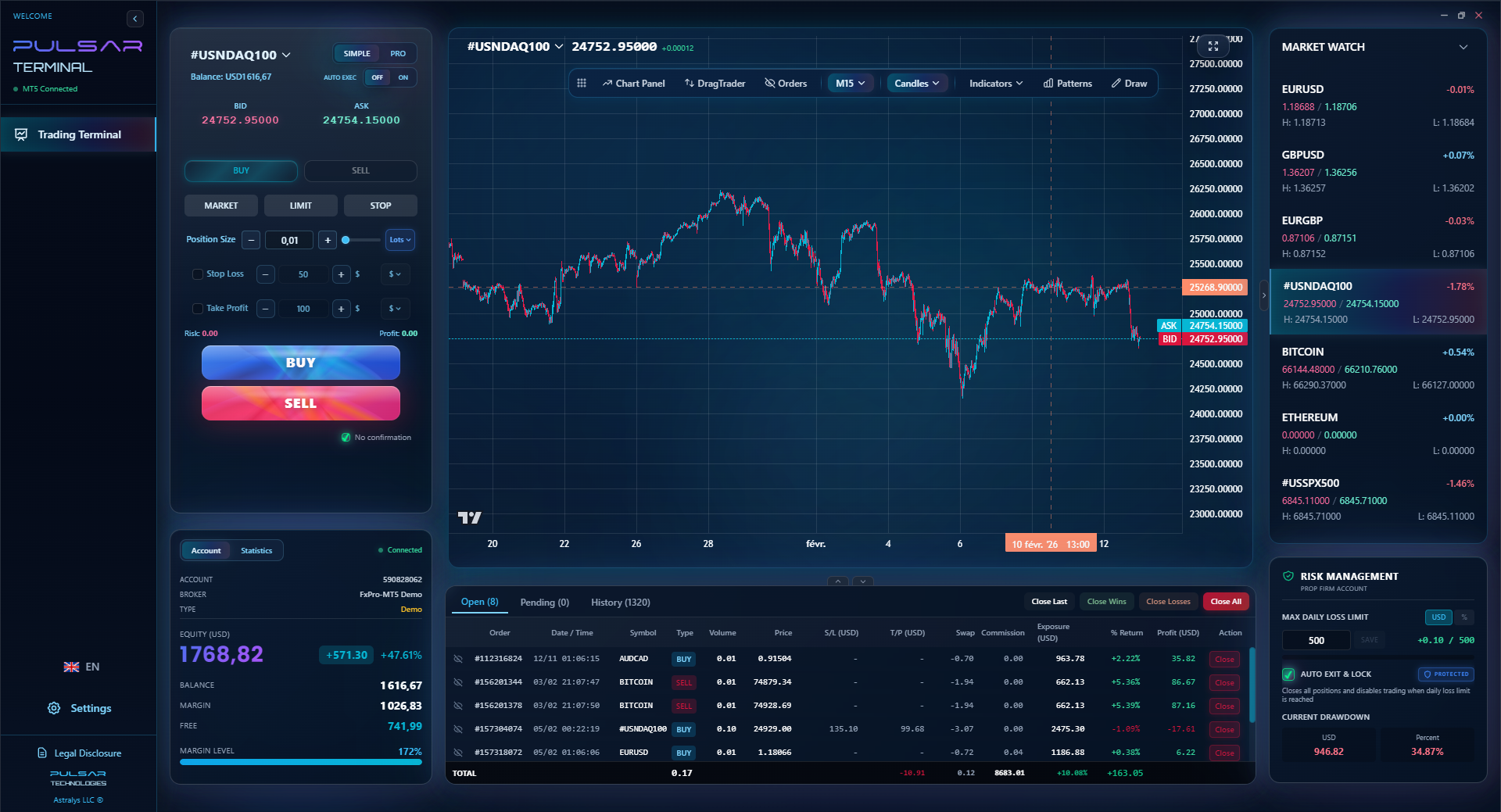
Executing a multi-level profit-taking strategy or moving stops to breakeven manually is stressful and error-prone; Pulsar Terminal automates these precise trade management rules directly on your MT5 platform.
Pulsar Terminal
أداة MT5 الشاملة: أوامر سحب وإفلات، متعدد TP/SL، تريلينج ستوب، تداول الشبكة، Volume Profile وحماية البروب فيرم. يستخدمها أكثر من 1000 متداول يومياً.
“The ZAR is a wild animal. Respect it or it will eat you.”
This is the invisible barrier. The mental game is where most fail, and the wealthy succeed.
They Are Okay Being Wrong They have no ego attached to a trade. A stopped-out trade is not a failure; it's a cost of doing business. I used to revenge trade after a loss, trying to win back the money immediately. It never worked. Now, after a loss, I often step away for the day. The pros have this discipline baked in.
They Think in Probabilities, Not Certainties No trade is a 'sure thing.' They enter every trade knowing there's a 40%, 50%, 60% chance it will work. Their system ensures that when they are right, they make more than they lose when they're wrong. This probabilistic thinking removes stress.
Delayed Gratification They don't withdraw profits to buy a new watch after a good month. They compound. They reinvest a portion of profits to grow their trading capital, treating it like a fund. The flashy lifestyle portrayed online is the antithesis of how real trading wealth is built - slowly and steadily.
💡 نصيحة وينستون
The market doesn't care about your rent. Trade the chart, not your bills. That emotional separation is the first step to real profitability.
“They think in probabilities, not certainties.”
Forget about becoming one of the richest forex traders overnight. Focus on becoming a competent, profitable trader first.
- Education with a Filter: Learn the basics - what a pip is, how use works, what moves currencies. But be ruthless. If a course promises 'guaranteed riches,' run. Focus on material that teaches risk management and psychology.
- Choose a Broker Wisely: Start with a reputable, well-regulated broker that offers a demo account and reasonable costs for South Africans. Do your research; read reviews like our Exness review or XM review to understand the landscape. Start with a demo, then a very small live account.
- Develop a ONE-Page Trading Plan: It should state your preferred pairs, your strategy rules, your risk-per-trade (start with 0.5%!), your daily/weekly loss limits, and your goals. Keep it simple.
- Journal Relentlessly: For every trade, note the setup, your emotion, the outcome, and what you learned. Review it weekly.
- Consider Gold as a Training Wheel: The XAU/USD guide shows that gold (XAU/USD) often has clearer trends than forex pairs. Many new traders find it easier to practice trend-following on gold before tackling the more chaotic currency markets.
The path is long, but it's real. It's built on consistent, small, smart decisions - not lottery tickets. That's the true secret the wealthy traders know.
FAQ
Q1Who is the richest forex trader in South Africa?
There's no publicly verified answer. True trading wealth is private. The most financially successful individuals are likely low-profile institutional traders or long-term retail traders who have compounded returns over decades, not social media personalities.
Q2Can you really get rich from forex trading in SA?
Yes, but it's more like building a successful small business than winning the lottery. It requires significant capital, years of disciplined practice, strong risk management, and emotional control. Getting 'rich' from a R5,000 account is a fantasy. Building wealth from a consistently funded and well-managed account over 5-10 years is a realistic, though challenging, goal.
Q3What is a realistic monthly return from forex trading?
A professional, risk-aware trader might target 5-10% per year, not per month. Aiming for consistent 2-5% per month is extremely aggressive and often leads to excessive risk-taking. A 1-2% monthly return, compounded, is a fantastic and sustainable result that will build significant wealth over time.
Q4Do I need a lot of money to start forex trading?
You need enough to survive the learning curve without blowing up. Starting with less than R10,000 is very difficult due to position sizing and risk rules. A more practical starter amount is R20,000 - R50,000, allowing you to trade micro lots and practice proper risk management without one loss ending your journey.
Q5Is forex trading taxable in South Africa?
Yes. Net profits from trading are considered income and are taxable by SARS. You must declare your earnings. Keep careful records of all trades, deposits, and withdrawals for tax purposes. Losses can be carried forward to offset future profits.
Q6What's the biggest mistake new SA traders make?
Over-leveraging on the ZAR pairs. The volatility combined with high use (even at the capped 30:1) can wipe out an account in a few bad trades. Successful traders use far less use, especially on our local currency.
درس البروفيسور وينستون
النقاط الرئيسية:
- ✓Risk max 1-2% per trade, always.
- ✓Specialize in 1-2 pairs you understand deeply.
- ✓Treat trading like a business, not a casino.
- ✓Use less use on ZAR pairs (under 15:1).
- ✓Wealth is built by compounding small, consistent gains.
ما مدى فائدة هذا المقال؟
انقر على نجمة للتقييم
رؤى التداول الأسبوعية
تحليلات واستراتيجيات أسبوعية مجانية. بدون رسائل مزعجة.
عن المؤلف
David van der Merwe
متداول الأسواق الناشئة
متداول مقيم في جوهانسبرغ مع 11 عاماً في عملات الأسواق الناشئة. متخصص في أزواج ZAR والتداول المنظم من FSCA وتحليل السوق الجنوب إفريقي.
التعليقات
تحذير من المخاطر
ينطوي تداول الأدوات المالية على مخاطر كبيرة وقد لا يكون مناسبًا لجميع المستثمرين. الأداء السابق لا يضمن النتائج المستقبلية. هذا المحتوى لأغراض تعليمية فقط ولا ينبغي اعتباره نصيحة استثمارية. قم دائمًا بإجراء بحثك الخاص قبل التداول.
قد يعجبك أيضًا

Cara Trading Forex Sukses: 7 Prinsip dari Trader Profesional
Cara trading forex sukses dengan 7 prinsip trader pro: manajemen modal, disiplin, journal trading, backtest. Data nyata, bukan janji profit palsu.
Jam Trading Forex Terbaik untuk Trader Indonesia: Panduan Lengkap dengan Tabel Waktu
Panduan jam trading forex untuk trader Indonesia. Tabel 4 sesi dunia, jam emas 20:00-00:00, sesi mana yang harus dihindari. Data akurat + tips dari trader berpengalaman.
Top 5 Sàn Forex Uy Tín Nhất 2026: Review Jujur dari Trader Indonesia
Top 5 sàn forex uy tín 2026 untuk trader Indonesia. Review jujur: spread, deposit, withdraw, dukungan lokal. Exness, XM, IC Markets & lebih.
احصل على Pulsar Terminal
جميع هذه الحاسبات مدمجة في Pulsar Terminal مع بيانات حية من حساب MT5 الخاص بك.
احصل على Pulsar Terminal