


I was short EUR/USD at 1.0950 in late 2023, watching the ECB press conference.

David van der Merwe
متداول الأسواق الناشئة ·  South Africa
☕ 12 دقائق قراءة
ما ستتعلمه:
- 1What STP Actually Means (And What Brokers Say It Means)
- 2STP vs. Market Maker: The South African Perspective
- 3The Real Costs of Trading STP in South Africa
- 4How to Choose an STP Broker in South Africa
- 5Common STP Execution Pitfalls and How to Avoid Them
- 6Adapting Your Trading Strategy for STP
- 7The Future of STP and Trading in South Africa
I was short EUR/USD at 1.0950 in late 2023, watching the ECB press conference. The pair spiked 15 pips on a headline, instantly hitting my stop-loss. My broker's platform showed 'Order Executed: 1.0965'. No requote, no delay. That's STP execution when it works. But here's the thing most traders in SA don't get: the term 'STP' is one of the most abused marketing phrases in forex. It sounds like your trade goes straight to the interbank market. The reality is more complicated, and understanding that difference is what separates the pros from the blown-up accounts.
Straight Through Processing, at its core, is an operational model. It means your trade order is processed electronically from the moment you click 'buy' or 'sell' until it's settled, without a human dealer manually intervening to accept or reject it. The original STP forex meaning was about efficiency and reducing paperwork.
In the retail world, brokers have co-opted the term to imply a specific execution model: your order is automatically passed straight through to their liquidity providers (big banks, hedge funds, other brokers). The broker doesn't act as the counterparty hoping you lose; they just collect a small markup on the spread or a commission. This is the ideal.
But here's the critical nuance that gets lost. Your broker is always your immediate counterparty. Legally, you have a contract with them, not with JP Morgan Chase. The STP model describes how they manage their risk. They take your order and immediately offset it (hedge) with their liquidity provider. If they can't hedge it fast enough or at a good price, that's where problems start.

Warning: A broker calling itself 'STP' doesn't guarantee no conflict of interest. Some operate a 'hybrid' model, routing most trades to liquidity providers but internalizing others (taking the other side) during predictable, high-volume events. Always check their regulatory filings for execution policy.
I learned this the hard way early on. I was with a broker that advertised 'True STP'. During the 2019 flash crash on the Japanese Yen, my stop-loss on USD/JPY was ignored. The price blew straight through it. The excuse? 'Exceptional market volatility.' A truly automated STP system should have executed, even at a terrible price. What likely happened was their risk model kicked in, and they chose not to hedge, becoming my direct opponent. I lost R8,000 on that one trade. The real STP forex meaning includes understanding that the broker's liquidity and technology are just as important as the label.
This is the classic debate. Let's cut through the noise with a local lens.
An STP broker, as we've defined, aims to pass your order through. A Market Maker (MM) typically acts as the direct counterparty to your trade. They quote you a price and take the other side of your trade, often profiting from the spread and potentially from your loss. Many traders villainize MMs, but it's not that simple.
In South Africa, some of the oldest, most established brokers operate as Market Makers. They provide a valuable service: they guarantee liquidity, especially for exotic pairs like USD/ZAR, even when the interbank market is thin. They might offer fixed spreads, which can be a blessing for beginners who don't want costs jumping around during news events.
The trade-off? There's an inherent conflict of interest. It's in their short-term interest for you to lose. They may use tactics like requotes ("The price has changed, do you accept?" during volatile news) or wider spreads to manage their risk against you. I used an MM broker when I first started trading ZAR pairs. The fixed 50-pip spread on USD/ZAR felt safe, but it meant I needed a much bigger move just to break even, which warped my entire position size calculator strategy.
| Feature | Typical STP/ECN Broker | Typical Market Maker Broker |
|---|---|---|
| Primary Revenue | Commission + small spread markup | The spread (bid/ask difference) |
| Conflict of Interest | Lower (profits from your volume) | Higher (can profit from your losses) |
| Spreads on EUR/USD | Low, often 0.1 - 0.5 pips + commission | Higher, often 1.0 - 2.0 pips, sometimes fixed |
| Execution | Usually faster, price feed from LPs | Can be slower, requotes possible |
| Best For | Scalpers, high-volume traders, algo trading | Beginners who value fixed costs, trading exotics like USD/ZAR |
The modern reality is that most reputable FSCA-regulated brokers, like IG or FP Markets, use a hybrid model. They are STP for most standard orders but may internalize orders from obviously struggling retail clients or during extreme events. The key is transparency. Read their execution policy.

💡 نصيحة وينستون
A broker's revenue model tells you everything. If they make money from your volume (commissions), they want you to trade often and survive. If they make money primarily from your spread, their incentive alignment is weaker. Follow the money.
“The real STP forex meaning includes understanding that the broker's liquidity and technology are just as important as the label.”
Thinking STP is always cheaper is a rookie mistake. The pricing structure is just different. You're trading closer to the raw interbank price, but you pay for the privilege.
The Spread + Commission Model
On a true STP or ECN account, you'll see spreads that can go down to 0.0 pips on majors. Don't get excited. You'll pay a commission per lot traded. For example, a broker like Tickmill might show a 0.11 pip spread on EUR/USD but charge a $3 commission per standard lot, per side. That's $6 round turn. You need to add the commission cost back into the spread to compare apples-to-apples with a commission-free broker.

Example:
- STP Account: Entry at 1.08500, Exit at 1.08550. 0.5 pip gain.
- Commission: $3 to enter + $3 to exit = $6 total.
- On a standard lot (100,000 units), a 0.5 pip move = $5 profit.
- Net Result: $5 profit - $6 commission = $1 LOSS. You won on price movement but lost on costs. This kills scalping strategies.
The ZAR-Specific Headaches
Trading USD/ZAR? Forget about 0.0 spreads. The average spread for a retail trader can range from 40 to over 300 pips, including any commission. Why? Lower liquidity and higher broker risk. If you're trading ZAR pairs, your cost of doing business is inherently higher. You must factor this into your risk/reward calculations. A 50-pip stop-loss on EUR/USD is reasonable. On USD/ZAR, it's a rounding error.
Other Fees That Bite
- Overnight Financing (Swap): This is the interest for holding a position past 5pm New York time. Rates can be positive or negative. Holding a long ZAR position against a high-yielding currency can cost you dearly.
- Inactivity Fees: Brokers like some offshore ones charge up to $100/month if you don't trade for 30 days. FSCA-regulated brokers are generally better about this.
- Bank Fees: Funding your account? A local EFT to an FSCA broker might be free. Sending money to an offshore broker via international SWIFT transfer can cost you R250-R500 at Capitec or FNB. That's a 5% hit on a R10,000 deposit before you even place a trade.
Regulation is your non-negotiable starting point. The FSCA (Financial Sector Conduct Authority) is your guardian. A local FSCA license means the broker must segregate client funds, adhere to fair execution policies, and provide a local recourse if things go wrong. You can trade with UK (FCA) or Australian (ASIC) regulated brokers, but resolving a dispute from South Africa is a nightmare.
Look beyond the marketing. Don't just trust the 'STP' label on the website.
- Read the Execution Policy: This legal document, found in the broker's FAQ or legal section, will state how they handle orders. Look for phrases like "we act as a counterparty" (Market Maker) or "we route orders to multiple liquidity providers" (STP).
- Check the Liquidity Providers: Good STP brokers proudly list their LPs (e.g., Citibank, Goldman Sachs, HSBC). No listed LPs is a red flag.
- Test with a Demo Account: This is crucial. Open a demo account with real-time market execution. Place trades during high volatility (like the US Non-Farm Payroll release at 2:30 pm SA time). Do you get requotes? Does the platform freeze? Does your stop-loss get slipped badly? I test every new broker this way during a high-impact news event. I once saw a 12-pip slippage on a demo trade; I never deposited real money with that broker.
- Compare Total Cost: Use a trade calculator. For your style (are you a swing trading holding for days, or a scalper?), calculate whether a raw spread + commission account (like IC Markets offers) or a wider spread, no-commission account (like some XM accounts) is cheaper.
- Platform & Tools: Most STP brokers offer MetaTrader 4 or 5. But the real edge comes from advanced tools. Can you easily set a trailing stop or multiple take-profit levels? Efficient order management is key to locking in profits, something a basic MT4 installation struggles with.
💡 نصيحة وينستون
Test a broker's execution during the Asian session (late night SA time). Liquidity is thin. If they still execute cleanly with minimal slippage on a major pair, their STP plumbing is probably solid.
“If your strategy relies on perfect, instantaneous execution to be profitable, it's not a strong strategy.”
Even with a good STP broker, you can get burned by execution nuances you didn't understand.
Slippage: This is when your order is filled at a different price than you requested. It happens to everyone. During fast markets, the price your broker quotes might be gone by the time your order reaches the liquidity pool. You can get positive slippage (a better fill) or negative slippage (a worse fill). The key is to expect it during high-volatility events like central bank announcements. If you can't stomach a 10-pip slippage on your stop-loss, don't hold the trade through the event.
Partial Fills: You order 5 lots, but only 2.7 lots get filled immediately because that's all the liquidity available at your price. The rest might fill at worse prices. This is common with large orders on less liquid pairs or during off-peak hours. To avoid this, break large orders into smaller chunks.
Latency: Your physical distance from the broker's servers matters. A broker with servers in London will have slower execution for you in Johannesburg than a broker with servers in Cape Town or Johannesburg. This is a hidden killer for scalpers. I once tried a high-frequency scalping strategy using a European broker. My entries were consistently 20-50 milliseconds late. Over hundreds of trades, that latency cost me thousands. I switched to a broker with local servers for South African clients.
The 'Last Look' Problem: Some liquidity providers have a 'last look' right. They can reject your order milliseconds after receiving it if the market has moved against them. This can lead to more rejections during volatile times. A good STP broker will have agreements with LPs that limit or disclose last look practices.
The best defense is a good strategy. If your strategy relies on perfect, instantaneous execution to be profitable, it's not a strong strategy. Build in a buffer for execution costs. Use limit orders instead of market orders where possible. And never, ever trade without a stop-loss, fearing slippage. A margin call from no stop is far worse than a slipped stop.
Your strategy needs to align with the STP environment. What works on a Market Maker's fixed-spread demo account might fail miserably on a live STP account.
For Scalpers: You live and die by costs. A 0.1 pip spread vs. a 0.5 pip spread is the difference between profit and loss. You must account for the commission on every single trade. Your profit targets must be significantly larger than your total cost (spread + commission). If your average win is 3 pips, but your all-in cost is 1.5 pips, you've given up 50% of your profit to the broker. It's unsustainable. Focus on the most liquid pairs (EUR/USD, USD/JPY) where spreads are tightest.
For Swing Traders: You care less about the raw spread and more about execution reliability on entry and exit. A 2-pip slippage on your 200-pip profit target is only 1%. It's annoying, but not fatal. Your bigger concern is the overnight swap fees. Holding a position for a week can add a significant cost or credit. Factor this into your trade plan. Sometimes, a positive swap can actually add to your returns over time.
Use Technology to Your Advantage: Manual order management on a fast STP feed is tough. If you use a trailing stop, you're constantly dragging a line on a chart. Tools that automate this - like setting a trailing stop that activates only after the price moves a certain distance in your favor - can protect profits without you babysitting the screen. This is where advanced trade management software that integrates with MT5 becomes a force multiplier, turning a good entry into a great exit.
Mind the News: Economic calendars are free. Use them. If you don't understand why the EUR/USD guide is moving, you shouldn't be trading it. Before major news, liquidity evaporates. Spreads widen, sometimes dramatically. Your STP broker isn't cheating you; their liquidity providers are protecting themselves. Either close your positions before high-impact news or be prepared for wild, costly executions.
💡 نصيحة وينستون
Wide spreads aren't evil; they're information. A suddenly widening spread on your STP platform is the market's way of screaming 'Danger!'. It's often smarter to step aside than to fight for a fill.
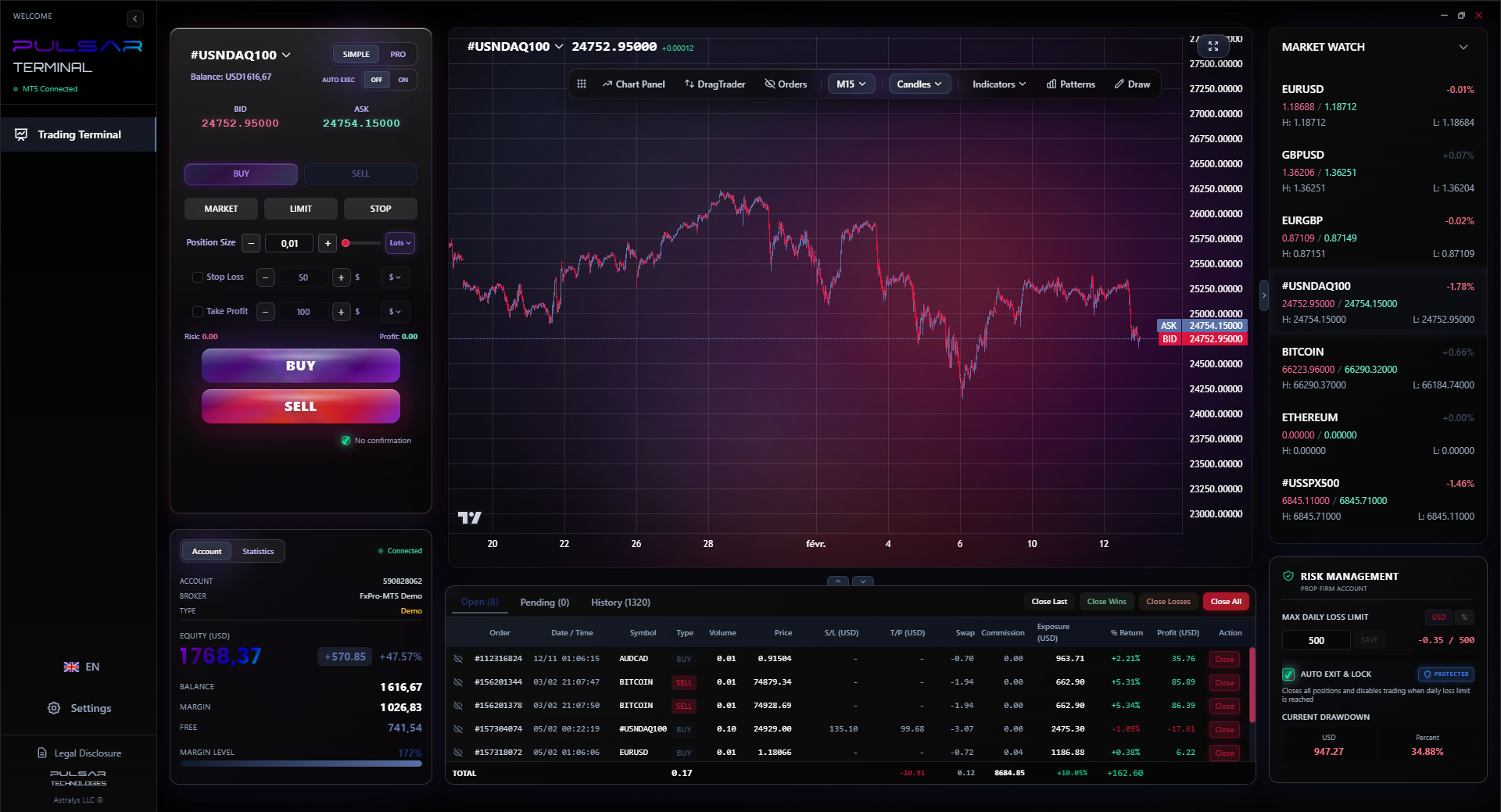
Managing complex exits with multiple take-profits and trailing stops is critical for STP trading, and Pulsar Terminal automates this directly on your MT5 platform.
Pulsar Terminal
أداة MT5 الشاملة: أوامر سحب وإفلات، متعدد TP/SL، تريلينج ستوب، تداول الشبكة، Volume Profile وحماية البروب فيرم. يستخدمها أكثر من 1000 متداول يومياً.
“Your edge doesn't come from finding a secret broker; it comes from understanding the mechanics better than the next person.”
The landscape is getting faster and more competitive, which is good for you.
The FSCA is finalizing the Conduct of Financial Institutions (COFI) Bill, expected around 2026. This should bring even stricter standards for transparency and execution quality. It will force brokers to be clearer about whether they are truly STP, hybrid, or market makers.
Technologically, we're seeing a push towards lower latency. By 2026, having access to professional-grade execution systems and advanced analytics won't be a luxury for the big funds; it'll be table stakes for serious retail traders. The 45% expansion in digital payment networks in 2025 means funding and withdrawing will get faster and cheaper.
For the Rand, commodities are becoming the key to watch in 2026 and beyond. The price of platinum, gold, and coal doesn't just affect mining stocks; it drives the ZAR's value. An STP broker with good execution on XAU/USD (Gold) might become more important than one with the tightest EUR/USD spread if you're trading the Rand.
The bottom line? The STP forex meaning is evolving from a vague marketing term into a measurable standard of execution quality. As a South African trader, your job is to demand that clarity. Choose FSCA-regulated brokers who are transparent about their model, test their execution relentlessly, and build a strategy that accounts for the real costs of trading in a global, electronic market. Your edge doesn't come from finding a secret broker; it comes from understanding the mechanics better than the next person.
FAQ
Q1Is STP trading better than Market Making for beginners in South Africa?
Not necessarily. While STP often has lower costs for active traders, the commission-based pricing can be confusing and expensive for beginners who trade small sizes. A reputable Market Maker with fixed spreads and FSCA regulation can offer simpler, more predictable costs for someone learning. The priority is a well-regulated broker, not the execution model label.
Q2Do all FSCA-regulated brokers offer STP execution?
No. The FSCA regulates for fairness and safety, not execution model. Many FSCA brokers are Market Makers or use a hybrid model. You must check the broker's website for their execution policy or contact their support directly to ask how they handle client orders.
Q3What is the typical minimum deposit for an STP broker account in South Africa?
It varies widely. Some international STP brokers like XM allow deposits as low as $5 (approx. R90). More serious professional-focused STP brokers like IC Markets or FP Markets typically require $100-$200 (R1,800 - R3,600). Local FSCA brokers like Khwezi Trade can start at R500. Remember, the minimum deposit is not a recommendation for starting capital. To trade properly with sound risk management, you should start with significantly more.
Q4Why are spreads on USD/ZAR so wide even with STP brokers?
Liquidity. The South African Rand is an emerging market currency. The interbank market for USD/ZAR is much smaller and less liquid than for EUR/USD. This means liquidity providers face higher risk when taking the other side of your trade, so they charge for it via a wider spread. Even with STP, you're getting a raw feed that reflects this reality.
Q5Can I avoid slippage completely with an STP broker?
No. Slippage is a function of market movement and liquidity, not broker type. During normal market conditions on highly liquid pairs, slippage with a good STP broker is minimal. During high-volatility events (news, market opens), slippage is guaranteed. You can reduce it by using limit orders instead of market orders, but you risk the order not being filled at all.
Q6What's the difference between STP and ECN?
They are closely related. ECN (Electronic Communication Network) is a specific type of liquidity pool where multiple participants (banks, brokers, funds) post bids and offers. An STP broker can route your order to an ECN. Often, 'ECN' is used to describe an account with the tightest raw spreads and a per-lot commission, while 'STP' might describe a standard account with a slightly marked-up spread and no commission. In practice, the terms are used interchangeably by brokers.
Q7How do I know if my broker is truly STP?
Look for concrete evidence: 1) A published list of tier-1 liquidity providers. 2) An execution policy stating they route orders directly to these LPs. 3) The presence of 'raw spread' or 'ECN' account types with commissions. 4) The absence of requotes during your demo testing. If they are vague and just say "we offer STP technology," be skeptical.
درس البروفيسور وينستون
النقاط الرئيسية:
- ✓STP describes risk flow, not a conflict-free utopia.
- ✓Always add commission to spread for true cost.
- ✓Test execution during high volatility on a demo.
- ✓FSCA regulation is your first and most important filter.
ما مدى فائدة هذا المقال؟
انقر على نجمة للتقييم
رؤى التداول الأسبوعية
تحليلات واستراتيجيات أسبوعية مجانية. بدون رسائل مزعجة.
عن المؤلف
David van der Merwe
متداول الأسواق الناشئة
متداول مقيم في جوهانسبرغ مع 11 عاماً في عملات الأسواق الناشئة. متخصص في أزواج ZAR والتداول المنظم من FSCA وتحليل السوق الجنوب إفريقي.
التعليقات
تحذير من المخاطر
ينطوي تداول الأدوات المالية على مخاطر كبيرة وقد لا يكون مناسبًا لجميع المستثمرين. الأداء السابق لا يضمن النتائج المستقبلية. هذا المحتوى لأغراض تعليمية فقط ولا ينبغي اعتباره نصيحة استثمارية. قم دائمًا بإجراء بحثك الخاص قبل التداول.
قد يعجبك أيضًا

Cara Trading Forex Sukses: 7 Prinsip dari Trader Profesional
Cara trading forex sukses dengan 7 prinsip trader pro: manajemen modal, disiplin, journal trading, backtest. Data nyata, bukan janji profit palsu.
Jam Trading Forex Terbaik untuk Trader Indonesia: Panduan Lengkap dengan Tabel Waktu
Panduan jam trading forex untuk trader Indonesia. Tabel 4 sesi dunia, jam emas 20:00-00:00, sesi mana yang harus dihindari. Data akurat + tips dari trader berpengalaman.
Top 5 Sàn Forex Uy Tín Nhất 2026: Review Jujur dari Trader Indonesia
Top 5 sàn forex uy tín 2026 untuk trader Indonesia. Review jujur: spread, deposit, withdraw, dukungan lokal. Exness, XM, IC Markets & lebih.
احصل على Pulsar Terminal
جميع هذه الحاسبات مدمجة في Pulsar Terminal مع بيانات حية من حساب MT5 الخاص بك.
احصل على Pulsar Terminal