


I held that EUR/USD short for eight days.

David van der Merwe
متداول الأسواق الناشئة ·  South Africa
☕ 12 دقائق قراءة
ما ستتعلمه:
- 1What Swing Trading Forex Actually Is (And Isn't)
- 2The South African Rules You Can't Ignore
- 3Building Your Swing Trading System: A 3-Part Framework
- 4Costs, Brokers, and the Real Numbers in Rands
- 5Mistakes I Made (So You Don't Have To)
- 6Managing Risk Like a Pro, Not a Gambler
- 7Essential Tools and Platforms for the SA Swing Trader
- 8Your First Month: A Step-by-Step Action Plan
I held that EUR/USD short for eight days. The chart was a perfect picture: a clear rejection at a major weekly resistance level, confirmed by a bearish divergence on the daily RSI. My profit target was 120 pips away, and I was already up 60. Then, on a quiet Tuesday afternoon, the US released a shock inflation print. The pair ripped 90 pips against me in 15 minutes, triggering my stop-loss and turning a winning trade into a R1,200 loss. That trade taught me the brutal, beautiful lesson of swing trading forex: it’s not about being right on the setup; it’s about surviving the news you never see coming. This guide is how you build a strategy that does just that.
Let's cut through the noise. Swing trading forex is about catching the 'meat' of a price move. You're not trying to scalp 5 pips like a day trader, and you're not buying the Aussie dollar to hold for five years. You're aiming for those moves that last several days to a few weeks. Think of it as the sweet spot between frantic screen-watching and passive investing.
For South Africans with jobs, families, or lives outside of trading, this is the main appeal. You don't need to be glued to the screen from London open to New York close. You can do your analysis in the evening, set your orders, and check in once a day. The trap, however, is thinking it's 'easy' or 'relaxed.' It's not. The longer you hold a position, the more unseen risks you're exposed to - like that inflation report that blew up my trade. Your job is to manage those risks first, and chase profits second.

Warning: Don't confuse 'less screen time' with 'less work.' The analytical work for a solid swing trade is often deeper than for a quick scalp. You need to understand higher time frame structure, which is where tools like the MACD indicator on the daily chart can be far more useful than on a 5-minute chart.

💡 نصيحة وينستون
Your first profit target should be to move your stop to breakeven. Making money is secondary to protecting capital.
Trading from South Africa comes with a unique set of regulatory fences. Ignoring them isn't rebellious; it's stupid and can cost you real money and legal headaches.
First, the big one: You cannot speculate against the South African Rand (ZAR). This means you cannot open a trade with the sole intention of the Rand weakening. For example, shorting USD/ZAR (betting the Rand strengthens) is generally the only permissible directional trade on the pair for a South African resident. Trying to go long USD/ZAR to profit from a falling Rand will get your broker's compliance team very interested, very quickly.
FSCA and Your Broker Choice
The Financial Sector Conduct Authority (FSCA) is our local watchdog. Trading with an FSCA-licensed broker like AvaTrade or Khwezi Trade offers a layer of local recourse if something goes wrong. But here's the practical truth: many of us also use top-tier international brokers like IC Markets or Pepperstone who hold FSCA licenses alongside other global regulations. This is perfectly legal. The risk is using an unregulated offshore bucket shop. If they vanish with your money, the FSCA can't help you.
Taxes and Getting Money In/Out
SARS sees your trading profits as income. Full stop. It doesn't matter if your broker is in Cyprus or the Cayman Islands. You must declare your net profits. Keep a careful trading journal - it's your best friend come tax season.
To fund an international account, you'll use your annual foreign capital allowance (R10 million) and single discretionary allowance (R1 million) through an Authorised Dealer (your bank). You can't just buy forex directly from your broker; the money must leave the country via the proper channels first. This process adds a small cost and a day or two of delay, so plan your deposits accordingly.
“Your stop loss is a pre-paid insurance policy. Think of the cost as a business expense.”
A system isn't a fancy indicator. It's a repeatable process for finding trades, entering them, and - most critically - managing them. Here’s a framework I’ve used for years.
1. The Hunting Grounds: Find the Trend
Start on the weekly chart. Is price generally making higher highs and higher lows (uptrend), or the opposite (downtrend)? I ignore the daily and 4-hour charts until I know the weekly story. In a strong weekly uptrend, I'm only looking for buy setups on lower time frames. This one filter eliminates 50% of the noise and bad trades.
2. The Trigger: Wait for the Pullback
Markets don't go straight up or down. They trend, then pull back. Your job is to spot where that pullback might end. This is where tools like the RSI indicator coming out of oversold territory in an uptrend, or a test of a moving average (like the 50 or 200 EMA), can give you a potential entry zone. Don't chase price. Let it come to you.
3. The Trade Plan: Entry, Exit, and Survival
This is where you make your money. You need three prices before you click buy:
- Entry: The price where you enter.
- Stop Loss: The price that proves your idea wrong. This is non-negotiable. Place it beyond a recent swing point. If your stop is 80 pips away, use a position size calculator to ensure you're not risking more than 1-2% of your account.
- Take Profit: Your profit target. A common method is to aim for a risk-to-reward ratio of at least 1:2. If you risk 80 pips, aim for 160 pips of profit.

Example: In early 2023, I bought GBP/USD on a pullback to the 200-day EMA on the daily chart. Entry: 1.2100. Stop: 1.2020 (80 pips risk). Target: 1.2260 (160 pips reward). The trade hit target in 11 days. Risk was R800, reward was R1,600.
The hard part is sitting through the volatility in between. This is where a tool for automated trade management is useful. Setting a trailing stop or moving your stop to breakeven at a logical point removes emotion.
Let's talk about the money you'll actually keep. Your broker and your habits eat into your profits.
The Real Costs for Swing Traders:
- Spreads: This is the bid/ask difference. On a major pair like EUR/USD, a good raw spread account might charge 0.1 pips + commission. A standard account might have a 1 pip spread built in. Over a 100-pip swing trade, that's a minor cost. But on a choppy pair, it adds up. Check our spread definition for a deeper look.
- Overnight Financing (Swap): This is THE big one for swing traders. You hold positions for days, so you pay or earn interest daily. Selling a high-yield currency and buying a low-yield one can earn you a small daily credit. Doing the opposite costs you money. These fees can seriously dent a long-term trade. Always check the swap rates in your platform before holding over Wednesday night (when triple charges apply).
- Inactivity Fees: Some brokers charge if you don't trade for 3-6 months. As a swing trader with fewer trades, be aware of this.
Broker Reality Check: You need a broker with reliable execution and a platform that doesn't fail. Here’s a quick comparison of popular choices in SA:
| Broker | Key Feature for Swing Traders | Minimum Deposit | FSCA Licensed? |
|---|---|---|---|
| IC Markets | Raw spreads, great MT4/5 execution | $200 (~R3,700) | Yes |
| Khwezi Trade | Local support, ZAR-based accounts | R500 | Yes (Proudly SA) |
| Exness | Very low minimum deposit | $10 (~R185) | Yes |
| XM | Flexible account types, good education | $5 (~R93) | Yes |
My experience? I started with a "cheap" broker and had terrible slippage on news events, which murdered my carefully placed stops. I switched to a more reputable Exness raw account and never looked back. The slightly higher commission was worth it for the peace of mind.

Pro Tip: Start with at least R5,000. With R1,000, proper position sizing (risking 1%) means your stop losses will be so tight that normal market noise will stop you out constantly. Swing trading needs room to breathe.
💡 نصيحة وينستون
If you find yourself checking a trade more than twice a day, your position size is too large. Scale down until you can forget about it.
“If you find yourself checking a trade more than twice a day, your position size is too large.”
Let me be the cautionary tale. Here are the classic swing trading errors that cost me money.
1. Widening Your Stop Loss Because 'It'll Come Back.' This is account suicide. I bought AUD/USD based on a daily support level. My stop was 50 pips below support. Price dipped, hit my stop, and I didn't take the loss. I moved my stop down another 50 pips, thinking it was just a wick. The pair kept falling. That R500 planned loss became a R2,500 nightmare. The fix: Set your stop based on the chart, not your pain threshold. If price hits it, you're wrong. Get out.
2. Ignoring Fundamentals and Economic Calendars. As a technical swing trader, I used to think news was noise. Then I got caught holding a EUR/USD position into a European Central Bank (ECB) meeting. The volatility spiked 150 pips in minutes, blew through my stop with massive slippage, and reversed to go my original direction. I was right on the trend, but dead on the timing. The fix: Always check the economic calendar. If a major Central Bank announcement or US Non-Farm Payrolls is due, either close your position before the event or widen your stop to survive the volatility. Better yet, just stay out.
3. Overtrading in a Sideways Market. Swing trading thrives on trends. In a ranging market, you'll get whipsawed - stopped out repeatedly. I once took four losing trades in a row on GBP/JPY, trying to force a trend that wasn't there. The fix: Learn to identify ranges (horizontal support and resistance). When the market is ranging, put the charts away. Go do something else. Preserving capital is a win. This is a core principle of successful swing trading discipline.
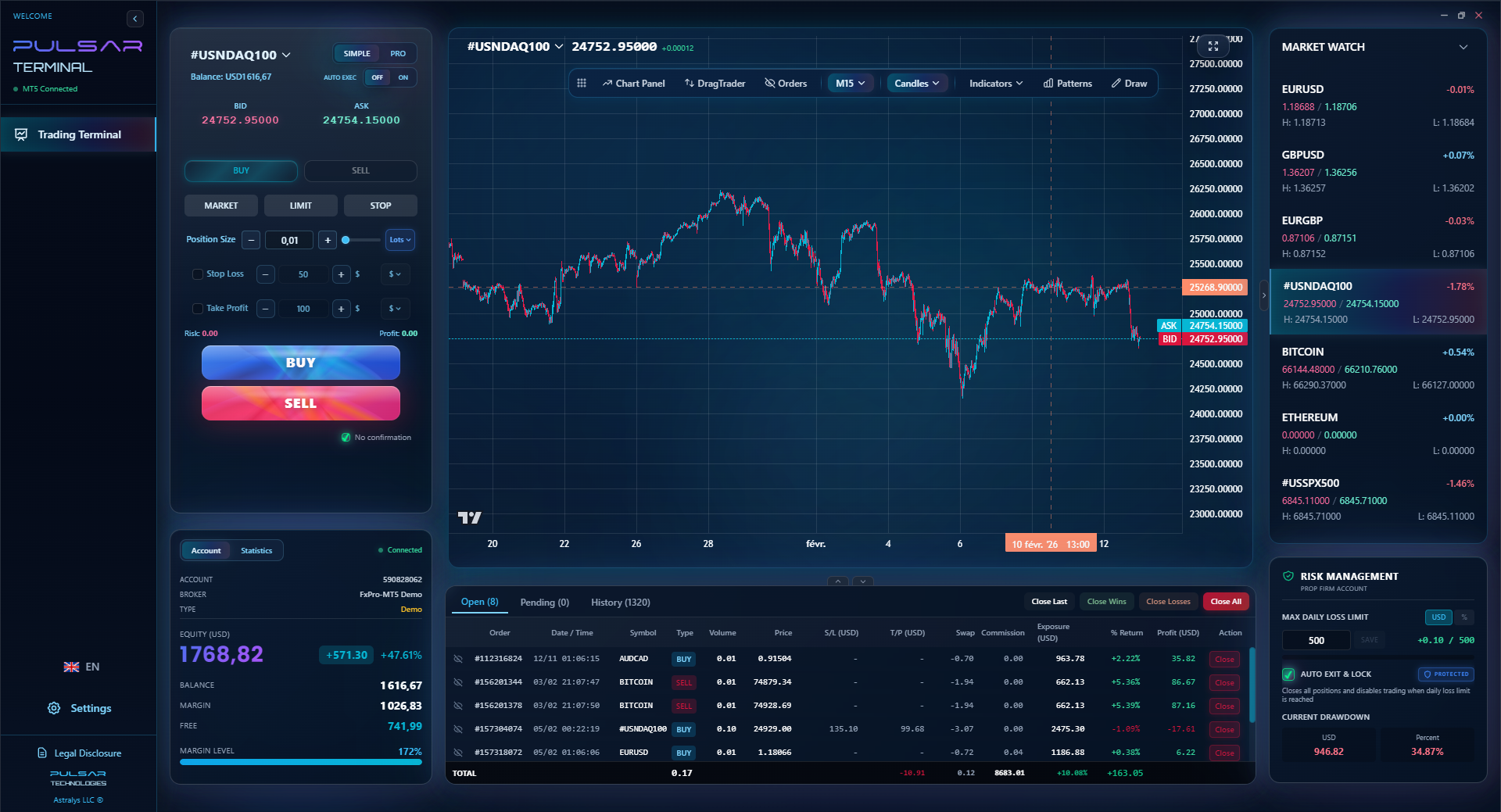
Manually managing multiple trades and moving stops to breakeven is where discipline often fails, which is why automating these rules with a tool like Pulsar Terminal directly on MT5 is a game-saver for swing traders.
Pulsar Terminal
أداة MT5 الشاملة: أوامر سحب وإفلات، متعدد TP/SL، تريلينج ستوب، تداول الشبكة، Volume Profile وحماية البروب فيرم. يستخدمها أكثر من 1000 متداول يومياً.
Risk management isn't a section in a guide; it's the entire foundation. Here’s how to apply it practically.
The 1% Rule is Your Bible: Never risk more than 1% of your total account capital on a single trade. If you have a R20,000 account, your max risk per trade is R200. If your stop loss is 100 pips away on EUR/USD, you can only afford to trade a position size where 100 pips = R200. This single rule keeps you in the game after a string of losses.
Beware of Correlation: Don't swing trade USD/CHF and EUR/USD at the same time. They move similarly. If you're wrong on the dollar, you'll get hit twice. You're effectively doubling your risk without realizing it.
The Psychology of the Stop Loss: Your stop loss is your best friend. It's a pre-paid insurance policy. Think of the cost (the potential loss) as a business expense. When it triggers, the trade is over. Don't analyze it, don't stare at it. Review it later in your journal. This emotional detachment is the hallmark of a professional.
Warning: use is a double-edged sword. The FSCA caps it at 30:1 for retail clients, which is still plenty to blow up an account if misused. With a R10,000 account and 30:1 use, you can control a R300,000 position. A 0.33% move against you wipes out your entire capital. Use use to enable smaller position sizes for tighter stops, not to maximize potential profit. Understand what a margin call is before you ever experience one.
“The goal of your first month with real money is not profit. It's perfect discipline.”
You don't need expensive software, but you do need the right basics.
Charting Platform: Most brokers offer MT4 or MT5. They're free and strong. I prefer MT5 for its better time frame selection and built-in economic calendar. TradingView is also excellent for analysis, but you'll still need your broker's platform to execute trades.
Your Trading Journal: This is non-negotiable. Use a spreadsheet or a dedicated app. Log every trade: entry/exit, reason for entry, stop loss, profit target, emotional state, and a screenshot. Review it weekly. Your journal will show you your real weaknesses - it's usually not your strategy, but your discipline.
Economic Calendar: Use ForexFactory.com or the calendar in your trading platform. Mark high-impact events (red news) for the currencies you trade.
The Game-Changer: Trade Management Tools This is where modern tools separate the amateurs from the pros. Manually moving stops to breakeven or trailing a stop is tedious and emotional. A platform that automates this based on your rules is a massive advantage. For example, you can set a rule to move your stop to breakeven once price moves 1.5x your initial risk in your favor, locking in a free trade. This turns a winning trade into a stress-free ride.
💡 نصيحة وينستون
The most important line on your chart isn't a trendline; it's the horizontal line marking your stop-loss price. Never redraw it after you're in the trade.
Ready to stop reading and start doing? Follow this plan.
Week 1: Paper Trade Your System. Don't deposit real money. Open a demo account with a broker like XM or your chosen one. Practice finding your weekly trend, daily pullback, and setting your three price points (entry, stop, target). Execute 5-10 paper trades. The goal isn't profit; it's process mastery.
Week 2: Analyse Your Demo Trades. Go through your journal. Did you follow your rules? Where did you deviate? How did your stop placement work? Tweak your entry rules if needed, but DO NOT tweak your risk management rules (the 1% rule).
Week 3: Fund a Live Account with Minimum Capital. Deposit a small, meaningful amount - say, R5,000. This is real money, so the psychology changes. Your goal for the first month is not to make profit. Your goal is to execute 5-10 live trades with perfect discipline: following your entry, respecting your stop, and taking profit at your target. If you end the month break-even but followed every rule, you are a HUGE success.
Week 4 & Beyond: The Grind. Now, focus on consistency. Slowly scale your position sizes as your account grows, keeping your risk per trade at 1%. Review your journal monthly. The market will change; your core rules should not. This is the path from a hopeful beginner to a consistent swing trader.
FAQ
Q1Is swing trading forex profitable in South Africa?
It can be, but the statistics are grim. A 2020 study showed 69% of forex-only traders in SA lost money. Profitability comes from rigorous risk management and discipline, not a magical indicator. Beginners might aim for R1,000-R10,000 monthly, but that's after months of practice and consistent rule-following.
Q2What is the best time frame for swing trading forex?
You should analyze multiple time frames. Use the weekly chart to determine the primary trend, the daily chart to find your trade setup and entry zone, and the 4-hour chart for a precise entry trigger. Never make a decision based solely on a low time frame like the 1-hour when swing trading.
Q3Can I use use for swing trading with the FSCA's 30:1 cap?
Yes, but cautiously. The 30:1 cap is a safety measure. For swing trading, you should use far less. Your position size should be determined by your stop-loss distance and your 1% risk rule, not by how much use is available. Using maximum use is a sure way to get a margin call.
Q4How do I avoid swap fees as a swing trader?
You can't avoid them entirely, but you can manage them. First, check the swap rates (long and short) for your chosen pair before entering. Some brokers offer 'swap-free' Islamic accounts, but these often have other fees built in. Alternatively, you can factor the daily swap cost into your risk-reward calculation for the trade.
Q5Do I need to pay tax on my forex trading profits in South Africa?
Yes. SARS considers your net trading profits (profits minus losses and expenses) as taxable income. You must declare it in your annual tax return. Keep detailed records of all trades, deposits, and withdrawals. Consult with a tax professional familiar with trading income.
Q6What's a realistic starting capital for swing trading forex?
While some brokers let you start with R150, that's unrealistic for proper swing trading. You need enough capital to place sensible stop losses. R5,000 is a practical minimum to start applying the 1% risk rule without your stops being impossibly tight. R20,000 provides much more flexibility.
Q7Is MetaTrader 4 or 5 better for swing trading?
MT5 is generally better. It has more time frames (like the 2-hour and 8-hour, which are useful for swing analysis), more technical indicators, and a built-in economic calendar. Most brokers now support MT5, and the learning curve is almost identical to MT4.
درس البروفيسور وينستون
النقاط الرئيسية:
- ✓Risk a maximum of 1% per trade, always.
- ✓Weekly chart defines the trend, daily chart finds the trade.
- ✓Know the economic calendar for your currency pairs.
- ✓A trading journal is your most valuable tool.
- ✓Profit comes from consistency, not home runs.
ما مدى فائدة هذا المقال؟
انقر على نجمة للتقييم
رؤى التداول الأسبوعية
تحليلات واستراتيجيات أسبوعية مجانية. بدون رسائل مزعجة.
عن المؤلف
David van der Merwe
متداول الأسواق الناشئة
متداول مقيم في جوهانسبرغ مع 11 عاماً في عملات الأسواق الناشئة. متخصص في أزواج ZAR والتداول المنظم من FSCA وتحليل السوق الجنوب إفريقي.
التعليقات
تحذير من المخاطر
ينطوي تداول الأدوات المالية على مخاطر كبيرة وقد لا يكون مناسبًا لجميع المستثمرين. الأداء السابق لا يضمن النتائج المستقبلية. هذا المحتوى لأغراض تعليمية فقط ولا ينبغي اعتباره نصيحة استثمارية. قم دائمًا بإجراء بحثك الخاص قبل التداول.
قد يعجبك أيضًا

Cara Trading Forex Sukses: 7 Prinsip dari Trader Profesional
Cara trading forex sukses dengan 7 prinsip trader pro: manajemen modal, disiplin, journal trading, backtest. Data nyata, bukan janji profit palsu.
Jam Trading Forex Terbaik untuk Trader Indonesia: Panduan Lengkap dengan Tabel Waktu
Panduan jam trading forex untuk trader Indonesia. Tabel 4 sesi dunia, jam emas 20:00-00:00, sesi mana yang harus dihindari. Data akurat + tips dari trader berpengalaman.
Top 5 Sàn Forex Uy Tín Nhất 2026: Review Jujur dari Trader Indonesia
Top 5 sàn forex uy tín 2026 untuk trader Indonesia. Review jujur: spread, deposit, withdraw, dukungan lokal. Exness, XM, IC Markets & lebih.
احصل على Pulsar Terminal
جميع هذه الحاسبات مدمجة في Pulsar Terminal مع بيانات حية من حساب MT5 الخاص بك.
احصل على Pulsar Terminal