


Let's be blunt: most 'top 10 forex brokers in Nigeria' lists are garbage.

Olumide Adeyemi
رائد التداول في غرب أفريقيا ·  Nigeria
☕ 12 دقائق قراءة
ما ستتعلمه:
- 1The Nigerian Forex Rules You Can't Ignore (But Everyone Does)
- 2How I Ranked the Top 10 Brokers (It's Not Just Popularity)
- 3The Top 10 Forex Brokers in Nigeria (2026)
- 4Deposits, Withdrawals, and the Real Costs of Trading in Nigeria
- 5My Personal Experience (The Good, The Bad, The Ugly)
- 6Common Pitfalls for Nigerian Traders (And How to Avoid Them)
- 7Final Verdict and My Recommendation
Let's be blunt: most 'top 10 forex brokers in Nigeria' lists are garbage. They're just affiliate marketing pages written by people who've never placed a trade from Lagos. I've traded from Abuja during a power cut and from a cafe in Port Harcourt. The reality is messy, regulated by new laws most traders ignore, and dominated by a few international players for good reason. I'm going to prove to you that choosing a broker isn't about shiny bonuses, it's about survival - your money's survival. We'll cut through the noise, look at the real numbers from my own accounts, and I'll even tell you which popular choice I think is a trap for new traders.
Trading is legal here. Full stop. But the game changed in 2025, and pretending it didn't is how you get your account locked or worse. The old days of the 'regulatory gap' are closing.
The big one is the Investments and Securities Act (ISA) 2025. This law says it's illegal to run an online forex trading platform without registering with the SEC Nigeria. Now, here's the practical truth: almost none of the big international brokers Nigerians use are registered with the SEC. They're regulated offshore (CySEC, FSCA, ASIC). This creates a weird limbo. The law exists, but enforcement on the client side is... unclear. Your broker choice is a calculated risk.
The Central Bank of Nigeria (CBN) is the other heavyweight. Their Nigeria Foreign Exchange Code from late 2024 is for the big banks and institutions, but it signals a direction: more transparency, less funny business with the Naira. They've been trying to unify exchange rates into the NAFEM. This affects your deposit and withdrawal rates more than your actual trading.
And then there's the taxman. Forget what your broker tells you about 'tax-free' profits. In Nigeria, you're on the hook for a 10% Capital Gains Tax on your gross trading profits. Yes, gross. If you make ₦1,000,000, you owe ₦100,000. Very few traders actually declare this, but that's between you and the FIRS. I set aside 10% of every profitable quarter into a separate account. It's not fun, but it's smart.

Warning: Using an unregistered international broker is the norm, but it's a legal grey area post-2025. Your funds are protected by that broker's foreign regulator, not by Nigerian law. Understand this risk before you deposit.
“Pick a broker based on reliable withdrawals in Naira, competitive costs, and a stable platform. That's it.”
I'm not ranking these by who pays the most for ads on Naija forums. I'm looking at what actually matters when your money is on the line. My criteria are brutal:
- Can you get your money in and out? This is the #1 issue for Nigerian traders. If a broker makes depositing or, more importantly, withdrawing a nightmare, they're useless. Local bank transfer support is non-negotiable.
- Real costs, not advertised ones. That '0.0 pip spread' often comes with a $3.50 commission per lot. I calculate the all-in cost for a standard 1-lot EUR/USD trade.
- Platform stability during Lagos volatility. Does the platform freeze when major news hits? I've been in trades during CBN announcements where a frozen platform would have wiped me out.
- Customer support that understands 'network issue.' A support agent in Manila might not get why my verification is delayed because of 'NEPA taking light.'
I've had live accounts with over half of these brokers. I'll tell you where I've won, where I've lost, and where I keep my main trading capital now.
The Nigerian Trader's Non-Negotiables
Your broker must have: Naira (NGN) account options or seamless Naira payments, acceptance of local methods like bank transfer and mobile money (Paga, Opay), and reasonable processing times for withdrawals (under 24 hours for e-wallets is the benchmark). If they only take crypto or international cards, they're adding friction and cost you don't need.

💡 نصيحة وينستون
Your broker's withdrawal policy is more important than their spread. A tight spread saves you dollars; a broken withdrawal process costs you your entire bankroll.
“High use isn't a feature for winners; it's a trap for the impatient.”
Here's the list, with the cold, hard specifics. Remember, the 'best' depends entirely on your style. A scalper needs a different broker than a swing trading veteran.
| Broker | Why It's Here (The Good) | The Catch (The Bad) | Min. Deposit | Best For... |
|---|---|---|---|---|
| 1. Exness | Withdrawal king. Instant to Naira wallets. Raw spreads, unlimited use (for qualified clients). | Unlimited use is a double-edged sword - it will destroy you if you're careless. Platform can feel basic. | $10 (Standard) | Traders who value fast cashouts above all else. |
| 2. HFM (HotForex) | Deep local roots, Naira accounts, solid education. Reliable execution. Negative balance protection. | Spreads aren't always the absolute tightest. Inactivity fees kick in. | $0 (but ₦4k via processor) | Beginner to intermediate traders wanting stability. |
| 3. XM | Rock-solid reputation, $5 minimum, tons of educational webinars relevant to Africa. | Spreads are higher than pure ECN brokers. Overnight swap rates can be steep. | $5 | Absolute beginners learning the ropes. |
| 4. IC Markets | True institutional pricing. One of the lowest all-in costs for high-volume traders. cTrader platform is excellent. | Less hand-holding. Withdrawals can take a full business day. | $200 | Experienced traders, scalpers, algo traders. |
| 5. Pepperstone | Razor-sharp spreads, fantastic for scalping strategy. Great MetaTrader tools. | Minimum deposit for Razor account is higher. More focused on advanced traders. | $200 (Standard) | Technical traders and scalpers who need tight spreads. |
| 6. FBS | The accessibility champion. $1 minimum, cent accounts for practice, crazy high use (1:3000). | That high use is a mass account destroyer. You're trading against their book more often. | $1 | Traders with very little capital to start (use with extreme caution). |
| 7. AvaTrade | Beginner's paradise. Copy trading, DupliTrade, tons of learning materials. Regulated everywhere. | Higher trading costs (wider spreads). Not the best for ultra-short-term trading. | $100 | New traders who want to learn or use copy trading. |
| 8. FXTM | Physical presence in Nigeria. Local seminars, dedicated support. Good for building skills. | Account options can be confusing. Costs are middle-of-the-road. | $10 | Traders who value local community and support. |
| 9. Capital.com | Clean, intuitive proprietary platform. Good for trading crypto CFDs alongside forex. | Not a MetaTrader broker, which turns off many pros. Limited advanced order types. | $20 | Traders who prefer a simple, modern app experience. |
| 10. XTB | Excellent in-house xStation 5 platform. $0 minimum deposit. Strong on education. | Limited product range compared to others. More of a CFD stock broker than pure forex. | $0 | Traders who like all-in-one platforms and invest in other assets. |

Example: Let's compare a 1-lot EUR/USD trade. At IC Markets (Raw Spread): Spread = 0.1 pips + $3.50 commission. Total cost = (0.1 * $10) + $3.50 = $4.50. At a standard broker with a 1.5 pip spread and no commission: 1.5 * $10 = $15. That's a 233% difference. It adds up fast.
“High use isn't a feature for winners; it's a trap for the impatient.”
This is where the rubber meets the road. You can have the best strategy in the world, but if you can't fund your account or get your profits out, it's all theory.
Payment Methods That Actually Work:
- Local Bank Transfer: The gold standard. Direct to your Nigerian bank account. Exness and HFM are best-in-class here. Processing: 0-24 hours.
- Mobile Money (Paga, Opay): Increasingly common. Fast and convenient for smaller amounts. Exness accepts these directly.
- E-Wallets (Skrill, Neteller): Fast, but you pay a currency conversion fee twice (NGN>USD>NGN). I use Skrill only for urgent withdrawals.
- Cryptocurrency (USDT): Fast and borderless, but volatile. Your profit in USD could be less in Naira by the time you convert it on a local exchange.
The Hidden Tax: Spread & Commission Your broker isn't a charity. They make money on the spread definition and/or commission. A 'zero spread' account always has a commission. You must calculate the total cost per trade.
I made a mistake early on. I signed up with a broker advertising 'low spreads' on EUR/USD. They were 1.2 pips, no commission. I thought it was great. Then I tried an ECN account at IC Markets review with 0.1 pips + $3.5 commission. For my typical 2-lot trade, the ECN account cost me $7.70 ( (0.1*$10*2) + $3.5 ). The 'low spread' account cost me $24 (1.2 * $10 * 2). I was overpaying by 212% per trade. I didn't notice because it was baked into the price. Don't be me.
use: Your Tool or Your Executioner Seeing use like 1:1000 or 1:2000 is tempting. It's also incredibly dangerous. With a $100 account and 1:1000 use, you can control a $100,000 position. A 10-pip move against you (a tiny blip) would be a $100 loss - wiping your entire account. I never use more than 1:50 on my main account, no matter what the broker offers. High use is for precision scalping strategy with tiny position size calculator, not for holding swings.

Pro Tip: Always do a test withdrawal of a small amount before you deposit large sums. If there's a problem, you find out when it's $20, not $20,000.
💡 نصيحة وينستون
If you're calculating your trade size in 'lots' instead of a percentage of your account, you're already wrong. Risk 1-2% per trade, no exceptions. Use a calculator.
“I blew a $100 account in a week with FBS. The high use they advertised was the trap I walked right into.”
Let's get specific. Here's where I've put my own money.
Exness: The Cashout Champion. I keep an account here purely for its withdrawal speed. In January 2026, I withdrew $500 via Skrill at 11:03 PM on a Tuesday. It hit my Skrill wallet at 11:04 PM. One minute. Converting to Naira and sending to my bank took another day, but the broker part was instant. I use it for short-term trades where I want immediate access to profits. The downside? I once got margin call on a gold trade during a flash crash. Their unlimited use on the Pro account meant my stop loss was skipped due to slippage. I lost 15% more than I planned. Lesson learned: with great power comes great responsibility.
IC Markets: The Professional's Workhorse. This is where my serious swing trading capital lives. The execution is flawless. I remember a specific trade on XAU/USD guide (gold). Entry at $2018.50, stop at $2012. My stop was hit exactly at $2012.00. No slippage, even during the NY open. The raw spreads mean my cost of doing business is low. The withdrawal to my Nigerian bank account takes about 36 hours, which I plan for. It's not sexy, but it's reliable.
The One I Regret: FBS. I opened an account in 2024, tempted by the 1:3000 use. I deposited $100. I used a scalping strategy on EUR/USD guide, aiming for 5-pip gains. It worked twice. On the third trade, the platform execution was painfully slow. My market order to get out of a losing trade took 1.2 seconds to fill. In scalping, that's an eternity. I lost the two previous wins and more. The high use had me over-positioned. I blew the account in a week. The use was a trap I walked right into. Their platform couldn't keep up with the strategy their marketing encouraged.
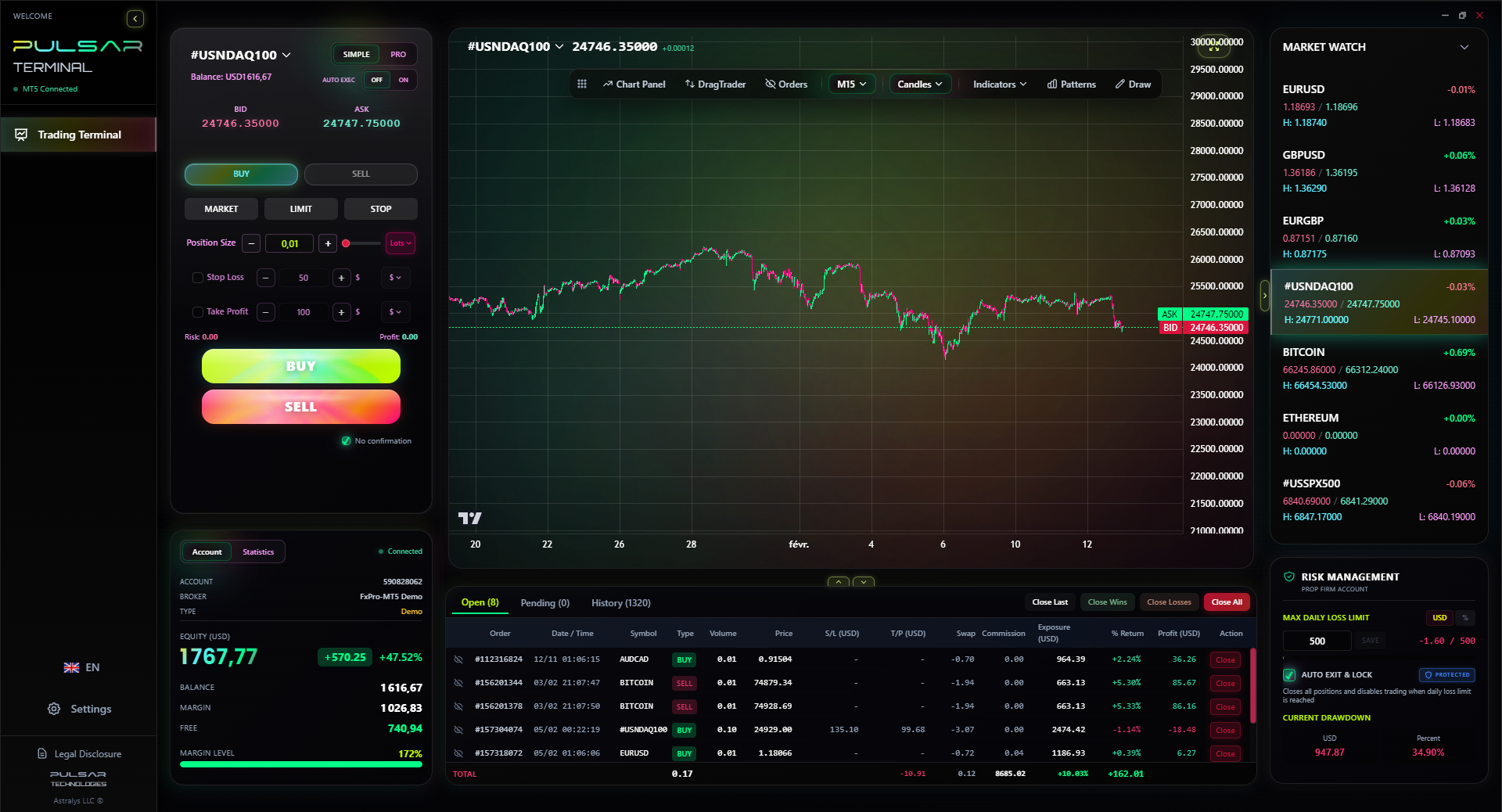
Managing multiple trades and risk manually is a headache; Pulsar Terminal automates trailing stops, partial closures, and even prop firm loss limits directly on your MT5 platform.
Pulsar Terminal
أداة MT5 الشاملة: أوامر سحب وإفلات، متعدد TP/SL، تريلينج ستوب، تداول الشبكة، Volume Profile وحماية البروب فيرم. يستخدمها أكثر من 1000 متداول يومياً.
“I blew a $100 account in a week with FBS. The high use they advertised was the trap I walked right into.”
I've seen these mistakes destroy accounts time and again.
Pitfall 1: Chasing Bonuses. A '100% deposit bonus' sounds great. But it always comes with insane trading volume requirements (lots to trade before you can withdraw). You end up over-trading just to unlock your own money. Ignore bonuses. They are a psychological trap.
Pitfall 2: Ignoring the Tax Man. That 10% Capital Gains Tax is real. The government may not be sophisticated at tracking forex profits yet, but that will change. Set aside a portion of your profits in a separate savings account. Treat it as a business expense.
Pitfall 3: Picking a Broker for the Wrong Reason.
- "My friend uses it." Your friend might be losing money.
- "They have a fancy office in VI." You're not trading the office.
- "They give the highest use." This is the fastest way to lose.
Pick a broker based on: 1) Reliable withdrawals in Naira, 2) Competitive total trading costs for YOUR style, 3) A stable platform. That's it.
Pitfall 4: Not Using a position size calculator. This is non-negotiable. Your position size is your primary risk control tool. If you're not calculating it for every single trade, you're gambling. I use one before every entry, no exceptions.
Warning: If a broker's website or support is full of broken English and promises of 'guaranteed profits,' run. These are often unregulated bucket shops targeting eager new traders. Stick to the established names, even if their sign-up process is more boring.
💡 نصيحة وينستون
The best broker for you is the one you stop thinking about. When the platform, deposits, and withdrawals become invisible, you can focus 100% on your trading edge.
“Your position size is your primary risk control tool. If you're not calculating it for every trade, you're gambling.”
So, who is the best of the top 10 forex brokers in Nigeria? There's no single answer, but I can tell you who I'd recommend to different people.
- For the Complete Beginner: Start with XM or AvaTrade. The $5 minimum at XM lets you test with real money without fear. The educational content at AvaTrade is top-notch. Learn here. When you're consistently profitable on a demo and understand risk management, then consider moving.
- For the Active Trader (Scalper/Day Trader): IC Markets or Pepperstone. The low all-in costs save you money on every trade, and execution speed is critical. These are professional-grade tools.
- For the Trader Who Wants Zero Hassle With Cash: Exness. Their payment processing is in a league of its own for Nigeria. Just be disciplined with their use.
- For the Balanced, Long-Term Trader: HFM. They offer a great mix of local support, good education, reliable platforms, and fair costs. They're the sensible, all-round choice.
My main account is with IC Markets. Why? After 12 years, I value low costs and reliable execution above all else. I'm not chasing bonuses or use. I'm running a business. My secondary 'operational' account is with Exness for quick access to funds.
Your final step before clicking 'sign up'? Read the full, boring Terms and Conditions. Check the withdrawal section, the inactivity fees, the margin close-out policy. That document, not the marketing splash page, tells you who the broker really is. Choose wisely, trade safely, and always, always manage your risk first.
FAQ
Q1Is forex trading legal in Nigeria?
Yes, forex trading is legal for individuals in Nigeria. However, the new Investments and Securities Act (ISA) 2025 requires online trading platforms to register with the SEC Nigeria. Most popular international brokers are not registered with the SEC, operating under their own foreign regulations (like CySEC or FSCA). This creates a legal grey area for the trader, though enforcement on individual clients is currently minimal.
Q2How do I withdraw forex profits in Nigeria?
The most common and reliable method is a local bank transfer in Naira (NGN). Brokers like Exness and HFM excel at this. Other methods include e-wallets (Skrill, Neteller) which are fast but have conversion fees, and mobile money (Paga, Opay) for supported brokers. Always test a small withdrawal first to confirm the process and timing.
Q3What is the minimum amount to start forex trading in Nigeria?
You can technically start with as little as $1 (FBS) or $5 (XM). However, I strongly advise against this. With such a small account, proper risk management is impossible, and you'll be forced to use dangerously high use to see any meaningful gain. A more realistic and responsible starting amount is between $200 and $500. This allows for sensible position sizing and can withstand normal market volatility.
Q4Do I pay tax on forex trading profits in Nigeria?
Yes. According to Nigerian law, you are liable for a 10% Capital Gains Tax on your gross trading profits. Many traders do not actively declare this, but the liability exists. It is prudent to set aside 10% of your profits in a separate account to cover this potential obligation.
Q5Which broker is best for beginners in Nigeria?
For a true beginner, I recommend XM or AvaTrade. XM has a very low $5 minimum deposit, reducing the fear of losing money while you learn with real trades. AvaTrade offers exceptional educational resources and copy-trading platforms. Both are well-regulated and have good customer support. Avoid brokers that push extreme use to beginners.
Q6Can I use MetaTrader 4 or 5 with Nigerian brokers?
Absolutely. The vast majority of the top brokers, including Exness, HFM, IC Markets, Pepperstone, and XM, offer full access to both MetaTrader 4 (MT4) and MetaTrader 5 (MT5). These are the industry-standard platforms. Some, like Capital.com, use their own proprietary platform, which is a consideration if you have a strong preference for MT4/5.
Q7What is the most important factor when choosing a broker in Nigeria?
Reliable and fast withdrawals in Nigerian Naira (NGN). Everything else - spreads, use, platforms - is secondary. If you can't easily access your profits, the broker has failed its primary function. Always prioritize brokers with a proven track record of smooth local bank transfers or other Naira-based payout methods.
درس البروفيسور وينستون
النقاط الرئيسية:
- ✓Withdrawal reliability in Naira is your #1 broker criterion.
- ✓Calculate total trade cost (spread + commission), not just the advertised spread.
- ✓Never use more than 1:50 use on a core trading account.
- ✓Set aside 10% of gross profits for Capital Gains Tax.
- ✓Test a small withdrawal before making a large deposit.
ما مدى فائدة هذا المقال؟
انقر على نجمة للتقييم
رؤى التداول الأسبوعية
تحليلات واستراتيجيات أسبوعية مجانية. بدون رسائل مزعجة.
عن المؤلف
Olumide Adeyemi
رائد التداول في غرب أفريقيا
أحد أنشط معلمي تداول الفوركس في نيجيريا. 8 سنوات من الخبرة في التداول من لاغوس. متخصص في استراتيجيات رأس المال المنخفض وتحديات شركات البروب للمتداولين الأفارقة.
التعليقات
تحذير من المخاطر
ينطوي تداول الأدوات المالية على مخاطر كبيرة وقد لا يكون مناسبًا لجميع المستثمرين. الأداء السابق لا يضمن النتائج المستقبلية. هذا المحتوى لأغراض تعليمية فقط ولا ينبغي اعتباره نصيحة استثمارية. قم دائمًا بإجراء بحثك الخاص قبل التداول.
قد يعجبك أيضًا

Cara Trading Forex Sukses: 7 Prinsip dari Trader Profesional
Cara trading forex sukses dengan 7 prinsip trader pro: manajemen modal, disiplin, journal trading, backtest. Data nyata, bukan janji profit palsu.
Jam Trading Forex Terbaik untuk Trader Indonesia: Panduan Lengkap dengan Tabel Waktu
Panduan jam trading forex untuk trader Indonesia. Tabel 4 sesi dunia, jam emas 20:00-00:00, sesi mana yang harus dihindari. Data akurat + tips dari trader berpengalaman.
Top 5 Sàn Forex Uy Tín Nhất 2026: Review Jujur dari Trader Indonesia
Top 5 sàn forex uy tín 2026 untuk trader Indonesia. Review jujur: spread, deposit, withdraw, dukungan lokal. Exness, XM, IC Markets & lebih.
احصل على Pulsar Terminal
جميع هذه الحاسبات مدمجة في Pulsar Terminal مع بيانات حية من حساب MT5 الخاص بك.
احصل على Pulsar Terminal