


Let's cut through the noise.

Olumide Adeyemi
رائد التداول في غرب أفريقيا ·  Nigeria
☕ 9 دقائق قراءة
ما ستتعلمه:
Let's cut through the noise. Everywhere you look in Lagos or on WhatsApp, some 'guru' is selling forex signals promising 500% monthly returns. It's nonsense. I've seen traders blow entire accounts following signals they didn't understand. Understanding forex signals isn't about finding a magic bullet; it's about learning to separate the rare useful information from the overwhelming pile of garbage. I'll show you how they really work, what to pay for (if anything), and how to use them without getting burned.
A forex signal is just a suggestion to buy or sell a currency pair at a specific price and time. That's it. It's not a prophecy. The signal tells you the entry, stop loss, and take profit levels. They come from two places: human analysts or automated algorithms (Expert Advisors).
In Nigeria, you'll see them everywhere: Telegram channels, WhatsApp groups, Instagram pages. The pitch is always the same: "Let me do the hard work for you." The problem? You have no idea what that 'hard work' actually is. Is it based on chart patterns, news events, or just a gut feeling? Without understanding forex signals at their core, you're flying blind.
Here's the raw truth I learned the hard way: a signal is only as good as the strategy behind it. Early in my career, I paid $50 a month for a service that just tweeted "BUY GBP/USD" with no stop loss. I lost $1,200 in a week when the pair tanked. The provider vanished. That experience taught me to demand the 'why' behind every call.

Warning: Any signal provider who doesn't clearly state their stop loss level is not a trader; they're a gambler selling you a lottery ticket. Run.
Signals can be free (usually used as bait) or paid. The paid ones, like those on Signal Start, range from $30 to $100 monthly. Services like Learn 2 Trade charge £50 to £250. The higher price doesn't guarantee success, but free signals are almost always a marketing tool to sell you something else.

💡 نصيحة وينستون
The best signal you'll ever get is your own common sense. If a trade setup looks confusing or feels like a gamble, it is. Hit the skip button. The market will be there tomorrow with a clearer opportunity.
Human vs. Algorithm
Human-generated signals come from a trader analyzing charts. They might use tools like the RSI indicator or MACD indicator. Algorithmic signals come from a computer program scanning the market 24/7. Humans can adapt to weird market moods (like Naira volatility); robots just follow their code.
The Copy Trading Loophole
Many Nigerian traders use platforms that offer built-in signal/copy trading. Brokers like AvaTrade offer ZuluTrade and DupliTrade. Exness and others have social features. You're not just buying a text alert; you're automatically copying someone's live trades. This is huge here because of payment issues. You fund your account once via crypto or a domiciliary account, and the platform handles the rest.
The Local Scam Special
Nigeria has a unique problem: the 'WhatsApp Guru.' They often claim secret 'CBN insider' knowledge on USD/NGN. It's fraud. The CBN doesn't leak rate moves to Instagram influencers. These guys prey on the fact that trading global pairs (EUR/USD) is straightforward, but the local Naira market feels mysterious. They create false expertise.
The Platforms We Actually Use
MetaTrader 4 and 5 are king. The MetaTrader signals market is a mixed bag. You can also find signals on TradingView and dedicated sites like Myfxbook. The key is the broker integration. If a signal says buy EUR/USD at 1.0850, your broker (IC Markets, XM, etc.) needs to offer that price with a decent spread. A 3-pip spread kills a tight scalping strategy signal before it starts.
“Using 1:1000 use because your broker offers it is like using a rocket launcher to open a door. You might succeed, but the collateral damage will be catastrophic.”
Blind faith loses money. Use this checklist. I wish I had it ten years ago.
1. Track Record & Verification: Demand a verified, long-term track record. A screenshot of a winning trade is meaningless. Look for a third-party verified history on a site like Myfxbook or the MQL5 signal marketplace. It should show at least 12-18 months of live trading. Anyone can get lucky for a month.
2. Risk Disclosure: What's their average risk per trade? If they're risking 5% of the account on each signal, run away. Consistent, professional trading is about small, managed risks. Look for risk/reward ratios. A good signal will have a clear stop loss and take profit, ideally with a risk-to-reward of 1:1.5 or better.
3. Strategy Transparency: Do they tell you why? "Buy because of bullish divergence on the 4H chart" is better than "BUY NOW!!!" A provider should be able to explain their edge in simple terms. Is it swing trading support/resistance? News plays? If it's a secret, it's probably rubbish.
4. Drawdown: This is the most important number. Drawdown is the peak-to-trough decline in the account. A 50% drawdown means they lost half the account value before recovering. Anything over 20% is a red flag. It shows poor risk management. A smooth, steady equity curve is better than a rollercoaster, even if the rollercoaster ends up higher.

Example: Provider A has a 12-month return of 80% with a 45% max drawdown. Provider B has a 40% return with a 12% drawdown. Provider B is the professional. Surviving a bad streak is more important than hitting home runs.
5. Cost vs. Value: Does the subscription fee make sense? If they charge $100/month, they should be providing more than just signals: maybe market analysis, webinars, or direct support. Compare their fee to your trading capital. Paying $100/month to manage a $500 account is insane. Use our position size calculator to see what a realistic return looks like after fees.
Okay, you found a decent-looking provider. Now the real work begins. Using signals is a skill itself.
Never Follow Blindly: This is non-negotiable. When a signal hits your phone, pause. Open your chart. Can you see the setup? Does the entry, stop, and target make logical sense with the price action? If not, skip it. Your job is to be a quality control inspector, not a robot.
Adjust for Your Broker: Signals are often generated from a broker with tight spreads. Your broker might be different. If a scalp signal has a 5-pip target and your broker's spread is 2 pips, you've already lost 40% of your potential profit. This killed one of my early copy trades on EUR/USD. The signal was right, but my execution was too slow and costly.
Manage Your Own Risk: The provider's risk is based on their account size. You must calculate the position size for your account. If they risk 2% per trade, you should too. Don't double your lot size because you're "confident." This is where most Nigerians fail. Greed takes over. Use a calculator. Every time.
Start with a Demo: Follow the signals on a demo account for at least a month. Track every trade. See how you react emotionally when a trade goes -$200 against you. Do you panic and close it early? Demo trading reveals your psychology, which is more important than the signal.
Beware the Lag: Especially in copy trading, there's a delay between the provider opening the trade and your account copying it. In fast markets, you can get a worse fill (slippage). This turns a winning signal into a loser for you. It's a hidden cost.

Pro Tip: Set a hard daily loss limit (e.g., 3% of your account). If the signals hit that limit, stop for the day. No excuses. This single rule has saved me from revenge trading more times than I can count.
💡 نصيحة وينستون
Track a provider's performance during a specific Naira volatility event. If their signals on USD/NGN or related pairs fall apart, it shows they can't handle real market stress. That's more telling than their win rate in calm conditions.
“Your job when following a signal is to be a quality control inspector, not a mindless robot. If you can't see the logic on the chart, don't take the trade.”
The ultimate goal of understanding forex signals is to stop needing them. Use them as a training tool.
Reverse-Engineer the Trades: This is how I finally learned. When a signal hits, don't just place the order. Mark the entry, stop, and target on your chart. Watch what happens. After the trade closes (win or lose), go back and analyze. What pattern was there? Was there a key news event? Did price respect a moving average? Write it down in a journal.
Find Your Style: You'll notice the provider has a style. Maybe they trade gold (XAU/USD) breakouts, or they fade GBP/USD rallies. See what resonates with your personality. Are you patient enough for their swing trading style, or do you prefer action?
Combine with Your Own Analysis: Use the signals as a second opinion. If you see a buy setup on USD/JPY and a signal service you respect also issues a buy, that's a stronger confluence. But if your analysis says sell and the signal says buy, that's a conflict. Skip the trade. Clarity is better than confusion.
The Tax Man Cometh: Remember, any profit you make is subject to a 10% Capital Gains Tax by the FIRS. Whether you make it from your own analysis or a signal, keep clean records. A signal provider's statement can be part of your records, but you're responsible for declaring the income.
The market here is growing fast - turnover hit $8.6 billion in 2025. But growth attracts sharks. Your best defense is knowledge. Signals can be a shortcut, but there's no shortcut to developing your own judgment. That takes screen time, losses, and relentless review.
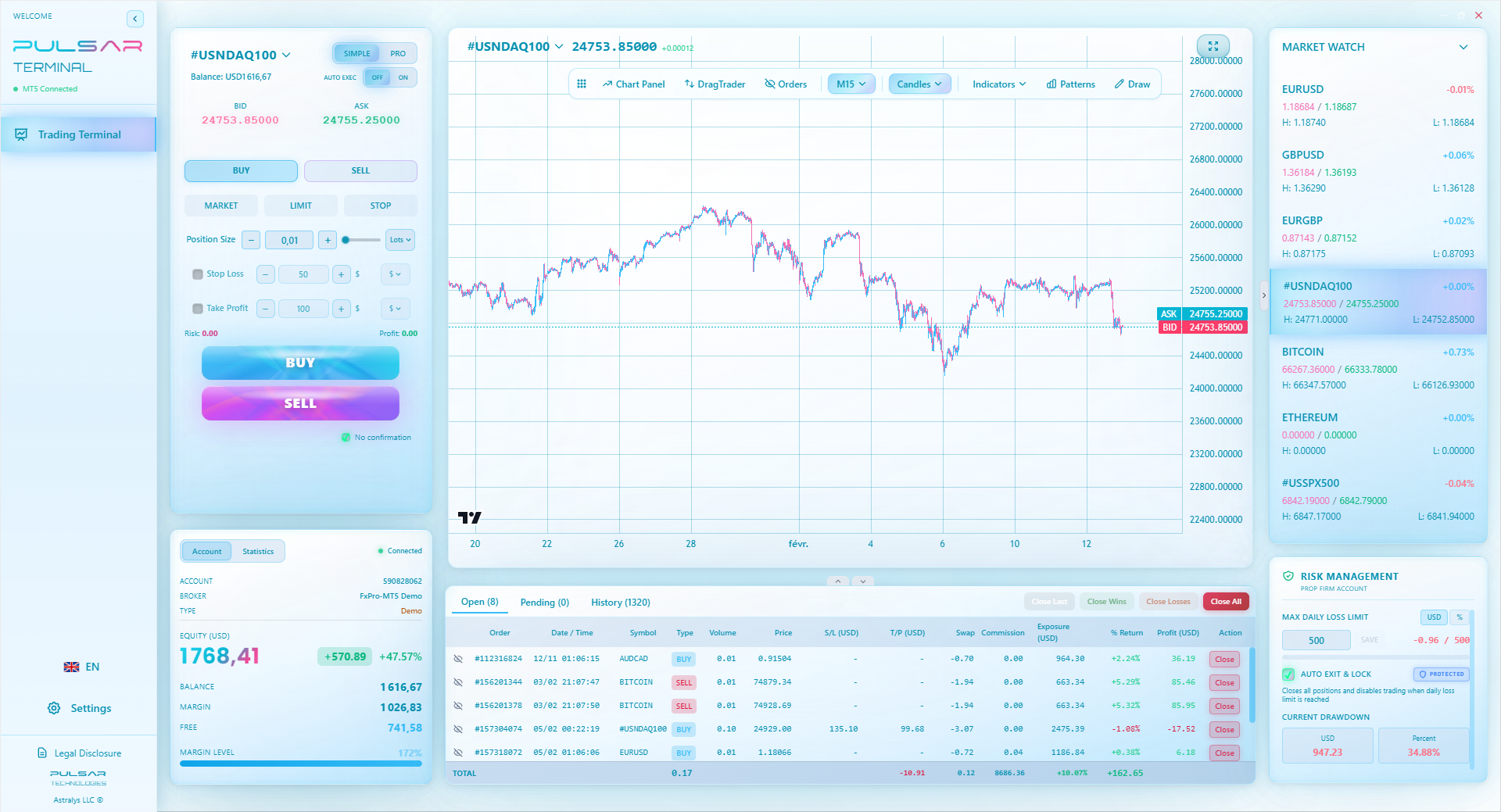
Manually managing multiple take-profit levels and trailing stops for signal-based trades is a hassle; Pulsar Terminal automates this with drag-and-drop order tools directly on your MT5 platform.
Pulsar Terminal
أداة MT5 الشاملة: أوامر سحب وإفلات، متعدد TP/SL، تريلينج ستوب، تداول الشبكة، Volume Profile وحماية البروب فيرم. يستخدمها أكثر من 1000 متداول يومياً.
I've made these mistakes so you don't have to.
1. The 'Guaranteed Return' Scam: If it's guaranteed, it's a lie. Period. The SEC Nigeria has repeatedly cracked down on these forex investment schemes. They're Ponzi schemes dressed in trading clothes.
2. Over-Leveraging: Because some international brokers offer insane use (1:1000, 1:2000) to Nigerian clients, signal providers might use it to show crazy percentage gains. Don't you dare follow suit. use amplifies losses faster than gains. A 1:1000 use means a 0.1% move against you wipes out your entire margin. It's a margin call waiting to happen.
3. Chasing Multiple Providers: You subscribe to three services. One says buy, one says sell, one says stay out. You freeze, then make an emotional decision and lose. Pick one, maybe two max, that fit your style and stick with them to learn their rhythm.
4. Ignoring Fees: Between the signal subscription ($50), the broker's spread (1 pip on EUR/USD), and potential commission, you need to make a certain amount just to break even. On a small account, these costs are a massive hurdle.
5. Neglecting Withdrawals: Test the withdrawal process with a small amount first. Can you easily get your profit out to your domiciliary account or crypto wallet? If not, the best signals in the world are useless. I once had $2,500 stuck with a shady broker for 6 weeks. Never again.
The landscape is improving with new CBN codes for transparency, but the onus is on you. Be the skeptical, informed trader. The one who reads the fine print, tests everything, and never bets the rent money.
FAQ
Q1Are forex signals legal in Nigeria?
Yes, using forex signals for your personal trading is legal. However, selling signals or managing money for others without the proper license from the SEC Nigeria is illegal. The SEC regularly warns against unlicensed 'forex investment schemes' that promise guaranteed returns.
Q2What is a realistic monthly return from following forex signals?
Anyone promising more than 5-15% per month consistently is likely lying or taking suicidal risks. A professional, risk-managed approach aims for steady growth. A 10% monthly return would be exceptional over the long term. Remember, a 50% drawdown requires a 100% return just to break even.
Q3Can I use signals with a small account (e.g., $100)?
Technically yes, but it's very tough. Broker minimums can be as low as $1 (FBS) or $10 (Exness). The problem is risk management. To properly follow a signal with a sensible 1% risk ($1), the position size will be tiny, and trading costs (spreads) will eat a large percentage of any profit. It's better to use a demo account until you can fund with at least $500-$1000.
Q4How do I pay for international signal services with Naira?
Direct Naira card payments often fail due to CBN restrictions. The most common ways are: 1) Using a domiciliary account (Dollar account) with your Nigerian bank to make an international transfer. 2) Funding an e-wallet like Skrill or Neteller via crypto or other means, then paying from there. 3) Paying the provider directly with cryptocurrency like USDT.
Q5What's better: manual signals or copy trading?
Copy trading is easier but you have less control. The trade is copied exactly, including the provider's position size relative to their equity. Manual signals give you control to adjust the position size for your account and skip trades that don't make sense to you. For beginners, copy trading is simpler; for those wanting to learn, manual signals force more engagement.
Q6Do signal providers account for the 10% Nigerian capital gains tax?
No. Tax compliance is 100% your responsibility. The signal provider gives you trading suggestions. You are responsible for calculating your profit, keeping records of all trades (entries and exits), and paying the 10% tax to the Federal Inland Revenue Service (FIRS) on your net annual gains.
درس البروفيسور وينستون
النقاط الرئيسية:
- ✓Demand verified track records, not screenshots.
- ✓A drawdown over 20% is a major red flag.
- ✓Always calculate your own position size.
- ✓Test withdrawals before depositing serious capital.
ما مدى فائدة هذا المقال؟
انقر على نجمة للتقييم
رؤى التداول الأسبوعية
تحليلات واستراتيجيات أسبوعية مجانية. بدون رسائل مزعجة.
عن المؤلف
Olumide Adeyemi
رائد التداول في غرب أفريقيا
أحد أنشط معلمي تداول الفوركس في نيجيريا. 8 سنوات من الخبرة في التداول من لاغوس. متخصص في استراتيجيات رأس المال المنخفض وتحديات شركات البروب للمتداولين الأفارقة.
التعليقات
تحذير من المخاطر
ينطوي تداول الأدوات المالية على مخاطر كبيرة وقد لا يكون مناسبًا لجميع المستثمرين. الأداء السابق لا يضمن النتائج المستقبلية. هذا المحتوى لأغراض تعليمية فقط ولا ينبغي اعتباره نصيحة استثمارية. قم دائمًا بإجراء بحثك الخاص قبل التداول.
قد يعجبك أيضًا

Cara Trading Forex Sukses: 7 Prinsip dari Trader Profesional
Cara trading forex sukses dengan 7 prinsip trader pro: manajemen modal, disiplin, journal trading, backtest. Data nyata, bukan janji profit palsu.
Jam Trading Forex Terbaik untuk Trader Indonesia: Panduan Lengkap dengan Tabel Waktu
Panduan jam trading forex untuk trader Indonesia. Tabel 4 sesi dunia, jam emas 20:00-00:00, sesi mana yang harus dihindari. Data akurat + tips dari trader berpengalaman.
Top 5 Sàn Forex Uy Tín Nhất 2026: Review Jujur dari Trader Indonesia
Top 5 sàn forex uy tín 2026 untuk trader Indonesia. Review jujur: spread, deposit, withdraw, dukungan lokal. Exness, XM, IC Markets & lebih.
احصل على Pulsar Terminal
جميع هذه الحاسبات مدمجة في Pulsar Terminal مع بيانات حية من حساب MT5 الخاص بك.
احصل على Pulsar Terminal