


I was staring at my screen in late 2024, watching USD/NGN hit 1,450 on the black market while my broker's chart showed 1,200.

Olumide Adeyemi
رائد التداول في غرب أفريقيا ·  Nigeria
☕ 9 دقائق قراءة
ما ستتعلمه:
I was staring at my screen in late 2024, watching USD/NGN hit 1,450 on the black market while my broker's chart showed 1,200. That gap, that reality check, is where Nigerian forex trading lives. It's legal, it's chaotic, and it's absolutely packed with opportunity if you know what you're doing. Forget the 'get rich quick' YouTube ads. Starting right means understanding the new rules, the real costs, and the mental game. Let's cut through the noise.
Before you even think about a broker, you need to get your head straight and understand the playing field. The biggest change happened in March 2025: the Investments and Securities Act (ISA) 2025. This law finally gives the SEC the power to regulate online FX platforms. It's a game-changer for legitimacy, but it's still early days. For now, you'll likely still be using an internationally regulated broker, but expect more local oversight soon.
Your mindset is your first capital. I've seen guys blow $500 accounts in a week because they treated it like a casino. Forex isn't a side hustle; it's a skill-based business with a 10% capital gains tax on your gross profits. The FIRS will want their cut, so factor that in from day one. You need the patience of a saint and the discipline of a soldier. The market doesn't care about your rent or your dreams.

Warning: The 1:2000 use you see advertised is a trap for beginners. It's like giving a learner driver a Formula 1 car. Yes, brokers like Exness and HFM offer it, but using it without iron-clad risk management is a guaranteed way to get a margin call. Start with 1:10 or 1:20 to learn how price moves.
I learned this the hard way in 2018. I put $200 on a GBP/USD trade with 1:500 use. A 20-pip move against me wiped out 50% of my account. I felt sick. That lesson on position size cost me real money, but it saved my future trading career. Always use a position size calculator before every single trade.

💡 نصيحة وينستون
Your first ₦100,000 profit is the most dangerous. It convinces you you're a genius. Withdraw half of it. Let your success pay for a real-life reward, and reduce the emotional pressure on your account.
“The 1:2000 use you see advertised is a trap for beginners. It's like giving a learner driver a Formula 1 car.”
Let's talk real numbers. You can technically start with $10. Some brokers like FBS or Exness will let you. But should you? Absolutely not. That's just play money. You can't practice proper risk management with that.
The Real Minimum
For a Nigerian beginner, I recommend a minimum of $200. Here's why: If you risk just 1% per trade (a standard rule), that's $2 per trade. With a realistic stop-loss of 20-30 pips on a major pair like EUR/USD, your position size becomes meaningful enough to learn without getting obliterated by the spread. A $500 starter fund is even better. It gives you breathing room.
Where Does the Money Go?
Your capital isn't just for trades. You need a reliable internet connection (fibre is best), a decent laptop or at least a powerful smartphone, and a buffer for living expenses so you're not forced to withdraw profits prematurely. Thinking you'll fund your entire life from a $100 account is a fantasy that ends in debt.

Example: You start with $200. You risk 1% ($2) on a EUR/USD trade. Your stop-loss is 25 pips away. To calculate your position size: $2 / (25 pips * $0.10 per pip on a micro lot) = 0.08 lots. That's a manageable, educative trade size. Trying this with a $10 account is impossible.
“Forex isn't a side hustle; it's a skill-based business with a 10% capital gains tax on your gross profits.”
This is your most critical partnership. You're sending them money, so due diligence is key. Look for international regulation (CySEC, FCA, ASIC) as a baseline of security. But for a Nigerian, the deposit and withdrawal process is just as important.
The Payment Problem
Many Nigerian banks have blocked Naira cards for international broker deposits. This is a huge hurdle. Your workarounds are e-wallets and crypto. Brokers like XM and IC Markets support Neteller and Skrill. Others are increasingly accepting USDT (Tether). You might need to convert your Naira to USDT on a local platform first, then send it to your broker. It's an extra step, but it works.
Broker Comparison for Nigerian Starters
| Broker | Min. Deposit (Approx.) | Key Feature for Nigerians | My Take |
|---|---|---|---|
| Exness | $10 (Standard) | Very high use, popular locally. | Good for ultra-low capital test runs, but beware the use trap. |
| OctaFX | $25 (or ₦30k) | Good local marketing, supports Naira deposits. | A solid all-rounder for beginners getting started. |
| XM | $5 | Massive variety of deposit options, good education. | Excellent for funding flexibility and learning resources. |
| IC Markets | $200 (Raw Spread) | Razor-thin spreads from 0.0 pips. | The pro's choice when you're serious and trade frequently. |
| Pepperstone | $200 | Great execution, trusted regulator. | Top-tier for when you graduate from beginner status. |
Your platform will almost certainly be MetaTrader 4 or 5. Learn it inside out. It's the global standard for a reason. Don't get distracted by flashy proprietary platforms until you've mastered the basics on MT5.
“Forex isn't a side hustle; it's a skill-based business with a 10% capital gains tax on your gross profits.”
You have a broker and capital. Now you need a plan. This is where 90% of people fail. They jump in with no strategy, chasing signals from Telegram groups.
Start with Price Action
Forget complicated indicators at first. Learn to read the naked chart. Understand support and resistance, trend lines, and basic candlestick patterns. Pick one major currency pair and study it every day. EUR/USD or XAU/USD (Gold) are great because they have lots of data and move predictably.
Build a Simple, Tested System
Your first strategy should be dead simple. For example: "I will only buy EUR/USD when the price bounces off a major support level on the 1-hour chart, and I will place my stop-loss below the recent swing low." That's it. Backtest this on historical data. Then practice it on a demo account for at least two months. Demo trading feels fake, but it builds muscle memory.

Pro Tip: Once you have a basic strategy, add ONE indicator for confirmation. The RSI indicator is perfect for spotting overbought/oversold conditions. Don't use five indicators that all say the same thing. It creates confusion, not clarity.
I made my first consistent profits with a simple swing trading strategy on GBP/JPY. I'd wait for a clear daily trend, then use the 4-hour chart to find pullbacks to the 50-period moving average. Entry, stop-loss, take-profit. Rinse and repeat. It was boring. It was profitable. Boring is good.
💡 نصيحة وينستون
Pick one pair. EUR/USD. Study it for 100 hours before you even consider another. Knowing one market intimately is better than having a superficial understanding of ten.
“I made my first consistent profits with a simple strategy. It was boring. It was profitable. Boring is good.”
Trading is not about being right. It's about managing how wrong you can be. Your number one job is capital preservation.
The Golden Rules
- Never risk more than 1-2% of your account on a single trade. This is non-negotiable. It means if you have a $500 account, your maximum loss per trade is $5-$10.
- Use a stop-loss on EVERY trade. Before you click buy or sell, know where you'll get out if you're wrong. Setting this mentally is not enough. Use the physical order.
- Aim for a risk-to-reward ratio of at least 1:2. If you're risking $10 (10 pips), your target should be at least $20 (20 pips). This means you can be wrong half the time and still break even.
Let me be vulnerable: I broke rule #1 in 2020. I was on a winning streak, got cocky, and put 8% of my account on a USD/CAD trade based on a 'sure thing' news event. The news was a dud, the trade reversed, and I lost a month's profits in 15 minutes. It was a brutal, self-inflicted lesson. Your trading plan is a contract with your future self. Don't violate it.
Tools that automate this are lifesavers as you scale up. Manually moving stop-losses to breakeven or trailing a winner is stressful and error-prone.
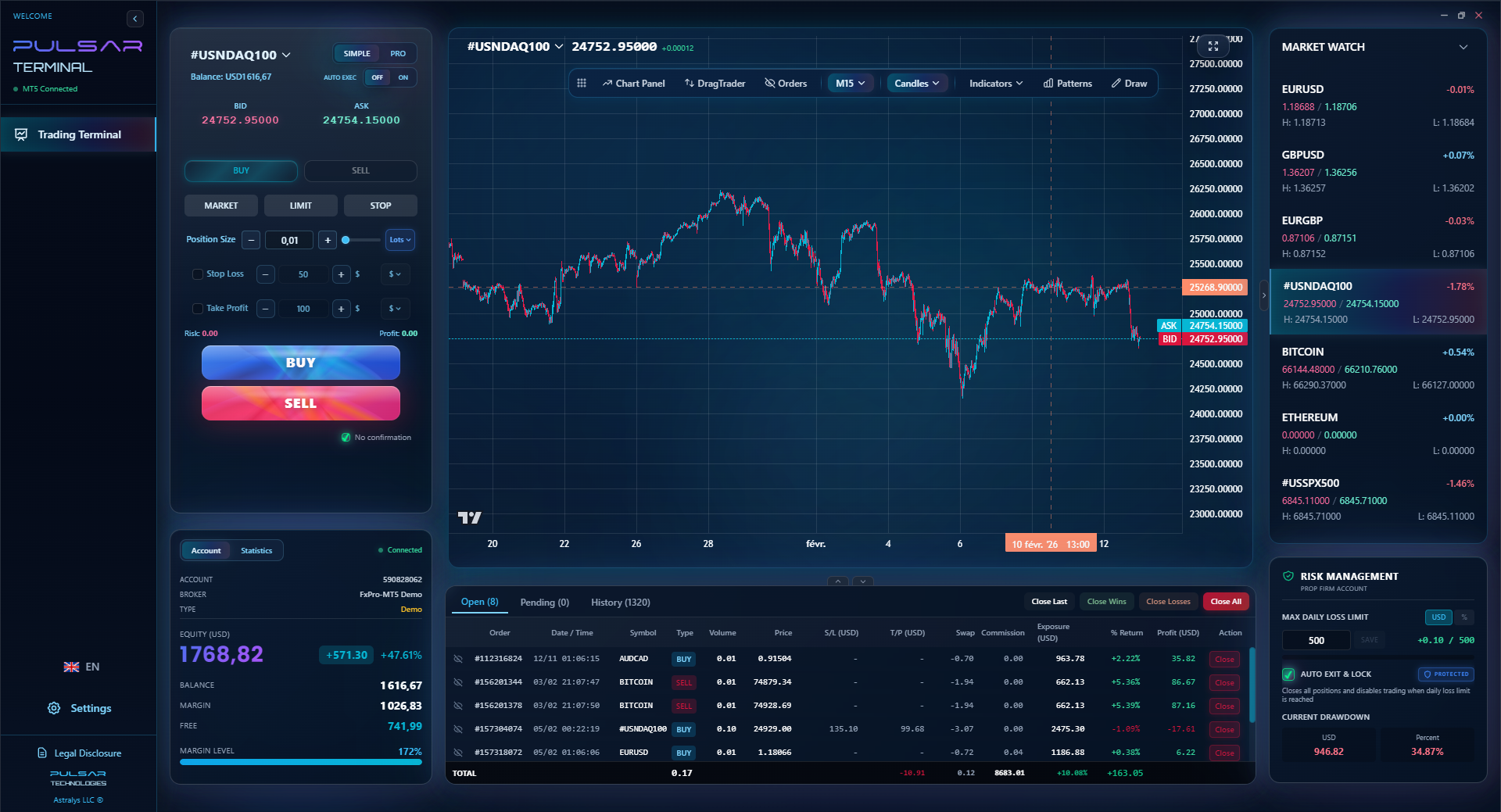
Manually managing stop-losses and partial take-profits on MT5 is a hassle; Pulsar Terminal automates trailing stops, breakeven moves, and multi-level exits with a single drag-and-drop.
Pulsar Terminal
أداة MT5 الشاملة: أوامر سحب وإفلات، متعدد TP/SL، تريلينج ستوب، تداول الشبكة، Volume Profile وحماية البروب فيرم. يستخدمها أكثر من 1000 متداول يومياً.
“I made my first consistent profits with a simple strategy. It was boring. It was profitable. Boring is good.”
You don't need six monitors. But you do need reliability.
Hardware Basics: A laptop with a clear screen, a stable internet connection (consider a backup like your phone's hotspot), and a quiet space. Your phone is for monitoring, not for executing complex analysis.
Software Essentials: Your broker's MT5 platform. A economic calendar (like Forex Factory). A notebook - physical or digital - to journal every trade. Why did you enter? What did you feel? What was the outcome? This journal is your best teacher.
The Daily Routine of a Beginner
- Morning (15 mins): Check the economic calendar. What major news is coming out for the USD, EUR, GBP? Avoid trading 15 minutes before and after high-impact news.
- Analysis (30 mins): Look at your chosen pair on the daily, 4-hour, and 1-hour charts. What's the trend? Where are the key support/resistance levels? Write down your bias (bullish/bearish/neutral).
- Trading Window: If your simple strategy gives a signal, place the trade with your stop-loss and take-profit. Then walk away. Don't watch it tick by tick. Overtrading and emotional tweaking are account killers.
- Evening Review (10 mins): Update your journal. Review any closed trades. What worked? What didn't? No blame, just analysis.
This routine turns trading from a gambling activity into a professional process. It's what separates the survivors from the casualties.
“Your first job isn't to make money. It's to not lose money. Capital preservation is the only rule that matters.”
Let's say you've turned your $200 into $500. Congratulations. Now the real work begins.
Scaling Your Strategy
Don't increase your risk percentage. If you're risking 1% on a $200 account ($2), you now risk 1% on a $500 account ($5). Your position size gets larger, but the risk relative to your capital stays the same. This is how you grow steadily without blowing up. You might explore more advanced strategies like scalping, but only with a fraction of your capital.
The Tax Man Cometh
Remember the 10% capital gains tax? You need to keep impeccable records. The FIRS taxes your gross profits. If you make ₦1,000,000 in a year from trading, you owe ₦100,000. Keep a separate spreadsheet logging every withdrawal from your broker (which represents your net profit). Consider consulting a local accountant who understands forex trading income. It's a cost of doing business, and being compliant keeps you safe.
Your end goal shouldn't be to trade giant sizes with massive use. It should be to generate consistent, manageable returns that you can withdraw, live on, and reinvest. That's the sustainable trader's life. It's not glamorous on Instagram, but it pays the bills year after year.
💡 نصيحة وينستون
If you can't explain your trade setup in one simple sentence ('Price bounced off support with RSI oversold'), it's too complicated. Complexity is the enemy of execution.
FAQ
Q1Is forex trading legal in Nigeria?
Yes, it's legal for individuals to trade forex. The new Investments and Securities Act (ISA) 2025 is bringing online platforms under SEC regulation, but for now, most Nigerians use internationally regulated brokers. You must pay 10% capital gains tax on your profits.
Q2What is the absolute minimum amount I need to start?
Technically, about $10 with some brokers. Realistically, I wouldn't start with less than $200. With $10, spreads and fees eat you alive, and you can't practice proper risk management. $200-$500 lets you trade real micro-lots and learn without the constant fear of a margin call.
Q3How do I fund my trading account with Naira?
Direct Naira card deposits to international brokers are often blocked. Your best options are: 1) Using e-wallets like Neteller or Skrill (fund them first), or 2) Buying USDT (crypto) on a local platform and sending it to a broker that accepts crypto deposits. Always check your broker's specific deposit options for Nigeria.
Q4Which trading platform is best for beginners?
MetaTrader 4 (MT4) or MetaTrader 5 (MT5). They are free, offered by almost every broker, and have a huge global community. There are thousands of tutorials on YouTube specifically for MT4/5. Learn one platform deeply before trying anything else.
Q5How much time do I need to dedicate daily?
When starting, plan for 1-2 hours of focused time: 30 mins for analysis, maybe 15 mins for order placement, and 15 mins for journaling. It's about quality, not staring at the screen all day. Overtrading is a beginner's biggest mistake.
Q6What's the biggest mistake new Nigerian traders make?
Using the maximum use (like 1:1000) because it's offered. It's the fastest way to lose everything. Start with 1:10 or 1:20. The second biggest mistake is not using a stop-loss on every single trade, hoping the market will 'come back'. It often doesn't.
Q7Do I need to pay tax on my forex profits?
Yes. The Federal Inland Revenue Service (FIRS) requires a 10% capital gains tax on your gross trading profits. Keep detailed records of all your withdrawals and profits. It's your responsibility to declare this income.
درس البروفيسور وينستون
النقاط الرئيسية:
- ✓Start with at least $200, not $10.
- ✓Never risk more than 1-2% per trade.
- ✓Use a stop-loss on every single trade.
- ✓10% tax on profits is mandatory.
- ✓Master one pair before adding more.
ما مدى فائدة هذا المقال؟
انقر على نجمة للتقييم
رؤى التداول الأسبوعية
تحليلات واستراتيجيات أسبوعية مجانية. بدون رسائل مزعجة.
عن المؤلف
Olumide Adeyemi
رائد التداول في غرب أفريقيا
أحد أنشط معلمي تداول الفوركس في نيجيريا. 8 سنوات من الخبرة في التداول من لاغوس. متخصص في استراتيجيات رأس المال المنخفض وتحديات شركات البروب للمتداولين الأفارقة.
التعليقات
تحذير من المخاطر
ينطوي تداول الأدوات المالية على مخاطر كبيرة وقد لا يكون مناسبًا لجميع المستثمرين. الأداء السابق لا يضمن النتائج المستقبلية. هذا المحتوى لأغراض تعليمية فقط ولا ينبغي اعتباره نصيحة استثمارية. قم دائمًا بإجراء بحثك الخاص قبل التداول.
قد يعجبك أيضًا

Cara Trading Forex Sukses: 7 Prinsip dari Trader Profesional
Cara trading forex sukses dengan 7 prinsip trader pro: manajemen modal, disiplin, journal trading, backtest. Data nyata, bukan janji profit palsu.
Jam Trading Forex Terbaik untuk Trader Indonesia: Panduan Lengkap dengan Tabel Waktu
Panduan jam trading forex untuk trader Indonesia. Tabel 4 sesi dunia, jam emas 20:00-00:00, sesi mana yang harus dihindari. Data akurat + tips dari trader berpengalaman.
Top 5 Sàn Forex Uy Tín Nhất 2026: Review Jujur dari Trader Indonesia
Top 5 sàn forex uy tín 2026 untuk trader Indonesia. Review jujur: spread, deposit, withdraw, dukungan lokal. Exness, XM, IC Markets & lebih.
احصل على Pulsar Terminal
جميع هذه الحاسبات مدمجة في Pulsar Terminal مع بيانات حية من حساب MT5 الخاص بك.
احصل على Pulsar Terminal