


I lost NGN 120,000 in a single week back in 2019.

Olumide Adeyemi
رائد التداول في غرب أفريقيا ·  Nigeria
☕ 10 دقائق قراءة
ما ستتعلمه:
I lost NGN 120,000 in a single week back in 2019. Not to a bad trade, but to ignorance. I’d funded an offshore broker with my Naira card, made a decent profit on EUR/USD, and then couldn’t withdraw. The broker’s payment processor had blacklisted Nigeria. That money is still stuck there. That painful lesson taught me that what you need to know about forex in Nigeria goes far beyond charts and indicators. It’s about navigating a unique, complex financial environment where the rules are written in shifting sand. This guide is what I wish I’d had before I placed my first trade.
Let's clear this up first. Yes, you can trade forex as an individual Nigerian. No, you won't find a local, SEC-regulated broker for spot forex like you would for stocks. The regulatory scene is a split screen. The Central Bank of Nigeria (CBN) is focused on the big picture: managing the Naira and the flow of foreign currency in the country. Their recent 2025 Foreign Exchange Code and the 2024 Revised Guidelines for the Nigerian Foreign Exchange Market (NFEM) are aimed at banks and big institutions, not you and me trading a micro lot on MetaTrader.
This creates a grey area. You're legally trading your own money, but you're almost certainly doing it with an international broker regulated abroad (like the FCA in the UK or ASIC in Australia). This is the standard workaround. The CBN's main concern is you trying to move large sums of Naira out of the country illegally. Using your personal funds for speculative trading with a reputable foreign entity? That's generally how it's done.

Warning: The taxman, however, is very real. Any profit you make is considered taxable income. The standard Capital Gains Tax is 10% on your gross profits. If you turn this into a full-time business, it's treated as regular income. Keep a detailed trading journal. The XM review I wrote discusses their detailed statement downloads, which are a lifesaver for this.
The New Rules (That Don't Really Affect You)
You might hear about new CBN guidelines for Bureau de Change (BDC) operators in 2026, letting them buy forex from banks with monthly caps. Or the Electronic Foreign Exchange Matching System (EFEMS). These are for the institutional and official retail FX market - changing dollars for travel or business. They don't directly impact your online brokerage account with Exness or IC Markets. But they do affect the underlying Naira liquidity and volatility, which absolutely shows up in your USD/NGN chart.

💡 نصيحة وينستون
Your first profitable system will be boring. It will involve waiting for one specific setup, often for days. Excitement is the enemy of consistency.
Forget the advertised 'minimum deposit'. Your first cost is conversion. Most international brokers operate in USD, EUR, or GBP. When you deposit NGN 50,000, your bank converts it to dollars at their rate, plus a fee (often 1-5%). That's money gone before you even open a trade.
Some brokers, like HFM, offer NGN-denominated accounts. This is a game-saver. You fund and see your balance in Naira, removing the conversion guesswork on every trade. If they don't offer this, you're at the mercy of your bank's spread on the USD/NGN rate.
Then come the trading costs. There are two main types:
- The Spread: The difference between the buy and sell price. On EUR/USD, a 'tight' spread is under 1.0 pip. A 'wide' spread can be 2.0 pips or more. On a standard lot (100,000 units), a 1-pip spread is a $10 cost to enter the trade.
- Commission: Some accounts have razor-thin spreads but charge a commission per lot. This is often cheaper for high-volume traders.
Here’s a real comparison from my own testing last month:
| Broker & Account Type | Avg. EUR/USD Spread | Commission (per lot) | Effective Cost on 1 Lot* |
|---|---|---|---|
| IC Markets (Raw Spread) | 0.1 pips | $7.00 round turn | $7.10 |
| XM (Zero Account) | 0.8 pips | $0.00 | $8.00 |
| Pepperstone (Razor Account) | 0.0 pips | $7.00 round turn | $7.00 |
*1 lot = 100,000 units; 1 pip = $10. Cost = (Spread in pips x $10) + Commission.

Example: On that losing trade I mentioned? I was using a broker with a 'commission-free' account but a 1.8 pip spread on GBP/USD. On a 0.5 lot trade, I paid $9 just to get in (1.8 pips x $10/ pip x 0.5 lots). On a scalping strategy where you're in and out quickly, those wide spreads eat you alive.
“The flashy ads promising ‘100% deposit bonus’ are a trap. I fell for it early on.”
The flashy ads promising ‘100% deposit bonus’ are a trap. I fell for it early on. That ‘bonus’ money comes with trading volume requirements so high you’ll likely blow your account trying to hit them. Your checklist should be boring but solid:
- International Regulation: This is your safety net. Look for brokers licensed by the UK’s FCA, Australia’s ASIC, Cyprus’s CySEC, or South Africa’s FSCA. These bodies have client money protection rules. My Exness review details their seven jurisdictions, which is a strong point.
- Deposit & Withdrawal Methods for Nigeria: Can you fund with a local bank transfer? Do they support popular e-wallets that work here? How long do withdrawals take? Test with a small amount first. My rule: if withdrawing is complicated, trading there is a no-go.
- Platform & Tools: Most use MetaTrader 4 or 5. But does the broker offer good charting tools, an economic calendar, and stable execution? Slippage during news events can kill a trade.
- Customer Support: Do they have a local number or WhatsApp line? Do they understand CBN-related funding issues? This is crucial.
I’ve had good execution experiences with both IC Markets and Pepperstone for my style, which leans towards swing trading. Their raw pricing models suit me. But a beginner might prefer the structure of a broker like XM, which has massive educational resources. It depends on you.
We have a cultural affinity for ‘fast money’ and ‘side hustles.’ Forex trading is often marketed here as the ultimate quick-rich scheme. It’s not. It’s a skilled profession with a 90% failure rate. The first thing you need to know about forex is that it will humble you.
The biggest trap? Over-use. Nigerian brokers often advertise insane use like 1:2000. That means with NGN 25,000 ($18-ish), you could control a $36,000 position. It’s suicidal. A 1% move against you wipes out your entire capital. I learned this the hard way trading XAU/USD (gold). Gold moved $50 overnight against me. With too much use, my stop-loss was blown through, and I got a margin call. I lost two months of profits in hours.

Pro Tip: Use a position size calculator for every single trade. My rule now: I never risk more than 1% of my account on any trade. On a NGN 500,000 account, that’s NGN 5,000. This forces sane position sizes and lets you survive a string of losses.
The other trap is trying to ‘defend the Naira’ by trading USD/NGN sentimentally. Trade the chart, not your patriotism. The market doesn’t care.
💡 نصيحة وينستون
If you can't articulate your trade's risk-to-reward ratio before you click 'buy,' you haven't done your job. The entry is the least important part of the plan.
“Your first profitable system will be boring. Excitement is the enemy of consistency.”
Your plan isn’t just ‘buy low, sell high.’ It’s a business plan. Here’s a skeleton based on what finally worked for me after years of trial and error.
1. The Session You Trade: London and New York overlaps (1 pm - 4 pm Nigerian time) have the highest volume and best moves for pairs like EUR/USD. Trading at 2 am Nigerian time because you saw a signal? The spreads are wide, and moves are erratic. Stick to the active hours.
2. Your Edge: What’s your method? Don’t collect 20 indicators. I use pure price action and the MACD indicator for trend confirmation. I know traders who swear by the RSI indicator for divergences. Pick one, backtest it on historical data, and stick to it.
3. Risk Management (The Most Important Part):
- Stop-Loss: Always. No debate. Decide where you’re wrong before you enter.
- Take-Profit: Have a target. A good rule is a risk-to-reward ratio of at least 1:1.5. You risk NGN 5,000 to make NGN 7,500.
- Daily/Weekly Loss Limit: Mine is 3% of my account per day. If I hit it, I shut down the platform. This prevents revenge trading.
4. Record Everything: I have a Google Sheet logging every trade: entry, exit, reason, profit/loss in Naira, and my emotional state. This is how you find your weaknesses. My sheet showed I lost money on 70% of my Monday trades. Now, I don’t trade on Mondays.
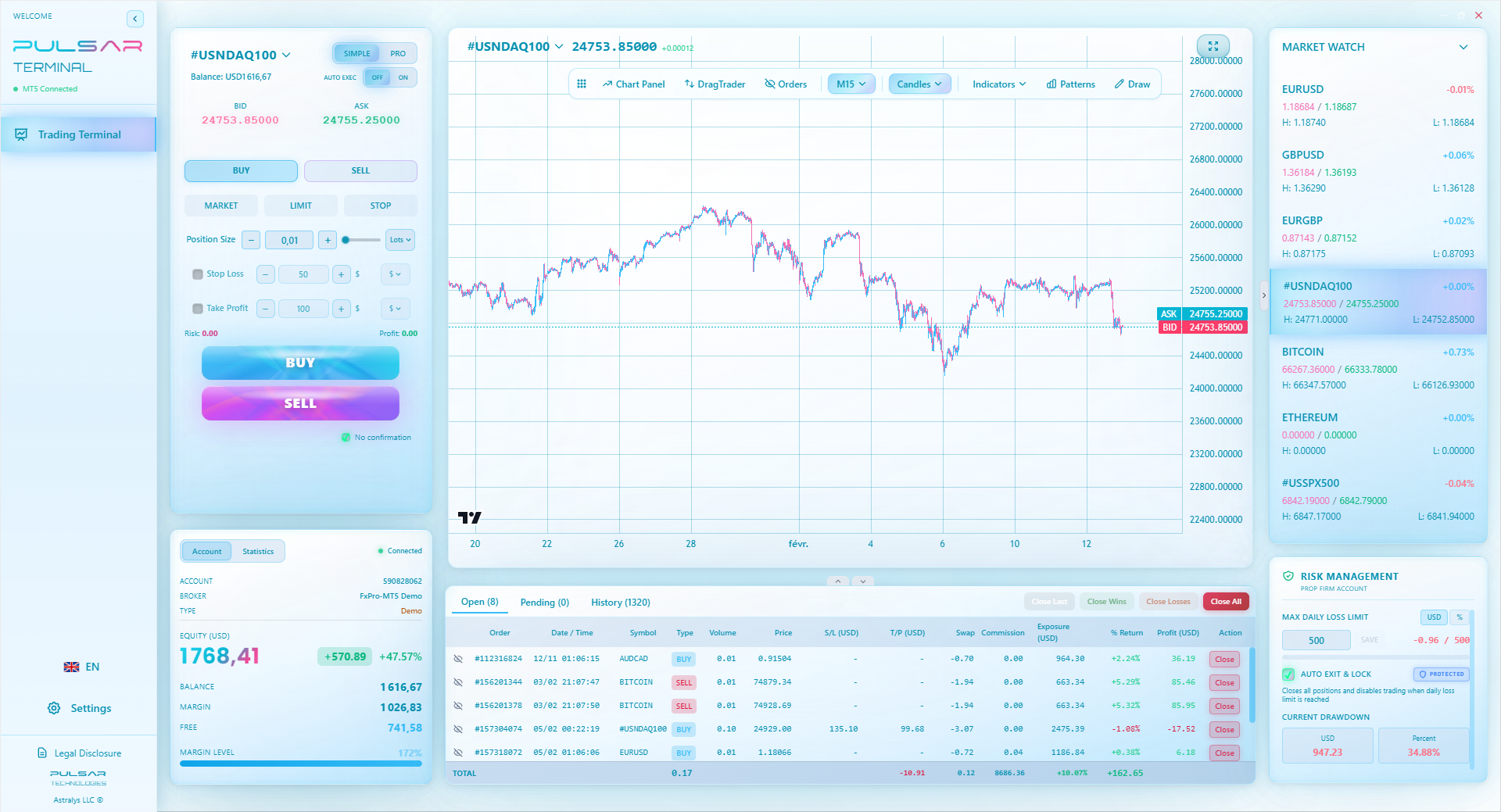
Sticking to a multi-level take-profit and stop-loss plan is critical for removing emotion, and Pulsar Terminal lets you set and automate these orders directly on your MT5 charts.
Pulsar Terminal
أداة MT5 الشاملة: أوامر سحب وإفلات، متعدد TP/SL، تريلينج ستوب، تداول الشبكة، Volume Profile وحماية البروب فيرم. يستخدمها أكثر من 1000 متداول يومياً.
This is the part everyone ignores until they have a problem. The Federal Inland Revenue Service (FIRS) considers trading profits taxable income. If you’re making consistent money, you need to be clean.
- Keep Impeccable Records: Your broker statements are your primary evidence. They show every trade, deposit, and withdrawal in USD. Keep a parallel record converting everything to Naira at the CBN’s official rate for the day of each transaction.
- Separate Your Finances: Get a dedicated bank account for trading. All deposits to your broker and all withdrawals come into this account. It makes tracking so much easier.
- Consult a Professional: Once your profits become significant (think hundreds of thousands of Naira consistently), pay for an hour with a tax consultant who understands forex. The NGN 50,000 fee could save you from a massive penalty later.
Remember, the goal is to build a sustainable business, not a secret hobby. Operating in the open from the start removes a huge layer of stress.
“Trade the chart, not your patriotism. The market doesn’t care.”
All the knowledge in the world fails when fear or greed takes over. The market is a mirror, and it will show you every flaw in your character.
I used to move my stop-loss further away when a trade went against me, hoping it would ‘come back.’ It’s called ‘stop-loss hunting’ in your own mind. It never ends well. I had to physically tape my stop-loss level on the screen to stop myself from touching it.
Another classic: taking profits too early on a winning trade because you’re scared it will reverse. You ride a loser for 50 pips but cut a winner at 15 pips. That math guarantees failure. Using a trailing stop or a multi-level take-profit plan helps automate this and remove emotion.
The loneliness is real too. Your family will see you on the computer and not understand the stress. They’ll ask for loans from your ‘online money.’ You need discipline with your profits and clear boundaries. This isn’t just trading; it’s managing your entire relationship with money and those around you.
💡 نصيحة وينستون
Keep two P&L statements: one in USD from your broker, and one you manually convert to Naira. The difference in those numbers will teach you more about real-world finance than any textbook.
If I could reset my journey, here’s exactly what I’d do.
Week 1-2: Paper Trading. Don’t touch real money. Open a demo account with a broker like XM or Pepperstone. Practice your deposit and withdrawal process (even on demo). Get comfortable with the platform. Try to lose money on purpose by making bad trades. See how it feels.
Week 3: Develop Your One Rule. Based on your demo, pick one simple rule. ‘I will only buy EUR/USD when it pulls back to the 50-period moving average on the 1-hour chart in the London session.’ Something specific. Backtest it by looking at old charts.
Week 4: The Live Test. Fund a live account with the absolute minimum amount. For IC Markets, that’s $200 (about NGN 275,000). But you can start with less elsewhere. The goal is not to profit. The goal is to execute 10 trades following your one rule perfectly, with a strict 1% risk. The P&L is irrelevant. Can you follow your plan when real money is on the line? That’s the only question you need to answer in your first month.
What you need to know about forex is that it’s a marathon of self-discipline. The market will always be there tomorrow. Your job is to make sure you still have capital to trade it.
FAQ
Q1Is forex trading illegal in Nigeria?
No, it's not illegal for individuals to trade forex with their own money through international brokers. However, the local regulatory framework for retail spot forex brokers is underdeveloped. You trade legally under the oversight of the broker's home regulator (e.g., FCA, ASIC), not directly under Nigerian SEC rules for forex.
Q2How much money do I need to start forex trading in Nigeria?
Technically, you can start with as little as $1 with some brokers. Practically, I recommend starting with an amount you can afford to lose completely - NGN 50,000 to NGN 100,000 is a common starting point for a live account after demo training. Remember to factor in conversion costs and use proper position sizing; a tiny account often leads to over-use.
Q3Which broker is best for Nigerian traders?
There's no single 'best.' Look for brokers with strong international regulation, reliable Naira deposit/withdrawal options (like local bank transfers or supported e-wallets), and competitive costs. Brokers like IC Markets, Pepperstone, Exness, and XM are popular choices among experienced Nigerian traders for their execution and services.
Q4How do I pay taxes on forex trading profits?
Forex trading profits are subject to a 10% Capital Gains Tax. You must declare this income to the FIRS. Maintain detailed records of all trades (broker statements) and convert profits to Naira using the official CBN rate on the day of the transaction. Consulting a tax professional for guidance is highly advised.
Q5Why do I keep losing money in forex?
The most common reasons are poor risk management (over-leveraging, no stop-loss), emotional trading (revenge trading, fear of taking profits), and not having a tested, consistent strategy. Trading without a plan is gambling. Review your trades, identify your recurring mistakes, and impose strict rules on your risk per trade.
Q6Can I use my Nigerian debit card to fund a forex account?
It's possible, but increasingly difficult due to CBN restrictions on international transactions. Many card attempts are declined. Better options are direct bank transfers to the broker's local Nigerian account (if they have one) or using international e-wallets that accept Naira funding, which the broker also accepts.
Q7What is the best time to trade forex in Nigeria?
The most liquid and ideal trading sessions are the London session (10 am - 7 pm Nigerian Time) and the overlap with the New York session (1 pm - 4 pm Nigerian Time). This is when spreads are tightest and major currency pairs like EUR/USD see the most decisive movements.
درس البروفيسور وينستون
النقاط الرئيسية:
- ✓Start with a NGN-denominated account to avoid hidden bank fees.
- ✓Never risk more than 1% of your capital on a single trade.
- ✓Your broker's international regulation is your primary safety net.
- ✓Keep a trading journal; your biggest edge is knowing your own mistakes.
- ✓The London-New York overlap (1-4 pm Naija time) is your most reliable session.
ما مدى فائدة هذا المقال؟
انقر على نجمة للتقييم
رؤى التداول الأسبوعية
تحليلات واستراتيجيات أسبوعية مجانية. بدون رسائل مزعجة.
عن المؤلف
Olumide Adeyemi
رائد التداول في غرب أفريقيا
أحد أنشط معلمي تداول الفوركس في نيجيريا. 8 سنوات من الخبرة في التداول من لاغوس. متخصص في استراتيجيات رأس المال المنخفض وتحديات شركات البروب للمتداولين الأفارقة.
التعليقات
تحذير من المخاطر
ينطوي تداول الأدوات المالية على مخاطر كبيرة وقد لا يكون مناسبًا لجميع المستثمرين. الأداء السابق لا يضمن النتائج المستقبلية. هذا المحتوى لأغراض تعليمية فقط ولا ينبغي اعتباره نصيحة استثمارية. قم دائمًا بإجراء بحثك الخاص قبل التداول.
قد يعجبك أيضًا

Cara Trading Forex Sukses: 7 Prinsip dari Trader Profesional
Cara trading forex sukses dengan 7 prinsip trader pro: manajemen modal, disiplin, journal trading, backtest. Data nyata, bukan janji profit palsu.
Jam Trading Forex Terbaik untuk Trader Indonesia: Panduan Lengkap dengan Tabel Waktu
Panduan jam trading forex untuk trader Indonesia. Tabel 4 sesi dunia, jam emas 20:00-00:00, sesi mana yang harus dihindari. Data akurat + tips dari trader berpengalaman.
Top 5 Sàn Forex Uy Tín Nhất 2026: Review Jujur dari Trader Indonesia
Top 5 sàn forex uy tín 2026 untuk trader Indonesia. Review jujur: spread, deposit, withdraw, dukungan lokal. Exness, XM, IC Markets & lebih.
احصل على Pulsar Terminal
جميع هذه الحاسبات مدمجة في Pulsar Terminal مع بيانات حية من حساب MT5 الخاص بك.
احصل على Pulsar Terminal