


Ever watched a currency pair like USD/ZAR coil up just below a key resistance level, felt the tension build, and then missed the entire move because you were waiting for a pullback that never came? I have.

David van der Merwe
متداول الأسواق الناشئة ·  South Africa
☕ 13 دقائق قراءة
ما ستتعلمه:
- 1The Buy Stop Order: Your Automated Breakout Ticket
- 2Why This Order is a Game Changer for ZAR Traders
- 3Putting It to Work: Real Trading Strategies
- 4The Real Cost: Spreads, Commissions & Slippage in SA
- 5Mistakes I've Made (So You Don't Have To)
- 6Where to Place Your Order: SA Platforms & Execution
- 7The Safety Net: FSCA Regulation & What It Means for You
- 8Wrapping Up: From Basic Tool to Strategic Edge
Ever watched a currency pair like USD/ZAR coil up just below a key resistance level, felt the tension build, and then missed the entire move because you were waiting for a pullback that never came? I have. More times than I care to admit. That gut-wrenching feeling of watching a rocket take off without you is exactly why understanding the buy stop order isn't just a technicality, it's a fundamental tool for any serious South African trader. It's the tool that lets you place your bet on momentum before it happens, automating your entry so you don't get left behind. But here's the kicker, using it wrong can be just as costly as not using it at all. Let me walk you through what a buy stop order really is, how we use it in our market, and the painful lessons I've learned along the way.
At its core, a buy stop order is a pending order you place above the current market price. You're telling your broker, "When the price hits this level, buy for me at the best available price." It's not active until the market reaches your specified trigger price.
Think of it like a tripwire for an uptrend. You're anticipating a breakout. The market is trading at, say, R18.50/USD, and there's a solid wall of resistance at R18.75. You believe if it cracks R18.75, it could run to R19.20. Instead of sitting glued to your screen, you place a buy stop order at R18.76. If the price surges and touches R18.76, your order is triggered and becomes a market order, executing your buy.
The key difference from a standard buy order? A standard buy is executed at the current (lower) price. A buy stop is only executed once the price has already risen to your level. You're paying a premium for confirmed momentum. This is crucial for strategies like breakout trading or adding to a winning trend. It's also a vital safety net for short positions, acting as a stop-loss (though we call it a buy stop in that context). If you're short USD/ZAR at R18.50 and want to limit your loss, you'd place a buy stop above your entry to close the trade if the market turns against you.

Warning: A triggered buy stop becomes a market order. In fast-moving markets, the price you get filled at (the execution price) can be different from your trigger price. This is slippage. On volatile pairs like USD/ZAR, especially around news events, this gap can be significant. I once had a buy stop on EUR/ZAR trigger during a SARB announcement. My order was at 20.5010, but I got filled at 20.5150. That's 4 extra pips of cost before my trade even started. Always factor in potential slippage into your position size calculator.
Our market has unique rhythms. The Rand is famously volatile, influenced by local politics, load-shedding headlines, commodity prices, and global risk sentiment. This creates sharp, explosive moves. A buy stop order lets you use that volatility rather than be victimized by it.
Catching ZAR Breakouts
Major support and resistance levels on USD/ZAR or EUR/ZAR aren't gently nudged, they're often shattered. When the US Dollar strengthens globally, or local data disappoints, USD/ZAR can blow through technical levels with force. A buy stop above resistance lets you participate in that directional momentum. Trying to buy at the breakout level manually is often too slow.
Managing Risk on Exotic Pairs
When trading exotic crosses involving the ZAR, spreads are wider. For example, the spread on EUR/ZAR can be 12-15 pips with a broker like Exness or IC Markets. This makes in-and-out scalping very difficult. A buy stop allows for a more patient, swing trading approach. You can set your order at a clear breakout point and let the market come to you, aiming for a larger move that justifies the wide spread.
Hedging Local Exposure
This is a more advanced use. If you have a business with natural short ZAR exposure (you expect to pay for imports in USD), a strategic long position in USD/ZAR via a buy stop order can act as a hedge. If the Rand weakens dramatically (USD/ZAR breaks out), your forex trade profits can offset your increased costs.
My own lightbulb moment came in early 2023. USD/ZAR had been range-bound between R17.80 and R18.20 for weeks. I was convinced a break higher was coming. Instead of buying in the range, I placed a buy stop at R18.25. It triggered, and the pair raced to R18.80. That R0.55 move, captured automatically, taught me more about discipline than a hundred manual trades.

💡 نصيحة وينستون
A buy stop is a commitment to a story: 'If price proves it's strong enough to break this level, I'm in.' Never place one without a clear narrative on why that level matters.
“A buy stop order is the tool that lets you place your bet on momentum *before* it happens, automating your entry so you don't get left behind.”
Let's get concrete. How do you actually use a buy stop in your trading plan?
1. The Classic Breakout Trade: This is the bread and butter. Identify a clear resistance level on your chart. Place your buy stop order 5-10 pips above that level. Why not exactly at the level? Because you want to avoid false breakouts where price just kisses resistance and reverses. Your stop-loss goes below the recent swing low, and your take-profit is set based on the next resistance or a measured move (e.g., the height of the previous consolidation range).
2. The Trend Continuation Add-On: You're already long USD/ZAR, and it's in a strong uptrend, making higher highs and higher lows. Instead of adding to your position at the current price, you place a buy stop order above the last minor high. This way, you only add to your winner when the trend resumes its upward path, improving your average entry price. I used this method adding to a GBP/ZAR trade in 2024, placing a buy stop above 23.40 after my initial entry at 22.90. It triggered, and my average entry became far stronger.
3. The Stop-Loss for Shorts: If you sell EUR/USD at 1.0850, your protective stop-loss is a buy stop order placed above your entry, say at 1.0880. This defines your maximum risk (30 pips in this case). It's not a pending order you hope gets hit, it's your essential risk management.

Pro Tip: When setting a buy stop for a breakout, combine it with a volume check. A breakout on high volume is more likely to be genuine. Many platforms have a Volume indicator. A breakout through R18.75 on thin volume? Might be a fake. On huge volume? Your buy stop is much more likely to lead to a profitable run.
One strategy that didn't work for me was using buy stops to "fade" extreme news spikes. After a huge SARB rate hike announcement, USD/ZAR spiked. I placed a buy stop above the spike high, thinking a continuation was due. It was a classic "buy the rumor, sell the news" event. The spike was the climax. My order triggered at the peak, and the pair immediately reversed. I learned that buy stops for breakouts work best after periods of consolidation, not as a reaction to explosive, one-off news candles.
Trading isn't free, and order execution quality varies wildly. Here’s what you're really paying for when that buy stop triggers.
Spreads: This is your primary cost. For major pairs like EUR/USD, you can get tight spreads (0.6 pips on average). But for ZAR pairs, it's a different story. They're exotic, less liquid, and cost more to trade.
| Currency Pair | Typical Spread (Pips) | Broker Example |
|---|---|---|
| EUR/USD | 0.6 - 1.0 | Most FSCA Brokers |
| USD/ZAR | 5.0 - 8.0 | Pepperstone, XM |
| EUR/ZAR | 12.0 - 18.0 | IC Markets, Exness |
That means your USD/ZAR buy stop needs to move at least 5-8 pips just for you to break even. Your profit target must account for this.
Commissions: Some brokers, like Tickmill, offer raw spreads but charge a commission. Their effective cost might be 0.71 pips on EUR/USD (0.11 pip spread + 0.6 pip commission). For a buy stop, this commission is charged when the order fills. Know your broker's model.
Slippage: I mentioned my 4-pip slippage earlier. On a USD/ZAR trade with a 5-pip spread, that's almost the spread again in extra cost. It happens during high volatility - market opens, news events, low liquidity periods (like between US close and Asia open). You can use limit orders to control price, but then you might miss the fill entirely. With a buy stop, you're choosing certainty of execution over certainty of price.
Overnight Financing (Swap): If your triggered buy stop leads to a position you hold overnight, you'll pay or receive swap. For a ZAR pair, this can be significant. Always check the swap rates in your platform before holding a trade for multiple days.
💡 نصيحة وينستون
The spread on ZAR pairs is your silent partner, always taking its cut. If your buy stop profit target isn't at least 3x the spread, you're just feeding the broker.
“That R0.55 move, captured automatically, taught me more about discipline than a hundred manual trades.”
I've blown up my fair share of trades with poorly placed buy stops. Here's the hall of shame.
1. Placing it Too Close to Resistance: This is the classic false breakout trap. Price taps resistance, triggers your buy stop, then reverses straight down, stopping you out. I did this on GBP/USD, placing my buy stop at 1.2800 (a big round number). It triggered, ran 5 pips, reversed, and took out my stop-loss. The solution? Give it breathing room. Place it 5-10 pips above a clear technical level, not at the exact line.
2. Ignoring the Overall Trend: Placing a buy stop in a strong, established downtrend is usually a recipe for getting chopped up. You're trying to catch a counter-trend bounce that may never sustain. The buy stop is a tool best aligned with the trend - for breakouts in the direction of the larger trend. Use tools like the MACD indicator or moving averages to gauge the trend first.
3. Forgetting About Slippage & Spread: Not factoring in the full execution cost. You think, "I'll risk 20 pips." But with a 5-pip spread and 2 pips of slippage, your effective risk is 27 pips. Your position size calculator input must be the 27, not the 20.
4. Setting and Forgetting (Without a Stop-Loss): This is catastrophic. You place a buy stop, walk away, and it triggers. But you didn't attach a stop-loss order to it. The market reverses, and your loss runs unchecked. Always attach a stop-loss to your buy stop order. Every single time. The moment that buy stop becomes a live trade, it must have a protective stop. I learned this the hard way on a gold trade years ago, a lesson that cost me 2% of my account before I intervened.
Managing multiple buy stop orders and their attached stop-losses across pairs like USD/ZAR and EUR/ZAR is complex, but tools like Pulsar Terminal automate this directly on your MT5, letting you set OCO brackets and trailing stops with a single drag-and-drop.
Pulsar Terminal
أداة MT5 الشاملة: أوامر سحب وإفلات، متعدد TP/SL، تريلينج ستوب، تداول الشبكة، Volume Profile وحماية البروب فيرم. يستخدمها أكثر من 1000 متداول يومياً.
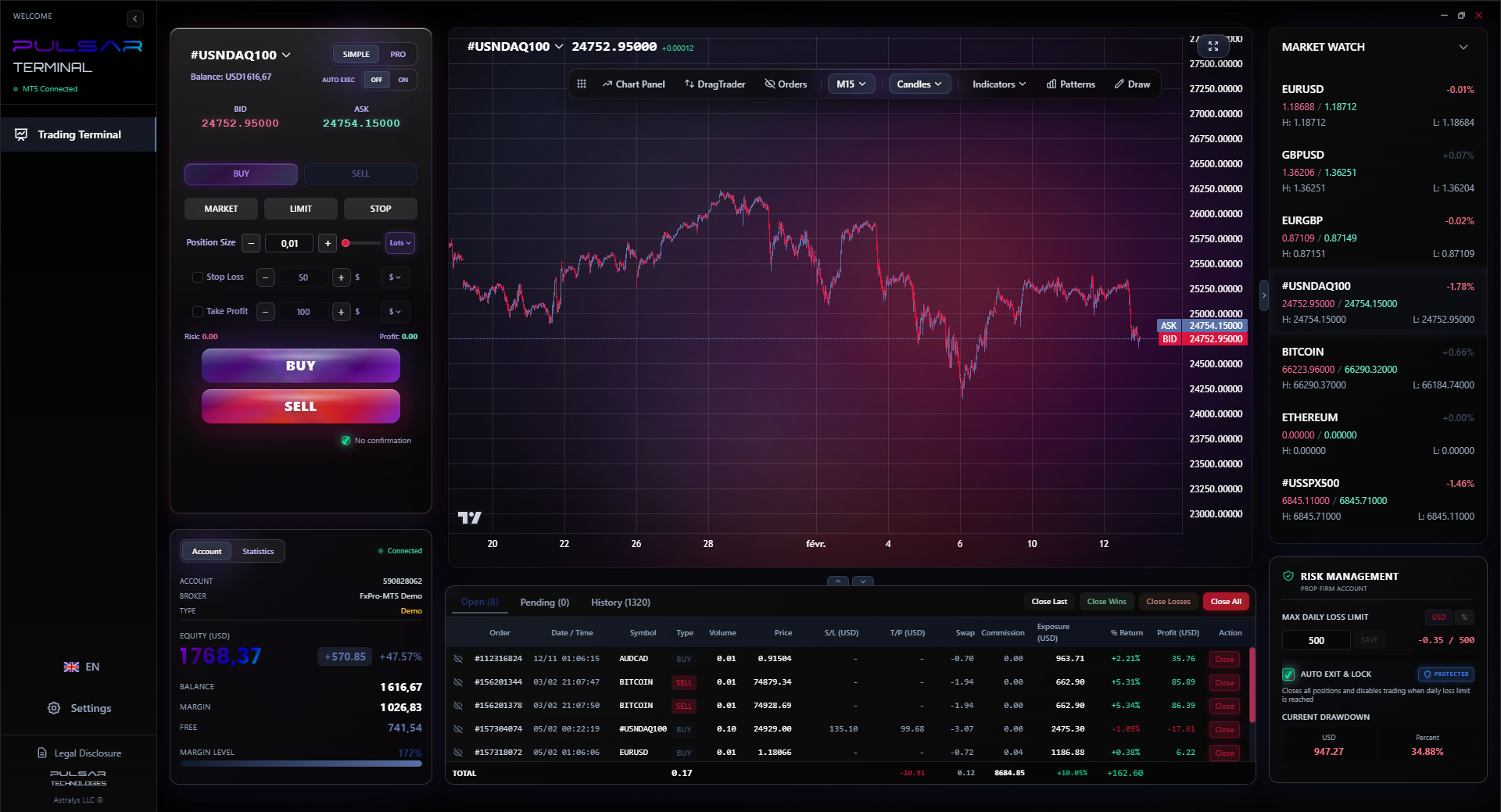
Most South African traders use MetaTrader 4 or 5. Placing a buy stop is straightforward.
On MT4/MT5:
- Right-click on the chart where you want your entry price.
- Select "Trading" then "New Order."
- In the "Type" dropdown, change "Market Execution" to "Pending Order."
- In the new dropdown, select "Buy Stop."
- Set your price (the trigger).
- Set your Stop Loss and Take Profit levels right there in the window.
- Click "Place."
You'll see a horizontal line on your chart at your trigger price. The beauty of MT5 is that you can modify this order easily - drag the line up or down.
Execution Quality Matters: Not all FSCA-regulated brokers are equal. A broker with deep liquidity pools and fast servers will give you better fill prices on your triggered buy stops, minimizing slippage. This is where brokers like IC Markets or Pepperstone often shine for active traders. Their infrastructure is built for speed.
Local Brokers & ZAR Accounts: Brokers like Khwezi Trade (an FSCA ODP) offer ZAR-denominated accounts. This is huge. It means your deposit, trading capital, and profits are all in Rands. You avoid the hidden cost of converting your ZAR to USD to trade and back again. When your USD/ZAR buy stop triggers and you profit in USD, that profit stays in USD in your account, but your account's net value is calculated in ZAR. It simplifies your accounting and tax calculations immensely.
Payment methods are also local-friendly. Funding your account via Instant EFT (like Ozow) is almost universal now, with deposits reflecting in minutes. This ease of access makes managing your trades and adjusting orders less of a hassle.
💡 نصيحة وينستون
The most expensive buy stop is the one placed in a vacuum. Always check the higher time frame trend. A buy stop against the dominant trend has the odds stacked against it.
“The most expensive buy stop is the one placed in a vacuum. Always check the higher time frame trend.”
This is non-negotiable for South African traders. The Financial Sector Conduct Authority (FSCA) is our regulator. Trading with an FSCA-licensed broker provides critical protections.
- Segregated Client Funds: Your trading capital is held in separate bank accounts from the broker's operating funds. If the broker goes under (highly unlikely for the big ones, but still), your money is protected and should be returned to you.
- Dispute Resolution: If you have a serious issue with order execution, like alleging your buy stop was triggered incorrectly due to platform manipulation, you have a formal path. The FSCA provides a dispute resolution mechanism. You're not just complaining to the broker's support desk.
- Financial Soundness: FSCA licensees must meet capital adequacy requirements. They can't just be a "bucket shop" operating from a garage.
Always verify a broker's FSP number on the FSCA's website before depositing a single cent. I've seen too many "international" brokers with flashy ads targeting South Africans, offering insane use, who are not regulated here. When your buy stop has a slippage issue with them, good luck getting a fair hearing.
The FSCA's recent expansion into regulating crypto is a sign of a maturing framework. It means they are keeping pace with the evolving trading landscape, which benefits us as traders in a regulated, safer environment.
So, what is a buy stop in forex? It's more than just an order type. For the South African trader, it's a mechanism for discipline. It takes the emotion out of chasing breakouts. It enforces a plan.
As you get more advanced, you can combine buy stops with other order types. One powerful concept is an OCO (One-Cancels-the-Other) bracket. You could place a buy stop above resistance AND a sell stop below support on the same pair, with attached take-profits and stop-losses. Whichever direction the market breaks, you have an order ready to catch the move. The first order to trigger automatically cancels the other. This is a pure volatility play, perfect for periods of tight consolidation before a major data release.
Another use is in scaling into a position. Instead of one large buy stop, you could place a series of smaller buy stops at progressively higher levels (a buy stop grid). This averages your entry price upward in a strong trend. However, this requires careful risk management, as your total exposure increases with each trigger.
My final thought? Master the basic buy stop for breakouts and risk management first. Get comfortable with how it fills on your chosen FSCA broker. Paper trade it. Then, and only then, consider more complex applications. The buy stop is a foundational tool. A builder doesn't blame his hammer, he learns to swing it properly. Learn this tool, respect its costs, and it will open up trading opportunities you used to only watch from the sidelines.
FAQ
Q1What's the difference between a buy stop and a buy limit order?
A buy stop is placed above the current market price to buy on a breakout upward. A buy limit is placed below the current market price to buy at a better (lower) price on a pullback. They are used for opposite market scenarios.
Q2Can I get a guaranteed fill at my exact buy stop price?
No. Once triggered, a buy stop becomes a market order. In fast markets, slippage can occur, and you may be filled at a slightly worse price. To guarantee a price, you'd use a buy limit, but then you risk not getting filled if the market doesn't pull back to your level.
Q3Is a buy stop the same as a stop-loss?
They are the same order type but used in different contexts. A 'stop-loss' is the term used when the order is closing a losing position (e.g., buying to close a short). A 'buy stop' is the general term for the order type, which can be used to open a new long position or close a short one.
Q4What's a good distance to place a buy stop above resistance?
There's no magic number, but 5-10 pips is a common range for major pairs like EUR/USD. For more volatile pairs like USD/ZAR, you might need 15-25 pips to avoid false breakouts caused by the wider spread and inherent volatility. Always look at recent price action to see how the pair behaves near levels.
Q5Do South African brokers charge extra for placing a buy stop order?
No, placing the pending order itself is free. You only incur costs (spread, commission) when the order is triggered and executed as a market trade.
Q6Can I use a buy stop on the MT4 mobile app in South Africa?
Absolutely. The process is similar. Tap on the chart to bring up the order ticket, change the type to 'Pending Order' and select 'Buy Stop.' All reputable FSCA brokers offering MT4/MT5 will have full functionality on their mobile apps.
Q7How does a buy stop help with FSCA-regulated prop firm challenges?
Prop firm challenges often have strict daily loss limits. A buy stop can be part of a disciplined breakout strategy that defines clear entry and stop-loss points, helping you manage risk precisely to avoid breaching those daily limits. It automates your entry, removing hesitation.
درس البروفيسور وينستون
النقاط الرئيسية:
- ✓Buy stops automate breakout entries, enforcing trading discipline.
- ✓On USD/ZAR, account for 5-8 pip spreads in your profit target.
- ✓Always attach a stop-loss to your buy stop before placing it.
- ✓Place buy stops 5-25 pips above resistance to filter false breaks.
ما مدى فائدة هذا المقال؟
انقر على نجمة للتقييم
رؤى التداول الأسبوعية
تحليلات واستراتيجيات أسبوعية مجانية. بدون رسائل مزعجة.
عن المؤلف
David van der Merwe
متداول الأسواق الناشئة
متداول مقيم في جوهانسبرغ مع 11 عاماً في عملات الأسواق الناشئة. متخصص في أزواج ZAR والتداول المنظم من FSCA وتحليل السوق الجنوب إفريقي.
التعليقات
تحذير من المخاطر
ينطوي تداول الأدوات المالية على مخاطر كبيرة وقد لا يكون مناسبًا لجميع المستثمرين. الأداء السابق لا يضمن النتائج المستقبلية. هذا المحتوى لأغراض تعليمية فقط ولا ينبغي اعتباره نصيحة استثمارية. قم دائمًا بإجراء بحثك الخاص قبل التداول.
قد يعجبك أيضًا

Cara Trading Forex Sukses: 7 Prinsip dari Trader Profesional
Cara trading forex sukses dengan 7 prinsip trader pro: manajemen modal, disiplin, journal trading, backtest. Data nyata, bukan janji profit palsu.
Jam Trading Forex Terbaik untuk Trader Indonesia: Panduan Lengkap dengan Tabel Waktu
Panduan jam trading forex untuk trader Indonesia. Tabel 4 sesi dunia, jam emas 20:00-00:00, sesi mana yang harus dihindari. Data akurat + tips dari trader berpengalaman.
Top 5 Sàn Forex Uy Tín Nhất 2026: Review Jujur dari Trader Indonesia
Top 5 sàn forex uy tín 2026 untuk trader Indonesia. Review jujur: spread, deposit, withdraw, dukungan lokal. Exness, XM, IC Markets & lebih.
احصل على Pulsar Terminal
جميع هذه الحاسبات مدمجة في Pulsar Terminal مع بيانات حية من حساب MT5 الخاص بك.
احصل على Pulsar Terminal