


I remember staring at the screen in 2015, watching GBP/USD plummet after the Brexit vote.

Olumide Adeyemi
رائد التداول في غرب أفريقيا ·  Nigeria
☕ 11 دقائق قراءة
ما ستتعلمه:
- 1use Explained: It's a Loan, Not Magic Money
- 2use Ratios in Nigeria: What's Actually on Offer
- 3The Real Math: Profits, Losses, and Margin Calls
- 4Nigerian-Specific Risks & Regulations You Can't Ignore
- 5How to Use use Safely (Without Being a Coward)
- 6Navigating Broker use Settings & Account Types
- 7use Pitfalls: How Nigerian Traders Blow Up
- 8The Final Verdict: Is use Good or Bad?

I remember staring at the screen in 2015, watching GBP/USD plummet after the Brexit vote. My account, juiced up on 1:500 use, was a fireworks show in reverse. One £50,000 position, controlled with just £100 of my own money, evaporated my margin in minutes. That sick feeling in my gut? That’s use. It’s not just a tool; it’s a magnifying glass for your decisions, your emotions, and your mistakes. For Nigerian traders navigating a tricky regulatory space, understanding what use in forex really means is the difference between building wealth and funding someone else’s Bentley.
Let's cut through the broker marketing. What is use in forex? It's a loan from your broker. Full stop. You put down a small deposit (your margin), and they front you the rest to control a much larger position in the market.
The ratio tells the story. If you see 100:1 use, it means for every 1 Naira of your own capital, you're controlling 100 Naira in the market. Your broker is lending you the other 99. This is why you can open a $10,000 position with just $100 in your account. Sounds great, right? It is, until the market moves against you. Then that loan gets called in very, very quickly.
Here’s the core mechanic: use works on margin. Margin is your skin in the game - the collateral you must maintain to keep that loan open. If your losses eat into that margin too much, you get a margin call and your position is liquidated. It’s not a suggestion; it’s an automated eviction.

Warning: High use does not increase your probability of winning. It only increases the size of the outcome, good or bad. Thinking it’s a shortcut to profits is the fastest way to the exit.

💡 نصيحة وينستون
Your first 100 trades should be about survival, not riches. Cap your use at 1:20. If you can't be profitable here, higher use will only kill you faster.
In Nigeria, you’ll see a wild range of use options. Because our local regulatory framework from the SEC and CBN is, let’s say, ‘developing,’ most of us use internationally regulated brokers. These guys compete hard for clients, and use is a key marketing weapon.
Common use Tiers
You’ll typically find these ratios:
| Ratio | What It Means | Minimum Margin per $10k Trade |
|---|---|---|
| 10:1 | Conservative. For every $1, control $10. | $1,000 |
| 50:1 | Common standard in many regulated regions. | $200 |
| 100:1 | Very common for Nigerian retail traders. | $100 |
| 200:1 | Getting risky. | $50 |
| 500:1 | Extremely high risk. My 2015 mistake zone. | $20 |
| 1000:1 / Unlimited | The danger zone. Offered by some brokers like Exness on specific accounts. | $10 or less |
Brokers like HFM and Exness often promote use up to 1:2000 or even ‘unlimited’ on certain accounts to attract traders looking for maximum power. XM and Pepperstone tend to offer up to 1:500 for retail clients. Remember, higher available use doesn’t mean you should use it all. It’s like having a car that goes 300km/h; it doesn’t mean you should drive that fast to the market.
Why Such High use Exists
Simple: volatility. Currency pairs like EUR/NGN or even major pairs can have sharp moves. High use allows traders with smaller accounts (a reality for many starting out here) to potentially make meaningful gains from small price movements, which is the basis of strategies like scalping. But it’s a trap if your risk management is weak.
“High use does not increase your probability of winning. It only increases the *size* of the outcome, good or bad.”
Forget theory. Let’s run the numbers with a Naira perspective. Assume your account balance is 50,000 NGN (roughly $33 at current rates).
Scenario 1: The Dream (It works)
- You buy USD/NGN at 1500.00 with a 100:1 use.
- Your margin for a 10,000 USD (1 mini lot) position is about 100 USD (15,000 NGN).
- Price moves to 1515.00. That’s a 150 pip move.
- Profit = (1515.00 - 1500.00) * 10,000 = 150,000 NGN.
- On your 15,000 NGN margin, that’s a 1000% return. Amazing! This is the siren song.
Scenario 2: The Reality (It usually doesn’t)
- Same trade, same use.
- Price moves against you to 1485.00.
- Loss = (1500.00 - 1485.00) * 10,000 = 150,000 NGN.
- Your loss (150k NGN) exceeds your entire account balance (50k NGN). You’ve been margin called long before this point. Your 15k NGN margin is gone, and the broker closes the trade to prevent further loss (theirs, not yours).

Example: Trade: Sell EUR/USD at 1.0850 Account Balance: $200 use Used: 100:1 Position Size: 0.1 lots (10,000 units) Margin Required: $108.50 Stop-Loss: 30 pips away at 1.0880 Potential Loss: 30 pips * $1 per pip on 0.1 lots = $30 Risk as % of Account: ($30 / $200) * 100 = 15% Even with a sensible stop-loss, you're risking 15% of your account on one trade. That's high. This is why you must use a position size calculator for every single trade.
My own painful lesson: I once got greedy on a XAU/USD (Gold) trade. Used 1:200 use on a 1-lot position with a $5,000 account. Gold moved $10 against me. That was a $1,000 loss, 20% of my account, in one go. I hadn't respected the math.

Trading with use here isn't just about market risk. You've got local hurdles that amplify the danger.
1. The Regulatory Gap: The SEC Nigeria doesn't currently license local retail forex brokers. So, you're almost certainly using an international broker regulated offshore (like CySEC, FSCA, or ASIC). While this gives you access to high use, it also means your primary recourse in a dispute is with a foreign entity. You need to pick your broker carefully - check our IC Markets review for an example of what due diligence looks like.
2. The Tax Man Cometh: Don't get it twisted. The FIRS doesn't care if your broker is in Cyprus or Mars. If you make a profit, you owe a 10% Capital Gains Tax on your gross trading profits. use inflates those gross profits (and losses). A great run with high use could leave you with a hefty tax bill, even if your net profit after a few losers isn't so grand. Keep impeccable records.
3. Funding & Withdrawal Friction: Funding your account can be a mission. Bank transfers can be slow, card transactions might be declined, and using intermediaries eats into your capital - the very capital that is your margin safety net. If you start with 100,000 NGN and 20,000 goes on fees and tricky transfers, you're already starting with a 20% ‘use’ against yourself before you even place a trade.
4. Emotional Volatility: Let's be real. The Nigerian economic environment is stressful. When you're worried about inflation, fuel prices, and the Naira's value, the emotional pressure to ‘make it big’ quickly is immense. This makes you a prime target for over-leveraging. You're not just fighting the market; you're fighting your own circumstances.
💡 نصيحة وينستون
Treat your maximum use like your maximum alcohol limit. You might be able to handle 10 shots, but driving home after 2 is always smarter.
“Your first calculation for any trade should be position size, not potential profit. If it seems too small to be exciting, that's your ego talking.”
I'm not telling you to use 1:10 use and trade once a month. That's boring. But you need a system, not just courage.
Rule 1: use is a Setting, Not a Strategy. Your trading edge comes from your analysis - using tools like the RSI indicator or MACD indicator to find high-probability setups. use just decides how much you get paid (or punished) for being right or wrong.
Rule 2: The 1% Rule is Your Holy Book. Never, ever risk more than 1% of your total account balance on a single trade. This is non-negotiable. With a 50,000 NGN account, that's a 500 NGN max risk per trade. This rule automatically dictates your position size and effectively caps your use. If your stop-loss is 50 pips away on EUR/USD, a 1% risk means you can only afford to trade a tiny position. That's discipline.
Rule 3: Match use to Your Strategy.
- Scalping: You're targeting 5-10 pips. Higher use (e.g., 100:1) might be necessary to make the profit meaningful on a small account.
- Swing Trading: You're holding for days, aiming for 100+ pips. You can and should use much lower use (e.g., 10:1 or 20:1). The larger potential profit per pip means you don't need the use boost.
Rule 4: Use Technology to Enforce Rules. This is where your broker's platform and tools come in. Set your stop-loss and take-profit orders the second you open a trade. No ‘I’ll move it later.’

Pro Tip: Your first calculation for any trade should be position size, not potential profit. Use a calculator. If the position size seems too small to be exciting, that's your ego talking. Tell it to shut up. Protecting your margin is job number one.
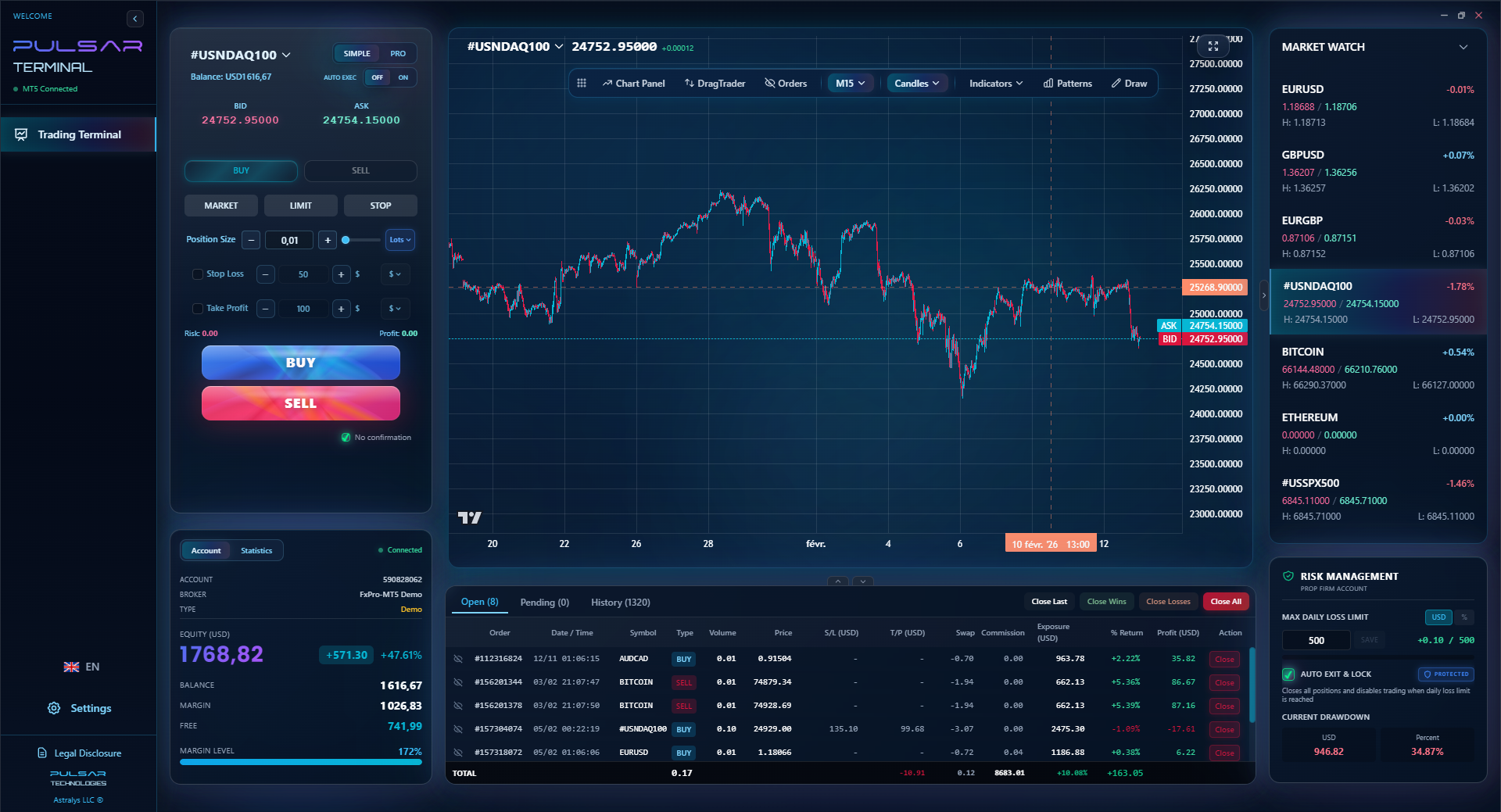
Manually moving stop-losses is where discipline fails; Pulsar Terminal's automated trailing stop and breakeven features enforce your risk rules directly on MT5.
Pulsar Terminal
أداة MT5 الشاملة: أوامر سحب وإفلات، متعدد TP/SL، تريلينج ستوب، تداول الشبكة، Volume Profile وحماية البروب فيرم. يستخدمها أكثر من 1000 متداول يومياً.
Brokers aren't stupid. They offer different account types with different use to segment their clients.
Standard/Classic Accounts: Often have fixed, moderate use (like 1:100 or 1:200) and commission-free trading with wider spreads. Good for beginners who trade less frequently.
ECN/Raw/Pro Accounts: These offer raw spreads (often from 0.0 pips) but charge a commission per lot. They usually come with higher available use (1:500, 1:1000). Why? Because experienced traders using these accounts are often scalping or trading large volumes; they need the tighter spread for their strategy and the use for their capital efficiency. But remember, you pay for it with the commission.
How to Adjust It: In your MT4/MT5 platform, use is usually set at the account level when you open it, but you can often request a change via your broker's client portal. You can also control it manually on a per-trade basis by adjusting your lot size. Choosing to trade 0.01 lots on a 500:1 account is effectively using very low use.
The key is to choose an account where the maximum available use is higher than you think you'll need, but then use only a fraction of it. This gives you headroom but forces you to make the conscious decision on each trade size.
“Use the lowest use possible to execute your strategy effectively. If your strategy requires 1:500 to work, your strategy is probably flawed.”
I've seen these stories a thousand times. Don't be the next one.
Mistake 1: Chasing Losses with Higher use. You lose 10,000 NGN on a bad trade. The instinct is to double down on the next one with even more use to ‘make it back fast.’ This is the death spiral. The market doesn't owe you anything.
Mistake 2: Ignoring Volatility Events. News like CBN MPC announcements or US NFP data cause massive spikes. If you're holding a highly leveraged position into these events, a 50-pip spread widening can liquidate you before the price even truly moves. I learned this the hard way holding EUR/USD into an ECB press conference. Slippage on my stop-loss cost me double what I'd planned.
Mistake 3: Confusing use with ‘Affordability.’ Just because you can control a $100,000 position with $200 doesn't mean you should. Ask yourself: "Would I be comfortable physically owning $100,000 of this currency right now?" If the answer is no, reduce your use.
Mistake 4: No Clear Exit Plan. Entering a trade with use but no predetermined stop-loss is like driving a Formula 1 car blindfolded. Your stop-loss defines your risk, which defines your position size. Without it, you have no idea what your real use exposure is.
The bottom line? use amplifies everything, especially poor discipline. It turns small errors into account-ending events.
💡 نصيحة وينستون
If the potential profit from a trade at 1:50 use doesn't excite you, the problem is your account size, not the use. Fund your account more, don't crank the use up.
use is neutral. It's a tool, like a sharp knife. In the hands of a skilled chef, it creates art. In the hands of a reckless person, it creates a mess.
For the Nigerian trader, it's a necessary part of the landscape. Our economic reality means many start with smaller capital. Sensible, calculated use allows that capital to participate meaningfully in the forex market. It makes strategies possible.
But ‘sensible’ is the key word. After 12 years, my personal rule is this: Use the lowest use possible to execute your strategy effectively. If your strategy requires 1:500 to work, your strategy is probably flawed. Start low - maybe 1:10 or 1:20 - and only increase it as you build a consistent track record and a larger account buffer.
What is use in forex, finally? It's your multiplier. Make sure you're multiplying skill, not luck or desperation. Your margin is your lifeline. Guard it with your life, because in trading, it literally is.
FAQ
Q1What is the best use for a beginner forex trader in Nigeria?
Start with no more than 1:10 or 1:20. It forces you to focus on learning the market and your strategy without the immediate threat of a margin call. You'll be bored by the small profits, but you'll stay in the game long enough to learn. Boredom is better than bankruptcy.
Q2Is 1:500 use illegal in Nigeria?
No, it's not illegal. Nigerian regulators (SEC/CBN) don't currently set use caps for retail traders using international brokers. The use limits are set by the broker's own primary regulator (e.g., CySEC, FSCA). However, just because it's available doesn't make it wise for your account size.
Q3How does use affect my profit and loss in Naira?
It multiplies the value of each pip movement. For example, on USD/NGN, a 1 pip move with a standard lot (100,000 units) is worth 100 NGN. With 1:100 use, you control that lot with 1,500,000 NGN margin. A 100 pip move yields a 10,000 NGN profit or loss. Without use, you'd need the full 150 million Naira to get that same pip value.
Q4Can I lose more money than I deposit with use?
With a standard retail trading account offering negative balance protection (a requirement under many international regulations like CySEC), you cannot lose more than your account balance. Your position will be liquidated at a margin call before your balance goes negative. However, not all account types or brokers guarantee this, so you must check their terms.
Q5Why do brokers offer such high use like 1:1000?
Two main reasons: 1) Marketing. It attracts new traders looking for 'power' and big potential returns. 2) For specific strategies. Scalpers with strong risk management might use high use on tiny position sizes to capitalize on minute price movements. For the vast majority, it's a dangerous temptation.
Q6How do I calculate the use I am actually using on a trade?
Use this formula: (Total Position Value) / (Your Account Equity). If you have a $5,000 account and open a $50,000 position, you're using 10:1 use ($50,000 / $5,000). Your broker's maximum use might be 100:1, but your used use is only 10:1. Focus on your used use.
درس البروفيسور وينستون
النقاط الرئيسية:
- ✓use is a loan, not free capital.
- ✓Never risk more than 1% of your account per trade.
- ✓Match use to your strategy: low for swing, higher for scalp.
- ✓High use amplifies losses faster than profits.
ما مدى فائدة هذا المقال؟
انقر على نجمة للتقييم
رؤى التداول الأسبوعية
تحليلات واستراتيجيات أسبوعية مجانية. بدون رسائل مزعجة.
عن المؤلف
Olumide Adeyemi
رائد التداول في غرب أفريقيا
أحد أنشط معلمي تداول الفوركس في نيجيريا. 8 سنوات من الخبرة في التداول من لاغوس. متخصص في استراتيجيات رأس المال المنخفض وتحديات شركات البروب للمتداولين الأفارقة.
التعليقات
تحذير من المخاطر
ينطوي تداول الأدوات المالية على مخاطر كبيرة وقد لا يكون مناسبًا لجميع المستثمرين. الأداء السابق لا يضمن النتائج المستقبلية. هذا المحتوى لأغراض تعليمية فقط ولا ينبغي اعتباره نصيحة استثمارية. قم دائمًا بإجراء بحثك الخاص قبل التداول.
قد يعجبك أيضًا

Cara Trading Forex Sukses: 7 Prinsip dari Trader Profesional
Cara trading forex sukses dengan 7 prinsip trader pro: manajemen modal, disiplin, journal trading, backtest. Data nyata, bukan janji profit palsu.
Jam Trading Forex Terbaik untuk Trader Indonesia: Panduan Lengkap dengan Tabel Waktu
Panduan jam trading forex untuk trader Indonesia. Tabel 4 sesi dunia, jam emas 20:00-00:00, sesi mana yang harus dihindari. Data akurat + tips dari trader berpengalaman.
Top 5 Sàn Forex Uy Tín Nhất 2026: Review Jujur dari Trader Indonesia
Top 5 sàn forex uy tín 2026 untuk trader Indonesia. Review jujur: spread, deposit, withdraw, dukungan lokal. Exness, XM, IC Markets & lebih.
احصل على Pulsar Terminal
جميع هذه الحاسبات مدمجة في Pulsar Terminal مع بيانات حية من حساب MT5 الخاص بك.
احصل على Pulsar Terminal