


I remember staring at my screen in 2018, watching EUR/USD.

Olumide Adeyemi
رائد التداول في غرب أفريقيا ·  Nigeria
☕ 11 دقائق قراءة
ما ستتعلمه:
- 1The Basics: It's All About the Bid and Ask
- 2Calculating the Real Cost in Your Naira
- 3Variable vs. Fixed Spreads: What Works for Nigeria?
- 4Broker Account Types: Decoding the Spread Menu
- 5Major, Minor & Exotic Pairs: The Spread Hierarchy
- 6How to Manage Spread Risk in Your Trading
- 7Choosing a Broker in Nigeria: The Spread Checklist

I remember staring at my screen in 2018, watching EUR/USD. My entry was perfect, the market moved my way by 5 pips... and I was still in the red. The trade closed at a loss. That was my brutal, expensive introduction to the spread. It’s the first thing you pay on every single trade, and in Nigeria, where every Naira counts, understanding it isn't just helpful - it's survival. Let's break down what the spread in forex really is, why it matters more than you think, and how to keep more of your hard-earned money.
Forget complex definitions for a second. Think of it like this: you walk into a bureau de change on Allen Avenue. They have two rates on the board. One price to buy dollars from them (that's high), and a lower price to sell your dollars back to them. The difference between those two prices? That's their spread, their profit. The forex market works the same way, just electronically.
The bid price is what the market (via your broker) is willing to pay you for the currency pair. It's your sell price. The ask price (sometimes called the offer) is what you must pay to buy it. The spread is the gap between them. If GBP/USD is quoted as 1.3089 / 1.3091, the bid is 1.3089, the ask is 1.3091. The spread is 0.0002, or 2 pips.

Warning: You always buy at the higher (ask) price and sell at the lower (bid) price. This means your trade is in a small loss the moment you open it. The market must move in your direction by at least the spread amount just for you to break even. This is the fundamental cost of doing business.
Understanding the pip definition is crucial here, as it's how we measure this cost. A pip is usually a one-digit move in the fourth decimal place for pairs like EUR/USD. For USD/JPY, it's the second decimal place. Knowing this lets you calculate your real cost per trade.

💡 نصيحة وينستون
The spread isn't a fee, it's a distance. Your trade must cross that distance before it even begins its journey to profit. Plan your fuel accordingly.
Knowing the spread in pips is one thing. Knowing what it costs in your local currency is where it gets real. This is where many new traders in Nigeria get shocked. A "small" 2-pip spread on a standard lot isn't small at all.
Let's do the math with a common scenario. You're trading EUR/USD, and the spread is 1.5 pips on a Standard account with a broker like XM or Exness. You decide to buy 1 standard lot (which is 100,000 units of the base currency).
The Cost: 1 Pip on EUR/USD = $10 for a standard lot. Spread Cost = 1.5 pips * $10 = $15.
That's $15 gone from your account before the market even moves a single pip in your favor. At an exchange rate of ₦1,380/$, that's ₦20,700. For one trade. If you're a scalping strategy trader making 10 trades a day, that's ₦207,000 in daily costs just to break even. It adds up terrifyingly fast.

Example: I learned this the hard way early on. I was scalping GBP/USD with a 3-pip spread on a mini lot (0.1 standard lot). My cost per trade was $3 (3 pips * $1). I made 15 trades in a session, caught 5-7 pips per trade on average. I felt like a genius until I did the math: $45 in spread costs had eaten nearly half my gross profit. My strategy was barely profitable after accounting for the spread. I had to either find a broker with tighter spreads or change my entire approach.
This is why using a position size calculator is non-negotiable. It forces you to account for the spread as part of your risk, not an afterthought.
“The spread is the first thing you pay on every single trade, and in Nigeria, where every Naira counts, understanding it isn't just helpful - it's survival.”
You'll see brokers offer two main types: variable and fixed. Your choice here can make or blow up your account, especially with our volatile Naira and sometimes shaky internet.
Variable Spreads: This is the norm for most ECN/STP brokers like IC Markets or Pepperstone. The spread changes constantly based on market liquidity. During major news events (like US Non-Farm Payrolls) or when liquidity is thin (Asian session late at night our time), spreads can widen dramatically.
- Pros: Usually much tighter during normal market hours. You can get spreads as low as 0.0 pips on majors (plus a small commission).
- Cons: You can get caught in a "widening." I've seen EUR/USD spreads jump from 0.2 to 15 pips in seconds during news. If your stop-loss is triggered during this, you lose far more than planned.
Fixed Spreads: Some brokers guarantee a set spread. It might be 1.5 pips on EUR/USD all day, every day.
- Pros: Predictable costs. No nasty surprises during news. Great for beginners who want cost certainty and for certain automated strategies.
- Cons: The fixed spread is usually higher than the average variable spread. You're paying a premium for that stability.
The Nigerian Reality Check
With our internet reliability issues, a fixed spread can be a safety net. If your connection drops during a news event and reconnects when spreads are wide, a fixed-spread account protects you from a massive, unexpected slippage loss. However, for day-to-day swing trading where you're not trading news, variable spreads on a good ECN account will save you money. You have to know your own style and infrastructure limits.
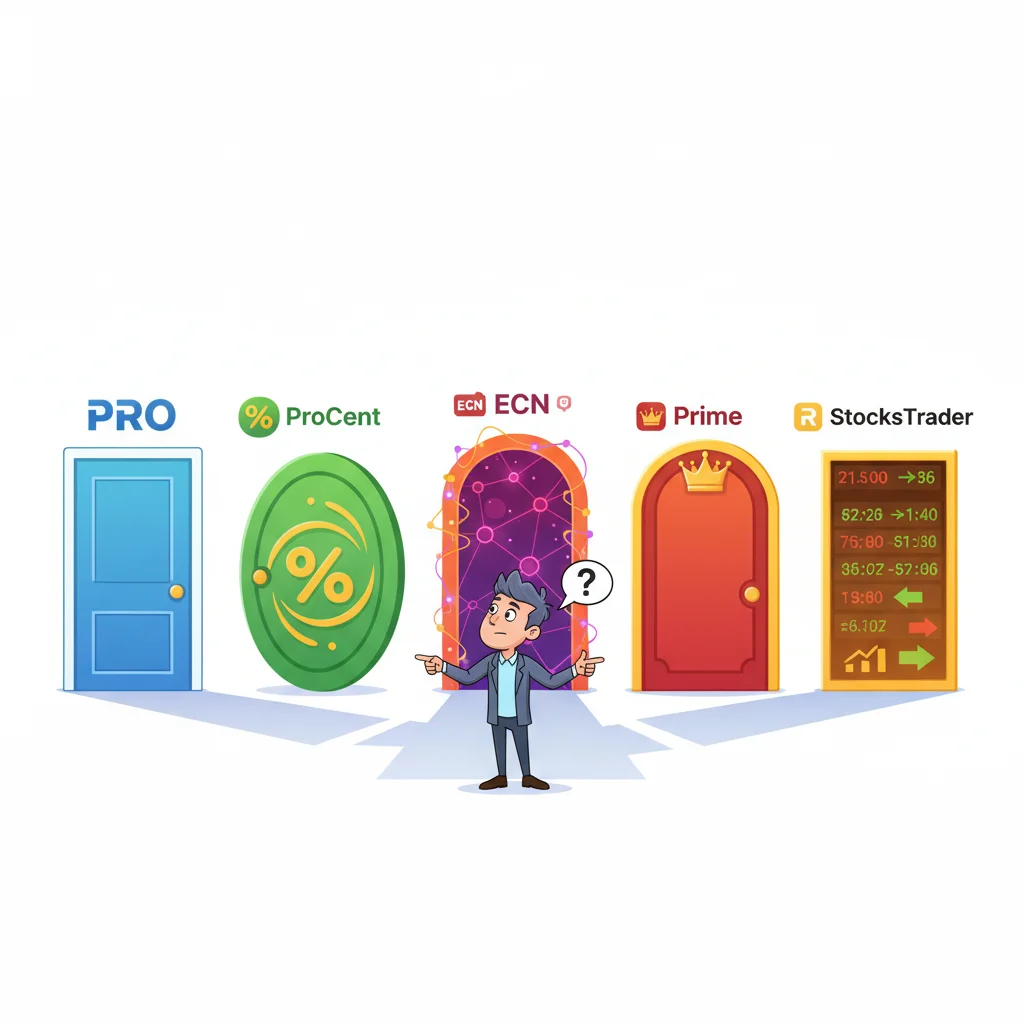
Walk onto any broker's website in Nigeria, and you'll be hit with a confusing list: Standard, Pro, Raw, ECN, Zero. They're all just different ways of packaging the spread and commissions. Here’s the translation:
| Account Type | How the Spread Works | Best For... | Nigerian Example Brokers |
|---|---|---|---|
| Standard / Classic | Wider, all-inclusive spread. No commission. | Beginners, smaller accounts, traders who hate math. | XM, Exness Standard, HFM Premium |
| Raw / ECN / Pro | Very tight spread (often from 0.0 pips) + a separate commission per lot. | Active traders, scalpers, large accounts. Lower total cost for high volume. | IC Markets Raw, Pepperstone Razor, FP Markets ECN |
The Commission Math: On a Raw account, you might pay 0.1 pip spread + $7 commission per round lot. For a 1-lot trade, that's $7 + (0.1 * $10) = $8 total cost. Compare that to a Standard account with a 1.5 pip spread: 1.5 * $10 = $15 cost. The Raw account is cheaper.

Pro Tip: Don't just look at the advertised spread. Do the total cost per lot calculation. For active trading, Raw/ECN accounts almost always win. But if you trade infrequently with small lot sizes, the simplicity of a Standard account might be okay, even if the per-trade cost is slightly higher.
The key is to match the account type to your trading frequency. Blowing ₦50,000 on spreads with a Standard account when a Raw account would have cost you ₦25,000 is a rookie mistake I made for far too long.
💡 نصيحة وينستون
In Nigeria, a broker's deposit method is as important as its spread. The tightest spread is worthless if you can't fund your account with your Naira.
“A 'small' 2-pip spread on a standard lot costs you ₦20,700 before the market even moves. That reality changes everything.”
Not all currency pairs are created equal, and their spreads tell the story of their liquidity. This is a global rule, but it hits home when you're trading with Naira.
Major Pairs (Tightest Spreads): These involve the USD and other major economies (EUR, GBP, JPY, CHF, CAD, AUD, NZD). Think EUR/USD, GBP/USD, USD/JPY. They have the highest trading volume, so competition is fierce and spreads are low. This is where you'll find sub-1 pip spreads easily. If you're starting out, stay here. The EUR/USD guide is a great place to begin.
Minor Pairs (Crosses) (Wider Spreads): These are majors without the USD. EUR/GBP, AUD/CAD, GBP/JPY. Less liquidity means wider spreads, often 2-4 pips. They can be great for analysis but cost more to trade.
Exotic Pairs (Widest Spreads): This is where a currency from a major economy is paired with one from a developing or smaller economy. USD/NGN (US Dollar vs. Nigerian Naira), USD/ZAR, EUR/TRY.
Let's talk about USD/NGN specifically. The spread can be enormous - 50 pips or more is not uncommon. Why? Limited liquidity in the retail forex market for Naira pairs and high volatility. Trading USD/NGN feels familiar, but the cost is punishing. You need a much bigger price movement just to cover the spread. I once tried to scalp USD/NGN, attracted by the big swings. A 30-pip spread meant I needed a 35-pip move just to make 5 pips. It was a fast way to lose money.
The same logic applies to other exotics and even to pairs like XAU/USD (Gold). Commodities and indices often have wider spreads than major forex pairs. Always check the typical spread for an instrument before you trade it.
You can't avoid the spread, but you can absolutely stop it from eating you alive. Here’s how I learned to manage it.
1. Avoid Trading During High-Spread Times: This is rule number one. Spreads widen when liquidity dries up. That's during major economic news releases (check an economic calendar), market opens/closes (especially the Sydney open if you're up late), and holidays. If you're trading around the US Non-Farm Payrolls report, you're not just risking a bad move - you're guaranteeing a huge entry cost.
2. Factor Spread into Your Stop-Loss: This is critical. If your strategy says "place a 10-pip stop-loss," but the spread is 3 pips, your real risk is 13 pips from your entry price. You must adjust your position size accordingly. A tool that can help you set precise stops and manage partial closures can be a lifesaver for locking in profit and managing this risk dynamically.
3. Choose Your Pairs and Strategy Wisely: If you have a strategy that aims for 10-pip profits, trading a pair with a 5-pip spread is suicide. Your win rate needs to be impossibly high. Scalping requires the tightest spreads possible. Swing trading, where you target 100+ pips, can absorb a wider spread more easily.
4. Understand Slippage: This is the spread's ugly cousin. It's when you get a different price than you clicked on, usually during fast markets. A wide spread often comes with higher slippage risk. A margin call can happen much faster if you get negative slippage on entry and the spread is wide.
5. Use Limit Orders: Instead of market orders (buy/sell now at whatever price), use limit orders to enter. You set the price you're willing to pay. This can help you get a better fill inside the spread, but there's no guarantee your order will be executed if the price doesn't hit your level.
💡 نصيحة وينستون
If your profit target is smaller than 3 times the average spread, you're not trading, you're donating. Re-evaluate your pair or your plan.

Managing spread risk requires precise order placement and profit-taking, which is where a tool like Pulsar Terminal's drag-and-drop orders and multi-take-profit features on MT5 become indispensable.
Pulsar Terminal
أداة MT5 الشاملة: أوامر سحب وإفلات، متعدد TP/SL، تريلينج ستوب، تداول الشبكة، Volume Profile وحماية البروب فيرم. يستخدمها أكثر من 1000 متداول يومياً.

“Choosing a broker in Nigeria isn't just about the lowest spread; it's about the total cost, reliable funding, and real regulation.”
Given the local regulatory landscape - where the CBN doesn't really oversee retail forex - choosing a broker with tight, honest spreads and strong international regulation is your first line of defense. Here’s your checklist:
1. Compare Real Spreads, Not Advertised Ones: Don't look at the "from 0.0 pips" on the homepage. Open a demo account or look for independent spread comparison tools. Check the average spread on EUR/USD during the London session (2pm - 5pm our time) and during a quiet period. See how wide it gets during a simulated news event.
2. Check the Commission Structure: If it's a Raw/ECN account, is the commission per lot or per side? ($7 per lot is common, meaning $7 to open and $7 to close a 1-lot trade). Do the total cost math.
3. Verify Regulation: Your broker should be regulated by a top-tier authority like the UK's FCA, Australia's ASIC, Cyprus's CySEC, or South Africa's FSCA. This provides a layer of protection for your funds and ensures some standard of conduct. Brokers like IC Markets (ASIC) and Pepperstone (FCA, ASIC) are popular for this reason.
4. Test Deposit/Withdrawal in Naira: This is the Nigerian-specific hurdle. Can you fund your account easily via local bank transfer, USSD, or popular e-wallets? How long do withdrawals take to your Nigerian bank? What are the fees? A broker with tight spreads is useless if you can't get your money in or out smoothly.
5. Platform & Tools: Does the broker offer MetaTrader 4/5? Are there tools to help you visualize and manage your risk in relation to the spread? Having advanced order management can help you secure profits faster in a moving market, directly impacting your net results after spreads.
FAQ
Q1Is forex trading legal in Nigeria, and how does spread affect my taxes?
Yes, forex trading is legal for individuals in Nigeria. The spread is a direct cost of doing business. When calculating your taxable profit for the 10% capital gains tax, you should deduct your total spread costs (and any commissions) from your gross profits. This lowers your taxable income. Keep clear records of all your trades.
Q2What is a good spread for a beginner in Nigeria?
For a complete beginner, focus on major pairs like EUR/USD. A "good" spread on a Standard (no commission) account would be under 1.5 pips during active hours. On a Raw/ECN account, look for an average spread below 0.3 pips plus a reasonable commission. Start with a demo account to see real spreads before risking your Naira.
Q3Why is the spread on USD/NGN so huge?
The USD/NGN pair has a very wide spread (often 50+ pips) due to lower liquidity in the retail forex market for the Naira, combined with high volatility and central bank controls. The interbank market is different. For retail traders, the cost to trade USD/NGN is prohibitively high for most strategies.
Q4Should I choose a fixed or variable spread account?
It depends on your strategy and risk tolerance. If you trade during volatile news events or have unreliable internet, a fixed spread offers cost certainty and protection from extreme widening. For most other day-to-day trading, a variable spread account from a good ECN broker will offer a lower average cost. Always test both in a demo.
Q5How do I know if my broker is manipulating the spread?
While you can't know for sure, red flags include: spreads widening dramatically at the exact moment you enter a trade consistently, spreads that are permanently much wider than other top brokers for the same pair, and frequent requotes. Stick to well-regulated, internationally recognized brokers to minimize this risk.
Q6Can I trade forex in Nigeria with a small account considering the spread?
Yes, but you must be extra careful. With a small account (e.g., $100 or ₦140,000), trade micro or mini lots (0.01 or 0.1 standard lots). This makes the monetary value of the spread smaller. A 2-pip spread on a micro lot might cost $0.20 instead of $20. This allows you to survive longer while learning without being wiped out by transaction costs.
درس البروفيسور وينستون
النقاط الرئيسية:
- ✓The spread is your #1 trading cost, paid instantly on entry.
- ✓Calculate cost in Naira, not just pips, to feel the real impact.
- ✓Variable spreads are cheaper on average but can widen dangerously.
- ✓Raw/ECN accounts save active traders money versus Standard accounts.
- ✓Never trade exotics like USD/NGN without checking the massive spread first.
- ✓Factor the spread into your stop-loss and position size, always.
ما مدى فائدة هذا المقال؟
انقر على نجمة للتقييم
رؤى التداول الأسبوعية
تحليلات واستراتيجيات أسبوعية مجانية. بدون رسائل مزعجة.
عن المؤلف
Olumide Adeyemi
رائد التداول في غرب أفريقيا
أحد أنشط معلمي تداول الفوركس في نيجيريا. 8 سنوات من الخبرة في التداول من لاغوس. متخصص في استراتيجيات رأس المال المنخفض وتحديات شركات البروب للمتداولين الأفارقة.
التعليقات
تحذير من المخاطر
ينطوي تداول الأدوات المالية على مخاطر كبيرة وقد لا يكون مناسبًا لجميع المستثمرين. الأداء السابق لا يضمن النتائج المستقبلية. هذا المحتوى لأغراض تعليمية فقط ولا ينبغي اعتباره نصيحة استثمارية. قم دائمًا بإجراء بحثك الخاص قبل التداول.
قد يعجبك أيضًا

Cara Trading Forex Sukses: 7 Prinsip dari Trader Profesional
Cara trading forex sukses dengan 7 prinsip trader pro: manajemen modal, disiplin, journal trading, backtest. Data nyata, bukan janji profit palsu.
Jam Trading Forex Terbaik untuk Trader Indonesia: Panduan Lengkap dengan Tabel Waktu
Panduan jam trading forex untuk trader Indonesia. Tabel 4 sesi dunia, jam emas 20:00-00:00, sesi mana yang harus dihindari. Data akurat + tips dari trader berpengalaman.
Top 5 Sàn Forex Uy Tín Nhất 2026: Review Jujur dari Trader Indonesia
Top 5 sàn forex uy tín 2026 untuk trader Indonesia. Review jujur: spread, deposit, withdraw, dukungan lokal. Exness, XM, IC Markets & lebih.
احصل على Pulsar Terminal
جميع هذه الحاسبات مدمجة في Pulsar Terminal مع بيانات حية من حساب MT5 الخاص بك.
احصل على Pulsar Terminal