


I remember staring at my screen in late 2022, watching the GBP/USD chart during the Truss budget fallout.

Olumide Adeyemi
رائد التداول في غرب أفريقيا ·  Nigeria
☕ 11 دقائق قراءة
ما ستتعلمه:
- 1The Billionaire Forex Club: Who Actually Holds the Title?
- 2One Trade That Changed Everything: The Soros Playbook
- 3What They All Share: Mindset Over Magic Indicators
- 4The Nigerian Reality Check: Applying the Lessons at Home
- 5My Expensive Education: Two Trades I'll Never Forget
- 6Building Your 'Bridgewater': A Practical Starter Plan
- 7The Final Word: It's a Marathon in Lagos Traffic
I remember staring at my screen in late 2022, watching the GBP/USD chart during the Truss budget fallout. The pound was in freefall, and all I could think was, 'This is what Soros must have felt like.' I took a small, nervous short position, made a few hundred dollars, and felt like a genius. Then I read about the scale of his 1992 trade - over a billion dollars in profit. It put my entire trading journey into perspective. The question of who is the richest forex trader in the world isn't just about envy; it's a masterclass in mindset, scale, and risk management that we can all learn from, right here from Lagos or Port Harcourt.
Let's cut through the noise. You won't find a definitive leaderboard with a single name at the top. The real wealth in forex isn't built by retail traders posting screenshots on Twitter (sorry). It's built by macro hedge fund managers who treat currencies as one piece of a global puzzle. Based on consistent estimates and their legendary status, a few names dominate the conversation.
Ray Dalio is often cited as the richest, with a net worth floating around $14-15 billion. His firm, Bridgewater Associates, is the world's largest hedge fund. He doesn't just trade EUR/USD on a hunch. He builds systematic, principles-based portfolios (like his 'All Weather' strategy) where forex positions hedge against global economic shifts. It's a different universe from checking the MACD indicator on a 15-minute chart.
Then you have the legends. George Soros and his right-hand man Stanley Druckenmiller are forever linked to 'Black Wednesday' in 1992. They famously 'broke the Bank of England' by shorting the British pound, a trade that netted over $1 billion. Soros's net worth is estimated north of $7 billion. Druckenmiller, a master in his own right, is worth several billion too. Their play wasn't a technical setup; it was a fundamental conviction that the UK's economic policy was unsustainable.
Bruce Kovner (net worth $6-8 billion) started as a cab driver and turned a $3,000 loan into a macro trading empire. Paul Tudor Jones ($4-8 billion) predicted and profited from the 1987 crash. These aren't gamblers. They're economists, historians, and risk managers who happen to use the forex market as their canvas.

Example: Imagine risking $10 billion on a single currency bet. That's the scale these traders operate at. A 10% move in their favor equals $1 billion. For context, that's more than the total net forex inflow into Nigeria in Q4 2024 ($17.39 billion). Their position sizing is a different dimension of reality.

💡 نصيحة وينستون
The market's job is to find your personal pain point - the point where your discipline breaks. Your job is to make that point so small (with strict position sizing) that the market can never find it.
“The richest traders share psychological traits, not technical secrets.”
We need to talk about the 1992 pound short. It's the most famous forex trade in history, and understanding it kills the get-rich-quick fantasy. Soros and Druckenmiller didn't see a double top on the chart. They saw a fundamental misalignment.
The UK was part of the European Exchange Rate Mechanism (ERM), which pegged the pound to other European currencies like the Deutsche Mark. The UK's economy was weak, interest rates were high, and the peg was politically motivated, not economically sound. It was a pressure cooker.
They built a massive short position against the pound, betting billions that the UK government would be forced to devalue it. When the pressure became too much, the UK withdrew from the ERM, and the pound plummeted. Quantum Fund made its legendary profit.
Here's the lesson for us: they waited for a high-probability, asymmetric bet. The downside was limited (the peg might hold), but the upside was enormous (a currency devaluation). They had the patience to analyze, the conviction to place a huge bet, and the capital to withstand volatility. My attempt during the 2022 mini-crisis was a pale imitation. I was reacting to price action; they were anticipating a regime change. That's the difference between trading and speculating.

Warning: Trying to replicate this as a retail trader with high use is a recipe for a margin call. We don't have their information edge or capital buffer. The takeaway isn't to find the next 'big short' but to cultivate the patience for high-conviction setups.
“Your goal isn't to make a billion-dollar trade. Your goal is to be the trader who survives.”
Forget searching for the perfect indicator. The richest traders share psychological traits, not technical secrets.
1. Risk Management is Religion. This is non-negotiable. Kovner was known for his extreme discipline. He'd risk maybe 1% of his fund on a single idea. For us, that means using a position size calculator for every single trade, no exceptions. I learned this the hard way in 2019. I got bullish on USD/NGN (on a black market premise) and threw 25% of my account at it without a clear stop. A sudden CBN intervention caused a sharp reversal, and I lost over ₦400,000 in a day. A brutal, expensive lesson in ego.
2. Macro Over Micro. They think in terms of decades, economic cycles, and political shifts. They ask: 'What is the central bank's mandate? What are the debt dynamics?' We get obsessed with the next pip on EUR/USD. Try spending a week just reading CBN monetary policy reports and global commodity news instead of staring at charts. It changes your perspective.
3. Emotional Detachment. Losses are a cost of doing business, not a personal failure. Wins don't make them geniuses. This is perhaps the hardest skill to learn. I used to ride losing trades on Gold (XAU/USD) hoping they'd turn around, turning a 2% loss into a 10% account blow. Now, if my stop is hit, I close the chart and walk away. The market doesn't care about your hope.
4. Continuous, Rigorous Learning. They are students of history. The 1920s German hyperinflation, the 1997 Asian financial crisis - these aren't just stories; they are case studies for future opportunities.
“Your goal isn't to make a billion-dollar trade. Your goal is to be the trader who survives.”
Okay, so we're not running billion-dollar hedge funds from Victoria Island. How does this translate to trading with your $500 account on Exness or IC Markets?
The Regulatory Landscape First, know your ground. Forex trading is legal in Nigeria. The Central Bank of Nigeria (CBN) manages currency stability, while the SEC does not regulate retail forex brokers. This is critical. It means if you use an unregulated local platform and something goes wrong, you have zero protection. Always choose internationally regulated brokers. The CBN's capital controls also mean funding your account can be a hassle - domiciliary accounts or e-wallets like Perfect Money are often smoother than Naira cards.
Costs You Can't Ignore Your profits aren't just yours. Remember the 10% Capital Gains Tax payable to the FIRS. Factor that into your profit targets. Then there's the cost of trading itself. Look at spreads closely:
| Broker (Example) | Typical EUR/USD Spread | Key Point for Naija Traders |
|---|---|---|
| Exness (Zero Acc) | From 0.0 pips + commission | Very popular here for raw spreads. |
| OctaFX | From 0.7 pips | Offers local deposit options in Naira. |
| XM | From 0.0 pips + commission | Strong educational resources. |
| AvaTrade | ~0.93 pips | User-friendly for beginners. |
A 2-pip spread difference might seem small, but if you're a scalping enthusiast, it's the difference between profit and loss over 100 trades.
use: Your Double-Edged Sword Brokers like FXTM or HF Markets offer use up to 1:2000 to Nigerian clients. That's insane temptation. Bruce Kovner's 1% risk rule becomes life-or-death here. With 1:1000 use, a 10-pip move against you can wipe out a huge chunk of capital. Use use to control position size for risk, not to amplify your betting power.

Pro Tip: Before you fund that shiny new broker account, do a dry run. How easy is it to actually withdraw your money back to your Nigerian bank account? Test the process with a small amount first. Liquidity is king.
💡 نصيحة وينستون
In Nigeria, your first profitability test isn't the charts; it's navigating withdrawals back to your local bank. Always test the full cycle with a small amount before committing serious capital.
“A 10% move for them equals $1 billion. For us, a 10% loss can mean game over.”
Let me get personal. Reading about billionaires is inspiring, but my real lessons came from my own losses. Here are two that carved these principles into my brain.
The 'Soros Wannabe' Disaster (2020) During the COVID market panic, the USD spiked. I saw the USD/NGN parallel rate soaring and thought, 'This is my macro moment!' I figured the official rate would have to catch up. I went long USD/NGN on a CFD platform with a huge position (about 15% of my account), ignoring proper stops. I was 'convicted.' A week later, the CBN intervened with measures to support the Naira, and the pair dropped sharply. I was down over $1,200 before I finally admitted I was wrong. I was playing macro without a macro player's information or risk control.
The 'Patient Druckenmiller' Win (2021) After that bruising, I changed. I spent months watching XAU/USD. Inflation fears were building. Instead of jumping in on every dip, I waited. I built a thesis: sustained inflation = gold bullish. I identified a key support zone around $1750. When price tapped it in September 2021 and the RSI indicator showed divergence, I entered. My risk was a tight 1.5% of my account. I set a target and walked away. It took weeks, but the trade ran to my target for a 3.5% account gain. It wasn't a billion dollars, but it was profitable discipline. It felt better than any reckless win.
The difference between these two trades? In the first, I focused on the potential reward. In the second, I focused on managing the risk. That's the entire game.
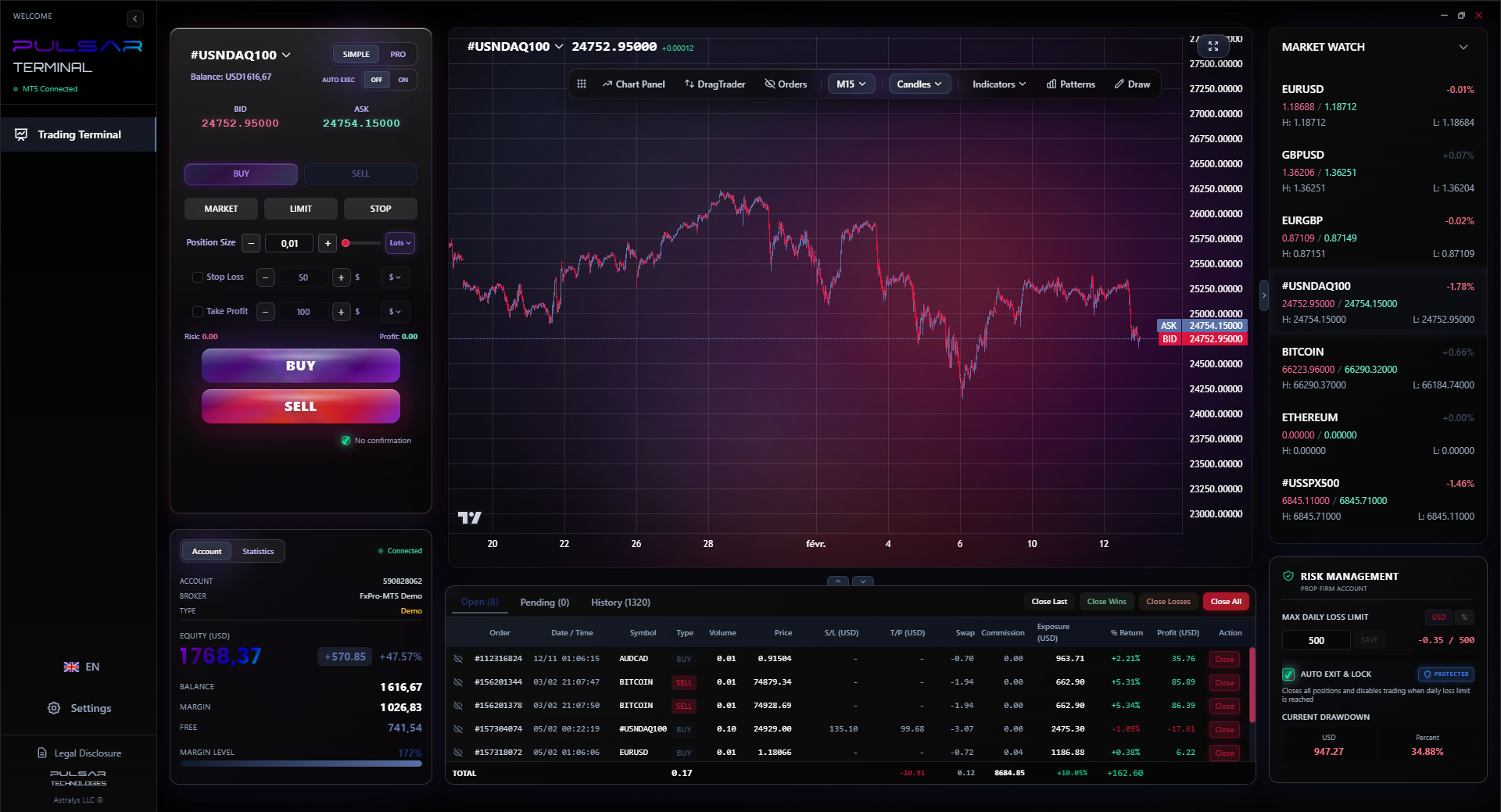
Executing a disciplined plan like the 'Patient Druckenmiller' trade requires precise order management, which tools like Pulsar Terminal provide directly on your MT5 platform.
Pulsar Terminal
أداة MT5 الشاملة: أوامر سحب وإفلات، متعدد TP/SL، تريلينج ستوب، تداول الشبكة، Volume Profile وحماية البروب فيرم. يستخدمها أكثر من 1000 متداول يومياً.
“A 10% move for them equals $1 billion. For us, a 10% loss can mean game over.”
You won't wake up as Ray Dalio. But you can start building habits that move in that direction. Here's a no-nonsense, one-month plan for a Nigerian trader.
Weeks 1-2: The Learning Ban
- Stop placing live trades. Seriously.
- Read one CBN monetary policy committee report.
- Read the biography 'Market Wizards' (it features interviews with many of these traders).
- Paper trade based only on fundamental headlines. Can you predict direction from news alone?
Week 3: The Strategy Surgery
- Audit your last 20 trades. How many were based on a clear, written-down reason (fundamental or technical)? How many were 'just a feeling' or boredom?
- Choose ONE currency pair. Master it. For Nigeria, USD/NGN (where available), EUR/USD, or GBP/USD are liquid and news-rich.
- Define your risk per trade. Write it down: 'I will never risk more than 1% of my account on any single trade.' Use that position size calculator every time.
Week 4: The Execution Test
- Fund a micro account with the minimum - maybe $50 on Exness or Pepperstone.
- Your only goal for the month is to execute 5 trades. Each must have a written plan before entry: reason, entry, stop-loss, take-profit.
- Your success metric is NOT profit. It's: 'Did I follow my plan exactly?' If you hit your stop, that's a successful trade. If you moved your stop, that's a failure.
This process forces the discipline the legends have. It's boring. It's unsexy. But it's the only path that doesn't lead to blowing up your account.
“I was reacting to price action; they were anticipating a regime change. That's the difference between trading and speculating.”
So, who is the richest forex trader in the world? It's a group of individuals who mastered psychology and risk long before they mastered markets. For us in Nigeria, with our unique challenges - from spreads and taxes to funding issues - their lessons are even more vital.
Don't chase their money. Chase their mindset. The patience to wait for the right setup. The discipline to cut losses short. The humility to keep learning. The understanding that forex isn't a lottery ticket; it's a profession of probability management.
Your goal isn't to make a billion-dollar trade. Your goal is to be the trader who survives, learns, and grows consistently over years. That's how you build real wealth from trading, whether you're in Ikoyi, Abuja, or Ibadan. Start with your next trade plan. Make it disciplined. Make it small. And just keep going.
Pro Tip: The market will always be there tomorrow. If you're feeling emotional - fearful after a loss or greedy after a win - close the platform. Go for a walk, drink a Chapman. The charts will look different when you come back with a clear head. Your capital is your army. Don't send it into battle when the general (you) is tired or emotional.
FAQ
Q1Is George Soros still the richest forex trader?
While George Soros remains one of the wealthiest and most famous, many estimates currently point to Ray Dalio, founder of Bridgewater Associates, as the richest individual whose wealth is significantly tied to forex and macro trading, with a net worth around $14-15 billion.
Q2Is forex trading legal and taxable in Nigeria?
Yes, forex trading is legal for individuals in Nigeria. You can use internationally regulated brokers. However, you are required by law to pay a 10% Capital Gains Tax on your trading profits to the Federal Inland Revenue Service (FIRS).
Q3What is the best broker for forex trading in Nigeria?
There's no single 'best' broker. Nigerian traders should prioritize brokers with strong international regulation, reliable deposit/withdrawal methods for Nigeria (like e-wallets or domiciliary account support), and competitive costs. Popular choices include Exness, XM, OctaFX, and IC Markets, but you must research based on your specific needs like account minimums and preferred trading style.
Q4How did George Soros break the Bank of England?
In 1992, Soros's Quantum Fund took a massive short position against the British pound, betting it was overvalued within the European Exchange Rate Mechanism. When economic pressure forced the UK to withdraw from the ERM and devalue the pound, Soros's fund profited by over $1 billion. It was a bet against unsustainable government economic policy, not a technical chart pattern.
Q5Can I become a billionaire from forex trading in Nigeria?
Realistically, the odds are astronomically low. The billionaire traders run multi-billion dollar hedge funds. A more achievable and sustainable goal is to focus on consistent profitability, rigorous risk management, and growing your capital steadily over time. Aim for financial independence, not billionaire status, to maintain a healthy and practical mindset.
Q6What use should a beginner in Nigeria use?
As low as possible. Even though brokers offer up to 1:2000, a beginner should start with 1:10 or 1:20 maximum. High use amplifies both gains and losses, and without experience, it dramatically increases the speed at which you can lose your capital. Use use to control position size for tight risk management, not to overexpose yourself.
درس البروفيسور وينستون
النقاط الرئيسية:
- ✓Risk 1% or less per trade, no exceptions.
- ✓Master one currency pair before adding more.
- ✓Taxes and spreads are silent account killers.
- ✓Patience for high-conviction setups beats frequent trading.
ما مدى فائدة هذا المقال؟
انقر على نجمة للتقييم
رؤى التداول الأسبوعية
تحليلات واستراتيجيات أسبوعية مجانية. بدون رسائل مزعجة.
عن المؤلف
Olumide Adeyemi
رائد التداول في غرب أفريقيا
أحد أنشط معلمي تداول الفوركس في نيجيريا. 8 سنوات من الخبرة في التداول من لاغوس. متخصص في استراتيجيات رأس المال المنخفض وتحديات شركات البروب للمتداولين الأفارقة.
التعليقات
تحذير من المخاطر
ينطوي تداول الأدوات المالية على مخاطر كبيرة وقد لا يكون مناسبًا لجميع المستثمرين. الأداء السابق لا يضمن النتائج المستقبلية. هذا المحتوى لأغراض تعليمية فقط ولا ينبغي اعتباره نصيحة استثمارية. قم دائمًا بإجراء بحثك الخاص قبل التداول.
قد يعجبك أيضًا

Cara Trading Forex Sukses: 7 Prinsip dari Trader Profesional
Cara trading forex sukses dengan 7 prinsip trader pro: manajemen modal, disiplin, journal trading, backtest. Data nyata, bukan janji profit palsu.
Jam Trading Forex Terbaik untuk Trader Indonesia: Panduan Lengkap dengan Tabel Waktu
Panduan jam trading forex untuk trader Indonesia. Tabel 4 sesi dunia, jam emas 20:00-00:00, sesi mana yang harus dihindari. Data akurat + tips dari trader berpengalaman.
Top 5 Sàn Forex Uy Tín Nhất 2026: Review Jujur dari Trader Indonesia
Top 5 sàn forex uy tín 2026 untuk trader Indonesia. Review jujur: spread, deposit, withdraw, dukungan lokal. Exness, XM, IC Markets & lebih.
احصل على Pulsar Terminal
جميع هذه الحاسبات مدمجة في Pulsar Terminal مع بيانات حية من حساب MT5 الخاص بك.
احصل على Pulsar Terminal