


You're probably asking yourself, 'Why should I trade forex?' Is it the ads promising quick money? The freedom of working from your phone? I asked the same thing 12 years ago in Lagos.

Olumide Adeyemi
رائد التداول في غرب أفريقيا ·  Nigeria
☕ 9 دقائق قراءة
ما ستتعلمه:
You're probably asking yourself, 'Why should I trade forex?' Is it the ads promising quick money? The freedom of working from your phone? I asked the same thing 12 years ago in Lagos. The real answer isn't in the hype. It's in the market's 24-hour rhythm, the direct link to our import-driven economy, and the brutal, beautiful lessons it teaches about risk and patience. Let me walk you through what I wish I'd known.
Forex isn't some abstract global game for us. It's woven into our daily lives. Think about it. Our economy runs on imports - from cars to wheat. The constant dance between the Naira and the Dollar, the Pound, the Euro? That's not just news. It's a trading opportunity born from real economic pressure.
The market here is massive. Daily trading volumes hit between ₦300 and ₦450 million. On average, Nigerian traders handle positions worth over a million dollars daily. That activity creates liquidity and movement. You're not trading in a vacuum. You're trading the same forces that determine the price of fuel or a bag of rice at Mile 12 Market.
And then there's access. With a smartphone and as little as $10 or ₦4,000 with some brokers, you're in. No need for connections or a fancy office in VI. This democratization is powerful. But it's also the trap. Easy entry doesn't mean easy profits. I learned that the hard way, blowing my first $200 account in two days because I treated it like a betting slip.

Warning: The ISA 2025 Act changed the game. It's now illegal for platforms to operate here without SEC registration. This is for your protection. Always, always verify a broker's regulatory status. Using a reputable international broker like IC Markets or Pepperstone, regulated abroad, is a common and legal path for Nigerian residents.

💡 نصيحة وينستون
Your first profitable system will be boring. It will involve waiting for specific, unexciting setups. Embrace the boredom. Excitement is expensive in this business.
“Easy entry doesn't mean easy profits. I learned that the hard way, blowing my first $200 account in two days.”
Let's cut through the 'get-rich-quick' noise. The genuine advantages of forex are practical, not magical.
24/5 Market Access
Your job ends at 5 PM. The market doesn't. You can trade the London session, the New York session, even the Asian session if you're a night owl. This flexibility was a lifesaver when I started while still working a 9-5. I'd analyze charts after work and place trades for the US session. It fits around your life, not the other way around.
Low Transaction Costs
Compared to buying stocks or real estate, the direct costs of forex are minimal. No brokerage fees, no stamp duty. Your main cost is the spread - the difference between the buy and sell price. On major pairs like EUR/USD, this can be razor-thin, sometimes less than a pip on raw spread accounts. This means more of your profit stays yours. Just remember, brokers make money on the spread or a commission, so it's never truly 'free'.
High Liquidity
You can get in and out of trades in milliseconds. This is crucial. I once had to exit a large position on GBP/JPY during a news event. The market swallowed my order whole without a significant price slip. Try selling a property that quickly. This liquidity is why forex is ideal for shorter-term strategies like scalping.
The use Double-Edged Sword
This is the big one. use lets you control a $10,000 position with just $100 (that's 1:100 use). Brokers here often offer up to 1:500 or more. My biggest early win came from this. I put $50 on a USD/NGN idea with high use and walked away with $700 in a day. I felt like a genius. Then I did the same thing the next week and lost $1,200. use amplifies everything - gains and losses. It's a tool, not a strategy. Never let it dictate your position size.
“use amplifies everything - gains and losses. It's a tool, not a strategy.”
If you're asking 'why should I trade forex,' you deserve the full picture. The downsides are real, and they break most people.
The first is psychological pressure. It's you versus the charts. There's no boss, no team. When you lose, it's your fault. When you win, you wonder if it was luck. I developed a twitch in my eye during the 2015 Naira crisis trades. The isolation and stress are immense.
Then there's the 90% statistic. You've heard it. Most lose. It's true. Why? They treat it like gambling, not a skilled profession. They chase losses, ignore risk management, and trade based on emotion. I was in that 90% for my first three years. I'd have a good month, get overconfident, and give it all back in one terrible trade.
Regulatory gaps, despite the new laws, can still be an issue. You must do your homework. Is your broker's client money segregated? Where are they regulated? A problem with an unregulated offshore entity means you have zero recourse. I learned this after a 'broker' I used in 2014 simply vanished with my $500 deposit.
Finally, the tax man. Profits are subject to a 10% Capital Gains Tax. If trading is your main business, it's taxable income. Keep careful records. The FIRS may not knock today, but they have a long memory.
“use amplifies everything - gains and losses. It's a tool, not a strategy.”
Success in forex isn't about finding a secret indicator. It's about building a trader's mindset. This is the core answer to 'why should I trade forex' - it forges discipline you can use anywhere.
You need a business plan, not a 'strategy.' My plan includes my risk per trade (never more than 1% of my account), my weekly loss limit, and the specific market conditions I'll trade. I have a written checklist I follow before every single entry. This boring paperwork saved me from countless impulsive mistakes.
Education is continuous. I still take courses and read trading psychology books. The market evolves. The MACD indicator I used in 2012 doesn't work the same way in 2026's algorithmic markets. You have to adapt.
Start with a demo, yes. But move to a live micro account quickly. The emotional weight of real money, even $20, is a teacher a demo account can never be. That's where you learn about slippage, emotional exits, and the true cost of the spread.

Pro Tip: Your first real goal shouldn't be profit. It should be survival. Can you trade for six months without blowing your account? Can you stick to your risk rules even after three losing trades in a row? That's the foundation everything else is built on.
💡 نصيحة وينستون
Keep a trading journal. Not just entries and exits. Write down your emotional state. 'Felt rushed because I missed the last trade.' That note is more valuable than the pip count.
“The best trade I ever made was the one I didn't take, because the setup wasn't perfect.”
Let's get concrete. Here's a step-by-step path, avoiding my early mistakes.
- Learn the Absolute Basics: Understand a pip, a spread, a margin call. Know what a currency pair is (e.g., GBP/NGN). Use free resources, but be critical.
- Choose a Regulated Broker: This is non-negotiable. Look for brokers regulated by the FCA, ASIC, or FSCA that accept Nigerian clients. Compare their spreads on the pairs you care about. Exness and XM are popular here for good reason, with low minimum deposits. Open a demo account first.
- Develop a Simple Strategy: Don't invent one. Start with a proven price action concept. Learn support and resistance. Practice drawing trendlines. Combine one or two indicators like the RSI for confluence. Backtest it on your demo for at least 100 trades. Write down the rules.
- Fund a Small Live Account: Start with money you can afford to lose completely. I mean it. $50, ₦20,000. Your mission is not to double it. Your mission is to execute your plan for two months.
- Analyze, Don't Just Trade: Spend 80% of your time analyzing the weekly and daily charts. Place trades based on the higher timeframes, not the 1-minute noise. This alone will filter out 80% of bad ideas.

Example: Let's say you fund with ₦50,000. With a 1% risk rule, you risk ₦500 per trade. If your stop loss is 50 pips away on USD/NGN, your position size should be calculated so that a 50-pip move loses you exactly ₦500. A position size calculator is essential for this math.
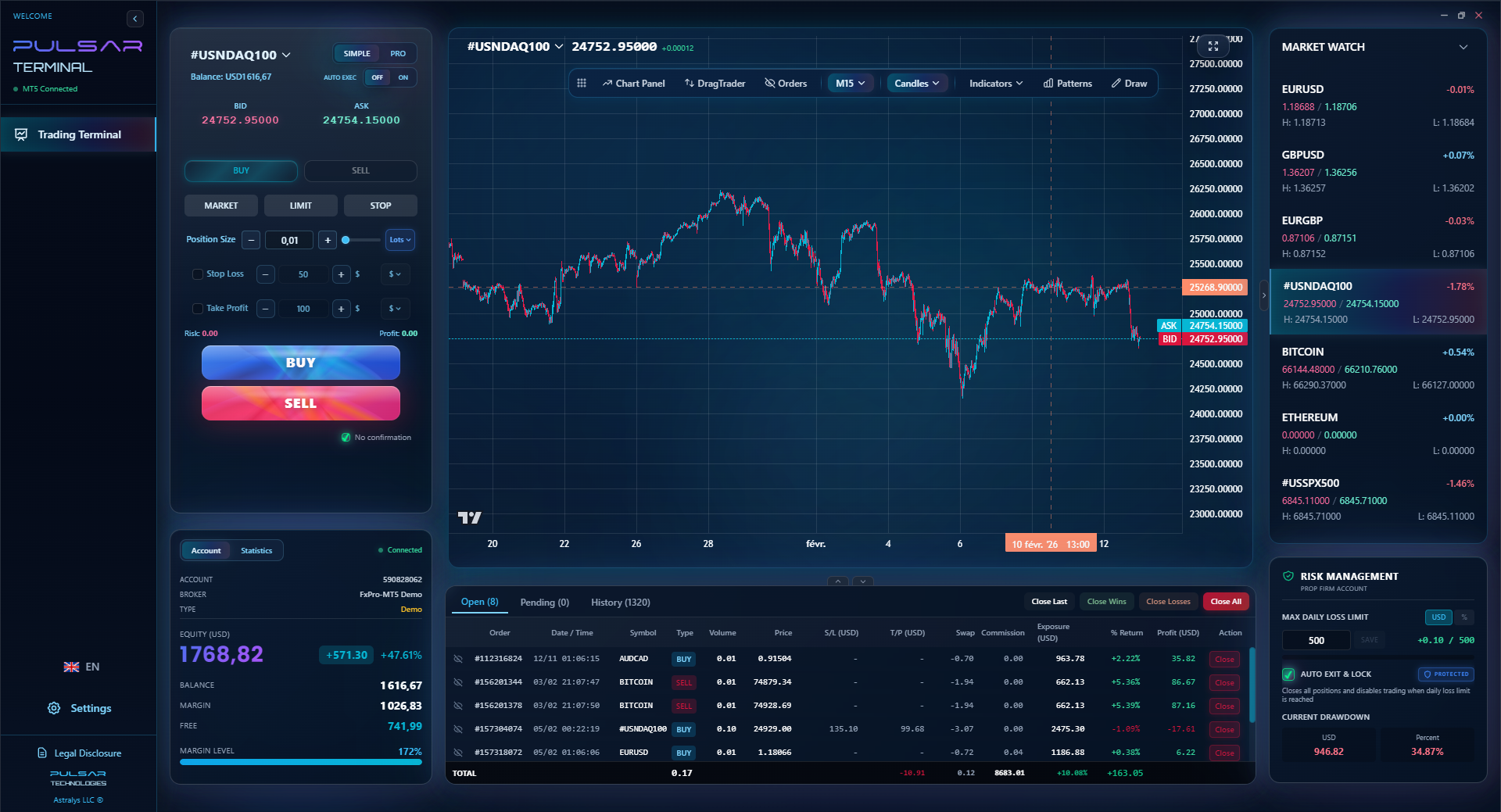
Sticking to a disciplined trading plan with precise stop-loss and take-profit levels is critical, and tools like Pulsar Terminal automate this execution directly on your MT5 platform.
Pulsar Terminal
أداة MT5 الشاملة: أوامر سحب وإفلات، متعدد TP/SL، تريلينج ستوب، تداول الشبكة، Volume Profile وحماية البروب فيرم. يستخدمها أكثر من 1000 متداول يومياً.
“The best trade I ever made was the one I didn't take, because the setup wasn't perfect.”
Let me be vulnerable. My ledger is public here.
The Big Loss (2013): I got a 'surefire' tip on EUR/USD. I ignored my rules, used extreme use, and put 40% of my $1,000 account on it. The trade went my way initially, up $300. Greed set in. I didn't take profit. Then news hit, and it reversed. I watched, frozen, as it hit my stop and wiped out $400 in minutes. I was sick. That loss taught me about use and emotional discipline. It took me three months to rebuild the courage to trade again, properly.
The Validating Win (2017): I'd been practicing swing trading on GBP/JPY. I identified a clear range. Bought at support at 148.50, placed a stop at 147.90 (60 pips), and set a target at 150.00 (150 pips). Risk: $60. Potential reward: $150. I left it alone for three days. It hit the target. A simple, planned trade, executed without emotion. That $150 profit meant more than the $700 use win, because I knew I could repeat the process.
The Lesson: The market doesn't care about your rent, your dreams, or your 'need' to win. It's a probability game. Your job is to manage risk so you can stay in the game long enough for probability to work in your favor. The best trade I ever made was the one I didn't take, because the setup wasn't perfect. That's a skill no one advertises.
💡 نصيحة وينستون
The trend on the weekly chart is your boss. Never take a trade on the 15-minute chart that goes directly against what the weekly chart is telling you. You're just arguing with a stronger force.
“The market doesn't care about your rent, your dreams, or your 'need' to win.”
So, why should I trade forex? You shouldn't, if you're looking for easy money, a side hustle without effort, or an escape from financial pressure. That path leads to loss.
You should trade forex if you're fascinated by global economics, if you have a disciplined mind, and if you're willing to treat it like a serious craft that takes years to master. You should trade forex for the intellectual challenge, for the potential of uncapped earnings on your own terms, and for the profound self-knowledge it forces upon you.
It's legal here. It's accessible. The potential is real. But the barrier to success isn't money - it's mindset. Start small. Learn relentlessly. Protect your capital like your life depends on it. Maybe you'll find, as I did, that the greatest profit wasn't in the money, but in the person you have to become to earn it consistently.
The question isn't really 'why should I trade forex?' It's 'am I the type of person who can?' Only you can answer that. But now, at least, you have the real map - not the brochure.
FAQ
Q1Is forex trading legal and safe in Nigeria?
Yes, it's legal for individuals. The Investments and Securities Act (ISA) 2025 now requires platforms operating within Nigeria to register with the SEC for increased safety. Most Nigerian traders also use reputable international brokers regulated by bodies like the UK's FCA or ASIC in Australia, which is a common and legal practice. Safety comes from your choice of a properly regulated broker.
Q2How much money do I need to start forex trading in Nigeria?
You can start with very little. Some brokers offer minimum deposits as low as $1, ₦4,000, or even $0. However, I strongly recommend starting with a minimum of $50-$100 (₦40,000-₦80,000) on a live account. This amount is meaningful enough to teach you real emotional control but small enough that losing it won't cripple you financially while you learn.
Q3How are my forex trading profits taxed in Nigeria?
Profits are typically subject to a 10% Capital Gains Tax, payable to the Federal Inland Revenue Service (FIRS). If trading is your primary business, the income may be taxed as business income. It's crucial to keep detailed records of all your trades, deposits, and withdrawals for tax purposes.
Q4What's the most important skill for a beginner forex trader?
Risk management. Full stop. Before you learn how to make money, learn how not to lose it. This means using a stop loss on every trade, risking only a tiny percentage of your account (like 1%), and never letting a single trade blow you up. Mastering this keeps you in the game.
Q5Can I trade forex part-time while working a 9-5 job in Nigeria?
Absolutely. The 24-hour market is a major advantage. Many traders focus on the London session (afternoon in Nigeria) or the New York session (evening). Swing trading, where you hold trades for days, is perfect for part-timers as it doesn't require staring at charts all day. I did it for years.
Q6What is use and why is it so dangerous?
use is a loan from your broker that lets you control a large position with a small deposit (e.g., control $10,000 with $100). It's dangerous because it magnifies both profits AND losses. A small move against you can wipe out your entire deposit. High use (like 1:500) should be used with extreme caution, if at all, by beginners.
Q7What's the difference between a demo and a live trading account?
A demo account uses virtual money. It's perfect for learning the platform and testing strategies without risk. A live account uses real money. The critical difference is psychology. Fear, greed, and hope only appear with real money. You must transition to a small live account to truly learn to trade.
درس البروفيسور وينستون
النقاط الرئيسية:
- ✓Risk only 1% of capital per trade.
- ✓use above 1:30 is for experts, not beginners.
- ✓Spend 80% of time analyzing, 20% trading.
- ✓Your first goal is survival, not profit.
- ✓A written plan beats a gut feeling every time.
ما مدى فائدة هذا المقال؟
انقر على نجمة للتقييم
رؤى التداول الأسبوعية
تحليلات واستراتيجيات أسبوعية مجانية. بدون رسائل مزعجة.
عن المؤلف
Olumide Adeyemi
رائد التداول في غرب أفريقيا
أحد أنشط معلمي تداول الفوركس في نيجيريا. 8 سنوات من الخبرة في التداول من لاغوس. متخصص في استراتيجيات رأس المال المنخفض وتحديات شركات البروب للمتداولين الأفارقة.
التعليقات
تحذير من المخاطر
ينطوي تداول الأدوات المالية على مخاطر كبيرة وقد لا يكون مناسبًا لجميع المستثمرين. الأداء السابق لا يضمن النتائج المستقبلية. هذا المحتوى لأغراض تعليمية فقط ولا ينبغي اعتباره نصيحة استثمارية. قم دائمًا بإجراء بحثك الخاص قبل التداول.
قد يعجبك أيضًا

Cara Trading Forex Sukses: 7 Prinsip dari Trader Profesional
Cara trading forex sukses dengan 7 prinsip trader pro: manajemen modal, disiplin, journal trading, backtest. Data nyata, bukan janji profit palsu.
Jam Trading Forex Terbaik untuk Trader Indonesia: Panduan Lengkap dengan Tabel Waktu
Panduan jam trading forex untuk trader Indonesia. Tabel 4 sesi dunia, jam emas 20:00-00:00, sesi mana yang harus dihindari. Data akurat + tips dari trader berpengalaman.
Top 5 Sàn Forex Uy Tín Nhất 2026: Review Jujur dari Trader Indonesia
Top 5 sàn forex uy tín 2026 untuk trader Indonesia. Review jujur: spread, deposit, withdraw, dukungan lokal. Exness, XM, IC Markets & lebih.
احصل على Pulsar Terminal
جميع هذه الحاسبات مدمجة في Pulsar Terminal مع بيانات حية من حساب MT5 الخاص بك.
احصل على Pulsar Terminal