


A student of mine blew a $100,000 FTMO challenge on day three.

Daniel Harrington
محلل تداول أول · MT5 specialist
☕ 9 دقائق قراءة
ما ستتعلمه:
- 1What Prop Firms Actually Measure (And Where Traders Get Blindsided)
- 2Step-by-Step: Build Your Daily Loss Limit Framework Before You Log In
- 3Position Sizing That Survives Bad Weeks, Not Just Bad Days
- 4The 3 Non-Negotiable Rules for Prop Firm Weekends and News Events
- 5Hitting the Profit Target Without Racing the Clock
A student of mine blew a $100,000 FTMO challenge on day three. Not because he couldn't trade. He sized a gold trade at 2.0 lots on a Friday afternoon, XAU/USD dropped 180 pips into the U.S. session close, and that single position wiped 9.4% of his account before he could close it manually. Challenge gone, $540 entry fee gone, three weeks of prep gone. The brutal truth is that most traders don't fail prop firm challenges because of bad analysis. They fail because they never built a risk framework that accounts for the specific, rigid rules these firms run. This blueprint fixes that.

Risk management separates challenge survivors from account blowers. The trader who sized 2.0 lots on gold lost 9.4% in one position—the difference between a blown $540 entry fee and a controlled drawdown is a pre-built loss framework, not better luck.
What Prop Firms Actually Measure (And Where Traders Get Blindsided)
Before you calculate a single lot size, you need to know exactly what rules you're operating under. FTMO, My Forex Funds (MFF), and The Funded Trader (TFF) all run slightly different models in 2025, and the differences matter a lot when you're building your risk structure.
Here's the current challenge structure across the three main firms:
| Firm | Account Size | Profit Target (Phase 1) | Max Daily Loss | Max Total Drawdown | Challenge Fee |
|---|---|---|---|---|---|
| FTMO | $100,000 | 10% ($10,000) | 5% ($5,000) | 10% ($10,000) | $540 |
| My Forex Funds | $100,000 | 8% ($8,000) | 5% ($5,000) | 10% ($10,000) | $299 |
| The Funded Trader | $100,000 | 10% ($10,000) | 6% ($6,000) | 12% ($12,000) | $499 |
The column that destroys most traders is the Max Daily Loss. This isn't a suggestion. It's a hard cut. At FTMO, if your account equity drops $5,000 in a single calendar day (they measure from the prior day's end-of-day balance), the challenge is over. Done. No appeal.
The second thing people miss is that the daily loss limit resets at midnight CET for FTMO, not at your local time. I've seen traders in Asia absolutely wrecked by this because they thought they had more runway than they did. Know your firm's reset clock before you place a single trade.
For a full breakdown of how spread costs eat into your daily limit on pairs like EUR/USD, factor in both the spread on entry and exit when calculating your real risk per trade.

FTMO, MFF, TFF—each has different daily loss limits, max drawdowns, and profit targets. Ignoring the fine print because you 'already know the rules' is how traders blow challenges in week one.
“Most traders don't fail prop firm challenges because of bad analysis. They fail because they never built a risk framework that accounts for the specific, rigid rules these firms run.”
Step-by-Step: Build Your Daily Loss Limit Framework Before You Log In
This is where most trading plans fall apart. People write vague rules like 'don't lose too much in one day.' That's not a plan. Here's the actual process I use and teach.
Step 1: Establish your hard stop dollar amount. Take your firm's daily loss limit and cut it to 70%. If you're on a $100,000 FTMO account with a $5,000 daily loss limit, your personal daily stop is $3,500. That 30% buffer is your protection against slippage, spread spikes, and the psychological spiral that happens when you're close to the edge.
Step 2: Divide that daily stop by your planned number of trades. If you plan three trades per day, each trade risks a maximum of $3,500 / 3 = $1,167. Round down to $1,100 to keep the math clean.
Step 3: Convert dollar risk to lot size using your actual stop loss distance. Formula: Lot Size = Dollar Risk / (Stop Loss in Pips x Pip Value)
For EUR/USD, one standard lot moves $10 per pip. If your stop is 40 pips and your dollar risk is $1,100: Lot Size = $1,100 / (40 x $10) = 2.75 lots
For XAU/USD (gold), one standard lot moves $10 per pip at most brokers, but gold pips are measured differently. A 100-pip stop on gold (which is $1.00 of price movement) = $1,000 risk per standard lot. So with a $1,100 risk on a 100-pip gold stop: Lot Size = $1,100 / $1,000 = 1.1 lots
I always run this through a position size calculator before entering the trade, not in my head. Doing this math mentally when you're excited about a setup is where errors happen.
Step 4: Set your MT5 account alerts before you trade. In MT5: View → Terminal → Trade tab. Right-click anywhere in that panel and you can set equity alerts. Set one at your personal daily stop ($3,500 below yesterday's closing equity in this example). When that alert fires, you close everything and walk away. No exceptions.
Step 5: Track open drawdown, not just closed P&L. Prop firms count your floating losses against the daily limit. This catches traders off guard constantly. A position that's sitting at -$2,000 open drawdown counts against your $5,000 daily cap even if you haven't closed it yet. Watch your equity line, not your balance line, in the Terminal tab.
Common mistake: Traders monitor their balance on MT5's top toolbar. The balance doesn't update until trades close. Your equity is the number that matters for daily loss calculations. Get into the habit of watching equity.
Pro tip: Build a simple spreadsheet that logs your starting equity each day when you open the terminal. Update it manually if your broker platform doesn't auto-track. It sounds old-school but it takes 10 seconds and has saved several of my students from late-day mistakes.

💡 نصيحة وينستون
Set your MT5 equity alert at your personal daily stop before you enter your first trade of the day. Every day. Not as a one-time setup. Markets change, your equity changes, and yesterday's alert level isn't today's correct number.
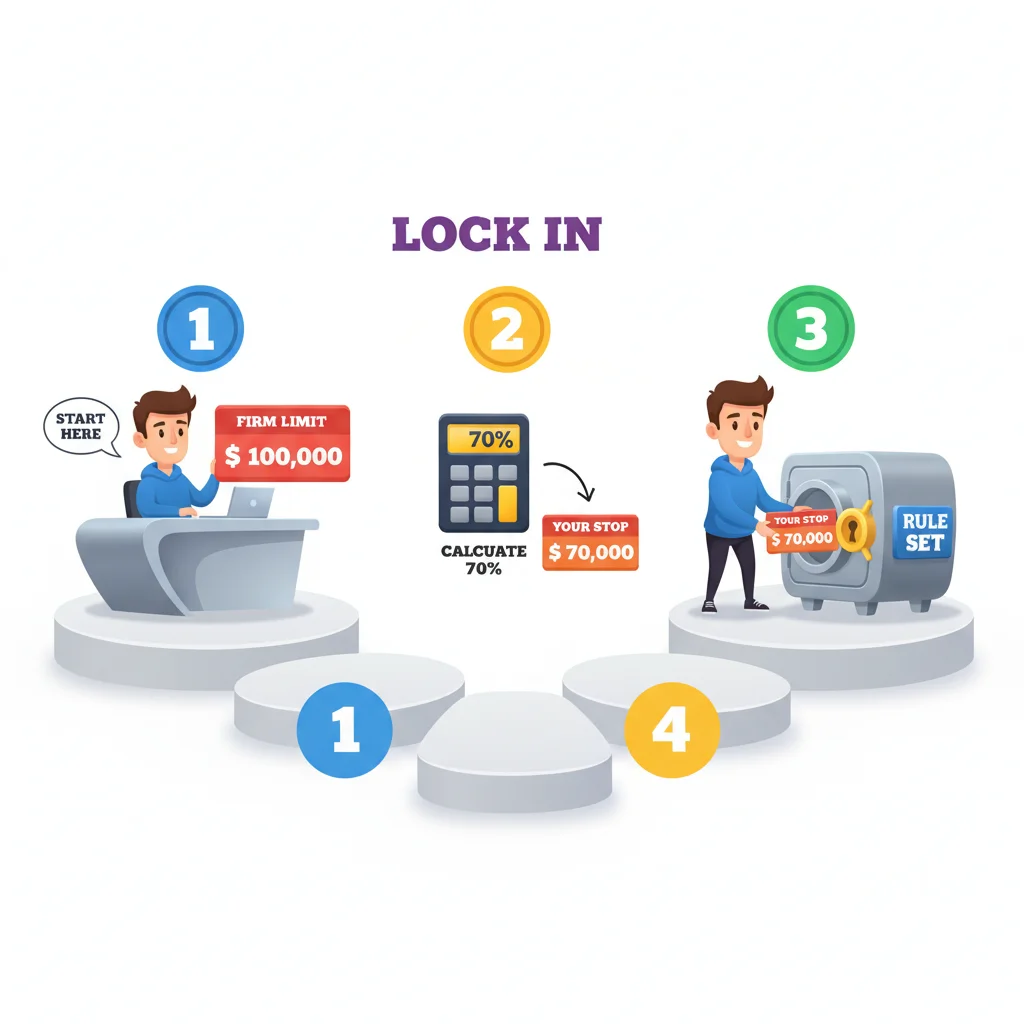
Build your daily loss limit by cutting your firm's maximum to 70% before you ever log in—this single step prevents 80% of blown challenges.
“Watch your equity line, not your balance line. The balance doesn't update until trades close, and prop firms don't care about your closed P&L when your floating losses are breaching the daily limit.”
Position Sizing That Survives Bad Weeks, Not Just Bad Days
A single good risk calculation per trade isn't enough. You need a system that survives a losing streak without compounding toward the total drawdown limit.
Let's say you're on a $100,000 FTMO account with a 10% max drawdown ($10,000). You've had three losing trades across two days and you're down $3,200. You now have $6,800 of total drawdown room left.
At this point, most traders do one of two wrong things. They either keep sizing normally (ignoring that they've already burned 32% of their total drawdown buffer) or they panic and go smaller than necessary, making it nearly impossible to reach the 10% profit target.
The right move is drawdown-adjusted position sizing. Here's how it works:
- Calculate your remaining drawdown buffer: $10,000 - $3,200 = $6,800
- Apply a 70% personal cap to that remaining buffer: $6,800 x 0.70 = $4,760 total risk left
- Divide by your expected remaining trade count for the challenge: if you expect 20 more trades, that's $4,760 / 20 = $238 per trade
- That's your new per-trade risk. It's smaller. Accept it.
I know this feels conservative. I resisted it myself for years and paid for it. In 2022 I was on a $200,000 challenge (a two-step funded program) and got to within $1,400 of the profit target before giving back everything in two days because I kept my original sizing even after drawing down. Failed the challenge with 9.8% total drawdown. Missed by a hair. The lesson cost me $780 in fees.
For pairs like GBP/USD, where volatility can be 80-120 pips on a busy London session, your stop distance matters enormously to this calculation. A tighter stop doesn't automatically mean less risk if the pair regularly blows through it.
The ATR indicator set to 14 periods on the H1 chart gives you a solid baseline for average daily range. If GBP/USD ATR(14) is reading 95 pips, don't put a 30-pip stop on a GBP/USD trade and call it managed risk. You'll get stopped out by noise before the move happens, and you'll burn 3-4 of those small losses before one winner can recover them.
💡 نصيحة وينستون
If you've hit two losing trades in a row on the same day, cut your lot size in half for the rest of that session. Your judgment is compromised when you're losing, and the challenge doesn't care about your emotional state.
“The traders who pass challenges consistently are boring. They grind 0.4-0.6% days and ignore the equity target until the last week.”
The 3 Non-Negotiable Rules for Prop Firm Weekends and News Events
Weekend gaps and high-impact news are where funded accounts go to die. I mean that literally. Three of the five challenge failures I've seen in my mentorship group this year happened over news events.
Rule 1: No open positions over the weekend. The spread on Sunday open can be 5-10x the normal spread on pairs like EUR/USD. If you're holding a 2-lot position and the spread spikes 40 pips at open, that's $800 in spread cost alone before price moves a tick. On a challenge account, you can't absorb that kind of friction repeatedly.
Rule 2: Halve your size on NFP, FOMC, and CPI days. These three events cause the most erratic price behavior. Don't stop trading them entirely if your strategy calls for it, but cut your lot size in half and widen your stop to account for the initial spike. A 50% size reduction on NFP day has never hurt my monthly returns meaningfully, but it's saved me from three potential challenge-ending trades.
Rule 3: Use a hard automation safety net. Even with all the manual rules above, you will have days where you're distracted, in a meeting, or just not watching the screen. This is exactly where something like Pulsar Terminal's Prop Firm Protection earns its place in your setup. It automatically closes all open positions before you breach the daily loss limit, with a 5% safety buffer built in, which means you don't blow a challenge because your internet dropped during a FOMC spike.
Warning: Leaving positions open over a three-day weekend (Easter, Thanksgiving week, etc.) on a prop firm account is not a calculated risk. It's a gamble. The risk-to-reward of that trade can't be evaluated when markets are closed and you have zero ability to manage the position. Just close it.

Weekend gaps and news volatility are account killers—three of my mentorship group's five challenge failures this year happened during these high-risk events. Rule 1 is non-negotiable: close all positions before the close on Friday.
“Cut your lot size in half on NFP, FOMC, and CPI days. A 50% size reduction on news day has never hurt monthly returns meaningfully, but it's saved more than a few challenges from a single bad spike.”
Hitting the Profit Target Without Racing the Clock
Most prop firm challenges don't have a time limit that's actually binding for competent traders. FTMO Phase 1 gives you 30 calendar days to hit 10%. That's roughly 0.33% per day. On a $100,000 account, that's $330 per day to stay perfectly on pace.
The mistake is treating the profit target like a deadline sprint. Traders who start chasing the target in week three are the ones who blow up in week three.
Here's the pacing model I give every student:
- Days 1-10: Trade normal size, aim for 3-4% total gain. Get comfortable with the platform and your rules.
- Days 11-20: If you're on pace (3-4% gained), continue same size. If ahead, reduce size slightly to protect the buffer.
- Days 21-30: Only increase size if you need to close a gap and you have meaningful drawdown room. Never increase size when you're already near the daily loss limit.
The traders who pass challenges consistently are boring. They grind 0.4-0.6% days and ignore the equity target until the last week. If you're ahead of pace, the worst thing you can do is add size to 'get it done faster.' Faster means more risk. More risk means the daily loss limit becomes relevant.
For high-volatility pairs like XAU/USD, one good setup can deliver 1.5-2% in a single session. That's great when it works, but the same volatility that gives you those wins can take 1.5% in 20 minutes if you're on the wrong side. Respect the asset, respect the sizing rules.
Disclaimer: This article is for educational purposes only and does not constitute investment advice. Trading forex and CFDs carries significant risk of loss. Past performance is not indicative of future results. Always do your own research and consider your financial situation before trading. Never risk money you cannot afford to lose.
💡 نصيحة وينستون
Pass the challenge by being boring. The traders who try to hit the profit target in week one are usually filling out refund requests by week two. Slow, consistent, and alive beats fast and funded-then-failed every time.
درس البروفيسور وينستون

النقاط الرئيسية:
- ✓FTMO, MFF, and TFF run different rule models in 2025—know your specific broker's requirements before trading.
- ✓Calculate daily loss limits before login; vague rules like 'don't lose too much' guarantee challenge failure.
- ✓Position sizing must survive losing streaks, not just single trades, to avoid compounding toward drawdown limits.
- ✓Weekend gaps and high-impact news caused 3 of 5 challenge failures this year—treat them as non-negotiable risk events.
❓ الأسئلة الشائعة
Q1Can I trade the same strategy I use on a live account during a prop firm challenge?
Yes, but you have to audit it first. Take your last 50 trades from your live account and calculate what the maximum consecutive loss streak was in dollar terms. If that streak would have breached the firm's daily loss limit or total drawdown limit even once, your live strategy needs sizing adjustments before you run it on a challenge. The strategy itself can stay the same. The position sizing almost always needs to come down 30-50% initially.
Q2What happens if I accidentally breach the daily loss limit by a few dollars?
At FTMO, the breach is automatic and immediate. Once equity touches the daily loss limit threshold, the challenge is flagged and terminated. There's no grace margin and no appeal process for this specific violation. MFF and TFF operate similarly. This is exactly why your personal daily stop should always be set 25-30% above (tighter than) the firm's official limit. A $3,500 personal stop on a $5,000 FTMO limit gives you a $1,500 buffer for slippage and spread spikes.
Q3How many lots should I trade on a $50,000 prop firm account with a 1% risk rule?
1% of $50,000 is $500 per trade. On EUR/USD with a 30-pip stop: Lot Size = $500 / (30 x $10) = 1.67 lots, so you'd round to 1.6 lots. On GBP/USD with a 50-pip stop: $500 / (50 x $10) = 1.0 lot. On XAU/USD with a 150-pip ($1.50 price) stop at $10 per pip per lot: $500 / (150 x $1) = 3.33 lots using gold's pip value. Always verify pip values at your specific broker because they vary between MT5 accounts.
Q4Is it better to take one large trade per day or multiple smaller trades on a prop firm challenge?
Multiple smaller trades is almost always better from a risk management standpoint, but there's a caveat. Each trade must have a full risk calculation applied individually. The reason multiple trades work better is that your daily loss cap gets consumed in smaller increments, which gives you time to realize you're having a bad day and stop before blowing the daily limit in one swing. One large trade at full daily risk is an all-or-nothing bet, and prop firms are won through consistency, not heroics. I aim for 2-3 well-selected setups per day, each risking around 0.5% of account balance.
ما مدى فائدة هذا المقال؟
انقر على نجمة للتقييم
التعليقات
ابقَ متقدمًا على الأسواق
احصل على تحليل السوق الأسبوعي واستراتيجيات التداول ونصائح MT5 في بريدك. بدون رسائل مزعجة، إلغاء الاشتراك في أي وقت.
عن المؤلف
Daniel Harrington
محلل تداول أول
دانيال هارينجتون هو محلل تداول أول حاصل على ماجستير في العلوم المالية متخصص في إدارة الأصول والمخاطر الكمية. بخبرة تزيد عن 12 عامًا في أسواق الفوركس والمشتقات، يغطي تحسين منصة MT5 واستراتيجيات التداول الآلي والرؤى العملية للمتداولين الأفراد.
احصل على Pulsar Terminal
جميع هذه الحاسبات مدمجة في Pulsar Terminal مع بيانات حية من حساب MT5 الخاص بك.
احصل على Pulsar Terminalقد يعجبك أيضًا

تحذير من المخاطر
ينطوي تداول الأدوات المالية على مخاطر كبيرة وقد لا يكون مناسبًا لجميع المستثمرين. الأداء السابق لا يضمن النتائج المستقبلية. هذا المحتوى لأغراض تعليمية فقط ولا ينبغي اعتباره نصيحة استثمارية. قم دائمًا بإجراء بحثك الخاص قبل التداول.