
Lot

/lɒt/since Early interbank forex eraLot — lot is your trade's portion size - it's how many currency units you're buying or selling in one go.
§1So, what IS a lot anyway?
Picture this: you're at a buffet. You don't just grab the entire tray of mashed potatoes, right? You take a portion - a scoop, a plateful, maybe just a taste if you're being cautious. That's exactly what a lot is in trading: your portion size. It's how many currency units you're buying or selling in one transaction. Think of it as your trade's 'helping' - too big and you might get sick (financially speaking), too small and you'll still be hungry for profits. I've seen traders blow accounts over this simple concept, so trust me, it matters. A lot isn't just some random number - it's your exposure to the market. Want to know the secret sauce of professional traders? They treat lot sizing like a chef treats seasoning: precise, measured, and never, ever haphazard.
§2The math (don't run away - it's simpler than it looks!)
Okay, I know formulas can make your eyes glaze over, but stick with me. The magic formula for sizing your trades is: Lot Size = (Account Balance × Risk Percentage) / (Stop Loss in Pips × Pip Value). See? Not so scary! Let's break it down. Your account balance is your trading capital - let's say $10,000. Risk percentage is how much of that you're willing to risk on one trade - smart traders keep it at 1-2%. Stop loss in pips is how far you'll let the market move against you before bailing. And pip value? That's how much each tiny market movement is worth to you. For EUR/USD with a standard lot, each pip is about $10. So if you risk 1% ($100) with a 50-pip stop loss, you'd trade 0.2 lots. Simple, right?
§3Here's how it plays out in real life
Let's walk through this step-by-step. Imagine you've got $10,000 in your account and you spot EUR/USD at 1.0801. You think it's going up, but you're not reckless - you'll risk only 1% ($100) with a 50-pip stop loss. First, calculate your pip value: for EUR/USD, a standard lot (100,000 units) gives you about $10 per pip. Now plug it in: $100 risk divided by (50 pips × $10 per pip) = 0.2 lots. That means you're buying 20,000 euros. If the price moves to 1.0811 (up 10 pips), your profit is 10 pips × $2 per pip (since 0.2 lots gives $2 per pip) = $20. See how the lot size directly controls your gains and losses? It's like the volume knob on your trading amplifier.
§4The weird exceptions nobody warns you about
Now, here's where things get quirky. First up: JPY pairs. While most currency pairs measure pips at the fourth decimal (0.0001), JPY pairs use the second decimal (0.01). So USD/JPY at 145.00 moving to 145.01 is one pip. Weird, right? Then there's broker specifics - some let you trade in increments of 100 units without sticking to standard/mini/micro categories. Always check your broker's contract specs! And don't get me started on regulatory limits. In Europe, ESMA caps leverage at 30:1 for major pairs, which affects how much you can trade with your margin. Oh, and CFDs? Gold might be 100 troy ounces per lot, oil 1,000 barrels. It's like trading in different measurement systems - always double-check what 'one lot' actually means for your instrument.

§5Three examples that'll make it click
Let's look at some real scenarios:
| Scenario | Pair | Entry | Exit | P&L |
|---|---|---|---|---|
| Standard lot win | EUR/USD | 1.0801 | 1.0811 (+10 pips) | +$100 |
| Mini lot loss | GBP/USD | 1.2650 | 1.2640 (-10 pips) | -$10 |
| Micro lot test | USD/CAD | 1.3500 | 1.3505 (+5 pips) | +$0.50 |
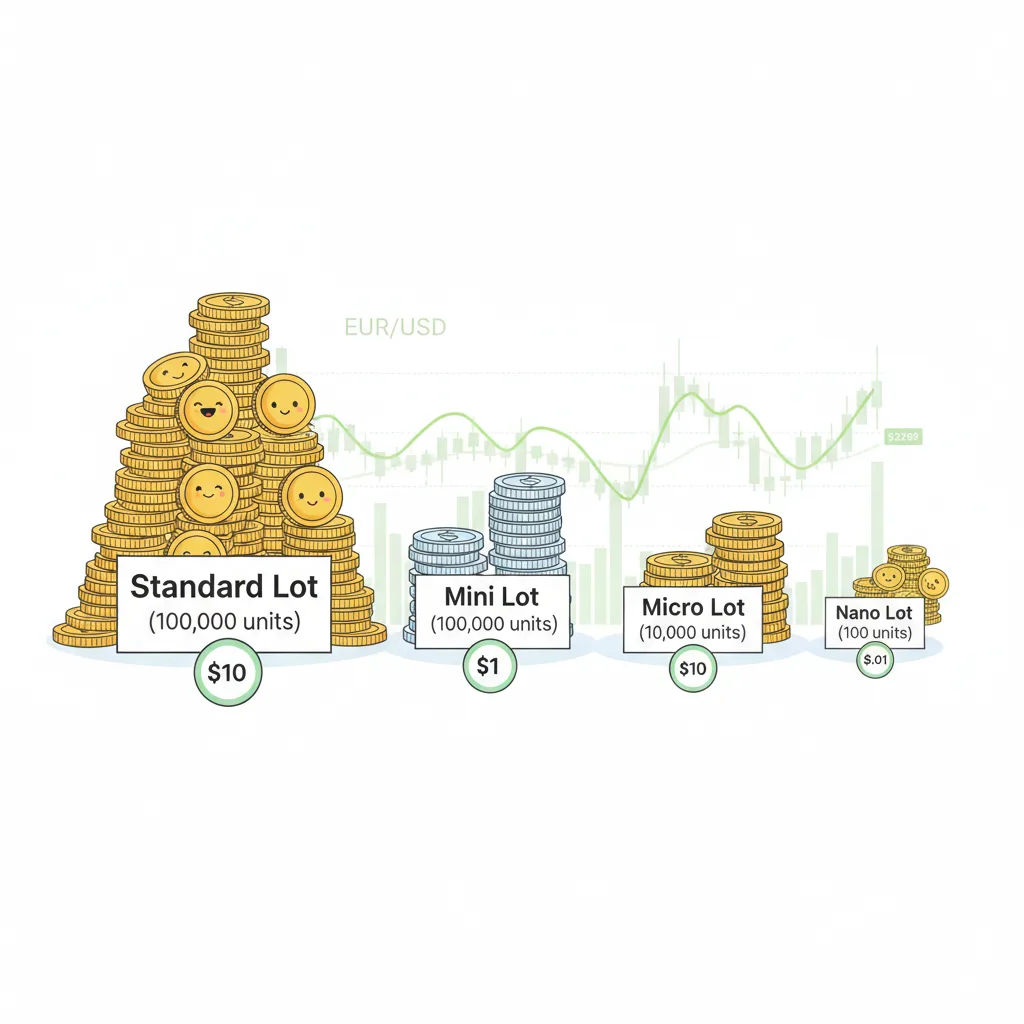
See the pattern? With EUR/USD at 1.0801, buying 1 standard lot (100,000 euros) means each pip is worth about $10. Move 10 pips to 1.0811? That's $100 profit. But with a mini lot (10,000 units), each pip is $1. And micro lots (1,000 units) give you $0.10 per pip. It's like choosing between a family-sized pizza, a personal pan, or just a slice - same ingredients, different portions.
§6Where this thing even came from
Back in the early days of currency trading, before screens and algorithms, traders would literally shout deals across crowded rooms. They'd negotiate 'batches' or 'lots' of currencies - no standardization, just whatever amount made sense for that deal. Can you imagine the chaos? As markets grew, this became unsustainable. Enter standardization: someone smart decided, 'Hey, let's make these lots uniform so we all know what we're trading.' Thus, the standard lot of 100,000 units was born. This allowed for efficient trading of those tiny price movements (pips) we now obsess over. It transformed forex from a wild west of random quantities into the streamlined market we know today. My first year trading, I wish someone had explained this history - it would've saved me from thinking lots were just arbitrary numbers!
§7Key takeaways
- A lot is your trade's portion size - standard (100k units), mini (10k), micro (1k), or nano (100 units).
- Always use the risk formula: Lot Size = (Account Balance × Risk %) / (Stop Loss × Pip Value).
- Start small with micro lots if you're new - each pip is only about 10 cents on EUR/USD.
- JPY pairs are weirdos: pips are at the second decimal (0.01) not the fourth (0.0001).
§8Frequently asked questions
QWhat's a lot in simple terms?
QHow many units are in different lot sizes?
QWhy does lot size even matter?
QHow do I choose the right lot size?
QWhat's the pip value for different lots?
§See also
§References
- Forex Trading Basics: Lot Sizes and Risk Management — The Trading Mentor Research
- CFD and Forex Contract Specifications — Broker Industry Standards