
Stop Loss

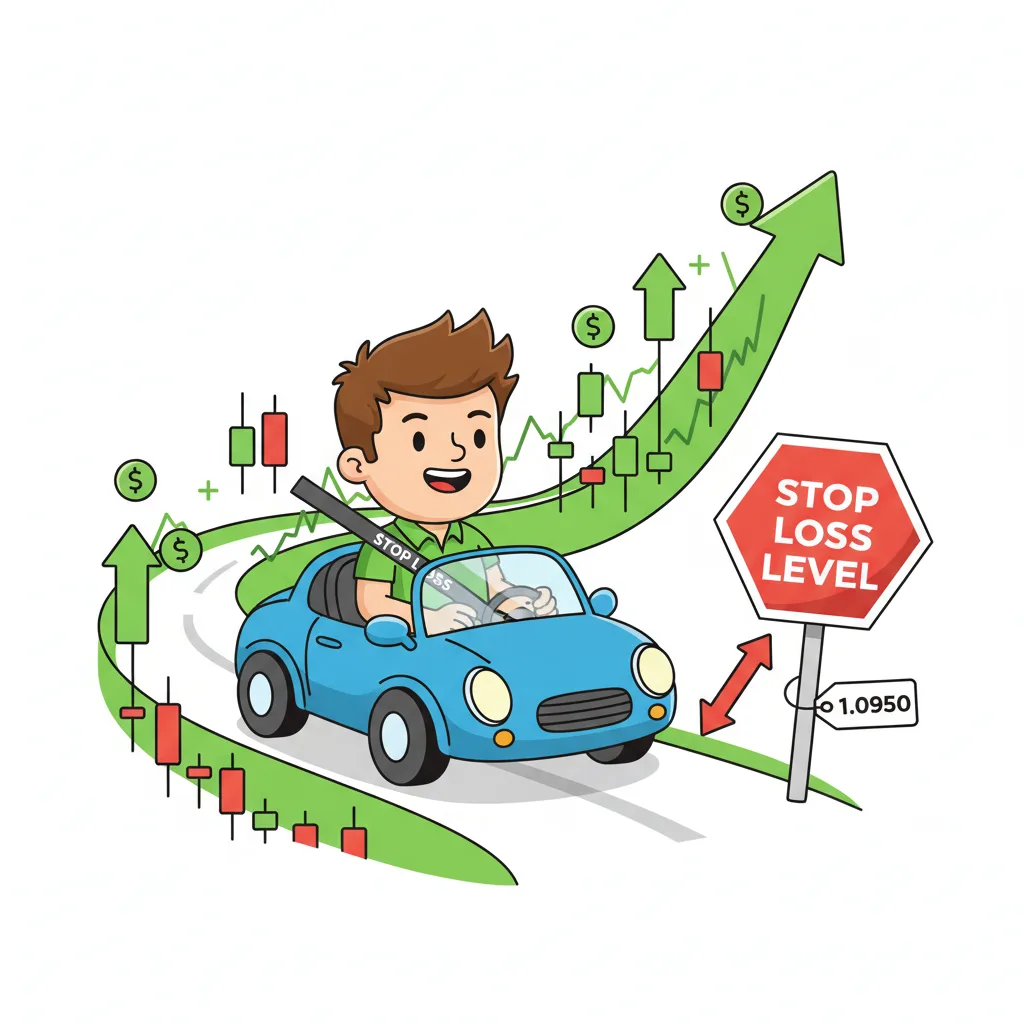
stop-losssince Early 1900s (first recorded 1901)Stop Loss — Your trading seatbelt—an automatic order that closes a losing position before it crashes your account.
§1So, what IS a stop-loss? Your trading seatbelt!
Picture this: you're driving down the trading highway, feeling confident about your EUR/USD position. Suddenly, economic news hits and the market swerves against you. Without a stop-loss, you're that driver without a seatbelt—heading straight for a financial crash. A stop-loss order is your automated safety system. It's an instruction you give your broker that says, 'Hey, if this trade goes south beyond this specific price, close it automatically!' For a buy position, you place it below your entry price. For a sell, you place it above. When the market hits that level—bam!—your position gets closed at the best available price. I've seen traders blow accounts over this, thinking they could 'ride it out.' Trust me, you can't out-stubborn the market. Think of it as your pre-agreed exit strategy before emotions take the wheel.
§2The math (don't run away—it's simpler than it looks!)
Okay, I know numbers can make your eyes glaze over, but stick with me. There's no single magical formula, but here's the basic logic. If you buy EUR/USD at 1.1000 and decide you're only willing to lose 50 pips, your stop-loss price is simply 1.1000 minus 0.0050 (that's 50 pips), which equals 1.0950. For a short position, you add instead: sell at 1.2500, stop at 1.2550. The real magic happens when you connect this to your account. Most pros risk 1% to 3% of their account per trade. So if you have $10,000 and risk 2%, that's $200 max loss. You then figure out how many pips that equals based on your position size. See? It's just arithmetic with a purpose—protecting your hard-earned cash.
§3Here's how it plays out in real life (with real prices!)
Let's walk through two scenarios so you can see exactly how this works. First, imagine you're bullish on Europe and buy EUR/USD at 1.1000. You decide 50 pips is your pain threshold, so you set your stop at 1.0950. If the pair drops to that level, your broker automatically closes your position. Loss capped at 50 pips—annoying, but not catastrophic. Now flip it: you think the British pound is overvalued, so you sell GBP/USD at 1.2500. Your analysis says if it rises above 1.2550, your thesis is wrong. So you set your stop there. If it hits 1.2550, you're out with a 50-pip loss. The key is setting that level BEFORE you enter the trade, not when you're sweating over charts later.
§4The weird exceptions nobody warns you about
Now, here's where things get interesting. First, JPY pairs—they're the quirky cousin in the forex family. While most pairs use four decimals (where 0.0001 = 1 pip), JPY pairs typically use two decimals. So USD/JPY moving from 150.00 to 150.01 is 1 pip. Don't get caught out! Then there's slippage—when the market moves so fast your stop gets executed at a worse price than you specified. Imagine setting your stop at 1.0950 but getting filled at 1.0945. Ouch. And gaps? Those happen when prices jump overnight or during big news, skipping right over your stop level. Some brokers offer 'guaranteed stop-loss orders' (for a small fee) to prevent this. Yeah, the market has tricks, but now you know them!

§5Three examples that'll make it click
Let's make this concrete with a quick comparison table:
| Scenario | Pair | Entry | Stop Loss | Outcome | P&L |
|---|---|---|---|---|---|
| Long EUR/USD | EUR/USD | 1.1000 | 1.0950 | Price drops, stop triggers | -50 pips |
| Short GBP/USD | GBP/USD | 1.2500 | 1.2550 | Price rises, stop triggers | -50 pips |
| Long Gold CFD | XAU/USD | $1,700 | $1,680 | Price falls, stop hits | -$200 |
Here's the gold example in detail: You buy 10 Gold CFDs at $1,700 per ounce. You decide $200 is your max loss. Since each point move might be worth $10 with your position size, you set your stop at $1,680 (that's 20 points down × $10 = $200). If gold drops to $1,680, you're automatically out. See how it all connects? Your risk percentage determines your dollar risk, which determines your stop distance.
§6Where this thing even came from
The term 'stop-loss' has been around longer than you might think—since the early 1900s! The Oxford English Dictionary has records from 1901. Traders have always known they needed to limit losses, but back then it was probably a shouted instruction across a trading floor. The formal order type became widespread with computer trading. Fast forward to 2020, and regulators like the UK's FCA capped retail leverage at 1:30 for major pairs, making stop-losses even more crucial. Why? Because with high leverage, small moves can wipe you out faster. So while the concept is over a century old, it's never been more relevant. My first year trading, I learned this the hard way—now I never enter a trade without one.
§7Key takeaways
- Always use a stop-loss—it's your trading seatbelt that prevents account crashes.
- Risk only 1-3% of your account per trade, then calculate your stop distance from that.
- Place stops logically (below support/above resistance), not arbitrarily.
- Watch for JPY pairs (2 decimals) and consider guaranteed stops during volatile times.
§8Frequently asked questions
QWhy should I use a stop-loss order?
QWhere should I place my stop-loss?
QWhat's the difference between a stop-loss and a stop-limit order?
QCan a stop-loss get gapped or slip?
QHow does a stop-loss differ from a take-profit?
§See also
§References
- Oxford English Dictionary — Oxford University Press
- FCA Leverage Restrictions — Financial Conduct Authority