


It was March 2023, and the Naira was in freefall.

Olumide Adeyemi
Pionier des Tradings in Westafrika ·  Nigeria
☕ 13 Min. Lesezeit
Was Sie lernen werden:
- 1Why Most Forex PDFs Fail Nigerian Traders
- 2The 7 Real Winning Strategies (Adapted for Naija)
- 3Broker Selection: Your First Strategic Move
- 4Implementing Strategies with Tools That Matter
- 5Risk Management: The Only Strategy That Counts
- 6Building Your Own 'Winning PDF' (Your Trading Journal)
- 7Next Steps: Beyond the List
It was March 2023, and the Naira was in freefall. My screen showed USD/NGN at 740 on the black market rate I was tracking. I had a short position from 710, thinking I was a genius. Then the CBN made an announcement about unifying exchange rates, and the pair spiked to 780 in hours. My stop-loss? A hopeful 725. I lost 15% of my account in one trade, chasing a 'winning strategy' I'd downloaded from a forum. That experience taught me more than any PDF ever could. Let's talk about the real 7 winning strategies for trading forex, the ones that account for Nigerian spreads, 10% capital gains tax, and our unique market pressures.
You've seen them. The slick ads promising a '7 winning strategies for trading forex PDF free download' that will unlock limitless profits. They usually feature a guy on a yacht. Here's the brutal truth: those generic guides are written for a theoretical, frictionless market. They don't account for your reality.
First, they ignore Nigerian transaction costs. That 'scalping strategy' promising 5-pip profits? It assumes spreads like 0.6 on EUR/USD. But if your broker's spread is 1.4 pips on a good day, and you're paying fees to fund your account, that 5-pip target becomes 2.6 pips before you even start. Suddenly, the math doesn't work. I learned this the hard way trying to scalp GBP/JPY. The strategy backtested beautifully. In live trading, the wider spreads and occasional slippage ate 70% of the projected profit.
Second, they never mention the 10% capital gains tax on gross profits. That's right, gross. Not net. If you make N100,000 in profit this month, but had N20,000 in losses, you still pay tax on the N100,000. This changes your entire risk-reward calculation. A common 'winning' rule is to aim for a 1:2 risk-reward ratio. But with our tax, that effective reward shrinks. You need to factor it into every single trade plan, something no offshore PDF will ever tell you.
Finally, they assume easy access to liquidity and stable deposits. With Nigerian banks limiting international transactions and the constant currency volatility, managing your trading capital is a strategy in itself. Your 'winning strategy' is useless if you can't reliably fund your account or withdraw profits without losing 5% in transfer fees and exchange rate gaps.

Warning: Any strategy PDF that doesn't discuss how local spreads, taxes, and funding methods affect its profitability is academic at best, and financially dangerous at worst. Your edge comes from adapting global concepts to local constraints.

💡 Winstons Tipp
A 'winning strategy' is just a hypothesis. Your trading journal is the lab report that proves or disproves it. If you're not journaling, you're just gambling with a fancy excuse.
“Your edge doesn't come from a secret strategy, it comes from adapting global concepts to Nigerian spreads, taxes, and power outages.”
Forget the yacht PDFs. These are the seven practical frameworks that actually work when you're trading from Lagos, Port Harcourt, or Abuja. They're not magic systems, but mental models and tactical approaches.
1. The Spread-Aware Momentum Trade
This is your bread and butter. Instead of fighting high spreads, you use them as a filter. Only trade pairs where the spread is less than 30% of your average take-profit target. For most Nigerian traders, this means focusing on majors like EUR/USD and GBP/USD during London and New York overlaps when spreads are tightest. Use a simple momentum indicator like the RSI indicator to catch the wave, but your entry order must be a limit order, not a market order, to avoid spread slippage.
2. The Naira-Hedge Swing Trade
This is a macro strategy unique to our environment. You take longer-term positions (1-4 weeks) in USD/NGN or other forex pairs based on fundamental pressures on the Naira. You're not just trading charts, you're trading CBN policy, oil prices, and diaspora remittance flows. This requires patience and a larger stop-loss. The 'win' here is protecting your dollar-denominated capital from local inflation, not just making pips.
3. The High-Probability Pin Bar (with a Twist)
Pin bar candlestick patterns are popular. The twist? On your platform, measure the average spread for the pair at that time of day. The pin bar's wick must be at least 3 times the current spread to be considered valid. This filters out false signals caused by normal liquidity gaps. I use this on the XAU/USD guide (Gold) during US sessions, and it significantly improved my hit rate.
4. The News Volatility Fade
When major US news (NFP, CPI) hits, volatility spikes. Most PDFs tell you to stay out. This strategy waits for the initial insane spike (often 30-50 pips in seconds), then fades the move once liquidity returns. The key is using a position size calculator to account for the wider stop-loss needed. You're betting that the initial move was an overreaction.
5. The Correlation Hedge
Nigeria's economy is tied to oil (Brent Crude). When oil prices rise, the Naira often gets temporary strength. You can trade this correlation by going long on oil-linked currencies (like CAD) against others, while being aware of the Naira's indirect influence. This is an advanced strategy that reduces overall portfolio risk.
6. The Prop-Firm Precision Method
If you're funding a challenge with a firm like FTMO or MyForexFunds, the strategy changes. It becomes about consistent, small gains and strict daily loss limits. This is pure scalping strategy discipline, often using 5-minute charts with a strict 1:1.5 risk-reward and a 90% win rate on tiny positions. The tool you use matters here for automating rules.
7. The Mental Capital Preservation Strategy
This is the most important one. Your strategy for managing frustration, internet downtime, and power outages. This means setting hard daily loss limits (e.g., 2% of account), using guaranteed stop-losses if your broker offers them (like IC Markets review shows they do), and never trading during known 'NEPA taking light' hours in your area. Preserving capital to trade another day is the ultimate win.

Example: Let's say you have a $1000 account. A 2% daily loss limit is $20. If the spread on your desired trade is 1.5 pips, and each pip is worth $1 for your lot size, you've already lost $1.50 just entering. Your stop-loss must therefore be placed to risk only $18.50 of market movement. This is real-world strategy.
“The 1% risk rule isn't a suggestion for discipline; it's the mathematical price of admission to survive long enough to learn.”
Your broker isn't just a platform, it's a strategic variable. Choosing wrong can make even the best strategy fail. For Nigerian traders, you need to check three boxes beyond regulation.
1. Naira Account & Local Deposits: Does the broker offer a Naira-denominated account or accept local transfers via providers like Flutterwave or Paystack? This bypasses bank restrictions and saves on forex conversion fees. Brokers like Exness review and HFM offer this. Funding your account shouldn't cost you 5%.
2. Raw Spreads on Majors: Check the actual EUR/USD spread on their standard account during your main trading hours (often 2-5 PM WAT). Don't look at the 'from' number, look at the average. If it's consistently above 1.2 pips for a standard account, your scalping viability drops. Pepperstone review often shows Razor account spreads under 0.6.
3. Reliable Withdrawals: This is critical. Search for 'broker name + withdrawal Nigeria' on forums like Nairaland. How long do withdrawals take? Are they in Naira or USD? A 'winning' trade means nothing if you can't access the profit.
Here’s a quick comparison based on 2024 data:
| Broker | Avg. EUR/USD Spread (Standard) | Naira Account? | Min. Deposit (Practical) | Key for Nigerian Traders |
|---|---|---|---|---|
| Exness | ~0.7 pips | Yes | $10 (but start with $100+) | Excellent for local deposits & withdrawals. |
| IC Markets | 0.0-0.2 pips (Raw) | No | $200 | Ultra-low spreads, good for scalping. |
| XM | ~1.7 pips | No | $5 | Low minimum, but higher spreads cost you. |
| HFM | From 1.4 pips | Yes | $0 (but fund with ~$100) | High use (1:2000), local support. |
Your broker choice directly enables or disables the strategies above. A high-spread broker kills Strategy 1 and 6. A broker with slow withdrawals violates Strategy 7.
💡 Winstons Tipp
Your broker's spread isn't a fixed number. It's a tax you pay on every trade. If your strategy's average profit is 8 pips and the average spread is 2, you're giving 25% to your broker before the market even moves. Choose your battles wisely.
“The 1% risk rule isn't a suggestion for discipline; it's the mathematical price of admission to survive long enough to learn.”
You can't manually execute these strategies while battling power cuts and network issues. You need tools that automate the tedious parts and enforce discipline.
Trade Management Automation: This is non-negotiable. Let's say you're using Strategy 4 (News Fade). The market spikes, you enter, and then your internet blinks. Without automation, you're a sitting duck. You need a tool that can automatically move your stop-loss to breakeven after a certain profit, or trail a stop to lock in gains. Doing this manually under pressure is how I blew that USD/NGN trade.
Visualizing the Battlefield: Most free PDFs tell you to 'draw support and resistance.' But on a fast-moving chart, drawing accurate lines by hand is slow. Tools with pattern recognition can instantly highlight key levels, Fibonacci retracements, or chart patterns, letting you focus on the decision, not the drawing. When I started using a tool that automated this, my prep time for swing trading setups dropped from 30 minutes to 5.
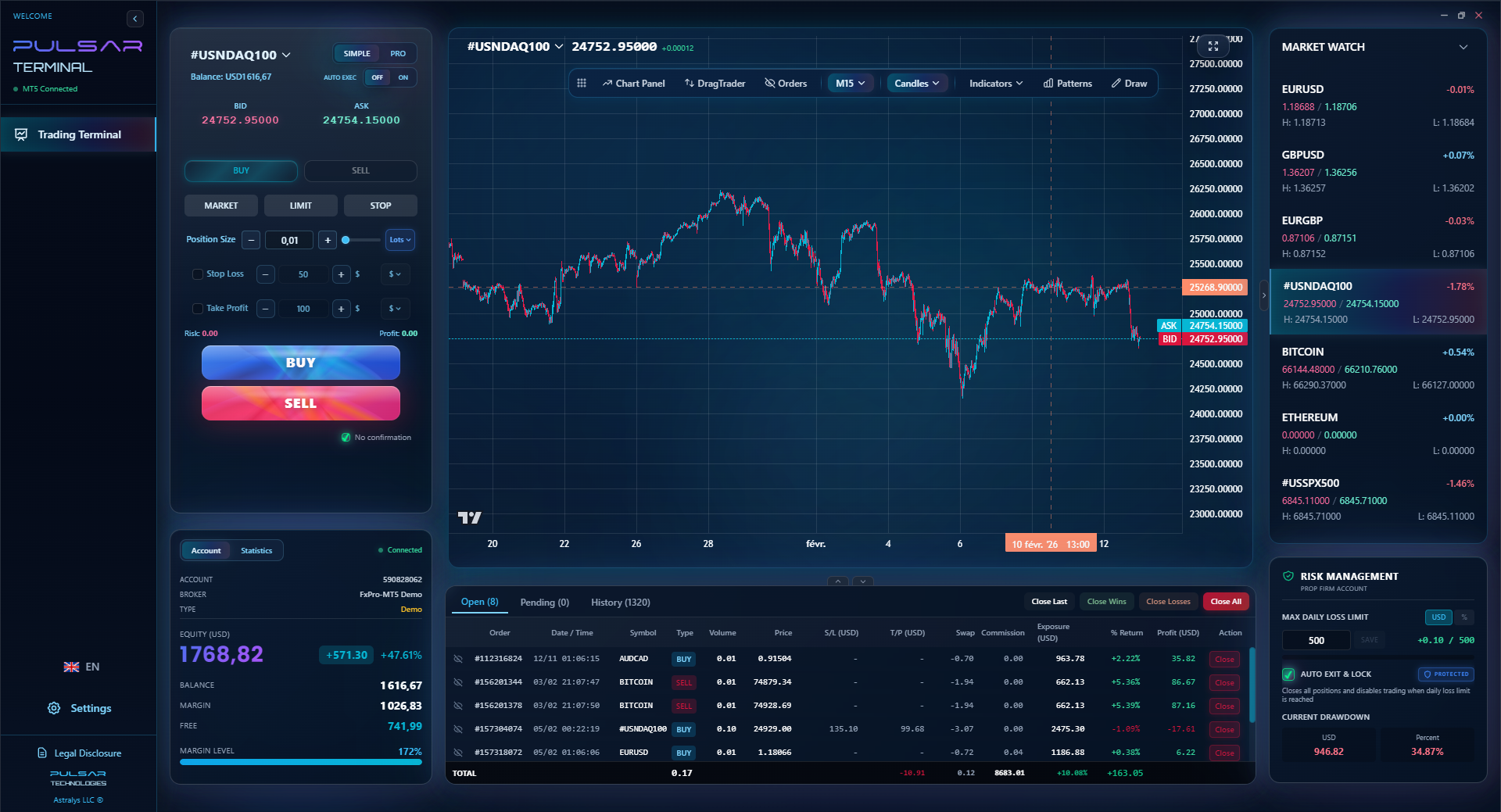
Prop Firm Compliance: If you're using Strategy 6 for a prop firm challenge, the rules are brutal. A 5% daily loss limit means if you're down 4.9%, you MUST stop. Manually tracking this is stressful and error-prone. A tool that monitors your account in real-time and can even prevent new trades once a limit is hit is a strategic advantage. It turns emotional discipline into a technical rule.
The right software acts as your co-pilot, handling the mechanics so you can focus on the strategy. It's the difference between having a map (the PDF) and having a GPS with live traffic updates (a proper trading terminal).
“A high-spread broker doesn't make trading harder; it makes your strategy mathematically impossible.”
All seven strategies above depend on one thing: not blowing up your account. I don't care how good your pin bar setup is, if you risk 10% of your capital per trade, you will be broke in a losing streak. It's not a maybe, it's a mathematical certainty.
The 1% Rule is a Starting Point: Everyone hears 'risk 1% per trade.' But what does that mean? It means before you enter a trade, you calculate your position size so that if your stop-loss is hit, you lose only 1% of your current account balance. Not your starting balance. If your account shrinks, your position size shrinks. This is survival.
Here's my personal rule, forged from loss: I risk 0.5% on normal trades and 1% only on my highest-conviction, spread-aware setups. This means with a $1,000 account, my maximum loss per trade is $5 to $10. Yes, it sounds small. But it lets me survive 20 consecutive losses, which happens to everyone. Use a position size calculator every single time. No exceptions.
Understand use, Don't Worship It: Nigerian brokers offer crazy use like 1:2000. That's a trap, not a feature. With 1:2000 on a $100 account, you can control a $200,000 position. A 5-pip move against you would wipe you out. use is a magnifier. It magnifies your gains, and your losses. For swing trading, I rarely use more than 1:10. For day trading, maybe 1:30. Anything more is gambling.
The Withdrawal Strategy: Your ultimate risk management move is regularly withdrawing profits. If you make N50,000 in a month, withdraw N15,000. Put it in a different account. This does three things: 1) It locks in real profit, 2) It psychologically reinforces success, 3) It reduces the capital you can emotionally gamble with next month. The market will always be there. Your profits might not be if you leave them on the table.

Pro Tip: Your stop-loss isn't a suggestion. It's a law. If you find yourself moving your stop-loss further away because the trade is going against you, shut down the platform and walk away. You've already lost. You're just deciding how big the loss will be. This single mistake accounts for more blown accounts than any bad strategy.
💡 Winstons Tipp
The most powerful indicator for a Nigerian trader isn't the MACD or RSI. It's your monthly profit & loss statement after accounting for the 10% capital gains tax. That's the only number that pays your bills.
Manually tracking daily loss limits for a prop firm challenge is stressful; Pulsar Terminal can automate this protection directly on your MT5 platform.
Pulsar Terminal
Das All-in-One MT5-Tool: Drag-and-Drop-Orders, Multi-TP/SL, Trailing Stop, Grid Trading, Volume Profile und Prop-Firm-Schutz. Täglich von 1.000+ Tradern genutzt.
“A high-spread broker doesn't make trading harder; it makes your strategy mathematically impossible.”
The true '7 winning strategies for trading forex PDF free download' is the one you write yourself. It's called a trading journal. This is where you move from theory to profit.
What to Record (Beyond P&L):
- Date, Pair, Strategy Used: (e.g., "March 12, EUR/USD, Strategy 1 - Spread-Aware Momentum")
- Entry/Exit Prices: Exact numbers.
- Spread at Entry: This is crucial. Note if it was wider than normal.
- Stop-Loss & Take-Profit: Did you stick to them?
- Screenshot of the Setup: Attach a chart image.
- Emotional State: Were you calm, frustrated, greedy?
- Post-Trade Analysis: Why did it win/lose? Was the spread the culprit? Was the news?
I review my journal every Sunday. After three months of logging, I saw a brutal pattern: 80% of my losses on GBP/JPY occurred between 1-3 PM WAT when liquidity was thin and spreads widened. I simply stopped trading that pair at that time. My profitability jumped instantly. The journal told me what no PDF could.
Backtesting is Your Homework: Don't risk real money on Strategy 2 (Naira-Hedge) without testing it first. Use your platform's demo account or a tool to replay old market data. See how the strategy would have performed during the 2023 Naira crash, during periods of stable oil prices, etc. This builds conviction, which is the antidote to fear and greed.
Your personalized journal, filled with local context - power outage times, optimal funding days, tax calculations - is the only 'winning PDF' you'll ever need. It turns your experience, including the painful losses, into a proprietary system.
“Your true 'winning PDF' is your trading journal, filled with the local context no offshore guru will ever understand.”
You now have seven adapted strategies, a broker checklist, and the non-negotiable rule of risk management. What's next?
Pick ONE. Just one. Master Strategy 1 (Spread-Aware Momentum) for three months. Trade it every day on a demo account, then a small live account. Know its win rate, its average loss, its feel. Trying to jump between all seven is the fastest way to master none. I spent six months only trading the News Volatility Fade (Strategy 4) before I added a second approach.
Integrate a Tool Stack: Choose your broker (IC Markets review for raw spreads, Exness review for local deposits). Then, select a charting or trade management tool that automates your chosen strategy's rules. This reduces human error, which is your biggest enemy.
Calculate Your Real Break-Even: Know your numbers. If your average winning trade is 15 pips and your average loss is 10 pips, you need a 40% win rate to break even before costs. Add in the average spread (say 1 pip) and the 10% tax on gross profits, and your required win rate might jump to 50% or more. This tells you if your strategy is viable. If it's not, tweak it: aim for larger wins (20 pips) or smaller losses (7 pips).
Forex trading from Nigeria isn't harder, it's just different. The winners aren't the ones with a secret PDF. They're the ones who do the boring work of adapting, journaling, calculating, and exercising inhuman discipline. They treat trading like a business, because that's what it is. Your strategy is your business plan. Now go execute it.
FAQ
Q1Is the '7 winning strategies for trading forex PDF free download' from online ads legit?
Almost never. They are lead magnets designed to get your email. The strategies are usually generic, unactionable theories that ignore Nigerian-specific costs like spreads averaging 1.4+ pips, 10% capital gains tax on gross profits, and funding challenges. Real strategy accounts for local friction.
Q2What is the single most important strategy for a beginner in Nigeria?
Capital Preservation (Strategy #7). Before making a single trade, learn to use a position size calculator and never risk more than 1% of your account. Master setting stop-losses and sticking to them. Your first goal isn't profit, it's surviving long enough to learn. Funding and withdrawing successfully is also part of this strategy.
Q3How do I account for the 10% capital gains tax in my trading?
You must factor it into your risk-reward. If your strategy aims for a 1:2 ratio (risk 10 pips to make 20), the tax effectively reduces your reward to 18 pips. You may need to adjust to a 1:2.2 ratio to compensate. Also, keep careful records of all trades, as you are liable for tax on your gross profits for the year.
Q4Which forex pairs are best for Nigerian traders considering spreads?
Stick to major pairs with high liquidity, especially during the London and New York session overlaps (2-5 PM WAT). EUR/USD, GBP/USD, and USD/JPY typically have the tightest spreads. Avoid exotic pairs and cross pairs like GBP/JPY during off-hours, as spreads can widen dramatically and destroy your strategy's profitability.
Q5Can I really start forex trading in Nigeria with less than $100?
Technically, yes. Some brokers like Exness allow a $10 minimum. But practically, it's very difficult. With a $50 account, even risking 2% ($1) per trade, a standard 1.5-pip spread on entry can consume a huge portion of your risk. A more realistic starting point is $300-$500, which allows for proper position sizing and can withstand normal trading costs without immediately triggering a margin call.
Q6How do I choose between a broker with low spreads and one with Naira accounts?
It's a trade-off. If you are a high-frequency scalper, low spreads (like IC Markets' raw spreads) are critical. If you are a swing trader or value easy deposits/withdrawals more, a broker with Naira accounts (like Exness or HFM) may be better, even with slightly higher spreads. , you need to prioritize based on your main strategy.
Q7What's the biggest mistake Nigerian traders make?
Using excessive use. Seeing offers of 1:1000 or 1:2000, they trade too large a position size. A small move against them wipes out the account. They confuse use with buying power. The second biggest mistake is not accounting for the total cost of trading - spreads, commissions, funding fees, and taxes - which turns a theoretically profitable strategy into a losing one.
Prof. Winstons Lektion
Wichtige Erkenntnisse:
- ✓Factor the 10% capital gains tax into every risk-reward calculation.
- ✓Test strategies against real Nigerian spreads, not theoretical ones.
- ✓Prioritize brokers with Naira accounts for reliable funding.
- ✓Use a position size calculator. Every. Single. Time.
- ✓use above 1:30 is a trap, not a tool.
Wie nützlich war dieser Artikel?
Klicken Sie auf einen Stern
Wöchentliche Trading-Einblicke
Kostenlose wöchentliche Analysen & Strategien. Kein Spam.
Über den Autor
Olumide Adeyemi
Pionier des Tradings in Westafrika
Einer der aktivsten Forex-Trading-Ausbilder Nigerias. 8 Jahre Trading-Erfahrung aus Lagos. Spezialisiert auf Strategien mit geringem Kapital und Prop-Firm-Challenges für afrikanische Trader.
Kommentare
Risikohinweis
Der Handel mit Finanzinstrumenten birgt erhebliche Risiken und ist möglicherweise nicht für alle Anleger geeignet. Vergangene Ergebnisse garantieren keine zukünftigen Renditen. Dieser Inhalt dient ausschließlich Bildungszwecken und stellt keine Anlageberatung dar. Führen Sie immer Ihre eigene Recherche durch, bevor Sie handeln.
Das könnte Sie auch interessieren

Cara Trading Forex Sukses: 7 Prinsip dari Trader Profesional
Cara trading forex sukses dengan 7 prinsip trader pro: manajemen modal, disiplin, journal trading, backtest. Data nyata, bukan janji profit palsu.
Jam Trading Forex Terbaik untuk Trader Indonesia: Panduan Lengkap dengan Tabel Waktu
Panduan jam trading forex untuk trader Indonesia. Tabel 4 sesi dunia, jam emas 20:00-00:00, sesi mana yang harus dihindari. Data akurat + tips dari trader berpengalaman.
Top 5 Sàn Forex Uy Tín Nhất 2026: Review Jujur dari Trader Indonesia
Top 5 sàn forex uy tín 2026 untuk trader Indonesia. Review jujur: spread, deposit, withdraw, dukungan lokal. Exness, XM, IC Markets & lebih.
Pulsar Terminal herunterladen
Alle diese Rechner sind in Pulsar Terminal mit Echtzeit-Daten Ihres MT5-Kontos integriert.
Pulsar Terminal herunterladen