


The screen was a sea of red.

Olumide Adeyemi
Pionier des Tradings in Westafrika ·  Nigeria
☕ 10 Min. Lesezeit
Was Sie lernen werden:
- 1What Is Forex, and Why Do Nigerians Care?
- 2The Real Mechanics (Not the Brochure Version)
- 3Choosing a Broker in Nigeria: The Minefield
- 4Core Strategies That Actually Work (When You Do)
- 5Risk Management: Your Survival Kit
- 6Common Pitfalls for Nigerian Traders (I've Hit Them All)
- 7Getting Started: Your First 100 Days

The screen was a sea of red. It was March 2020, and the USD/NGN pair on my broker's platform was doing things I'd only read about in textbooks. Liquidity had vanished. The spread, normally a tight 15 pips on a good day, blew out to over 200. My stop loss on a short position got hit at a price that shouldn't have existed, wiping out a week's gains in seconds. That wasn't just a bad trade; it was a masterclass in how the forex market really works when the world panics. It's that reality - the messy, expensive, emotionally draining one - that we need to talk about. Forget the 'get rich' YouTube ads. Let's get into all about forex trading, the real version.
Forex, or foreign exchange, is simply the global marketplace for trading national currencies against one another. It's the largest financial market in the world, with a daily turnover hitting over $7.5 trillion. For Nigerians, it's personal. It's not just about EUR/USD charts. It's about the Naira. Every time you hear your uncle complain about the dollar rate for school fees, or a business owner stressing over import costs, you're hearing the real-world impact of forex.
We trade because our economy is intrinsically linked to major currencies. The Central Bank of Nigeria's (CBN) policies, oil prices (which are in USD), and foreign investment flows directly affect the Naira's value. Trading forex, for many, is an attempt to navigate that volatility, to hedge personal exposure, or to seek opportunity in the chaos. But here's the raw truth: while the global market is huge, the average Nigerian retail trader is speculating on international pairs like GBP/JPY or XAU/USD (gold), not directly defending the Naira. Understanding that distinction is your first lesson.

Warning: Trading is not a patriotic duty to 'defend the Naira.' It's a speculative business. Confusing the two will cloud your judgment and lose you money.
Your goal isn't to outsmart the CBN. It's to execute a disciplined strategy on price movements, often on currencies that have nothing to do with Nigeria. Start by learning the pip definition, the basic building block of every move.

💡 Winstons Tipp
If you can't explain your trade setup in one simple sentence ('I'm buying here because it bounced off support with bullish momentum'), you don't have a trade. You have a hope.

“Trading is not a patriotic duty to 'defend the Naira.' It's a speculative business.”
Brokers make it look like a simple buy/sell button. It's not. When you click 'buy' on EUR/USD, you are not buying a physical thing. You're entering a contract for difference (CFD) in 99% of cases. You're betting on the price direction. The broker facilitates that bet.
The Three Markets (And Where You Are)
There's the interbank market (big banks), the institutional market, and the retail market where you and I play. We get our prices from liquidity providers via our broker, with a markup (the spread). Your trade is a drop in an ocean, and you have zero price influence.
use: Your Double-Edged Sword
This is where Nigerians get burned. use of 1:500 sounds like a shortcut. It's a trap. It amplifies both gains AND losses. I learned this the hard way in 2015. I put $100 in an account with 1:500 use. A 20-pip move against me on a standard lot wasn't just a loss, it was a margin call. My account was gone in under an hour. I was 'right' on the overall direction a day later, but my account was already history.
| use | Margin Required for 1 Lot ($100k) | Effective Capital Control |
|---|---|---|
| 1:100 | $1,000 | Moderate |
| 1:200 | $500 | High Risk |
| 1:500 | $200 | Extreme Risk (Common in Nigeria) |
The Cost of Doing Business
Your costs are the spread and possibly a commission. A 'zero spread' account usually has a commission. Always calculate your break-even point. If the EUR/USD spread is 1.2 pips, you're down $12 on a standard lot the moment you enter. You need the market to move in your favor just to get back to zero. This is why reckless scalping strategy with high use is a recipe for donating to your broker.
“use of 1:500 sounds like a shortcut. It's a trap.”
This is the most critical decision you'll make, and the landscape is full of predators. Regulation is your first, second, and third filter. An unregulated broker is not a broker; it's a gambling site where they control the dice.
Look for brokers regulated by top-tier authorities like the UK's FCA, Australia's ASIC, or Cyprus's CySEC. They offer client fund segregation, which means your money is held separately from the company's money. If the broker goes bust, your funds should be safe. I've had funds stuck with an offshore broker for 8 months after they 'had technical issues.' Never again.
For Nigerian traders, brokers with local payment options are key. Look for seamless deposits and withdrawals in Naira via bank transfer, USSD, or local e-wallets. But don't let convenience override safety. A slick deposit process means nothing if you can't withdraw.

Pro Tip: Before depositing real money, test the withdrawal process with the smallest possible amount. If there are delays, excuses, or hidden fees, run.
Based on my experience and that of my students, brokers like Exness and XM have established a strong local presence with decent payment processing. IC Markets and Pepperstone are also reputable international names that accept Nigerian clients. Do your own due diligence. Check their regulatory status TODAY, not based on an old blog post.
“use of 1:500 sounds like a shortcut. It's a trap.”
You need a system. Random trading is gambling. Here are two foundational approaches, but remember, the strategy is only 20% of the battle. Your psychology and risk management are the other 80%.
Price Action Trading: This is reading the raw price chart - support, resistance, candlestick patterns. You're looking for where the price has bounced or broken before. In early 2023, I took a long position on GBP/USD after a clear 'double bottom' pattern formed on the daily chart around 1.1800. The risk was clear (a break below 1.1780), and the reward was a move to prior resistance near 1.2200. I used a simple 1:2 risk-reward ratio. Entry: 1.1825, Stop Loss: 1.1780 (45 pips risk), Take Profit: 1.1915 (90 pips target). It worked, but only because I had the discipline to wait for the setup and not jump in early.
Indicator-Based Trading: Using tools like the RSI indicator or MACD indicator to gauge momentum. The classic mistake is using 10 indicators that all say the same thing. Keep it simple. I might use the RSI to spot overbought (>70) or oversold (<30) conditions on a 4-hour chart, then look for a price action confirmation (like a bearish engulfing candle at resistance) to enter. Never trade on an indicator signal alone.

Example: A swing trading plan for AUD/USD. Identify a weekly trend (e.g., downtrend). Wait for a pullback to a 4-hour resistance level where the RSI is near 60. Enter short on a rejection candle. SL above the recent swing high, TP at the next major support level. Calculate your position size so you risk no more than 1% of your account.
The strategy you choose is less important than sticking to it religiously. Backtest it. Then forward-test it on a demo account for at least 100 trades. Keep a journal. If you can't be consistent in demo, you'll be a disaster with real money.
💡 Winstons Tipp
Your first profit target should always be to move your stop loss to breakeven. Protecting your capital is a win. Everything after that is a bonus.

“Your stop loss is your life insurance. It's a pre-admission that you can be wrong.”
This is the chapter that separates the survivors from the sob stories. You can have a mediocre strategy and excellent risk management and still be profitable. The reverse is never true.
The 1% Rule: Never, ever risk more than 1% of your trading capital on a single trade. If you have a $1,000 account, your maximum loss per trade is $10. This isn't a suggestion; it's law. It protects you from a string of losses wiping you out. Use a position size calculator for every single trade.
Stop Losses Are Not Optional: Your stop loss is your life insurance. It's a pre-admission that you can be wrong. Placing it is not a defeat; it's a professional cost of doing business. Basing your SL on your account balance ('I can only afford to lose $20') is amateurish. Base it on the chart - place it beyond a logical level that, if broken, invalidates your trade idea.
Take Profit and Trailing Stops: Have a profit target based on a key resistance/support level. Better yet, use a trailing stop to let winners run. This is psychologically hard but crucial. I once watched a 350-pip gain on a EUR/USD guide trade shrink to 90 pips because I got greedy and didn't trail my stop. The market reversed, and I gave back most of the profit. Automation is your friend here.
Risk management isn't sexy. It's the boring, repetitive work that keeps you in the game long enough to learn and succeed.
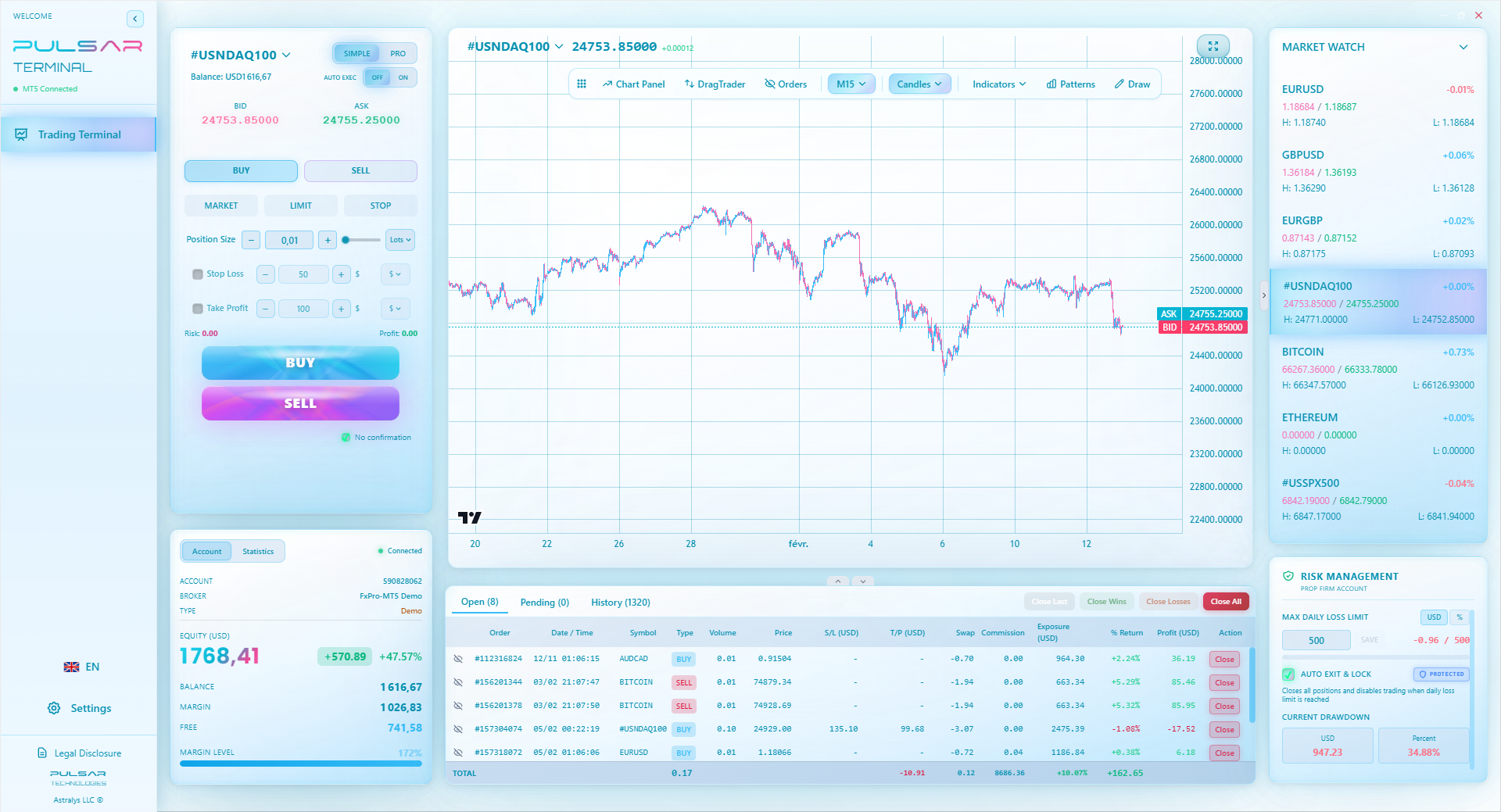
Managing multiple take-profit levels and trailing stops manually is stressful and error-prone; a tool like Pulsar Terminal automates this directly on your MT5 chart, so your strategy executes even when you look away.
Pulsar Terminal
Das All-in-One MT5-Tool: Drag-and-Drop-Orders, Multi-TP/SL, Trailing Stop, Grid Trading, Volume Profile und Prop-Firm-Schutz. Täglich von 1.000+ Tradern genutzt.
“Your stop loss is your life insurance. It's a pre-admission that you can be wrong.”
Let's be blunt about our shared cultural and environmental challenges.
Trading the News Blindly: When the CBN makes an announcement, the USD/NGN pair on the parallel market might move, but the EUR/USD on your international broker likely won't care. Don't conflate local economic anxiety with a signal to trade major forex pairs. I once bought GBP/USD because I heard 'positive UK news,' without understanding the context. It was already priced in, and I lost.
Overleveraging for 'Quick Wins': The pressure to 'blow up' an account quickly to solve financial problems is immense. This leads to using insane use on tiny accounts. You're not trading; you're buying a very expensive lottery ticket with terrible odds.
Ignoring the True Cost: Data costs, power outages, and emotional stress are real trading costs. Trading on a smartphone during a bumpy bus ride because you're anxious to 'catch a move' is a guaranteed way to make a bad decision. Your trading environment matters.
Prop Firm Hype: Passing a prop firm challenge is a skill in itself, often involving very strict risk limits and time pressures. It's not the same as sustainably growing your own capital. Many focus so hard on the challenge they have no viable plan for the funded account, leading to quick failure. The rules are different, and your strategy must adapt.
💡 Winstons Tipp
Keep a trading journal. Not just 'won/lost.' Write down your emotional state, the time, what distracted you. You'll see patterns you need to break.
“Your first year is paid tuition. The market will teach you expensive lessons.”
Here's your action plan. Skip a step, and you'll pay for it later.
- Education (Days 1-30): Don't touch a live account. Read. Understand terms like spread definition, margin, and lot size. Watch market hours. Learn one chart pattern. Follow the XAU/USD guide to see how a specific asset behaves.
- Demo Trading (Days 31-70): Open a demo account with a reputable broker. Practice executing trades. Your goal is not to make fake money. Your goal is to make every mistake in the book with fake money. Blow up a demo account. Then do it again. Practice your risk management rules until they are muscle memory.
- Live Trading (Micro Account) (Days 71-100): Fund a live account with the absolute minimum amount you can - money you can afford to lose completely. Trade the smallest possible position size (0.01 lots). Your goal for the first month with real money is to end the month with the same balance you started with, not to make profit. If you can break even while following your rules, you're ahead of 90% of beginners.
All about forex trading starts with accepting that it's a marathon, not a sprint. Your first year is paid tuition. The market will teach you expensive lessons. Your job is to make them as cheap as possible.
FAQ
Q1How much money do I need to start forex trading in Nigeria?
Technically, you can start with as little as $10 with some brokers due to high use. This is a terrible idea. Realistically, you need a minimum of $200-$500 to trade properly with sane use (1:100 or less) and micro lots (0.01), allowing you to implement the 1% risk rule without your position size being meaningless. Consider this your 'tuition fee' you are prepared to lose while learning.
Q2Is forex trading legal in Nigeria?
Yes, trading forex with international brokers is legal for individuals. The Central Bank of Nigeria (CBN) regulates the official forex market but does not license or regulate international retail forex brokers. Your protection comes from the broker's foreign regulator (e.g., FCA, ASIC). You are responsible for choosing a reputable, regulated entity. Trading on the unlicensed parallel market is a different, riskier activity.
Q3What is the best time to trade forex in Nigeria?
The most volatile (and opportunity-rich) sessions overlap from 1:00 PM to 4:00 PM Nigerian time (12:00-15:00 GMT). This is when the London session is fully open and the New York session is beginning. Liquidity is high, and spreads are typically at their tightest. Avoid trading during major Nigerian news announcements unless you are very experienced, as local bank liquidity can dry up, causing erratic spreads on Naira pairs.
Q4Can I trade the Naira (NGN) directly?
Not easily on major international retail platforms. You'll typically trade pairs like USD/NGN or EUR/NGN through local platforms or the parallel market, which carries significant counterparty risk and may have limited regulation. Most Nigerian retail traders focus on major global pairs like EUR/USD, GBP/USD, and commodities like gold (XAU/USD), where regulation and liquidity are better.
Q5Why do I keep losing money even when my analysis seems right?
This is the universal beginner experience. The most common reasons are poor risk management (position size too large), placing stops too tight (getting 'stopped out' by normal market noise), and trading psychology (exiting winners too early out of fear, or letting losers run out of hope). Your analysis might be 60% right, but if your risk management is 0%, you'll lose. Focus on the process, not the outcome of a single trade.
Q6What's the difference between a demo and live account?
The only difference is your psychology. A demo account uses virtual money, so the fear of loss and the greed for gain are absent. This creates bad habits. You might take reckless risks or be overly patient because there's no consequence. In a live account, your emotions are in the driver's seat. This is why you must transition slowly, starting with tiny real-money trades to acclimatize to the emotional pressure.
Prof. Winstons Lektion
Wichtige Erkenntnisse:
- ✓Never risk more than 1% of your capital per trade.
- ✓Regulation is your first filter for a broker. Never skip it.
- ✓A demo account is for practicing mistakes, not collecting fake money.
- ✓The strategy is 20% of success. Your psychology is the other 80%.
Wie nützlich war dieser Artikel?
Klicken Sie auf einen Stern
Wöchentliche Trading-Einblicke
Kostenlose wöchentliche Analysen & Strategien. Kein Spam.
Über den Autor
Olumide Adeyemi
Pionier des Tradings in Westafrika
Einer der aktivsten Forex-Trading-Ausbilder Nigerias. 8 Jahre Trading-Erfahrung aus Lagos. Spezialisiert auf Strategien mit geringem Kapital und Prop-Firm-Challenges für afrikanische Trader.
Kommentare
Risikohinweis
Der Handel mit Finanzinstrumenten birgt erhebliche Risiken und ist möglicherweise nicht für alle Anleger geeignet. Vergangene Ergebnisse garantieren keine zukünftigen Renditen. Dieser Inhalt dient ausschließlich Bildungszwecken und stellt keine Anlageberatung dar. Führen Sie immer Ihre eigene Recherche durch, bevor Sie handeln.
Das könnte Sie auch interessieren

Cara Trading Forex Sukses: 7 Prinsip dari Trader Profesional
Cara trading forex sukses dengan 7 prinsip trader pro: manajemen modal, disiplin, journal trading, backtest. Data nyata, bukan janji profit palsu.
Jam Trading Forex Terbaik untuk Trader Indonesia: Panduan Lengkap dengan Tabel Waktu
Panduan jam trading forex untuk trader Indonesia. Tabel 4 sesi dunia, jam emas 20:00-00:00, sesi mana yang harus dihindari. Data akurat + tips dari trader berpengalaman.
Top 5 Sàn Forex Uy Tín Nhất 2026: Review Jujur dari Trader Indonesia
Top 5 sàn forex uy tín 2026 untuk trader Indonesia. Review jujur: spread, deposit, withdraw, dukungan lokal. Exness, XM, IC Markets & lebih.
Pulsar Terminal herunterladen
Alle diese Rechner sind in Pulsar Terminal mit Echtzeit-Daten Ihres MT5-Kontos integriert.
Pulsar Terminal herunterladen