


Thinking about trading futures with a prop firm's capital? Alpha Futures is one name you'll see everywhere.

James Mitchell
Senior Trading-Analyst
☕ 10 Min. Lesezeit
Was Sie lernen werden:
- 1What Exactly is Alpha Futures?
- 2The Real Costs: Subscriptions, Fees, and Hidden Charges
- 3The Rules: How to Pass (And How to Blow It)
- 4Getting Paid: Profit Splits and Payout Process
- 5Platforms, Tools, and the US Trader's Reality
- 6Alpha Futures vs. Other Prop Firms: A Quick Comparison
- 7Final Verdict: Who Should (and Shouldn't) Try Alpha Futures?

Thinking about trading futures with a prop firm's capital? Alpha Futures is one name you'll see everywhere. But is it the right fit for you, or just another expensive challenge? I've traded with them, passed an evaluation, and seen the good and the bad. Let's break down exactly how Alpha Futures works, what it costs, and whether you should put your money on the line.
Alpha Futures is a proprietary trading firm based in the UK that gives traders access to capital to trade futures contracts. You don't use your own money for the trades, just theirs. The catch? You have to prove you can trade profitably and manage risk first by passing their evaluation program.
They're part of a new wave of prop firms that use a subscription model. You pay a monthly fee for a chance to trade a simulated account. If you hit their profit targets without breaking their risk rules, they'll give you a funded account (they call it a 'Qualified Account'). From there, you keep a big chunk of the profits you make.
It sounds straightforward, but the devil is in the details. Their rules, costs, and platform setup are what make or break the experience. I remember signing up for my first $50k evaluation, thinking it was just like any other challenge. I learned quickly it wasn't.

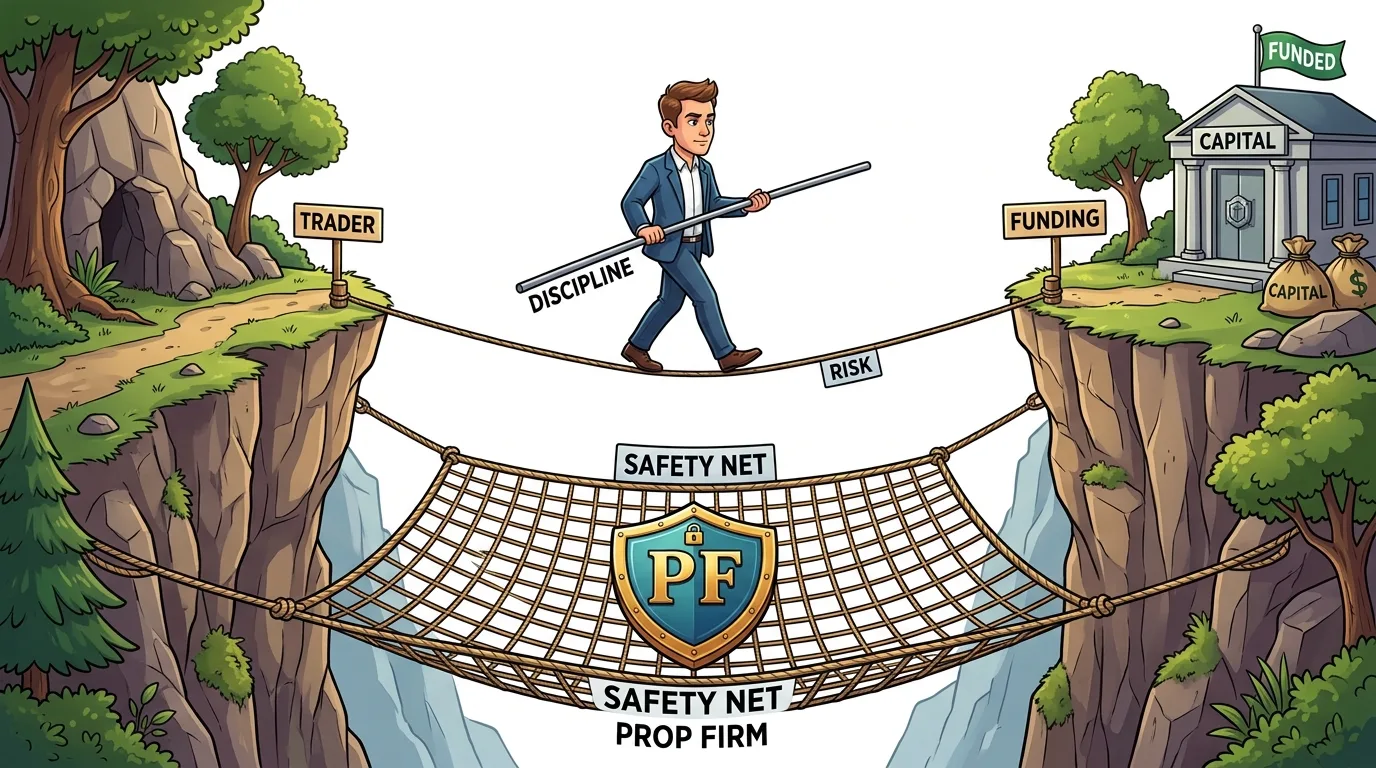
Warning: Don't confuse 'funded' with 'free money.' You're trading the firm's capital, but you're still risking your subscription fees, time, and mental energy. It's a business arrangement, not a grant.
This is where you need to sharpen your pencil. The upfront cost isn't just one fee; it's a stack of them. Let's talk real numbers, because this math decides if the whole endeavor is even worth it.
Monthly Evaluation Fees
You pay these every month you're in the evaluation phase. As of early 2026:
- $50,000 Standard Plan: $79/month
- $100,000 Standard Plan: $159/month
- $150,000 Standard Plan: $239/month
The 'Advanced' plans cost more but offer a better profit split from the start.
The Activation Fee
This one stung a bit. After you pass the evaluation, you have to pay a one-time activation fee to get your Qualified Account. For Standard and Advanced plans, that's $149. They do have a 'Zero Plan' with a $0 activation fee, but the total cost structure is different.
The Costs You Might Miss
This is critical. Once you're funded, you're no longer a retail trader in the eyes of the exchange. You're professional. That means market data fees.
If you want to trade the E-mini S&P 500 (ES) or Micro E-mini (MES) futures, you need data from the CME Group. As a professional, that's about $130 per month, per exchange. This comes out of your pocket, not the firm's capital. I wasn't fully prepared for this when I got my first payout statement; it ate into my profits more than I'd anticipated.
Then there are commissions. Alpha Futures states their fees, but remember, it's per contract, per side. A round turn on a standard futures contract will run you about $6-$8 all-in. For micros, it's about $1. It adds up fast if you're a high-volume trader or using a scalping strategy.

Example: Let's say you trade 10 MES contracts in a day (a buy and sell is one round turn). That's 10 contracts * $1 = $10 in commissions. Do that 20 days a month, and you've paid $200 in commissions before you've even made a net profit.

“The trailing drawdown is the silent killer. You can be in profit for the whole challenge and have one bad day that pulls you below a limit that has invisibly crept up behind you.”
The evaluation is a test of discipline, not just skill. Their rules are designed to filter out gamblers. Break one, and you're resetting or starting over.
Profit Target & Maximum Loss
For a Standard $50k account, you need a $2,500 profit target (5%). Your maximum loss is a 4% trailing drawdown from the starting balance or your highest equity point, whichever is higher. This is an End-of-Day (EOD) check. So if you start at $50,000, your loss limit starts at $48,000. If you make money and your equity peaks at $51,000, your new loss limit trails up to $48,960.
This trailing drawdown is the silent killer. You can be in profit for the whole challenge, have one bad day that pulls you back, and suddenly you're below a limit that has invisibly crept up behind you. I've seen it happen. It's why managing your position size is non-negotiable.
The 50% Consistency Rule
This is Alpha Futures' signature rule, and it trips up more traders than the drawdown. During the evaluation, no single day's profit can exceed 50% of your total profit.
Let's say your total profit so far is $1,000. If you make $600 on a Tuesday, you've broken the rule ($600 is 60% of $1,000). The rule forces you to trade consistently over time, not hunt for one home-run trade. Once you're funded, this relaxes to 40% for Standard plans, and Advanced plans have no consistency rule.
Trading Days
You need a minimum of 5 trading days. This stops people from trying to pass in one incredibly lucky session.
My personal mistake? I blew a $100k evaluation not on a loss, but on the consistency rule. I had a steady $3,000 profit over two weeks, got overconfident, and caught a perfect move on the NASDAQ futures for a $1,800 day. That was 60% of my total. Account failed. I was furious at myself, not at the rule. It did its job: it proved I wasn't being consistent.

💡 Winstons Tipp
The consistency rule isn't your enemy; it's your teacher. It forces you to build a strategy that works day in, day out, not one that hopes for a miracle.
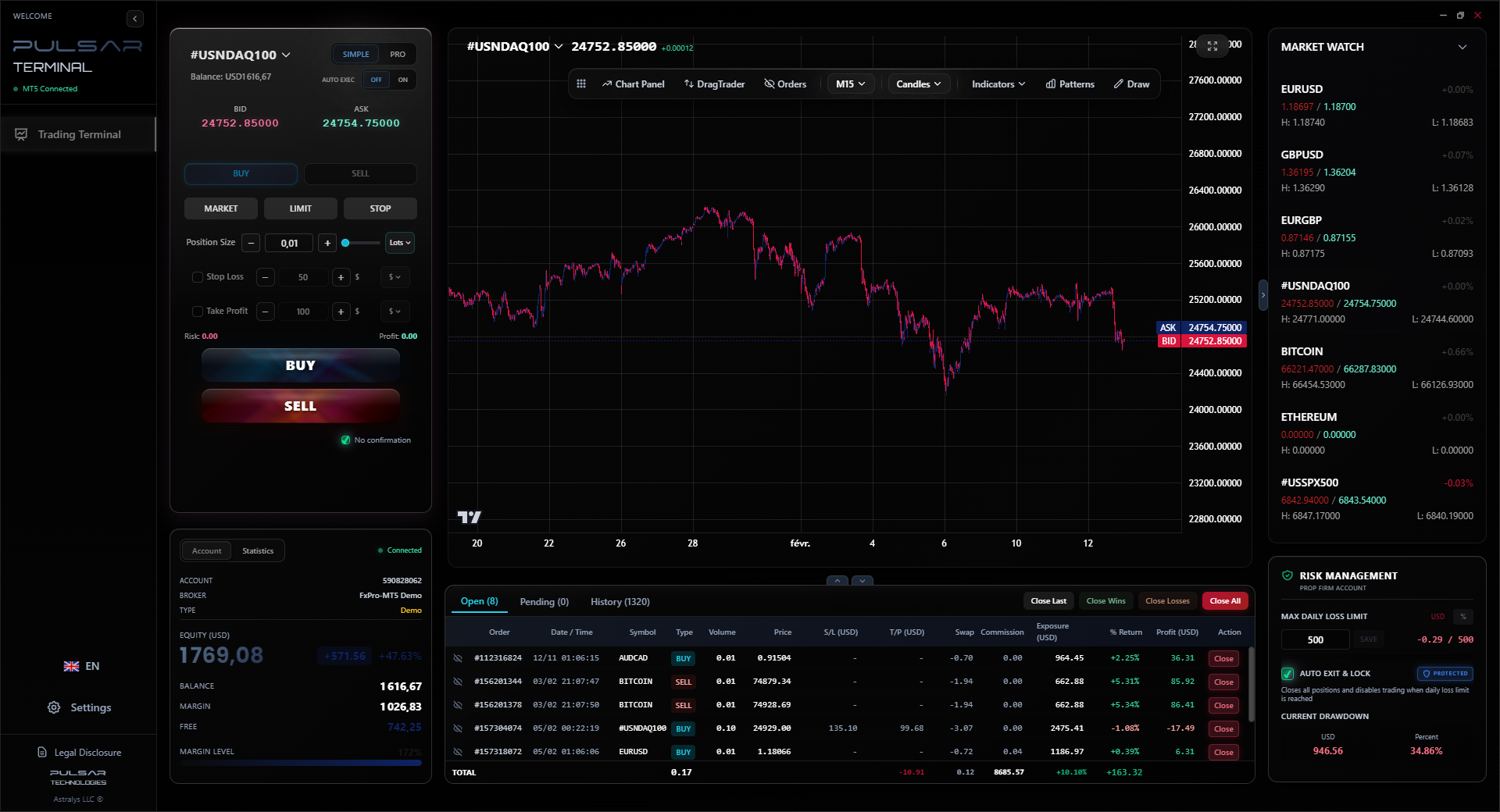
Managing a trailing drawdown and daily profit limits requires constant monitoring, a task perfectly suited for automation with a tool like Pulsar Terminal on MT5.
Pulsar Terminal
Das All-in-One MT5-Tool: Drag-and-Drop-Orders, Multi-TP/SL, Trailing Stop, Grid Trading, Volume Profile und Prop-Firm-Schutz. Täglich von 1.000+ Tradern genutzt.
This is the whole point, right? Let's talk about how you actually get money in your pocket.
Alpha Futures has a tiered system for their Standard plan that rewards longevity:
- First 2 Payouts: You get 70% of the profits.
- Next 2 Payouts: Your split increases to 80%.
- All Payouts After That: You keep 90%.
If you're on an Advanced or Zero plan, you start at a 90% split immediately. There's no scaling. This is a major consideration. If you're a confident, proven trader, the higher monthly fee for an Advanced plan might be worth it for the instant better split.
Payouts are requested on their dashboard and are processed, according to them, within 1-3 business days. They pay via bank transfer, PayPal, and even crypto. I've received two payouts via USDC, and they were surprisingly smooth and fast.
But remember, your split is on the net profit. Those monthly data fees and commissions we talked about? They're deducted from your gross profit first. What's left is the net that gets split. Always, always track your trading costs. A seemingly great 90% split can feel a lot smaller after expenses.

Pro Tip: Before you even request a payout, run your own numbers. Use a simple spreadsheet: Gross Profit - (Commissions + Data Fees) = Net Profit. Then take your split (e.g., 70%). Is the number you're left with worth the effort and risk? This clarity stops you from chasing pennies.

“Alpha Futures' model is engineered to find the consistent, risk-averse grinder, not the lottery-ticket hunter.”
Alpha Futures supports specific platforms that are popular in the US futures scene. You're not getting a generic MT5 setup here.
Their main supported platforms are Tradovate and NinjaTrader. Both are excellent, professional-grade platforms for futures. Tradovate is cloud-based and incredibly user-friendly. NinjaTrader is a powerful desktop platform with deep customization and scripting capabilities. This is a strong point for Alpha Futures - they're giving you access to top-tier retail futures platforms.
You connect to these platforms using Rithmic data feeds, which is the industry standard for low-latency futures trading. The connection is stable and execution is good.
The Regulatory Gray Area for US Traders
Here's a crucial point many gloss over. Alpha Futures is a UK firm. In the US, prop firms operate in a regulatory gray area. They're not brokers holding your money; they're firms letting you trade their money. This generally keeps them outside direct CFTC/NFA oversight as a brokerage would be.
However, the regulatory winds are shifting. The SEC and CFTC are looking more closely at these models. While a recent SEC rule expansion was rolled back in 2025, the scrutiny hasn't vanished. For you, the trader, this means:
- Your rights as a US-based customer of a UK firm are different than with a US-regulated broker like those in our Pepperstone review or IC Markets review.
- Your protection comes from Alpha Futures' own business integrity, their terms of service, and their desire to maintain a good reputation (hence their strong Trustpilot score).
It's not inherently shady, but it's less clear-cut than trading with your own capital at a fully regulated US broker. You're trusting their model.
💡 Winstons Tipp
Always calculate your true cost of trading: subscription + data fees + commissions. If this number is more than 20% of your target profit, the challenge might be a money-losing endeavor before you even place a trade.
Alpha Futures isn't the only game in town. How does it stack up? Let's look at a few key differences.
| Feature | Alpha Futures | Typical Competitor (e.g., Apex, Topstep) |
|---|---|---|
| Main Rule | 50% Daily Consistency | Often a Max Daily Loss (e.g., $2,000) |
| Drawdown Type | End-of-Day (EOD) Trailing | Often Static, or Trailing from High-Water Mark |
| Profit Split (Entry) | 70% (Standard), 90% (Advanced) | Usually 80-90% from start |
| Data Fees | Paid by Trader (Professional) | Sometimes paid by firm, sometimes by trader |
| Platform | Tradovate, NinjaTrader | Often own platform or Tradovate/NinjaTrader |
The Consistency Rule is the Big Differentiator. Most firms use a max daily loss to control risk. Alpha uses the consistency rule. Which is harder? It depends on your style. A swing trader who holds for days might prefer a max daily loss. A day trader who has occasional huge wins might find the consistency rule a straitjacket.
The EOD trailing drawdown is also stricter than a static loss limit. Your safety net shrinks as you profit, which psychologically pressures you to not give back gains. Some competitors use a drawdown that only trails from the starting balance, which is more forgiving.
Alpha's strength is its straightforward, high profit splits for proven traders (90%) and its use of premium platforms. Its potential weakness is the combination of rules that can feel restrictive for certain aggressive trading styles.
“I blew a $100k evaluation not on a loss, but on the consistency rule. The rule did its job: it proved I wasn't being consistent.”
After trading with them and analyzing the model, here's my blunt take.
Alpha Futures is a good fit for you if:
- You are a consistently profitable day trader or swing trader who rarely has single days that dwarf your weekly performance.
- You are disciplined with risk and understand trailing drawdowns inside and out.
- You prefer or are comfortable with Tradovate/NinjaTrader.
- You're okay with covering professional market data fees for the higher-quality feed.
- You plan to trade with them long-term to reach that 90% split tier.
Look elsewhere if:
- Your strategy relies on catching a few big moves a month. The consistency rule will break you.
- You're new to futures trading. The evaluation costs will become expensive tuition. Learn with micro futures in a personal account first.
- You can't stomach the idea of paying for data feeds on top of everything else.
- You want the simplest, most straightforward path to a funded account. Firms with static rules might be easier to mentally game-plan for.
My Bottom Line: Alpha Futures is a legitimate, well-regarded prop firm with a unique rule set. They're not a scam. But their model is specifically engineered to find and fund a certain type of trader: the consistent, risk-averse grinder, not the lottery-ticket hunter. If that's you, and you've done the math on the fees, it can be a powerful way to scale your trading. If not, you'll just be donating your monthly subscription fee to them.
Start small. Try their $50k Standard plan first. Treat it as a paid learning experience. If you pass and like the process, then consider scaling up. That's a far smarter approach than jumping into a $150k account and watching real money evaporate from a misunderstood rule.

FAQ
Q1Is Alpha Futures legit and trustworthy?
Based on their transparent pricing, high Trustpilot rating (4.9/5), and timely payouts reported by many traders, yes, Alpha Futures appears to be a legitimate prop firm. They have a clear business model and contractual terms. However, 'legit' doesn't mean 'easy money.' It's a rigorous evaluation designed for skilled traders.
Q2What's the hardest rule in the Alpha Futures challenge?
For most traders, it's the 50% daily consistency rule. It's psychologically tough to throttle back when you're having a great day. The End-of-Day trailing drawdown is also a major challenge, as it removes your buffer as you profit, constantly raising the floor you can't fall below.
Q3Do I need to pay taxes on profits from Alpha Futures?
Yes. In the United States, any profit you receive from trading (even with someone else's capital) is considered taxable income. You will receive a payout, but not a tax form like a 1099. It is your responsibility to report this income to the IRS. Keep detailed records of all your payouts.
Q4Can I trade during overnight or 24-hour sessions?
Yes, you can trade futures during their active global sessions. However, remember that the Maximum Loss Limit and Consistency Rule are calculated based on End-of-Day (EOD) metrics. EOD is typically defined by the firm's daily cutoff time (often 5 PM EST). All trades must be closed by this time for them to be settled for that day's accounting.
Q5What happens if I break a rule? Can I reset?
If you violate a rule (like the max loss or consistency rule), your evaluation fails. You can purchase a 'reset' for a discounted fee to start the same evaluation over from the beginning, keeping any progress you made toward the trading day minimum. Reset fees are lower than a new subscription (e.g., ~$59 for a $50k account).
Q6Does Alpha Futures offer a free trial?
No, they do not offer a free trial or demo of their evaluation. You must pay the monthly subscription fee to participate. The closest thing is their lower-cost 'Zero Plan,' which has a $0 activation fee but still requires an upfront payment for the evaluation period.
Q7Can I use my own indicators and trading tools?
Absolutely. Since they provide access to NinjaTrader and Tradovate, you can use any custom indicators, scripts, or tools compatible with those platforms. For advanced charting, many traders use TradingView for analysis and execute on Tradovate/Ninja.
Prof. Winstons Lektion
Wichtige Erkenntnisse:
- ✓The 50% daily consistency rule is the core filter.
- ✓You pay professional data fees (~$130/month).
- ✓Profit splits scale from 70% up to 90%.
- ✓Use Tradovate or NinjaTrader platforms.
- ✓EOD trailing drawdown is stricter than static limits.
Wie nützlich war dieser Artikel?
Klicken Sie auf einen Stern
Wöchentliche Trading-Einblicke
Kostenlose wöchentliche Analysen & Strategien. Kein Spam.
Über den Autor
James Mitchell
Senior Trading-Analyst
In New York ansässig mit über 9 Jahren Trading-Erfahrung. Fokus auf Haupt-USD-Paare, Prop-Firm-Challenges und die US-Regulierungslandschaft.
Kommentare
Risikohinweis
Der Handel mit Finanzinstrumenten birgt erhebliche Risiken und ist möglicherweise nicht für alle Anleger geeignet. Vergangene Ergebnisse garantieren keine zukünftigen Renditen. Dieser Inhalt dient ausschließlich Bildungszwecken und stellt keine Anlageberatung dar. Führen Sie immer Ihre eigene Recherche durch, bevor Sie handeln.
Das könnte Sie auch interessieren

Cara Trading Forex Sukses: 7 Prinsip dari Trader Profesional
Cara trading forex sukses dengan 7 prinsip trader pro: manajemen modal, disiplin, journal trading, backtest. Data nyata, bukan janji profit palsu.
Jam Trading Forex Terbaik untuk Trader Indonesia: Panduan Lengkap dengan Tabel Waktu
Panduan jam trading forex untuk trader Indonesia. Tabel 4 sesi dunia, jam emas 20:00-00:00, sesi mana yang harus dihindari. Data akurat + tips dari trader berpengalaman.
Top 5 Sàn Forex Uy Tín Nhất 2026: Review Jujur dari Trader Indonesia
Top 5 sàn forex uy tín 2026 untuk trader Indonesia. Review jujur: spread, deposit, withdraw, dukungan lokal. Exness, XM, IC Markets & lebih.
Pulsar Terminal herunterladen
Alle diese Rechner sind in Pulsar Terminal mit Echtzeit-Daten Ihres MT5-Kontos integriert.
Pulsar Terminal herunterladen