


Let's cut through the hype.
James Mitchell
Senior Trading-Analyst
☕ 10 Min. Lesezeit
Was Sie lernen werden:
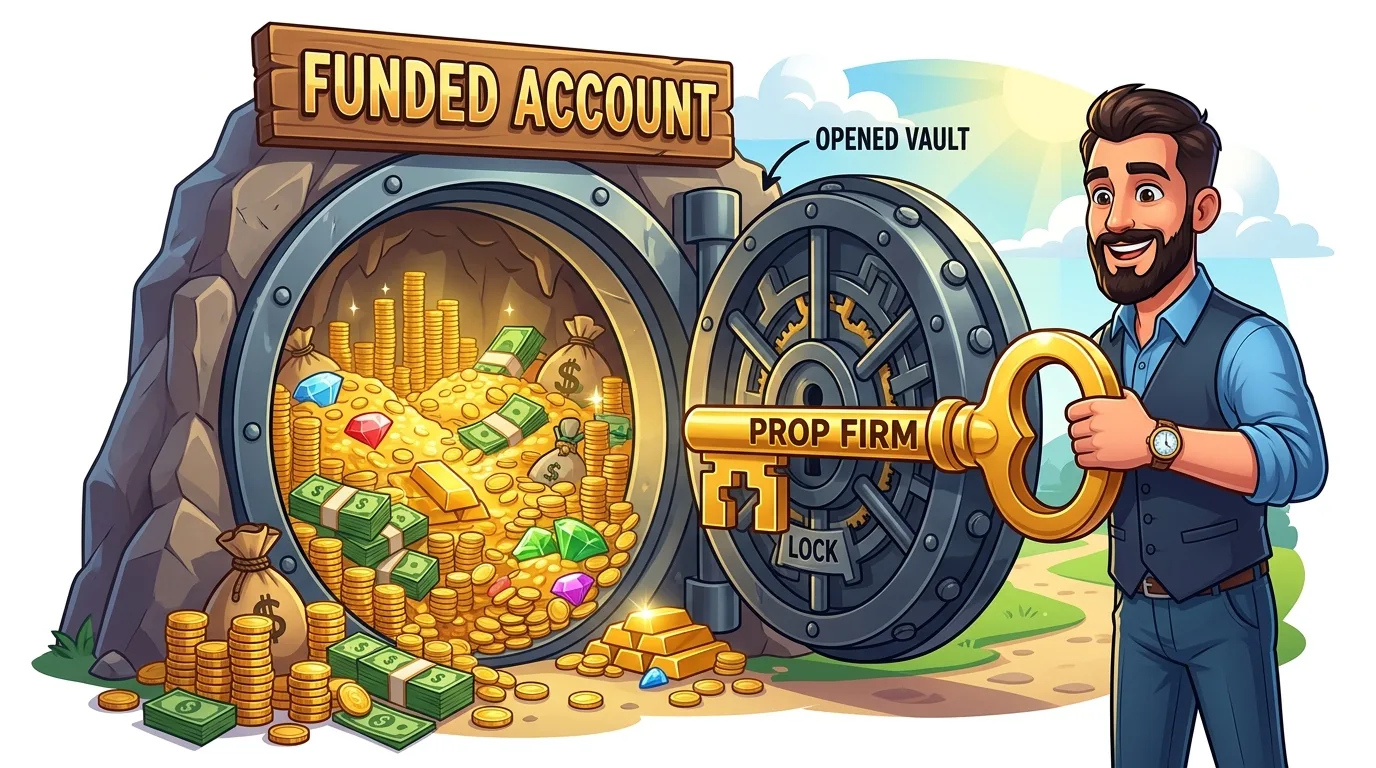
Let's cut through the hype. Most prop firms are glorified subscription services that bank on you failing. Apex Trader Funding is different, but not for the reasons you think. They've paid out over $600 million because their model is brutally simple: they make money when you trade, and they make even more when you're good. I'll show you the exact numbers, the trap doors in their new 2026 rules, and how I personally navigated their system to get funded. This isn't a sales pitch; it's a blueprint from someone who's been through the wringer.
Forget the fancy terms. Apex is a futures prop firm that gives you a simulated account (the "Evaluation") and charges you a monthly fee to trade it. If you hit their profit targets without breaking their rules, they give you a "Performance Account" with real capital. You trade, you keep most of the profits.
The twist? Their real business is selling those monthly subscriptions. The math is ugly for most traders. Say 1,000 people buy a $167/month 50k eval. That's $167,000 in revenue before a single trade is placed. If only 10% pass, that's 100 funded traders. Apex only risks capital on those winners, while the subscription fees from the 900 who fail cover the payouts and then some. It's a sharp model.
They're not a broker. You'll trade on Rithmic or Tradovate, but Apex is the entity backing the risk. This structure is why they've largely flown under the regulatory radar... for now. We'll get to the looming CFTC problem later.

Warning: Don't confuse "funded" with "rich." A $50,000 account doesn't mean you have $50k in your pocket. It's a risk limit. Your job is to grow it slowly and consistently to trigger payouts.
This is where you need to put your accountant hat on. Getting funded is a project with a budget.
The Evaluation (The Paywall)
You pay a monthly subscription. There's no "free trial." As of early 2026, here's the lay of the land:
- $25,000 Account: Starts around $137/month.
- $50,000 Account: Starts around $167/month.
- $300,000 Account: Starts around $657/month.
You pick your challenge: a standard profit target or a "reduced drawdown" version (tougher rules, lower fee). My advice? Start small. Blowing a $167 account hurts less than blowing a $657 one while you're figuring out their platform quirks.
The Hidden Costs
After you pass, you pay a one-time activation fee (between $79-$99) to get your live Performance Account. Then, you pay commissions on every trade. This is critical.
| Platform | Commission (Per Side, E-mini S&P) | Round Turn Cost |
|---|---|---|
| Tradovate | ~$1.55 | ~$3.10 |
| Rithmic | ~$1.99 | ~$3.98 |
If you're a scalper making 10 trades a day, that's $30-$40 a day in costs. It adds up fast and directly eats into your profit target. You must factor this into your position size calculator. A trade that nets 2 points might only be breakeven after commissions.
The Payout: Where They Shine
This is Apex's best feature. You keep 100% of the first $25,000 you earn per account. After that, it's a 90/10 split (you get 90%). This is the most trader-friendly split in the industry. That first $25k is a massive incentive to get you to the payout window.

“Apex's real business is selling monthly subscriptions. The funded accounts are just the marketing cost.”
Apex overhauled their system in early 2026. If you're reading an old guide, you're already behind. Here’s what matters now.
The Two-Tier System:
- Legacy Accounts: If you bought an eval before March 1, 2026, you're here. You operate under the old, slightly more forgiving rules (30% consistency rule, $50 daily minimum profit for payout days).
- New Product Accounts: Everything after March 1, 2026. This is you. The rules are tighter.
Key New Product Rules You Must Memorize:
- Profit Target: Still generally 10% of the account size for the eval (e.g., $2,500 on a $25k account).
- Maximum Loss: This is your hard stop. Usually 10% of the account, but it includes commissions and fees. If your max loss is $2,500 and you've paid $500 in commissions, you only have $2,000 of trading loss buffer. This catches so many people.
- Consistency Cap: This is the big one. No single day's profit can exceed 50% of your total profit since your last payout (or since starting). If you're up $4,000 total, you cannot make more than $2,000 in one day. Go over, and you violate. This kills the "one great trade" strategy. It forces grinding consistency.
- Minimum Trading Days: You need 5 profitable days (with at least $100 profit each) to request a payout. This is to prevent lucky one-hit wonders.

Pro Tip: The consistency rule is your new god. Track your running profit total daily. I use a simple spreadsheet. If I'm up $3,000 total, my mental max for the day is $1,500. I stop trading the moment I hit it. This discipline is what separates the funded from the failed.
The rule changes in May 2025 also targeted bots and copy-trading. They have algorithms looking for non-human patterns. Just trade your own strategy. Trying to game this is a fast track to account closure.
These rules make swing trading more appealing than scalping strategy for many, as the daily pressure is lower.

💡 Winstons Tipp
The consistency rule isn't a constraint, it's a teacher. It's training you for the only thing that matters in professional trading: surviving to trade tomorrow.

I don't just talk about this stuff. Here's my raw data from a $50,000 New Product eval I passed in Q1 2026.
The Bad First: I failed my first attempt. I chose the Rithmic platform for its speed but underestimated the higher commissions. I was trading MES (Micro E-mini S&P) contracts. My strategy was solid, but after 7 days I was up $1,200 in gross P&L. I felt great. Then I looked at my net P&L: +$412. Commissions and fees had eaten nearly $800. I was so focused on the price movement I forgot the business of trading. I hit the max loss shortly after because my position size calculator was using gross targets, not net.
The Pass: I reset, switched to Tradovate for lower commissions, and adjusted. My goal was a net profit of $5,000. I treated the 50% daily consistency rule as my primary guide.
- Day 1: +$680 net. Easy.
- Day 2: -$310. A bad NFP reaction.
- Day 3 to Day 7: Small, steady gains of $200-$400 net per day.
- Day 8: I had a perfect read on a XAU/USD futures (GC) setup. I was up $1,900 by noon. My total profit at that point was $3,850. My daily cap was $1,925. I closed the position at $1,900 and walked away. It was painful to leave potential money on the table, but rules are rules.
- I hit the $5,000 target on Day 14 with a boring $350 gain on the EUR/USD futures (6E).
The lesson? Sustainability over excitement. The system is designed to reward the tortoise, not the hare.

“The 50% daily consistency cap kills the 'one great trade' strategy. It forces grinding consistency, which is exactly what real trading requires.”
Your platform choice dictates your trading cost and style. This isn't a casual decision.
Tradovate: My recommendation for most. The commissions are lower, and the platform is all-in-one (charts, DOM, orders). It's less intimidating for newcomers. The integration is seamless. If you're learning, start here.
Rithmic: The choice for serious scalpers and algo traders. Lower latency, more raw data. But you'll need to connect it to a charting platform like NinjaTrader or TradingView, and the commissions are higher. Only use this if you know your edge requires millisecond advantages.
WealthCharts/NinjaTrader: Great for analysis and complex charting. Often used in conjunction with Rithmic for data.
Strategy Fit:
- Scalping: Possible, but the commission drag is real. You need a high win rate and a strategy that captures enough points per trade to cover costs 2-3 times over. The new 50% consistency cap is less of an issue here, as your daily gains are smaller.
- Swing Trading: Fits the Apex model beautifully. Fewer trades, lower commissions, easier to manage the daily consistency rule. This is where I've had the most success.
- Day Trading: The middle ground. You can hold for hours, capture larger moves than a scalper, but avoid overnight risk. This aligns well with the 5-day minimum payout rule.
Your tools matter. I use the MACD indicator for trend confirmation and the RSI indicator on higher timeframes for confluence. But the most important tool is your risk manager. Knowing your exact spread definition and cost per trade is non-negotiable.
💡 Winstons Tipp
Your first calculation before any trade shouldn't be your target. It should be your commission + fees. If the trade can't cover that 3 times over, it's not a trade, it's a donation.

Here's the uncomfortable truth nobody in the prop firm space wants to shout about: this party might have a hard curfew.
The CFTC is starting to ask hard questions. The current model - charging for evaluations - walks a fine line. The fear is that prop firms like Apex could be classified as Commodity Trading Advisors (CTAs). That would mean registration, audited financials, specific risk disclosures, and a mountain of compliance paperwork.
What does this mean for you, the trader?
- Stricter Onboarding: The KYC (Know Your Customer) process is already getting more thorough. Have your ID and proof of address ready.
- Potential Rule Changes: If classified as CTAs, the firms' own risk management will become a regulatory issue. Their rules (drawdowns, consistency) could become even stricter to satisfy regulators.
- Industry Shakeout: Smaller, shakier prop firms might not survive the cost of compliance. Apex, as one of the largest, is likely best positioned to adapt, but nothing is guaranteed.
My take? Don't put all your eggs in the prop firm basket. Use it as a capital accelerator, but build your own personal account alongside it. The regulatory risk is real, and you don't want your entire trading career tied to an entity that might have to change its fundamental model overnight.
This environment makes a tool that helps you manage risk automatically even more valuable. Strict daily loss limits are the key to survival, both in the challenge and in a potentially more regulated future.

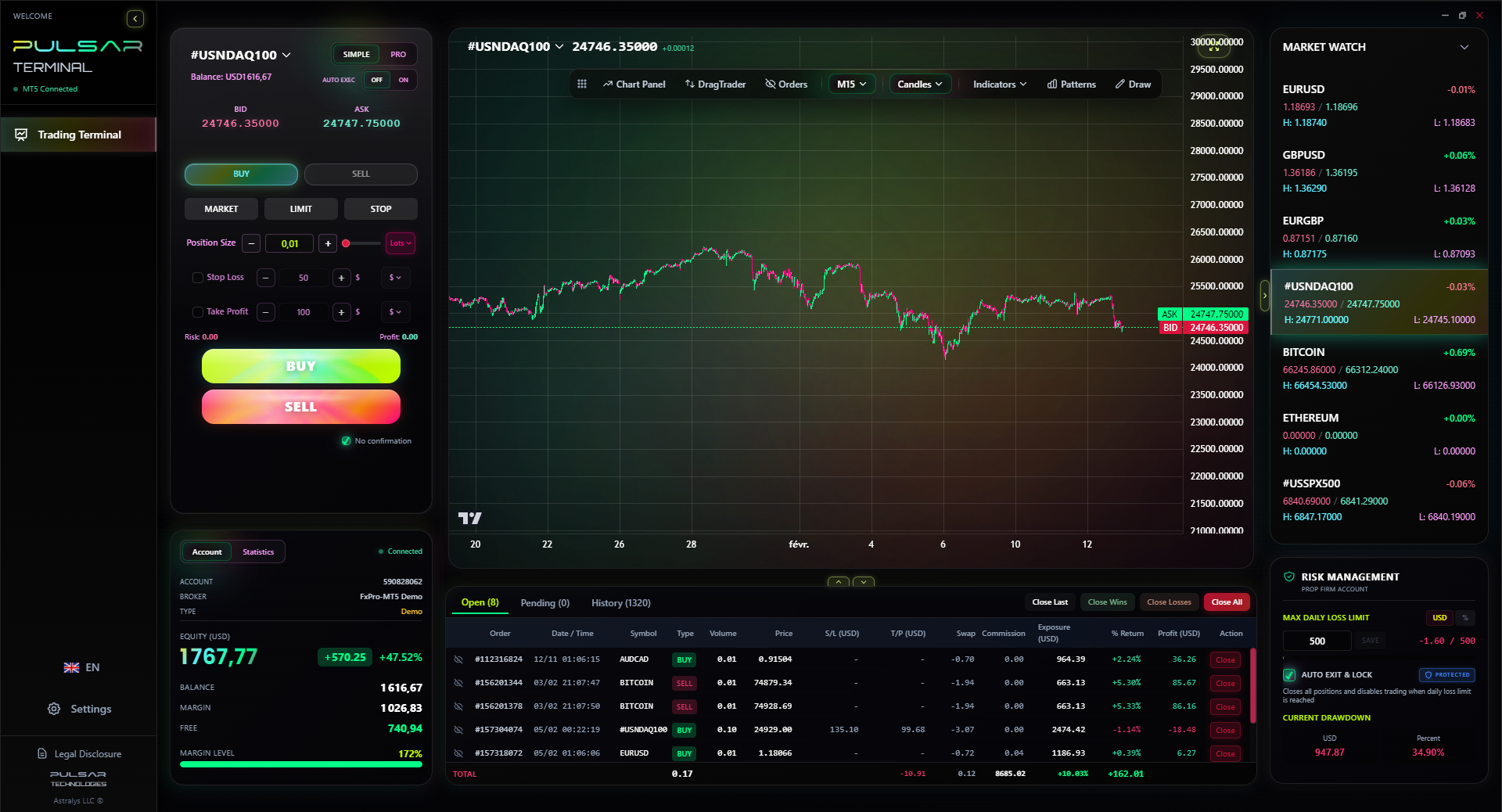
Managing the strict daily loss limits and consistency rules of an Apex challenge is a full-time job, which is why tools like Pulsar Terminal that automate risk protocols directly on your MT5 chart are no longer a luxury, but a necessity for funded traders.
Pulsar Terminal
Das All-in-One MT5-Tool: Drag-and-Drop-Orders, Multi-TP/SL, Trailing Stop, Grid Trading, Volume Profile und Prop-Firm-Schutz. Täglich von 1.000+ Tradern genutzt.
“I failed my first Apex challenge because I forgot trading is a business. I tracked gross P&L and ignored the $800 eaten by commissions.”
Apex Trader Funding is the real deal for a specific type of trader.
You're a good fit if:
- You trade futures and have a proven, rule-based strategy.
- You possess monk-like discipline and can adhere to external rules (consistency cap, max loss).
- You understand that trading is a business and can calculate your costs down to the penny.
- You're looking for a capital boost without taking on personal debt or giving away 50% of your profits.
Look elsewhere if:
- You're still "figuring it out." You'll just burn subscription money.
- You're an emotional trader who can't walk away after a big win because of a daily cap.
- You want to get rich quick. The 5-day minimum payout and consistency rules prevent that.
- The thought of potential regulatory changes keeps you up at night.
For me, it was worth it. The structure forced better habits. The 100% first-$25k payout is a fantastic incentive. But I went in with my eyes open, a tight budget for eval fees, and a strategy tailored to their rulebook.
The bottom line? Apex isn't a lottery ticket. It's a performance-based loan with very strict terms. If you can perform under those terms, it's one of the best tools available to scale a futures trading business. Just know exactly what you're signing up for.

Example: Your $50k Account Payout Math
- You trade, netting $300/day average after commissions.
- You hit the 5-day minimum ($1,500) and request a payout.
- You continue. Your first $25,000 is all yours.
- To get that $25k, you need about 84 trading days at that pace (accounting for losers). That's about 4 months of consistent work. This is a marathon.
FAQ
Q1What's the difference between a Legacy and a New Product Apex account?
Legacy accounts are from before March 1, 2026, and use a 30% daily consistency rule and have a $50 profit floor for payout days. New Product accounts (after March 1, 2026) use a stricter 50% daily consistency cap and have a 5-day payout path. Always check which rules apply to your specific purchase.
Q2How often does Apex Trader Funding pay out?
Once you're funded, you can request a payout after meeting a 5-day minimum trading day requirement (each with at least $100 profit). Under the new system, you can request payouts on-demand once you're eligible, rather than waiting for a set weekly or monthly date.
Q3Can I trade stocks or forex with Apex?
No. Apex Trader Funding is exclusively a futures prop firm. You can trade futures contracts like the E-mini S&P 500 (ES), Micro E-mini (MES), crude oil (CL), gold (GC), and currency futures like the Euro (6E). You cannot trade spot forex, stocks, or cryptocurrencies directly through their funding.
Q4What happens if I hit the maximum loss?
Your evaluation or performance account is immediately and automatically closed. This is a hard rule. There is no warning or margin call in the traditional sense. The loss limit includes all closed-trade losses, commissions, and platform fees, so your actual trading loss buffer is smaller than the stated max loss.
Q5Is the Apex Trader Funding challenge worth the fee?
It's worth it only if you treat it as a serious business investment. If you have a profitable, disciplined futures strategy, the fee is a cost of accessing larger capital. If you're using it as a learning experience or to test a new strategy, you will likely lose the fee. The high pass rate they advertise is because consistent traders buy evals; most beginners do not pass.
Q6Can I use expert advisors (EAs) or trade copiers with Apex?
Officially, no. Apex's May 2025 rule enforcement specifically targeted bot trading, copy trading, and hedging across accounts. They use detection software. If you are caught, your account will be terminated without a payout. Trade your own strategy manually.
Prof. Winstons Lektion
Wichtige Erkenntnisse:
- ✓Net Profit is your only metric. Gross P&L is a lie told by commissions.
- ✓The 50% daily cap is your primary risk management tool.
- ✓Factor $3-$4 per round turn into every single trade plan.
- ✓Choose Tradovate to learn, Rithmic only if your edge demands it.
Wie nützlich war dieser Artikel?
Klicken Sie auf einen Stern
Wöchentliche Trading-Einblicke
Kostenlose wöchentliche Analysen & Strategien. Kein Spam.
Über den Autor
James Mitchell
Senior Trading-Analyst
In New York ansässig mit über 9 Jahren Trading-Erfahrung. Fokus auf Haupt-USD-Paare, Prop-Firm-Challenges und die US-Regulierungslandschaft.
Kommentare
Risikohinweis
Der Handel mit Finanzinstrumenten birgt erhebliche Risiken und ist möglicherweise nicht für alle Anleger geeignet. Vergangene Ergebnisse garantieren keine zukünftigen Renditen. Dieser Inhalt dient ausschließlich Bildungszwecken und stellt keine Anlageberatung dar. Führen Sie immer Ihre eigene Recherche durch, bevor Sie handeln.
Das könnte Sie auch interessieren

Cara Trading Forex Sukses: 7 Prinsip dari Trader Profesional
Cara trading forex sukses dengan 7 prinsip trader pro: manajemen modal, disiplin, journal trading, backtest. Data nyata, bukan janji profit palsu.
Jam Trading Forex Terbaik untuk Trader Indonesia: Panduan Lengkap dengan Tabel Waktu
Panduan jam trading forex untuk trader Indonesia. Tabel 4 sesi dunia, jam emas 20:00-00:00, sesi mana yang harus dihindari. Data akurat + tips dari trader berpengalaman.
Top 5 Sàn Forex Uy Tín Nhất 2026: Review Jujur dari Trader Indonesia
Top 5 sàn forex uy tín 2026 untuk trader Indonesia. Review jujur: spread, deposit, withdraw, dukungan lokal. Exness, XM, IC Markets & lebih.
Pulsar Terminal herunterladen
Alle diese Rechner sind in Pulsar Terminal mit Echtzeit-Daten Ihres MT5-Kontos integriert.
Pulsar Terminal herunterladen