


Here's a trading myth that cost me real money early on: you can just use any economic calendar.

David van der Merwe
Schwellenland-Trader ·  South Africa
☕ 11 Min. Lesezeit
Was Sie lernen werden:
- 1Why Your Economic Calendar Choice Matters (Especially in SA)
- 2Non-Negotiable Features for Your Forex Calendar
- 3My Hands-On Review of the Top Calendars (2026)
- 4How I Actually Trade the News (A Practical Strategy)
- 5Mistakes I Made (So You Don't Have To)
- 6Making Your Calendar Work With MT4/MT5
- 7My Final Recommendation & Daily Setup
Here's a trading myth that cost me real money early on: you can just use any economic calendar. I learned the hard way that a generic, unfiltered calendar is worse than useless - it's dangerous. For us trading from South Africa, the 'best forex calendar' isn't just about global events; it's about seeing the SARB interest rate decision in Johannesburg time, understanding the impact on USD/ZAR, and not getting blindsided by local data. Let me walk you through exactly what to look for, the tools I trust, and the painful lessons that shaped my approach to trading the news.
When I first started, I'd just glance at a list of events. Big mistake. The rand is a commodity currency, and it dances to a different tune than the Euro or Yen. A US Non-Farm Payroll report might shake EUR/USD, but South African CPI data or a SARB speech can send USD/ZAR into a 200-pip spiral in minutes. If your calendar doesn't highlight these local events, you're flying half-blind.
I remember in 2020, I was focused on ECB news and completely missed a major announcement about Eskom. USD/ZAR ripped higher, and my short position got stopped out for a R1,200 loss. The event wasn't even on my radar because I was using a basic calendar. That was the day I realized a South African trader needs a South African-centric tool. It's not just about avoiding losses; it's about seeing opportunities others might miss. A proper calendar helps you anticipate volatility, which is crucial for managing your position size calculator correctly before big news drops.

Warning: Trading high-impact news without a proper calendar is like driving at night with your lights off. You might get lucky once, but eventually, you'll crash.
The local market is growing fast - projected to hit $6.85 billion by 2033 - and that means more volatility, not less. Your calendar is your first line of defense and your primary source of alpha.

💡 Winstons Tipp
Filter your calendar to show only High/Medium impact events for the US, Eurozone, and South Africa. Everything else is just noise for a ZAR-focused trader.
“A generic, unfiltered calendar is worse than useless for a South African trader - it's dangerous.”
After years of testing, here's my checklist. If your calendar misses even one of these, find a new one.
1. Real-Time SAST/Johannesburg Time Display
This is non-negotiable. You can't be converting from GMT or EST while the market is moving. I need to see that the SARB rate decision is at 3:00 PM my time. Period.
2. Granular Filtering for South Africa
You must be able to filter specifically for 'South Africa'. Better yet, for 'ZAR' pairs. I set my main view to show only High and Medium impact events for South Africa, the US, and the EU. This cuts out the noise of Polish manufacturing data or Swiss employment figures that have zero effect on my trades.
3. Actual vs. Forecast vs. Previous Data
This is the heart of news trading. The market moves on the deviation from the forecast. A good calendar shows all three numbers clearly. I got burned early on just looking at the headline 'CPI higher'. Was it higher than last month? Sure. But was it higher than the market expected? Nope. That's why the price sold off. You need that forecast number.
4. Historical Data and Charts
Seeing a trend is everything. Is South African manufacturing PMI consistently missing forecasts? That tells a story. I use the historical view on FXStreet's calendar religiously to gauge market sentiment heading into a release.
5. Broker Integration (A Nice-to-Have)
Some brokers, like IC Markets or XM, have decent built-in calendars. It's convenient, but I always double-check with a dedicated tool. Don't rely solely on your broker's version.

Example: Let's say the forecast for SA Retail Sales is 2.1%. The previous was 1.8%. If the actual comes out at 2.5%, that's a positive surprise for the Rand. If it comes at 1.9%, even though it's up from last month, it's a miss versus expectations, and ZAR could weaken.
“I don't trade the initial news spike anymore. I wait for the retracement. Let the gamblers take the first volatile bite.”
I've used them all. Here's my brutally honest take.
1. FXStreet Economic Calendar This is my daily driver. It's complete, reliable, and gets the SA data right.
- Pros: Covers over 2,000 events from 40+ countries. The filtering is excellent - I can easily isolate South African events. The 'Deviation' column (showing actual vs. forecast in percentage points) is a game-saver. Their related news snippets are often the fastest.
- Cons: The interface can feel cluttered. Sometimes there's almost too much information.
- My Verdict: The best all-rounder. It's the one I have pinned in my browser 24/7.
2. Myfxbook Economic Calendar A fantastic, no-nonsense option that many pros use.
- Pros: Incredibly clean and fast. It has a dedicated 'South Africa' view, which is perfect for a quick morning check. I love the simple red/green color coding for misses/beats.
- Cons: Less educational content around the events compared to FXStreet. Fewer filtering options for cross-referencing countries.
- My Verdict: If you want speed and clarity, especially for SA data, this is a top contender.
3. Investing.com Calendar Widely used, but I have reservations.
- Pros: Very popular, so you'll often see it referenced. The mobile app is decent.
- Cons: I've noticed occasional delays in updating the 'Actual' data. The impact ratings (volatility meter) can be questionable. I've seen low-impact SA events cause big moves that their meter didn't predict.
- My Verdict: Okay as a secondary source, but I wouldn't trust it as my primary.
4. Broker-Specific Calendars (e.g., Exness, Pepperstone)
- Pros: Convenient. Sometimes they add proprietary commentary.
- Cons: Often simplified, lack depth, and can be slow. I view them as a reminder service, not a trading tool.
- My Verdict: Use them as a backup, not your main research hub.
Here’s a quick comparison of my top two:
| Feature | FXStreet | Myfxbook |
|---|---|---|
| SA Event Filtering | Excellent | Excellent (dedicated view) |
| Time Zone Adjust | Perfect SAST | Perfect SAST |
| Historical Charts | Yes | Limited |
| Interface | Dense, informative | Clean, minimalist |
| Best For | Deep research, multi-country analysis | Quick, focused SA market check |
💡 Winstons Tipp
The 'Previous' number is often revised. Always check the calendar on the day of the event to ensure you're comparing the actual to the latest, correct forecast.
“I don't trade the initial news spike anymore. I wait for the retracement. Let the gamblers take the first volatile bite.”
Okay, you've got the best forex calendar open. Now what? Here's the simple, repeatable process I've settled on after many blown accounts and small victories.
Step 1: The Weekly Scan (Sunday Night) I open my calendar, filter for the week ahead, and highlight all High-Impact events for the US, EU, and South Africa. I put these in my trading journal. For SA, I'm laser-focused on: CPI, SARB Interest Rate Decision, GDP, and Trade Balance. These are the USD/ZAR movers.
Step 2: The Daily Prep (Each Evening) I look at tomorrow's highlighted events. What's the forecast? What was last month's? I form a basic, unbiased view. For example: "Forecast is for SARB to hold rates. The language in the statement will be key."
Step 3: The Entry Tactic (My Preferred Method) I rarely trade the initial spike. That's casino stuff. The spread widens to 20 pips or more, and you can get slipped badly. My method is the 'Fade the Extreme' or 'Momentum Follow' on the retracement.
- Scenario: SA CPI comes out much higher than forecast. USD/ZAR spikes down 150 pips (Rand strengthens).
- My Play: I wait. I watch the RSI indicator on a 1-minute or 5-minute chart. If it shoots into overbought territory (above 70) as the spike peaks, I look for a pullback. I might enter a long USD/ZAR trade on a retracement of 30-50% of the initial spike, targeting a test of the spike's high. This uses the principle that initial overreactions are often partially retraced.
A Real Trade from 2025: SARB hiked by 25bps, which was expected. But the statement was less hawkish than forecast. USD/ZAR spiked up 120 pips instantly (from 18.2500 to 18.3700). I waited. The MACD indicator on the 5-min chart showed momentum stalling. Price retraced to 18.3100. I entered short (betting on Rand strength returning) at 18.3120. Stop loss at 18.3300 (20 pips). It drifted back down to 18.2800 over the next hour. I took half profit at 18.2900 and let the rest run. Net gain: +65 pips on the full position.

Pro Tip: Always know your broker's policy on news trading. Some widen spreads massively, some offer guaranteed stops (at a cost), some might requote. Test in a demo first. I find ECN brokers like IC Markets or FP Markets generally handle it better during high volatility.
“Your calendar isn't just a list of times; it's a strategic map of market-moving landmines and potential roads.”
Let's get vulnerable. This is where the real lessons are.
Mistake 1: Trading Every Red 'High Impact' Event I used to think I had to be in the market for every NFP, CPI, and ECB presser. It was exhausting and unprofitable. I wasn't specializing. Now, I focus primarily on USD/ZAR and EUR/USD. I understand their drivers. I ignore Canadian employment data. Specialize.
Mistake 2: Ignoring the 'Whisper Number' The official forecast is one thing. But sometimes, there's a 'whisper number' circulating among institutional desks - a different expectation. If the actual beats the official forecast but misses the whisper, the price can go the opposite way. I now check financial news wires (like Reuters) in the 30 minutes before a major release to gauge the real sentiment.
Mistake 3: No Pre-News Risk Management This was a R5,000 lesson. I had a large swing trading position on GBP/USD. A high-impact US event was due. I thought, 'I'll just hold through it.' The news was catastrophic for my trade, it gapped through my stop loss, and I suffered worse-than-expected slippage. My stop was at 1.2550, but I was filled at 1.2520. That extra 30 pips of loss hurt.
Now, my rule is ironclad:
- For scalping: I am either flat or have a tiny position before high-impact news.
- For swing trades: I always adjust my stop to breakeven (or very close) if I'm in profit before a major, unrelated news event. Protecting capital is job number one. Tools that automate breakeven stops are useful here for peace of mind.
💡 Winstons Tipp
Before a major SA event, check the 1-hour USD/ZAR chart. If it's already made a big move in the direction of the expected news, the actual result might be a 'sell the fact' reversal.
“Your calendar isn't just a list of times; it's a strategic map of market-moving landmines and potential roads.”
A calendar in a browser tab is good. A calendar integrated into your trading workflow is powerful.
The Manual Method (What I Do): I have two monitors. On the left: my MT5 chart for USD/ZAR or EUR/USD. On the right: my FXStreet calendar and a news feed. This works because I've disciplined myself to look back and forth.
The Semi-Automated Dream: This is where technology can help. Some advanced traders use tools that can place trades based on news feeds, but that's complex and risky. For most of us, the sweet spot is using a trading terminal that helps manage the chaos.
Think about it: news hits, volatility explodes, you need to move fast. Having to manually drag stop-losses or set multiple take-profit levels is slow and error-prone. Imagine if you could pre-set a strategy that says, 'If this trade goes 20 pips in my favor, move stop to breakeven and trail the rest by 15 pips.' You could then focus entirely on reading the price action and the news flow, not on clicking buttons frantically.
This kind of automated trade management turns a high-stress news event into a controlled execution of a plan. It's the difference between being a reactive gambler and a proactive trader. For trading major SA events on pairs like USD/ZAR or even XAU/USD (gold, which the Rand is tied to), this control is everything.
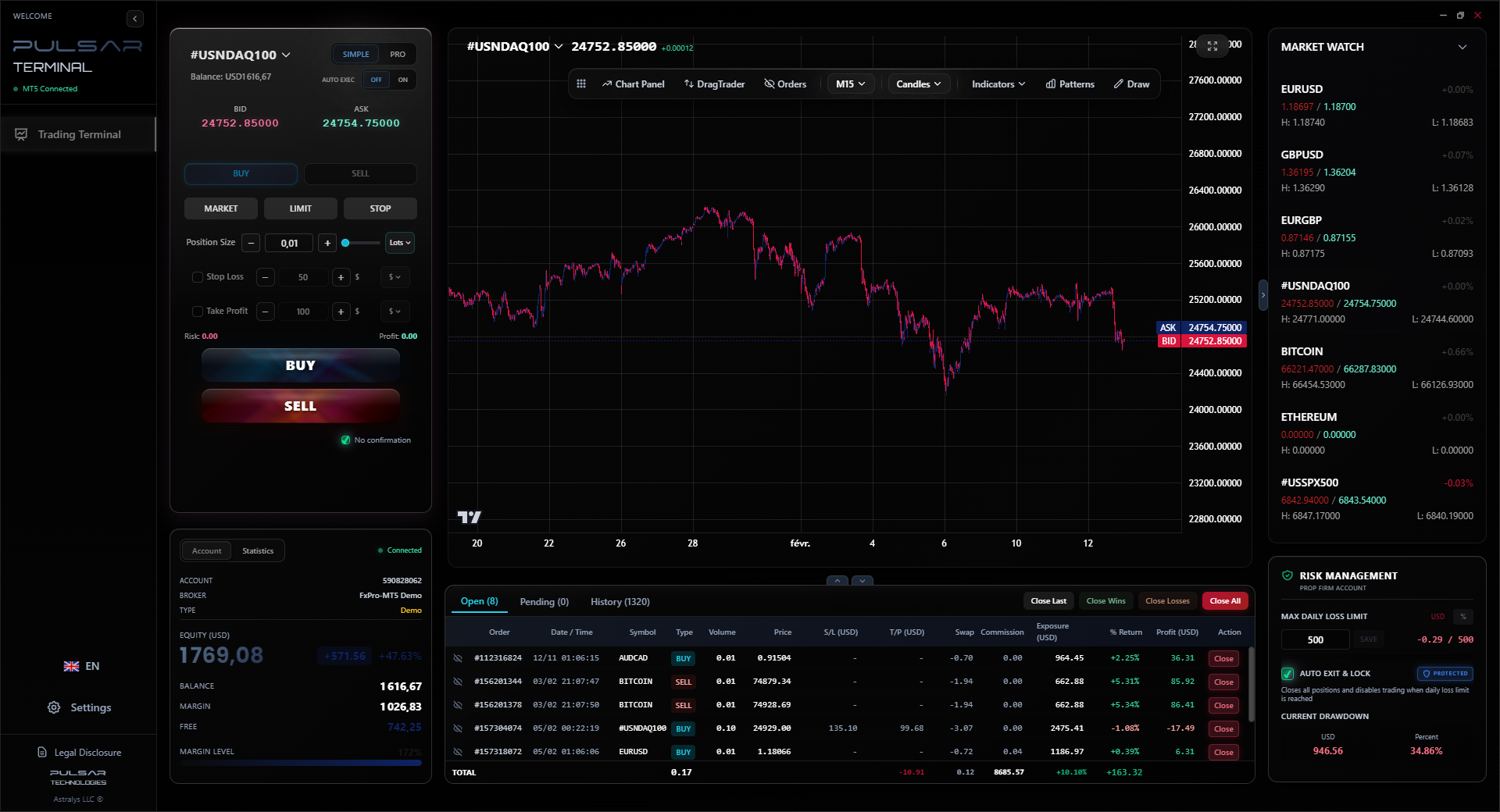
Managing complex entries and exits during volatile news events is stressful, which is why I rely on Pulsar Terminal to automate my stop-loss and take-profit strategies directly on MT5.
Pulsar Terminal
Das All-in-One MT5-Tool: Drag-and-Drop-Orders, Multi-TP/SL, Trailing Stop, Grid Trading, Volume Profile und Prop-Firm-Schutz. Täglich von 1.000+ Tradern genutzt.
“Specialize in the events that move your pairs. Ignoring Canadian data was one of the best decisions I ever made.”
So, what's the best forex calendar for a South African trader in 2026? For me, it's a one-two punch.
Primary Tool: FXStreet Economic Calendar. It's the workhorse. I use it for my weekly planning, deep dives into historical data, and understanding the global context. Secondary/Quick Check: Myfxbook South Africa Calendar. It's my pre-market glance to see what's on the docket for the Rand today.
My Daily Routine:
- 7:00 AM SAST: Check Myfxbook's SA view. Any high-impact local data today? Note it.
- Evening (After NY Close): Open FXStreet. Filter for the next day. Review all high/medium impact events for US, EU, ZA. Note forecasts and previous values in my journal.
- 30 Min Before Major News: Close out any sensitive scalps. Ensure swing trade stops are protected. Re-check news wires for 'whisper' sentiment.
- During News: I'm not trading. I'm watching. I'm looking for the spike, the rejection, the volume. I'm waiting for my setup.
- After Initial Volatility: I execute my planned trade (e.g., fade the retracement) with a strict pip definition risk limit (never more than 1% of my account).
Your calendar is your strategic map. It tells you where the landmines (volatility) are and where the roads (trends) might be built. Don't just look at it. Study it, filter it, and integrate it into every single trading decision. It took me years and many losses to respect it fully. Hopefully, this guide helps you get there a bit faster.
FAQ
Q1Is a free economic calendar good enough, or should I pay for one?
In my 12 years, I've never paid for a standalone economic calendar. The free versions from FXStreet, Myfxbook, and Investing.com are more than sufficient for retail traders. The value isn't in paying for data; it's in how you filter and interpret the free data available. Save your money for a good charting package or better internet connectivity instead.
Q2What's the single most important South African economic event for forex?
Hands down, the South African Reserve Bank (SARB) Monetary Policy Committee (MPC) interest rate decision. It's our version of the Fed meeting. It doesn't just set the repo rate; the tone of the statement and the governor's press conference can set the trend for USD/ZAR for weeks. Always mark it in red on your calendar.
Q3How do I handle the huge spread widening during news on USD/ZAR?
You have three choices: 1) Don't trade the initial spike - wait for the spread to normalize (my preferred method). 2) Use a broker that offers fixed spreads during news (but these are often wider overall). 3) If you must enter, use a limit order instead of a market order to avoid the worst of the slippage. Always check your broker's typical spread definition behavior on USD/ZAR during SA data releases.
Q4Can I use a forex calendar for trading cryptocurrencies?
You can, but it's different. Major crypto moves are often driven by regulatory news, tech updates, or macro sentiment, not scheduled economic data. However, I do watch high-impact US events (like CPI) on my forex calendar when trading Bitcoin, as they affect the whole 'risk-on' market. For pure crypto, a dedicated crypto news aggregator is more useful.
Q5What time zone should I set my calendar to in South Africa?
Always set it to SAST (South Africa Standard Time) or Africa/Johannesburg. This is critical. You need to know an event is at 3:00 PM your time, not that it's at 1:00 PM GMT. Mental time-zone conversion is a common source of costly errors.
Q6Do prop firm challenges require using an economic calendar?
Absolutely, it's essential. Most prop firms have strict daily loss limits. A surprise high-impact news event can blow through that limit in seconds and cause a margin call, failing your challenge. Managing news risk is a core part of passing a challenge. You must know when to reduce position size or be flat.
Prof. Winstons Lektion
Wichtige Erkenntnisse:
- ✓Filter for SAST time & South African events first.
- ✓Trade the retracement, not the initial news spike.
- ✓Always compare Actual vs. Forecast, not Actual vs. Previous.
- ✓Reduce position size or be flat before high-impact news.
- ✓Use two calendars: FXStreet for depth, Myfxbook for a quick SA check.
Wie nützlich war dieser Artikel?
Klicken Sie auf einen Stern
Wöchentliche Trading-Einblicke
Kostenlose wöchentliche Analysen & Strategien. Kein Spam.
Über den Autor
David van der Merwe
Schwellenland-Trader
In Johannesburg ansässiger Trader mit 11 Jahren Erfahrung in Schwellenländerwährungen. Spezialisiert auf ZAR-Paare, FSCA-regulierten Handel und Analyse des südafrikanischen Marktes.
Kommentare
Risikohinweis
Der Handel mit Finanzinstrumenten birgt erhebliche Risiken und ist möglicherweise nicht für alle Anleger geeignet. Vergangene Ergebnisse garantieren keine zukünftigen Renditen. Dieser Inhalt dient ausschließlich Bildungszwecken und stellt keine Anlageberatung dar. Führen Sie immer Ihre eigene Recherche durch, bevor Sie handeln.
Das könnte Sie auch interessieren

Cara Trading Forex Sukses: 7 Prinsip dari Trader Profesional
Cara trading forex sukses dengan 7 prinsip trader pro: manajemen modal, disiplin, journal trading, backtest. Data nyata, bukan janji profit palsu.
Jam Trading Forex Terbaik untuk Trader Indonesia: Panduan Lengkap dengan Tabel Waktu
Panduan jam trading forex untuk trader Indonesia. Tabel 4 sesi dunia, jam emas 20:00-00:00, sesi mana yang harus dihindari. Data akurat + tips dari trader berpengalaman.
Top 5 Sàn Forex Uy Tín Nhất 2026: Review Jujur dari Trader Indonesia
Top 5 sàn forex uy tín 2026 untuk trader Indonesia. Review jujur: spread, deposit, withdraw, dukungan lokal. Exness, XM, IC Markets & lebih.
Pulsar Terminal herunterladen
Alle diese Rechner sind in Pulsar Terminal mit Echtzeit-Daten Ihres MT5-Kontos integriert.
Pulsar Terminal herunterladen