


Let's cut through the noise.

Olumide Adeyemi
Pionier des Tradings in Westafrika ·  Nigeria
☕ 9 Min. Lesezeit
Was Sie lernen werden:

Let's cut through the noise. The biggest mistake I see Nigerian traders make is thinking a signal provider will hand them free money. They scroll Instagram, see screenshots of perfect trades, and send their airtime. It's a recipe for disaster. I'm here to set the record straight on what the best forex signal providers actually offer, how to spot the fakes, and why you'll never truly succeed until you learn to verify every single call yourself.
A forex signal provider sends you trade suggestions. That's it. It's usually an entry price, stop loss, and take profit level. They might send it via Telegram, WhatsApp, SMS, or through a dedicated app.
The promise is simple: follow these signals and make money without doing the analysis. Sounds good, right? Here's the problem I had to learn the hard way. Back in 2017, I paid $100 a month to a "VIP" group. The guy had all the credentials in his bio. For two weeks, the signals were decent, maybe 60% winners. I got confident, increased my lot size. Then came a week of five consecutive losses that wiped out my entire account growth and then some. The provider's response? "Market was volatile, manage your risk." No accountability. That's when I realized I was outsourcing my brain, and my wallet paid the price.
A real provider should give you more than just numbers. They should explain the why. What chart pattern, what news event, what indicator confluence prompted the trade? If they don't, you're just a monkey pressing buttons.

Warning: Any provider who guarantees profits or shows only winning trades is lying. Forex is probabilistic. Losses are part of the game. A honest provider will show their loss history too.
In Nigeria, we have our own flavour of signal service scams. They're often wrapped in flashy cars, spiritual talk, and pressure tactics. Let's break down the red flags.
The 'Maga Must Pay' Vibe
They operate on FOMO (Fear Of Missing Out). "Last 5 slots left at this price!" "My signals closed 500 pips today, see screenshot!" The screenshots are often from a demo account or, worse, doctored. They'll never show you the full trade history or a verified myfxbook link. If they're pushing you to pay RIGHT NOW, walk away.
The Spiritual/Prophetic Angle
This one is uniquely painful. A provider claims God gave them the signals, or they use "spiritual analysis." Trading is about probability and price action, not anointing oil. I've seen pastors ruin congregations with this nonsense. It preys on trust. Never mix faith with your forex trading decisions.
The Fake Proof
They'll flood you with testimonials. "Brother Mike made me N500,000 in 2 days!" Ask for a video of that person's MT4/MT5 terminal showing the trade history. You'll get blocked. Real proof is transparent and verifiable over the long term. Look for a track record of at least 6-12 months, with every trade documented.
A real provider's results should be boringly consistent, not explosively miraculous. Remember, if it sounds too good to be true, especially in Lagos traffic, it absolutely is.

💡 Winstons Tipp
A signal is just an opinion. The chart is the truth. If the price action contradicts the signal, side with the chart every single time.

“Using a signal provider without verification is like letting a stranger drive your car blindfolded.”
Forget the hype. Judge a signal provider on these cold, hard metrics. I use this checklist, and you should too.
| Criteria | What to Look For | The Red Flag |
|---|---|---|
| Transparency | Verified, real-time track record (e.g., MyFxBook, FXBlue). All trades listed, wins AND losses. | Only shares cherry-picked screenshots in Telegram. |
| Risk Disclosure | Clearly states the risk per trade (e.g., 1-2% of capital). Provides a sensible stop loss. | Says "set a wide stop" or "this trade cannot lose." |
| Strategy Explanation | Explains the rationale for each signal: support/resistance, indicator signal, news. | Just gives numbers: "Buy GBP/USD at 1.2500, SL 1.2450, TP 1.2600." |
| Frequency & Style | Matches your trading style (e.g., 2-5 swing trading signals per week, not 50 scalps a day). | Spams 10+ scalping strategy signals daily, impossible to follow. |
| Cost | Reasonable monthly fee (N5,000 - N30,000). Offers a free trial. | Demands huge upfront annual payment or a percentage of your profits. |
The most important metric? The provider's average risk-to-reward ratio. If they're consistently aiming for 2:1 or 3:1, they understand probability. If they're going for 10:1 miracles with tiny stops, they're gambling with your money.

Pro Tip: Before paying, paper trade their signals for a full month. See if you could have actually executed them at the given prices, and calculate the net result yourself. This one step saved me from three bad services.

Not all signal services are created equal. Here's a breakdown of the main models you'll encounter, especially for Nigerian traders.
The Automated Bot/EA
These are algorithms that supposedly trade for you. Some brokers, like Exness or IC Markets, allow you to copy trades from these systems. My experience? Brutal. In 2019, I ran a popular "Gold Miner" EA on a VPS. It made steady 5% gains for two months. Then, during a low-liquidity period, it opened 15 trades on XAU/USD at once without a stop loss. I lost 40% of the account in 20 minutes before I could manually intervene. Bots lack discretion. They can't see a news event about to drop.
The Manual Analysis Group
This is where the better providers live. A human analyst (or team) does the chart work and sends signals. The value here is in their commentary. A good one will say, "We're buying here because the daily MACD indicator has crossed bullish at a key support level, and we have a hidden divergence on the RSI indicator." This teaches you something.
The Prop Firm Copy Trade
Some providers trade funded accounts from prop firms. You copy their trades via a platform. The theory is they're extra careful because it's "the firm's money." This can be legitimate, but you must ensure the copy-trading latency is low. If their exit comes 5 seconds after yours, your results will differ wildly.
For most Nigerian traders starting out, a manual analysis group with a focus on education is the best middle ground. It gives you signals while forcing you to learn the reasoning.
💡 Winstons Tipp
The cost of a signal service is not the fee. It's the opportunity cost of not learning to fish for yourself. Budget for both.
“Real proof is transparent and verifiable over the long term. Look for a track record that's boringly consistent, not explosively miraculous.”
This is the core lesson. Using a signal provider without verification is like letting a stranger drive your car blindfolded. You must learn to check their work. Here's my process, every single time.
- Plot Their Levels: I open my chart and mark their entry, stop loss, and take profit. Does the stop loss make technical sense? Is it placed beyond a obvious swing high/low, or is it sitting in no-man's land where market noise will take it out? I once got a signal to buy EUR/USD with a stop loss 3 pips below entry. That's not a stop loss, that's a donation. The trade hit the stop in minutes.
- Check the Confluence: What's on the chart? If they say it's a buy at a support level, I zoom out. Is that support on the higher time frame too? Are any major economic events scheduled (check Forex Factory)? I avoid signals placed within an hour of high-impact news.
- Manage Your Own Risk: Their risk might be 5% per trade. That's insane for me. I always recalculate the position size for my own 1-2% risk rule using a position size calculator. Your risk management is your responsibility, not theirs.
This verification process does two things. It filters out bad signals, and it trains your eye. After six months of this, you'll start to see the patterns yourself and rely on the provider less. That's the ultimate goal.

Example: Provider signal: Buy XAU/USD at $1980, SL $1970, TP $2000. That's a 20-pip risk for a 20-pip reward (1:1). Not great. You check the chart and see a stronger support at $1965. You could adjust the SL to $1964, making it a 16-pip risk for a 20-pip reward (1.25:1), and use a smaller position size. You've just improved the trade.

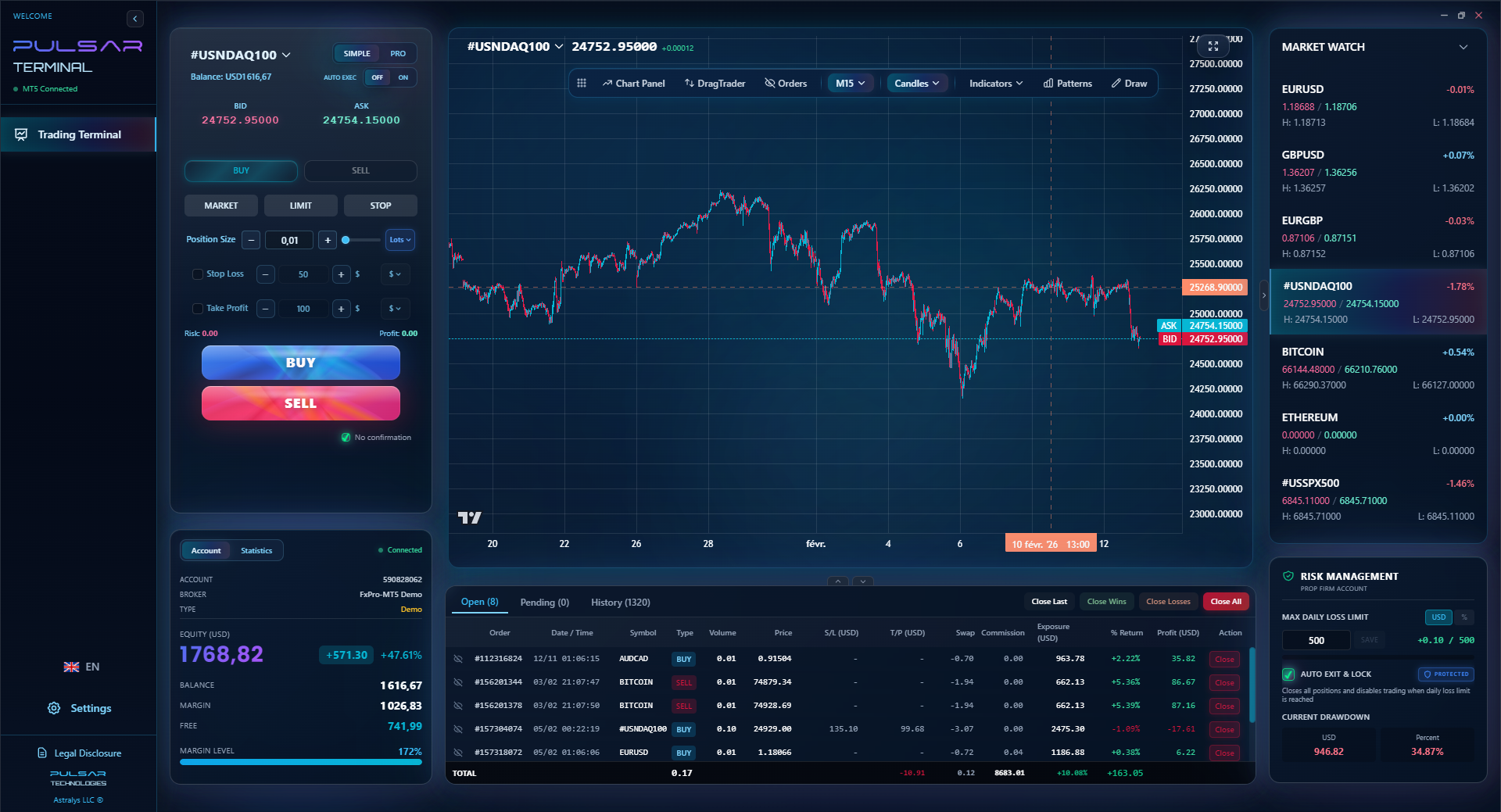
Manually managing multiple take-profit levels from a signal provider is a hassle; Pulsar Terminal lets you set them all with a single drag-and-drop directly on your MT5 chart.
Pulsar Terminal
Das All-in-One MT5-Tool: Drag-and-Drop-Orders, Multi-TP/SL, Trailing Stop, Grid Trading, Volume Profile und Prop-Firm-Schutz. Täglich von 1.000+ Tradern genutzt.
Signals shouldn't be your strategy. They should be an input into your own, well-defined trading plan. Here's how to fit them in without losing your shirt.
First, have a plan. Know your daily loss limit, your preferred trading sessions (London-New York overlap is best for EUR/USD), and your account size. If your plan says "max 2 trades per day," and the provider sends 5, you ignore 3. Your plan is the boss.
Second, treat it as a second opinion. Do your own analysis first. Maybe you see a potential sell setup on GBP/JPY. Then you check your provider's feed. If they also have a sell signal, that's confluence. That's a stronger trade idea. If they have a buy signal, it forces you to re-examine your chart. Maybe you missed something. This dialogue makes you a better trader.
Finally, keep a journal. For every signal you take, record: The provider's rationale, your verification notes, the outcome, and most importantly, how you felt. Did you hesitate? Did you move the stop loss? This emotional log is gold. I found I was terrible at following through on losing trades from signals, often closing them early for a bigger loss. The journal showed me the pattern, and I fixed it.
Using signals this way turns a crutch into a training tool. You're actively engaged, not passively waiting for a WhatsApp message.
💡 Winstons Tipp
Your greatest tool isn't a signal; it's the 'Ignore' button. Have the discipline to not take a trade that doesn't fit your plan.
“Your edge should eventually be your own mind, not a monthly subscription.”
Look, I get the appeal. You're busy, the charts are confusing, and you want results. But the forex market doesn't care about your schedule. It will take your money if you're not in control.
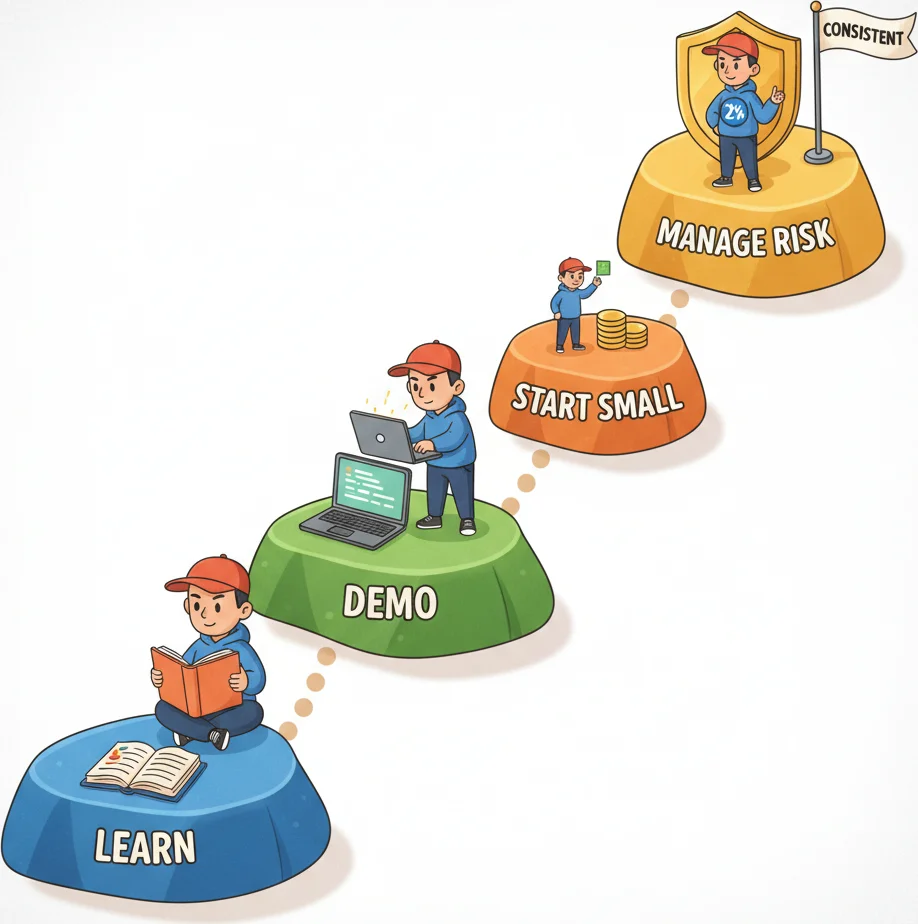
If you absolutely must use a signal provider starting out, do this:
- Start with a free trial. Any reputable service offers one.
- Use a microscopic account. A $100 or N50,000 account. The goal is to test the process and your psychology, not to get rich.
- Verify every trade for at least three months before even considering a larger account.
- Choose a provider whose style you understand. If you don't get their analysis, you'll never trust them when a trade goes against you.
And a final, critical warning about brokers. Using signals with a bad broker is a nightmare. Slippage will ruin your entries and exits. You need a broker with tight, reliable spreads and fast execution. I've had good experiences with Pepperstone and XM for this, but always do your own research. If your broker is constantly requoting you or their platform freezes, even the world's best signal is useless.
The path isn't finding a magical signal giver. The path is using these services as a temporary scaffold while you build your own trading house. Once the house is built, you tear the scaffold down. Your edge should eventually be your own mind, not a monthly subscription.

FAQ
Q1Are free forex signal groups on Telegram legit?
Some are, most are traps. Free groups often use low-quality signals to get you hooked, then push you into a paid "VIP" group with the "real" signals. Others are run by brokers' introducing brokers (IBs) who make money from your spread, not your success. Be extremely skeptical. The best free resource is often a provider's public analysis, not their trade calls.
Q2How much should I pay for a forex signal service in Nigeria?
Anywhere from N5,000 to N30,000 per month is a reasonable range for a manual analysis service. Anything higher better come with exceptional, verified results and personal mentorship. Never pay a percentage of your profits or a huge annual fee upfront. Monthly subscriptions give you an exit if the service degrades.
Q3Can I get rich quick by following forex signals?
No. This is the fantasy that empties accounts. Even the best providers have losing streaks. If you over-use your account chasing quick riches, a normal string of 3-4 losses will trigger a margin call. Sustainable trading is about consistent risk management over hundreds of trades, not getting rich from one signal.
Q4What's better: automated trading robots or human signal providers?
For most traders, especially beginners, a human provider is better. Robots (EAs) can't adapt to changing market conditions or unexpected news. They work until they don't, and often fail catastrophically. A human can explain a loss and adjust strategy. However, a disciplined human following a strict rule-based system is the ideal.
Q5How long should I test a signal provider before going live with real money?
Minimum one month, ideally three. You need to see how they perform in different market conditions (ranging, trending, high volatility). Paper trade their signals faithfully, including their suggested stop loss and take profit. Only consider real money after you have a full month of positive results and, crucially, after you understand why their winning trades worked.
Q6Do signal providers work for all account sizes?
Not always. A provider giving 50-pip stop loss signals might be fine for a $5,000 account, but the same stop loss in dollar terms could be way too risky for a $200 account. You must always recalculate the position size for your own account and risk tolerance using a position size calculator. A good provider will state the risk in percentage terms, not just pips.
Prof. Winstons Lektion
Wichtige Erkenntnisse:
- ✓Verify every signal on your own charts before execution.
- ✓Never risk more than 2% of your capital on any single trade idea.
- ✓Demand a 6-month minimum verified track record from any provider.
- ✓A 1:2 risk-to-reward ratio is the bare minimum for a viable signal strategy.
Wie nützlich war dieser Artikel?
Klicken Sie auf einen Stern
Wöchentliche Trading-Einblicke
Kostenlose wöchentliche Analysen & Strategien. Kein Spam.
Über den Autor
Olumide Adeyemi
Pionier des Tradings in Westafrika
Einer der aktivsten Forex-Trading-Ausbilder Nigerias. 8 Jahre Trading-Erfahrung aus Lagos. Spezialisiert auf Strategien mit geringem Kapital und Prop-Firm-Challenges für afrikanische Trader.
Kommentare
Risikohinweis
Der Handel mit Finanzinstrumenten birgt erhebliche Risiken und ist möglicherweise nicht für alle Anleger geeignet. Vergangene Ergebnisse garantieren keine zukünftigen Renditen. Dieser Inhalt dient ausschließlich Bildungszwecken und stellt keine Anlageberatung dar. Führen Sie immer Ihre eigene Recherche durch, bevor Sie handeln.
Das könnte Sie auch interessieren

Cara Trading Forex Sukses: 7 Prinsip dari Trader Profesional
Cara trading forex sukses dengan 7 prinsip trader pro: manajemen modal, disiplin, journal trading, backtest. Data nyata, bukan janji profit palsu.
Jam Trading Forex Terbaik untuk Trader Indonesia: Panduan Lengkap dengan Tabel Waktu
Panduan jam trading forex untuk trader Indonesia. Tabel 4 sesi dunia, jam emas 20:00-00:00, sesi mana yang harus dihindari. Data akurat + tips dari trader berpengalaman.
Top 5 Sàn Forex Uy Tín Nhất 2026: Review Jujur dari Trader Indonesia
Top 5 sàn forex uy tín 2026 untuk trader Indonesia. Review jujur: spread, deposit, withdraw, dukungan lokal. Exness, XM, IC Markets & lebih.
Pulsar Terminal herunterladen
Alle diese Rechner sind in Pulsar Terminal mit Echtzeit-Daten Ihres MT5-Kontos integriert.
Pulsar Terminal herunterladen