


Here's a hard truth most new traders in Nigeria miss: you're already in a losing trade the moment you click 'buy'.

Olumide Adeyemi
Pionier des Tradings in Westafrika ·  Nigeria
☕ 13 Min. Lesezeit
Was Sie lernen werden:
- 1Bid vs. Ask: The Two Prices on Every Trade
- 2The Spread: Your Silent Partner (Who Always Takes a Cut)
- 3How Nigerian Regulations Shape Your Bid and Ask (2026 Update)
- 4Beyond the Quote: Execution, Slippage, and Broker Tricks
- 5Putting It All Together: Calculating Your True Cost & Profit
- 6Choosing a Broker in Nigeria: The Spread Checklist
- 7Adapting Your Trading Strategy to the Spread Reality
- 8Common Mistakes Nigerian Traders Make (And How to Avoid Them)
Here's a hard truth most new traders in Nigeria miss: you're already in a losing trade the moment you click 'buy'. That's because of the spread - the gap between the bid and ask price. In 2025, Nigeria's forex market turnover hit $8.6 billion, a massive 56.4% jump from the year before. All that money flowing, and a huge chunk of it gets quietly siphoned off as transaction costs before the market even moves. If you don't understand these two prices, you're basically driving a car without knowing where the brake is. Let's fix that.
Every single currency pair you look at has two prices, not one. This isn't a suggestion, it's the fundamental mechanic of the market. Think of it like a roadside market for dollars. You have sellers shouting their prices (ask) and buyers shouting theirs (bid).
The bid price is what the market is willing to pay you for your currency. If you're selling EUR/USD, this is your price. It's always the lower number on your screen.
The ask price (sometimes called the offer) is what you must pay to buy that currency. If you want to go long on GBP/NGN, you buy at the ask. It's always the higher number.

Example: Let's say USD/NGN is quoted as 1450.50 / 1452.00.
- Bid Price: 1450.50. This is where you SELL dollars for Naira.
- Ask Price: 1452.00. This is where you BUY dollars with Naira.
- The Spread: 1452.00 - 1450.50 = 1.50 Naira. That's your immediate cost.
I learned this the expensive way. Back in 2020, I placed a "buy" order on GBP/USD thinking the price shown was my entry. I didn't realize I was instantly down 1.8 pips because I entered at the ask. The trade eventually went my way, but that initial hole made my risk management a mess from the start. Understanding your exact entry point is non-negotiable. For a deeper look at how this works on a major pair, check out our EUR/USD guide.
The spread is the difference between the bid and ask price. It's not a fee you see on a statement, it's baked into the price. This is how many brokers and liquidity providers make their money. In Nigeria, with our unique market volatility, spreads can be your biggest enemy or a manageable cost, depending on how you trade.
How Spreads Eat Your Profits
Let's say you have a strategy that aims for 10-pip profits on USD/NGN. If the average spread is 3 pips, your trade needs to move 13 pips in your favor just for you to break even. That's a 30% higher hurdle right out the gate. For strategies like scalping, where profits are measured in a few pips, a wide spread can make a potentially profitable system completely unworkable.
Variable vs. Fixed Spreads
Most brokers offer variable spreads. This means the gap between bid and ask widens and narrows with market liquidity. During major news events (like CBN announcements) or when liquidity is thin (Asian session for Naira pairs), spreads can blow out dramatically. I've seen USD/NGN spreads jump from 5 pips to over 25 pips in under a minute during a policy speech.
Some brokers offer fixed spreads. They promise the gap won't change. Sounds great, right? The catch is that fixed spreads are usually much wider than the average variable spread to protect the broker. You're paying for predictability. For a new trader, a fixed spread can help with calculating exact risk, but it's a more expensive form of insurance.

Warning: Always check the typical spread on the specific pair you're trading before you fund your account. A broker might advertise "spreads from 0.0 pips!" but that's usually only for EUR/USD. The spread on GBP/NGN or USD/NGN could be 5-10 times wider. Don't get fooled by the marketing.

💡 Winstons Tipp
The spread is the first loss. Never enter a trade unless your projected profit is at least 2.5 times the spread. It's the only way to give your edge room to breathe.
“A 'commission-free' broker is just a broker who charges you through a wider, less transparent spread.”
You can't talk about trading prices in Nigeria without understanding the rules of the game. Our market isn't like London or New York. The Central Bank of Nigeria (CBN) and SEC are constantly shifting the sand under our feet, and it directly affects liquidity, spreads, and which brokers you can even use.
The big change recently is the Investments and Securities Act, 2025 (ISA 2025). It made it illegal for any digital asset or forex trading platform to operate here without formal SEC registration. Here's the kicker: the SEC Nigeria still doesn't license international spot forex brokers. So, legally, the broker you're probably using (like Exness or IC Markets) isn't "registered" to operate here in the traditional sense.
What does this mean for bid and ask prices?
- Broker Choice: We're reliant on international brokers regulated offshore (like CySEC, FCA, ASIC). This isn't inherently bad - many are excellent - but it means your legal recourse is different. You must do your own due diligence on their reputation and execution practices.
- Naira Liquidity: The CBN's move to unify the FX windows into the Nigerian Foreign Exchange Market (NFEM) and the new rules for BDCs are meant to improve liquidity. In theory, more liquidity should mean tighter spreads for Naira pairs. In practice, we're still seeing high volatility, which keeps spreads wide. When the Naira swings 10% in a quarter, market makers protect themselves with a bigger buffer (i.e., a wider spread).
- Payment Impacts: Depositing and withdrawing in Naira often involves a conversion spread itself. You might get a slightly worse rate converting your Naira to USD to fund your account. This is a hidden addition to your trading costs.
The landscape is moving towards more transparency with electronic FX systems, but for now, the regulatory environment adds a layer of complexity and cost we have to account for.
Seeing a bid/ask quote is one thing. Getting your order filled at that price is another. This is where the rubber meets the road, and where many Nigerian traders get frustrated.
Slippage is when your order gets filled at a worse price than you expected. It happens almost exclusively during fast markets. You click buy at an ask price of 1452.00, but by the time your order reaches the market, the best available price is 1452.50. You've just lost an extra 0.50 Naira per dollar to slippage.
I got hammered by this during the CBN's policy announcement in late 2024. I had a stop-loss order on USD/NGN at 1480.00 (bid). The news hit, liquidity vanished, and my stop was executed at 1495.00. That's 15 pips of slippage, turning a small, planned loss into a account-damaging one. It was a brutal lesson in avoiding news events unless you're specifically trading them.
How Brokers Can Manipulate the Spread (A Little)
Not all brokers are created equal. Some, known as "market makers," may internally match your order instead of sending it to the interbank market. This can lead to:
- Re-quotes: Your order is rejected, and you're shown a new, worse bid/ask price.
- Widening Spreads on Stop-Losses: A shady practice where the spread is artificially widened just as your stop-loss is about to be triggered, guaranteeing it gets hit.
This is why I personally prefer ECN/STP brokers like Pepperstone or IC Markets. They connect you directly to liquidity providers. You often pay a small commission per trade, but the spreads are razor-tight (sometimes 0.0 pips on majors) and execution is generally faster with less conflict of interest. The raw spread plus a known commission is often cheaper than a "commission-free" account with a wide, variable spread.

Pro Tip: Always test a broker's execution with a small, live trade in volatile conditions before committing serious capital. Look for slippage and check if the fill price matches the historic bid/ask chart on TradingView.
“Your strategy isn't complete until you've checked the current spread. No entry is valid if the cost swallows the reward.”
Let's move from theory to your trading account. You need to know exactly how much the bid and ask price forex dynamic costs you, in Naira.
Step 1: Know Your Spread in Pips Look at your trading platform. Let's use a common scenario for a Nigerian trader:
- Pair: GBP/NGN
- Quote: 2150.00 / 2154.00
- Spread: 4.0 pips (2154.00 - 2150.00)
Step 2: Calculate the Monetary Cost The value of a pip depends on your trade size. Let's say you're trading a mini lot (10,000 units).
- Pip Value for GBP/NGN = (10,000 * 0.01) / 2150.00 ≈ 0.0465 Naira. (We use the current rate for accuracy).
- Spread Cost = 4.0 pips * 0.0465 Naira = 0.186 Naira per unit.
- For a 10,000 unit trade, your total immediate cost is 1,860 Naira (0.186 * 10,000).
That's 1,860 Naira gone before the market moves a single point in your favor. This is why a position size calculator is essential. It forces you to account for this cost in your risk.
Step 3: Defining Your Break-Even and Profit If you BUY (at the ask) at 2154.00:
- Your break-even point is not 2154.00. It's 2154.00 + the spread cost per unit.
- You need the BID price to rise to about 2154.186 just to get back to zero. Your profit is only calculated from that point onward. This is the single most important math in trading. Ignoring it is why most traders fail. For strategies that hold trades longer, like swing trading, the spread is a smaller percentage of your target, but it's still a tax on every entry and exit.
💡 Winstons Tipp
If you're constantly getting stopped out by a pip or two, it's not bad luck. It's your strategy being strangled by the spread. Widen your targets or find a tighter market.
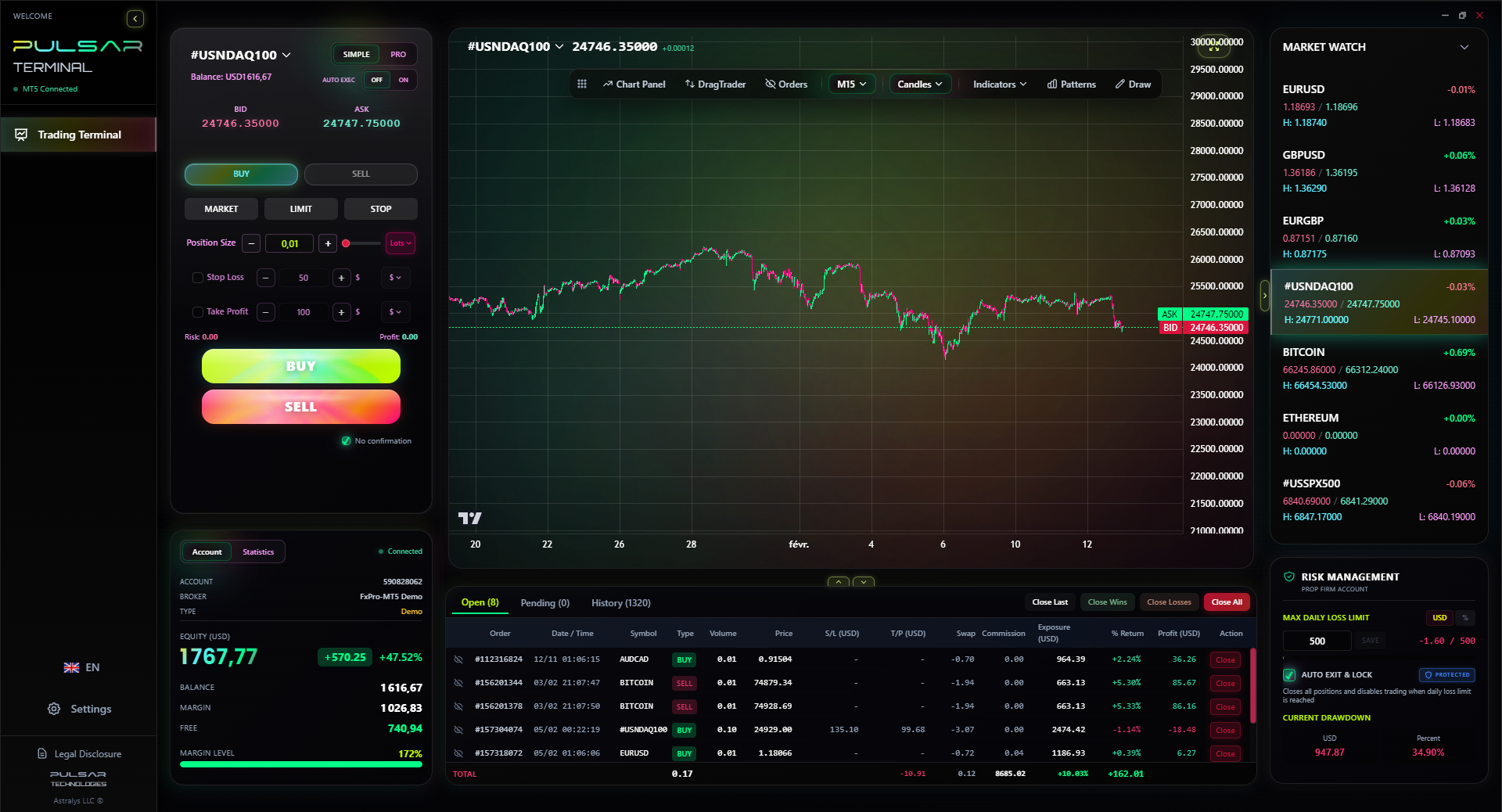
Manually calculating spread costs for every entry and exit is tedious; Pulsar Terminal's advanced trade management lets you set precise entry orders and visualize your true break-even point directly on the MT5 chart.
Pulsar Terminal
Das All-in-One MT5-Tool: Drag-and-Drop-Orders, Multi-TP/SL, Trailing Stop, Grid Trading, Volume Profile und Prop-Firm-Schutz. Täglich von 1.000+ Tradern genutzt.
Given our regulatory situation, picking a broker is about finding a reliable offshore partner with fair pricing. Don't just look at the minimum deposit (though starting small is smart). Here’s your checklist focused on bid/ask and costs:
| Feature | What to Look For | Why It Matters for Nigerians |
|---|---|---|
| Average Spread | Check the typical spread on the pairs YOU trade (e.g., USD/NGN, GBP/NGN, EUR/USD). Not just the advertised "from" spread. | Naira pairs often have wider spreads. You need realistic data. |
| Account Type | ECN/Raw Spread accounts vs. Standard accounts. ECN usually has a commission + tiny spread. | Calculate the total cost (spread + commission). For active trading, ECN is often cheaper. |
| Execution Model | STP/ECN preferred. Avoid brokers with a history of re-quotes or slippage scandals. | Clean execution means you get the price you see, protecting your strategy. |
| Deposit/Withdrawal | Local bank transfer, cards, and e-wallets (like Paystack, Flutterwave) in Naira. Check processing times and fees. | You don't want to lose 2-5% on every funding round due to poor FX conversion by the payment processor. |
| use Offered | Up to 1:500 or more is common. Higher use amplifies both gains AND losses from the spread. | Start low (1:10 or 1:20) while you learn. High use with wide spreads is a quick path to a margin call. |
Based on my experience and consistent testing, brokers like Exness are popular here for their raw spreads and super-fast withdrawals. XM is another with a strong local presence and flexible options. But you must verify their current conditions yourself. Open a demo account and watch the spreads during Lagos market hours and when London opens.
“In Nigeria, the spread isn't just a cost; it's a reflection of our market's volatility and liquidity challenges.”
Your strategy must be built with the spread in mind. A plan that works in a textbook with zero spreads will bleed money in the real world.
For Scalpers: You're fighting the spread with every trade. Your profit target must be significantly larger than the average spread. If USD/NGN has a 3-pip spread, aiming for a 5-pip profit is a losing game over time. You need a broker with the tightest possible spreads (think 0.5-1 pip on your chosen pair) and ultra-fast execution. Even then, it's a tough grind.
For Day Traders: You have more breathing room. A 3-pip spread on a 20-pip target is a 15% cost. It's high, but manageable with a good win rate. Use limit orders to enter trades. Instead of buying at the market ask, place a buy limit order between the current bid and ask. You might not get filled, but when you do, you've effectively reduced your spread cost. This requires patience.
For Swing Traders: The spread is a tiny fraction of a 200-pip move. Your bigger concern is the overnight financing swap fees. However, a wide spread still reduces your effective profit. More importantly, be cautious of spreads widening over weekends or around major economic releases, which can affect your stop-loss placement.
My Personal Adjustment: I used to trade a mean-reversion strategy on XAU/USD (Gold). It relied on quick, small bounces. The spread on gold can be 30-50 cents. I was constantly getting stopped out because my profit zone was smaller than the spread. I had to either abandon the strategy for gold or widen my targets, which changed the entire risk profile. I switched to using it on major forex pairs with tighter spreads instead. The instrument matters as much as the idea.
Using tools like the RSI indicator or MACD indicator for entries? Your signal isn't complete until you've checked the current spread. No entry is valid if the spread is abnormally wide and swallows your potential reward.
I've made these. My friends have made these. Let's save you the money and frustration.
Mistake 1: Ignoring the Spread in Risk Calculations. You risk 1% of your account per trade. You calculate your stop-loss as 50 pips away. But if the spread is 5 pips, your true risk from entry to stop-loss is 55 pips. Your 1% risk is now 1.1%. This error compounds and blows up your risk management. Always add the spread to your stop distance when calculating position size.
Mistake 2: Chasing "Commission-Free" Brokers. Nothing is free. A commission-free broker makes money from you via a wider spread. Often, the "free" spread is more expensive than a raw spread + commission model. Do the math for your typical trading volume.
Mistake 3: Trading Exotic or Illiquid Pairs. The temptation to trade GBP/NGN or EUR/NGN is high because it feels familiar. But these pairs often have the widest spreads and lowest liquidity compared to majors like EUR/USD or GBP/USD. You're paying a premium for that familiarity. Start with the major global pairs where competition keeps spreads tight.
Mistake 4: Placing Trades During Low Liquidity. Trading the Naira pair at 2 AM Lagos time? Spreads will be wider. Trading right before or after a major CBN announcement? Spreads will be massive. Know the market hours for your currency's primary trading session (e.g., USD/NGN is most liquid when London and Lagos are open).
Mistake 5: Not Using a Stop-Loss Because of Spread Fear. This is a deadly one. You're afraid your stop will get picked off due to spread widening, so you don't use one. This is like not wearing a seatbelt because it might wrinkle your shirt. The solution is to place your stop-loss a reasonable distance away from key support/resistance, accounting for the typical spread. No stop-loss is a guaranteed way to a total loss.
FAQ
Q1Which is more important for a beginner in Nigeria, low spreads or low minimum deposit?
Low minimum deposit lets you start, but low spreads let you survive. Start with a small amount (even $50-100) on a demo or live account with a broker known for fair spreads. It's better to learn with realistic costs than to have a huge account that gets eaten by spreads. A broker like FBS with a $1 minimum is great for testing, but check their spreads on your desired pairs before scaling up.
Q2How does the CBN's FX unification affect my trading spreads?
In the long term, the goal is to increase liquidity and transparency in the official market, which should lead to tighter and more stable spreads for Naira-related transactions. However, in the short term (2024-2026), the transition and associated volatility are actually causing wider spreads as market participants price in the uncertainty. Don't expect spreads on USD/NGN to match EUR/USD anytime soon.
Q3Can I buy at the bid price or sell at the ask price?
No, not with a standard market order. The bid is the price for sellers, the ask is for buyers. However, you can use limit orders to try and get a better price. You can place a buy limit order at the current bid price, hoping the market dips to fill you. But you're not guaranteed a fill. The market price must trade at your specified level.
Q4What is a 'pip' in Naira terms?
For most forex pairs, a pip is 0.0001 (or 0.01 for JPY pairs). For Naira pairs like USD/NGN quoted as 1450.00, a move to 1450.01 is a 1-pip move. The monetary value of that pip depends on your trade size. For a standard lot (100,000 units), a 1-pip move in USD/NGN is roughly 100,000 * 0.01 = 1,000 Naira, divided by the current rate. Always use a calculator.
Q5Why does the spread on my platform differ from what I see online?
Online spread comparisons often show averages or best-case scenarios. Your broker's live spread depends on their specific liquidity providers, the time of day, and market volatility. The spread you see on your MT4/MT5 terminal is your real-time cost. Trust your platform over a generic website.
Q6Is it legal for me in Nigeria to use an international broker not registered with SEC?
The legal landscape is complex. The ISA 2025 requires platforms to register. However, international brokers aren't physically located in Nigeria and are regulated abroad. Nigerian authorities primarily focus on entities operating within the country. Thousands of Nigerians use these brokers. The risk is not typically on the individual trader but on the broker's ability to offer services. Your protection comes from the broker's offshore regulator (like FCA or ASIC), not Nigerian law. Always choose a well-regulated international broker.
Prof. Winstons Lektion
Wichtige Erkenntnisse:
- ✓The bid is for selling, the ask is for buying. Always.
- ✓Calculate your true risk: Stop-Loss Distance + Spread.
- ✓For Naira pairs, expect spreads 3-10x wider than EUR/USD.
- ✓Test broker execution with real money in volatile times.
- ✓ECN accounts (spread + commission) are often cheaper than 'free' accounts.
Wie nützlich war dieser Artikel?
Klicken Sie auf einen Stern
Wöchentliche Trading-Einblicke
Kostenlose wöchentliche Analysen & Strategien. Kein Spam.
Über den Autor
Olumide Adeyemi
Pionier des Tradings in Westafrika
Einer der aktivsten Forex-Trading-Ausbilder Nigerias. 8 Jahre Trading-Erfahrung aus Lagos. Spezialisiert auf Strategien mit geringem Kapital und Prop-Firm-Challenges für afrikanische Trader.
Kommentare
Risikohinweis
Der Handel mit Finanzinstrumenten birgt erhebliche Risiken und ist möglicherweise nicht für alle Anleger geeignet. Vergangene Ergebnisse garantieren keine zukünftigen Renditen. Dieser Inhalt dient ausschließlich Bildungszwecken und stellt keine Anlageberatung dar. Führen Sie immer Ihre eigene Recherche durch, bevor Sie handeln.
Das könnte Sie auch interessieren

Cara Trading Forex Sukses: 7 Prinsip dari Trader Profesional
Cara trading forex sukses dengan 7 prinsip trader pro: manajemen modal, disiplin, journal trading, backtest. Data nyata, bukan janji profit palsu.
Jam Trading Forex Terbaik untuk Trader Indonesia: Panduan Lengkap dengan Tabel Waktu
Panduan jam trading forex untuk trader Indonesia. Tabel 4 sesi dunia, jam emas 20:00-00:00, sesi mana yang harus dihindari. Data akurat + tips dari trader berpengalaman.
Top 5 Sàn Forex Uy Tín Nhất 2026: Review Jujur dari Trader Indonesia
Top 5 sàn forex uy tín 2026 untuk trader Indonesia. Review jujur: spread, deposit, withdraw, dukungan lokal. Exness, XM, IC Markets & lebih.
Pulsar Terminal herunterladen
Alle diese Rechner sind in Pulsar Terminal mit Echtzeit-Daten Ihres MT5-Kontos integriert.
Pulsar Terminal herunterladen