


Let's cut through the noise.

Olumide Adeyemi
Pionier des Tradings in Westafrika ·  Nigeria
☕ 9 Min. Lesezeit
Was Sie lernen werden:
- 1What Exactly Are Black Market Forex Rates?
- 2The Real Costs and Risks (It's Not Just the Rate)
- 3The P2P Crypto 'Loophole' – A Wolf in Sheep's Clothing
- 4Legitimate Alternatives for Nigerian Traders
- 5Trading Strategy in a Volatile Naira Environment
- 6Selecting a Broker: The Nigerian Trader's Checklist
- 7The Long-Game Mindset
Let's cut through the noise. The biggest myth I hear from traders in Lagos to Port Harcourt is that the black market, or 'parallel market', is a shortcut to better forex rates. It's not a shortcut, it's a minefield dressed up as a solution. I've seen more accounts blown up from the fallout of chasing these rates than from bad technical analysis. This guide isn't about moralizing, it's about cold, hard trading reality. I'll show you what those rates really cost you, the hidden dangers nobody talks about, and how to legally access forex without putting your entire stack at risk.
In Nigeria, when people say 'black market forex rates,' they're talking about the exchange rate for currencies like the USD, GBP, or EUR traded outside the official banking and CBN-regulated channels. It's the rate you get from the 'abokis' at Bureau de Change hubs, through informal street networks, or on peer-to-peer (P2P) crypto platforms where the trade is cash-for-crypto disguised as a currency swap.
The key driver is simple: scarcity. When access to dollars through official means is restricted or comes with lengthy delays, demand floods into the parallel market. This pushes the black market rate significantly higher than the official CBN rate. For example, if the official rate is ₦1,450/$, the parallel rate might be ₦1,650/$. That spread is the premium you pay for immediate, often unregulated, access.

Warning: Don't confuse liquidity with legality. The black market is liquid, sure. But that liquidity comes with zero protection, zero recourse, and a hefty dose of counterparty risk. You're not trading on MetaTrader 5; you're making a private deal with a stranger.
Everyone looks at the premium over the official rate and thinks, 'That's the cost.' That's just the entry fee. The real risks are what happen after you've sent your money.
Counterparty Risk and Straight-Up Theft
You wire ₦10 million to a guy your cousin knows. He promises dollars at a great rate. Then he ghosts you. Game over. There's no customer support line, no regulatory body to file a complaint with. I lost $2,500 this way in 2019 trying to fund an international brokerage account quickly. Learned that lesson in Naira and blood.
Fraud and Fake Notes
You meet in person, do the swap. You get a stack of $100 bills. Later, you find out half are clever counterfeits. Now you're holding worthless paper and have committed a crime (unknowingly possessing counterfeit currency). The risk is real and shifts entirely onto you.
Legal Repercussions
While enforcement is sporadic, trading in the black market is illegal under Nigerian law. The bigger risk isn't necessarily jail time for the small trader, but the potential for your bank accounts to be flagged or frozen if they see transactions linked to known parallel market operators. This can cripple your entire financial life, not just your trading position size calculator.
Economic Impact
On a macro level, chasing these rates fuels the very problem you're trying to escape. It increases demand on the parallel market, which further widens the gap with the official rate, creating a vicious cycle of depreciation pressure on the Naira.

💡 Winstons Tipp
The market doesn't care how you got your stake. A dollar from a risky black market trade is identical to a dollar from a bank transfer, but the stress from getting the first one will cloud every decision you make afterwards.
“The black market rate is just the entry fee. The real costs are what happen after you've sent your money.”
This is the modern twist. Traders think using Binance P2P or other platforms is a safe, tech-savvy alternative. It feels cleaner than a street deal. It's not.
You're still engaging in a parallel market transaction. The platform is just an escrow service, not a regulator. The rate you see is the black market rate, plain and simple. The risks evolve:
- Account Freezes: The most common issue. You release crypto to the buyer, they mark 'payment made' on the app, but the Naira never hits your bank account. You're now in a dispute with a stranger while your crypto is gone.
- Bank Account Flagging: Nigerian banks are increasingly monitoring and freezing accounts receiving funds from P2P crypto transactions tagged as suspicious. Getting your account unfrozen is a bureaucratic nightmare.
- No Price Certainty: The rate fluctuates wildly minute-by-minute based on platform liquidity. It's terrible for calculating precise trade entries or exits if you're converting for trading capital. For a strategy like scalping where every pip counts, this volatility in your funding source is a non-starter.
I used P2P for a while in 2021. Made a trade where I needed to exit quickly. The P2P rate had moved 3% against me between the time I decided to sell my crypto for Naira and when the trade finally completed. That wiped out my entire profit from the actual forex trade. The funding mechanism killed the trade.
You don't have to choose between the official bottleneck and the black market chaos. There are legal paths.
International Retail Forex Brokers
This is the #1 solution for active traders. You fund your account in Naira (via bank transfer or card), the broker converts it at their commercial rate (which is usually better than the official CBN rate), and you trade global markets. Your capital is in a regulated environment.
Key points:
- Regulation is everything. Use brokers regulated by top-tier authorities (ASIC, FCA, CySEC). Your funds are segregated.
- Funding Methods: Brokers like Exness, IC Markets, and XM offer local bank transfers and card deposits in Naira. The conversion happens on their end.
- You're Trading, Not Speculating on Naira: Your focus shifts to analyzing EUR/USD or XAU/USD charts, not fretting about the street rate for physical dollars.
Investment Platforms
Platforms like Risevest or Trove allow you to invest in dollar-denominated assets (stocks, bonds) directly from Nigeria. You deposit Naira, they handle the forex conversion at a competitive institutional rate. This is for longer-term capital allocation, not active day trading.

💡 Winstons Tipp
Your first profitable trade isn't when you close a position in the green. It's when you successfully fund your brokerage account through a legal, repeatable method without losing a kobo to fraud.
“Using legitimate brokers isn't just about compliance; it's about freeing up your mental capital to focus on trading.”
Even using legitimate brokers, the Naira's volatility is a background risk you must manage. It affects your real returns in Naira terms.
1. Denominate Your Mind in USD: From day one, think of your trading capital in US Dollars. When you deposit ₦1.5M at a rate of ₦1,500/$, you have a $1,000 account. Your profit targets, risk per trade (e.g., 1% = $10), and position size calculator settings should all be in USD. This isolates your trading performance from Naira fluctuations.
2. Hedge (For Larger Accounts): If you have significant capital, consider a long-term hedge. This is advanced. You could hold a portion of your net worth in a stable, accessible dollar asset (even via the investment platforms mentioned) to offset Naira depreciation against your local living costs.
3. Withdraw Profits Strategically: Don't automatically convert every $100 profit back to Naira. Let profits compound in USD within your trading account. Only withdraw what you need for expenses. This builds a dollar-denominated asset over time.
4. The Psychological Edge: The biggest benefit of using a regulated broker is mental capital. You're not stressed about your funding source being illegal or stolen. You can focus 100% on your charts, your RSI indicator divergences, and your MACD indicator crossovers. That focus is worth more than any black market rate premium.
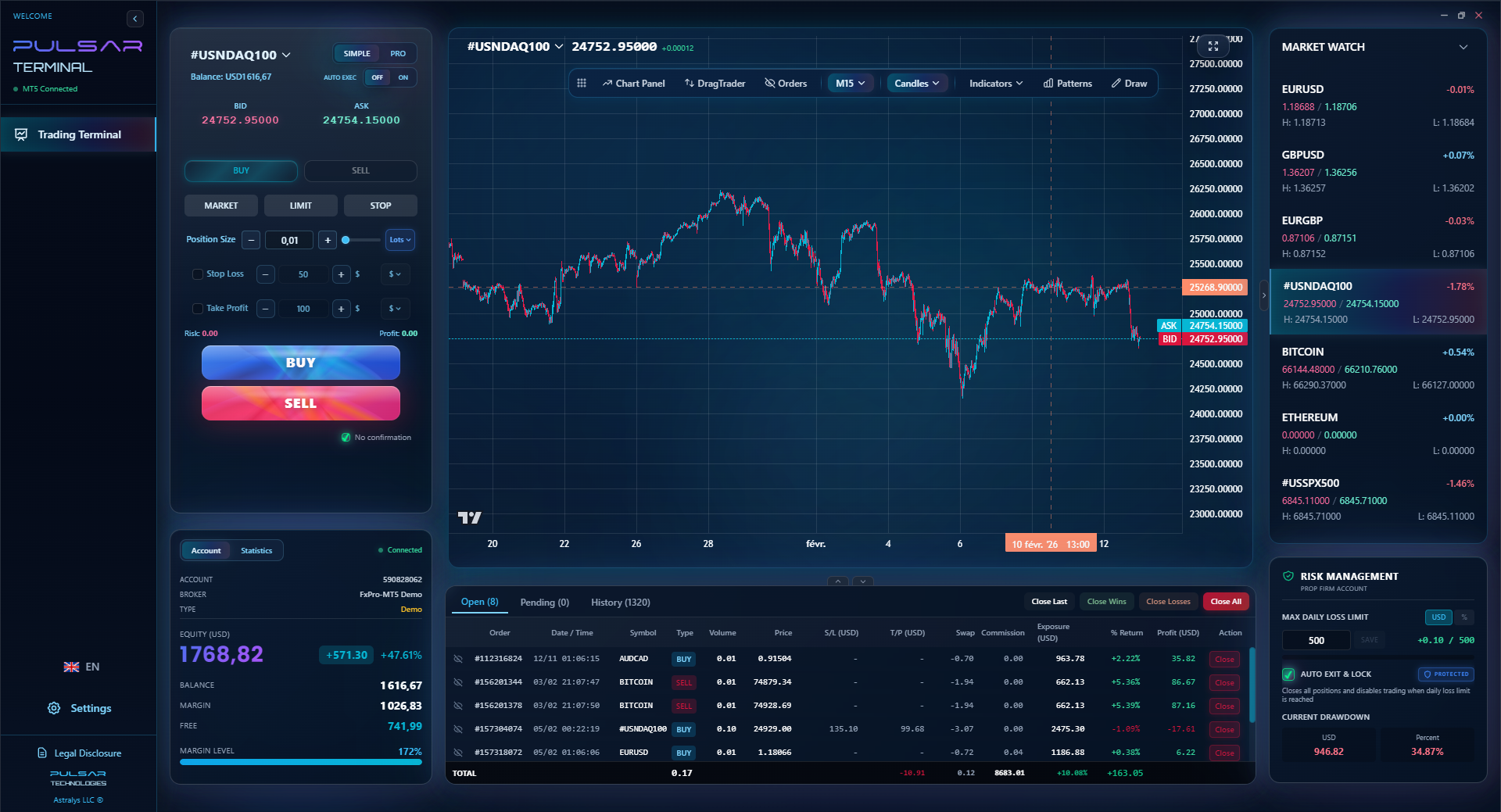
When your capital is hard-earned and legally sourced, protecting it with precise order management becomes non-negotiable, which is where tools like Pulsar Terminal's advanced trade execution shine.
Pulsar Terminal
Das All-in-One MT5-Tool: Drag-and-Drop-Orders, Multi-TP/SL, Trailing Stop, Grid Trading, Volume Profile und Prop-Firm-Schutz. Täglich von 1.000+ Tradern genutzt.
Here’s what matters specifically for a trader based in Nigeria:
| Criteria | Why It Matters | What to Look For |
|---|---|---|
| Naira Deposits/Withdrawals | Avoids the black market entirely. | Local bank transfer options, card deposits. Low or zero fees from the broker's side. |
| Regulation | Safety of funds. Legal recourse. | ASIC (Australia), FCA (UK), CySEC (EU) licenses. Avoid offshore-only regulators. |
| Trading Costs | Directly impacts profitability. | Competitive spreads on major pairs, low commissions if on ECN/RAW account. |
| Platform & Tools | Your battlefield. | strong MT4/MT5 support. Access to advanced tools for swing trading or analysis. |
| Customer Support | When things go wrong. | Responsive support, preferably with local or African office hours. |
I've personally run accounts with IC Markets and Pepperstone. Their Naira funding via PayCom (a local payment processor) has been reliable for me, with deposits reflecting in under an hour. Withdrawals back to my Nigerian bank account typically take 2-3 business days. The peace of mind is the real value.

Example: Let's say you deposit ₦750,000. Broker converts at ₦1,480/$. You get ~$506.76 in your trading account. You trade, grow it to $600. You withdraw $600. Broker converts at their sell rate (say ₦1,490/$), and you receive ~₦894,000. Your entire profit in Naira terms is realized through a legal, traceable channel. No street corners, no fear.
💡 Winstons Tipp
In finance, the easiest route is usually the most expensive. The extra few minutes it takes to fund a proper broker saves you the days of panic wondering if your parallel market transfer will arrive.
“Chasing black market rates is a short-term, scarcity mindset. Building a trading edge is a long-term game.”
Chasing black market forex rates is a short-term, scarcity mindset. It's about getting dollars now at any cost (including risk).
Successful trading is a long-term, abundance mindset. It's about building a sustainable edge in the global markets where your skill, not your location or access to forex, determines your success.
By using legitimate brokers, you're doing two powerful things:
- Building a Track Record: Your profit and loss is clean, documented, and verifiable. This is crucial if you ever want to scale up to a prop firm or manage other people's money.
- Creating Dollar Cash Flow: You are using your trading skill to generate dollar-denominated returns. Over time, this can significantly mitigate the impact of Naira devaluation on your personal wealth.
I made the switch in 2020. Since then, my trading has improved not because I found a magic indicator, but because I removed the massive, distracting risk of my funding source. I could finally focus on the market itself. That's the ultimate edge.
FAQ
Q1Is it illegal for a regular Nigerian to buy dollars on the black market?
Yes, technically. The Foreign Exchange (Monitoring and Miscellaneous Provisions) Act and CBN regulations require forex transactions to go through authorized dealers. While enforcement on small individuals is inconsistent, the activity itself is illegal and carries risks of fraud, loss, and potential account issues.
Q2Can I fund an international forex broker from Nigeria?
Absolutely. Many reputable international brokers like Exness, IC Markets, XM, and Pepperstone accept Naira deposits directly through local bank transfers or debit/credit cards via payment processors. They handle the forex conversion at their commercial rate.
Q3Won't I get a worse rate with a broker than on the black market?
On the surface, the broker's buy rate for your Naira might be slightly less attractive than the black market's sell rate for dollars. But this ignores the massive risk premium. The broker's rate is the total cost for a safe, legal, and instant transaction. The black market rate is just the starting point before factoring in risk of theft, fraud, or fake currency.
Q4What if my bank blocks a transfer to an international broker?
This can happen. Use brokers that employ well-known local payment processors (like PayCom, Flutterwave). These transfers often appear as domestic transactions. If blocked, call your bank's customer service and explain it's for a legitimate international trading service. Having the broker's regulatory details handy helps.
Q5Are P2P crypto platforms safe for getting forex?
They are safer than street deals but carry significant new risks. Your bank account can be frozen receiving funds from unknown parties, and dispute resolution is slow. The rate is still a black market rate, and you have no price certainty during volatile periods.
Q6How do I calculate my real returns in Naira with a forex broker?
Denominate everything in USD first. If you deposit $1,000 and trade it to $1,100, you made a 10% return in USD. When you withdraw, the broker will convert the $1,100 to Naira at their prevailing rate. Your Naira return depends on that rate at withdrawal time, but your trading skill is measured in USD.
Q7Can trading forex protect me from Naira devaluation?
It can be a hedge, but don't trade just for that reason. If you are a profitable trader generating USD returns, those profits will be worth more in Naira terms if the Naira weakens. However, you must be profitable first. Trading to hedge devaluation with no skill is a sure way to lose money.
Prof. Winstons Lektion
Wichtige Erkenntnisse:
- ✓The black market premium is a risk surcharge, not a discount.
- ✓P2P crypto platforms still trade at black market rates with added tech risk.
- ✓Fund via regulated brokers using local Naira payment processors.
- ✓Denominate your trading capital and P&L in USD from day one.
- ✓Legal funding lets you focus 100% on your trading strategy.
Wie nützlich war dieser Artikel?
Klicken Sie auf einen Stern
Wöchentliche Trading-Einblicke
Kostenlose wöchentliche Analysen & Strategien. Kein Spam.
Über den Autor
Olumide Adeyemi
Pionier des Tradings in Westafrika
Einer der aktivsten Forex-Trading-Ausbilder Nigerias. 8 Jahre Trading-Erfahrung aus Lagos. Spezialisiert auf Strategien mit geringem Kapital und Prop-Firm-Challenges für afrikanische Trader.
Kommentare
Risikohinweis
Der Handel mit Finanzinstrumenten birgt erhebliche Risiken und ist möglicherweise nicht für alle Anleger geeignet. Vergangene Ergebnisse garantieren keine zukünftigen Renditen. Dieser Inhalt dient ausschließlich Bildungszwecken und stellt keine Anlageberatung dar. Führen Sie immer Ihre eigene Recherche durch, bevor Sie handeln.
Das könnte Sie auch interessieren

Cara Trading Forex Sukses: 7 Prinsip dari Trader Profesional
Cara trading forex sukses dengan 7 prinsip trader pro: manajemen modal, disiplin, journal trading, backtest. Data nyata, bukan janji profit palsu.
Jam Trading Forex Terbaik untuk Trader Indonesia: Panduan Lengkap dengan Tabel Waktu
Panduan jam trading forex untuk trader Indonesia. Tabel 4 sesi dunia, jam emas 20:00-00:00, sesi mana yang harus dihindari. Data akurat + tips dari trader berpengalaman.
Top 5 Sàn Forex Uy Tín Nhất 2026: Review Jujur dari Trader Indonesia
Top 5 sàn forex uy tín 2026 untuk trader Indonesia. Review jujur: spread, deposit, withdraw, dukungan lokal. Exness, XM, IC Markets & lebih.
Pulsar Terminal herunterladen
Alle diese Rechner sind in Pulsar Terminal mit Echtzeit-Daten Ihres MT5-Kontos integriert.
Pulsar Terminal herunterladen