


If you're searching for brokers for MetaTrader 5 in the US, you've probably hit a wall.

James Mitchell
Senior Trading-Analyst
☕ 10 Min. Lesezeit
Was Sie lernen werden:
If you're searching for brokers for MetaTrader 5 in the US, you've probably hit a wall. You see all these amazing international brokers with tight spreads, but they won't touch you with a ten-foot pole if you're American. That's not a conspiracy, it's the law. I spent years frustrated by this before I understood the rules. Let's cut through the noise. I'll show you exactly who you can use, what it really costs, and how to make MT5 work for you within the strict US regulatory box.
Here's the cold, hard truth most articles gloss over: being a US retail trader puts you in a heavily protected cage. It's for your safety, sure, but it also massively limits your freedom. The main gatekeepers are the Commodity Futures Trading Commission (CFTC) and the National Futures Association (NFA).
For a broker to offer you MT5 legally, they must be a registered Retail Foreign Exchange Dealer (RFED). That's a huge hurdle. They need to maintain at least $20 million in adjusted net capital and submit to intense, frequent audits. This is why giants like IC Markets review or Pepperstone review, which are fantastic elsewhere, simply don't operate here. The compliance cost is astronomical.
The rules also dictate how you trade on MT5. The FIFO (First-In, First-Out) rule means you can't pick and choose which lot to close. You close the oldest one first. Hedging? Forget it. You can't have a buy and a sell open on EUR/USD at the same time. And use is capped at 50:1 for majors, which feels like trading with handcuffs on if you're used to international norms. These rules are baked into the US version of the MT5 platform your broker provides.
So when you're looking at brokers for MetaTrader 5, you're not just looking for a company that supports the software. You're looking for one that's willing to jump through the US regulatory hoops and build a special, compliant version of it just for you. Very few are.
As of right now, your realistic choices boil down to a very short list. Don't waste time searching for others; they either don't accept US clients or they're operating in a grey area you should avoid.
FOREX.com
This is your heavyweight champion. They're the largest retail FX broker in the US by client assets and have fully embraced MT5. I've held accounts with them for years. Their integration is seamless. You get the full MT5 experience, but with the US rule-set (FIFO, no hedging) automatically applied. They offer two main account types relevant to MT5 users: a standard account with wider spreads but no commission, and a RAW Pricing account.
I used their RAW account for a scalping strategy on EUR/USD. The spreads were consistently at 0.1 pips, but they charge a commission of $7 per $100k traded. So, a 1-lot trade (100k) costs you $7 to open and $7 to close, totaling $14. You need to factor that into your position size calculator. Minimum deposit is $100.
Trading.com
A smaller but fully regulated player. They offer MT5 directly to US traders. Their focus seems to be on a straightforward offering. Spreads are variable and competitive, though in my experience, they can widen a touch more than FOREX.com's during off-peak hours. They don't have a complex tier of accounts, which simplifies things. The platform is the vanilla, US-compliant MT5. Funding and withdrawals are standard.

Warning: Many "broker finder" sites will list OANDA or tastyfx (formerly IG US) as MT5 brokers. For US residents, this is currently misleading. OANDA offers MT4. tastyfx offers MT4. As of this writing, they do not offer MT5 directly to US retail traders. This could change, but always confirm on the broker's own website for your country of residence.
“Being a US retail trader puts you in a heavily protected cage. It's for your safety, but it also massively limits your freedom.”
The platform is free, but trading isn't. Here’s what actually eats into your profits, with real numbers from the US brokers for MetaTrader 5.
Spreads & Commissions: This is your primary cost. You're choosing between a higher spread with no commission, or a razor-thin spread with a commission.
| Cost Type | FOREX.com (Standard) | FOREX.com (RAW) | Trading.com (Standard) |
|---|---|---|---|
| Avg. EUR/USD Spread | ~1.2 pips | 0.0 - 0.1 pips | ~1.0 - 1.5 pips |
| Commission | $0 | $7 per $100k | $0 |
| Cost per 1 Lot Trade | ~$12 | ~$14 | ~$10 - $15 |
Cost calculated as (Spread in pips * $10) + Commission. 1 pip on EUR/USD = $10 per standard lot.
As you can see, the total cost is remarkably similar. The RAW account is better for strategies super sensitive to spread definition entry points.
Overnight Financing (Swap): If you hold a trade past 5 PM ET, you pay or earn interest. This isn't a broker fee per se, but a market rate plus a small admin charge. For a swing trading position, this can add up. I once held a short GBP/USD position for three weeks and paid about $45 in total swap fees. It turned a good trade into just an okay one.
Inactivity Fees: This one stings if you step away. FOREX.com charges $15 per quarter after 12 months of no trades. Always read the fee schedule.
Deposit/Withdrawal: ACH transfers are almost always free. Credit card deposits might have a small fee (or be treated as a cash advance by your bank). Wire transfers can cost $25 or more on your bank's end.

💡 Winstons Tipp
Your first goal with a US broker isn't to make money. It's to not lose money to hidden fees. Track every commission, swap, and spread for your first 100 trades in a journal.
The MT5 you download from a US broker is different. It's not worse, but it's configured for compliance.
First, you can't hedge. The platform won't let you open an opposite position on the same pair. If you try, it will either reverse your current position or just give you an error. This changes how you manage trades. You can't just throw a hedge on and think about it later.
Second, FIFO is enforced automatically. In your trade window, you'll see your positions listed by open time. When you close, it closes the oldest one. You don't get a choice. This makes partial closing strategies a bit more mechanical.
Third, the use is pre-set. You won't see an option for 1:500. The maximum dropdown will show 1:50 for EUR/USD and 1:20 for something like EUR/CAD.
The good news? All the powerful parts of MT5 are still there. The depth of market (DOM), the economic calendar, the superior backtester compared to MT4, and the ability to trade stocks and futures from the same platform (if your broker offers those assets). The charting tools and indicators like the MACD or RSI function identically.
“With only a couple of real options, your choice comes down to your style and the finer details.”
This is a hot topic. You might see prop firms like FTMO advertising MT5. Here's what happened: In early 2024, MetaQuotes (the maker of MT5) cracked down hard on prop firms offering "grey label" access to US traders. They basically pulled the plug. Overnight, many US traders found their accounts frozen.
The prop firms scrambled. Some moved to platforms like cTrader or Match-Trader. Then, in 2025, FTMO found a clever workaround: they partnered with OANDA, a US-regulated broker. So, when you take an FTMO challenge in the US now, you're technically trading on a platform linked to OANDA's regulated infrastructure. It's a backdoor, but a legal one.
If you go this route, understand the rules are the same: FIFO, no hedging, limited use. The prop firm's rules (like daily loss limits) are on top of the US regulations. It's a double layer of restriction. Managing this manually is tough. This is where tools that automate rule enforcement become useful, because one slip can blow your challenge.

Pro Tip: If you're trading a prop firm account with US rules, your biggest risk is often the daily loss limit. You need a tool that can track your running P&L and automatically close all trades if you hit that limit. Doing this manually while in a losing trade is a recipe for disaster and a surefire way to get a margin call.
💡 Winstons Tipp
The FIFO rule forces discipline. You can't cherry-pick losing lots to hold. This painful constraint will make you a better entry-level trader over time.
With only a couple of real options, your choice comes down to your style and the finer details.
Pick FOREX.com if:
- You want the security of the largest US broker.
- You need the tightest possible raw spreads for scalping.
- You value having a strong proprietary platform as a backup.
- You might want to trade other assets like futures or US stocks through the same broker.
Pick Trading.com if:
- You prefer a simpler, no-commission model.
- You like a straightforward account structure without multiple tiers.
- You are a standard swing or day trader where the slight spread difference won't make or break your system.
The Non-Negotiables:
- Open a Demo Account First. Trade on it for at least two weeks. See how the spreads behave during the London open, the US session, and the Asian session. Test the execution speed.
- Read the Fee Schedule. Know the inactivity fee, the withdrawal fee, and any account minimums.
- Test Customer Support. Call them. Ask a technical question about MT5. See how long it takes to get a competent answer. You don't want to find out they're useless when you have a live trade on.
I made the mistake of funding an account based on a marketing promo once. The spreads were great in the demo, but live, they were consistently 0.3 pips wider. That added up to hundreds over a few months. The demo is your best research tool.
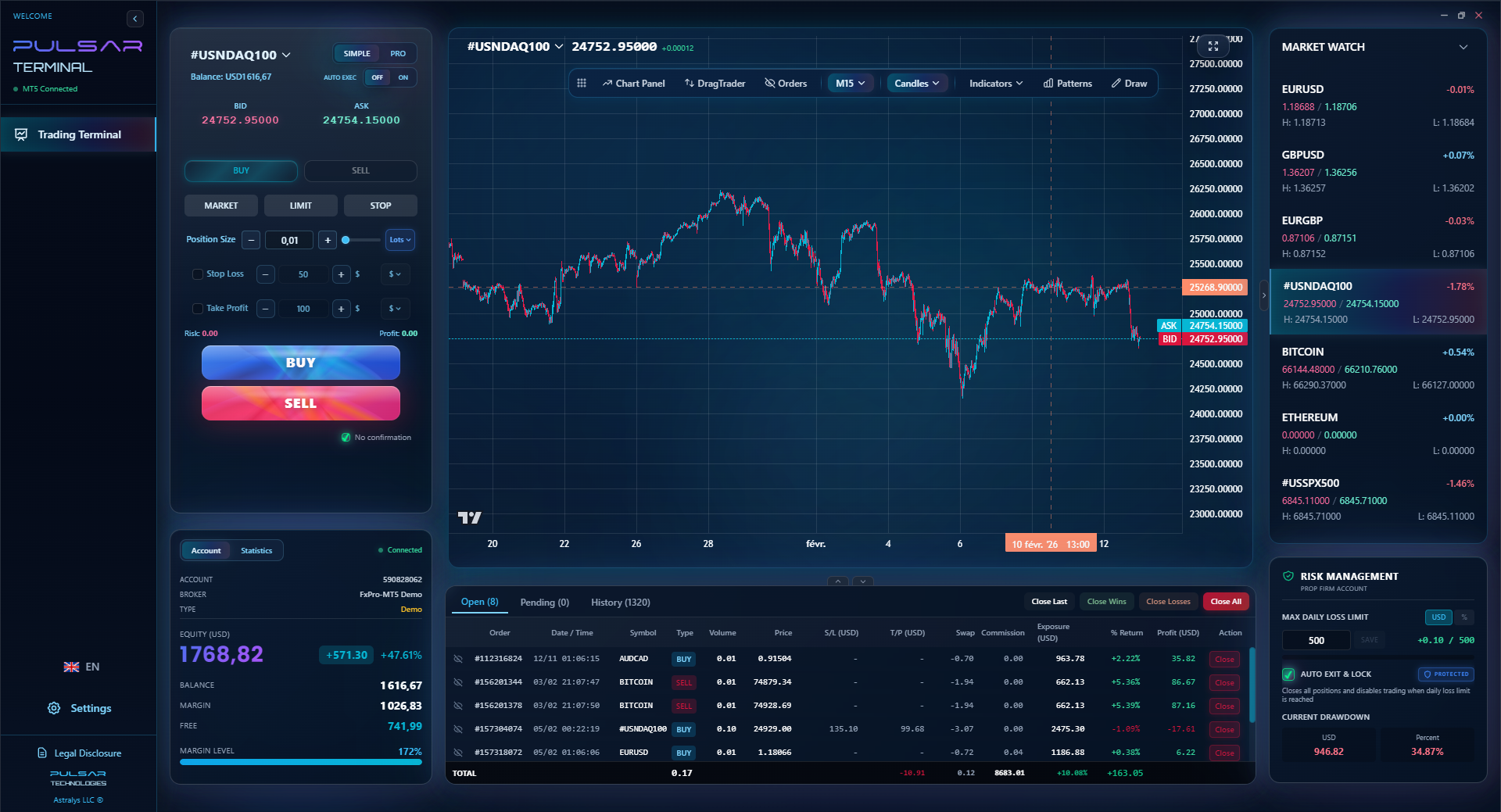
Managing multiple take-profit levels and trailing stops under US FIFO rules is complex, but Pulsar Terminal automates this directly on your MT5 platform.
Pulsar Terminal
Das All-in-One MT5-Tool: Drag-and-Drop-Orders, Multi-TP/SL, Trailing Stop, Grid Trading, Volume Profile und Prop-Firm-Schutz. Täglich von 1.000+ Tradern genutzt.
“I blew up my first US account because I thought 'only 50:1' meant it was safe to go big. I was wrong.”
Trading in the US can feel restrictive, but you can build a serious career within these rules. You just have to adapt.
Embrace the Netting System: Since you can't hedge, your trade management has to be precise. Use stop-losses religiously. Consider using a multi-take-profit strategy where you scale out of positions. This helps you lock in profit and reduce risk without needing to hedge.
Factor in ALL Costs: Your trade isn't just spread. It's spread + commission + potential swap. Before you enter, know your exact break-even point. A simple 5-pip target might only be 3 pips of actual profit after costs. Use a position size calculator that lets you input commission.
use is a Trap: With a 50:1 cap, you might be tempted to use it all. Don't. A 2% risk on a 50:1 leveraged position is still a 100% move relative to your margin. I blew up my first US account because I thought "only 50:1" meant it was safe to go big. I was wrong. Risk management is even more critical.
Supplement Your Toolkit: The US MT5 platform is solid, but adding a professional charting tool can help. Many traders use TradingView for analysis and then execute on MT5. For trade management, look for tools that can automate trailing stops or breakeven moves, which MT5's native system is clunky with.
Focus on mastering one or two pairs, like the EUR/USD guide or XAU/USD guide, rather than jumping around. Depth beats breadth in a regulated environment.
FAQ
Q1Can I use a broker like IC Markets or XM if I live in the US?
No. Legally, they cannot accept you as a retail client. If you find a way to open an account, you are likely breaking their terms of service and may have no legal protection if something goes wrong. Always trade with a broker regulated for your region.
Q2What is the minimum deposit for a US MT5 account?
It's typically low. FOREX.com requires $100. Trading.com's minimum isn't prominently advertised but is generally in the same ballpark. Remember, the minimum deposit is different from the capital you should start trading with. Start with an amount you can afford to lose completely.
Q3Are CFDs available on MT5 in the United States?
Almost universally, no. CFDs are largely prohibited for US retail traders. Your trading on US-regulated MT5 will be in spot forex, futures, and possibly stocks/ETFs, depending on the broker.
Q4Why does my MT5 platform look different than what I see in YouTube tutorials?
You're likely seeing tutorials from traders using international, non-compliant versions of MT5. Their platform allows hedging, doesn't enforce FIFO, and shows different use options. Your US version has these features locked down to comply with CFTC/NFA rules.
Q5Can I use Expert Advisors (EAs) and automated trading on US MT5?
Yes, absolutely. The MetaTrader Strategy Tester and live automated trading work perfectly. However, your EA must be coded to comply with FIFO rules. An EA designed to hedge will not work on a US account.
Q6Is MetaTrader 5 better than MetaTrader 4 for US traders?
For forex-only traders, the difference is minimal due to the regulatory overlay. However, MT5 is a more modern platform with a better backtester, more timeframes, and built-in economic calendar. If your broker offers both, go with MT5 for the slightly better technology.
Prof. Winstons Lektion
Wichtige Erkenntnisse:
- ✓Only 2-3 brokers legally offer MT5 to US retail traders.
- ✓US rules enforce FIFO, no hedging, and max 50:1 use.
- ✓Total trade cost (spread + commission) is similar across brokers.
- ✓Prop firm access to MT5 exists via special broker partnerships.
- ✓Adapt your strategy to the netting system, don't fight it.
Wie nützlich war dieser Artikel?
Klicken Sie auf einen Stern
Wöchentliche Trading-Einblicke
Kostenlose wöchentliche Analysen & Strategien. Kein Spam.
Über den Autor
James Mitchell
Senior Trading-Analyst
In New York ansässig mit über 9 Jahren Trading-Erfahrung. Fokus auf Haupt-USD-Paare, Prop-Firm-Challenges und die US-Regulierungslandschaft.
Kommentare
Risikohinweis
Der Handel mit Finanzinstrumenten birgt erhebliche Risiken und ist möglicherweise nicht für alle Anleger geeignet. Vergangene Ergebnisse garantieren keine zukünftigen Renditen. Dieser Inhalt dient ausschließlich Bildungszwecken und stellt keine Anlageberatung dar. Führen Sie immer Ihre eigene Recherche durch, bevor Sie handeln.
Das könnte Sie auch interessieren

Cara Trading Forex Sukses: 7 Prinsip dari Trader Profesional
Cara trading forex sukses dengan 7 prinsip trader pro: manajemen modal, disiplin, journal trading, backtest. Data nyata, bukan janji profit palsu.
Jam Trading Forex Terbaik untuk Trader Indonesia: Panduan Lengkap dengan Tabel Waktu
Panduan jam trading forex untuk trader Indonesia. Tabel 4 sesi dunia, jam emas 20:00-00:00, sesi mana yang harus dihindari. Data akurat + tips dari trader berpengalaman.
Top 5 Sàn Forex Uy Tín Nhất 2026: Review Jujur dari Trader Indonesia
Top 5 sàn forex uy tín 2026 untuk trader Indonesia. Review jujur: spread, deposit, withdraw, dukungan lokal. Exness, XM, IC Markets & lebih.
Pulsar Terminal herunterladen
Alle diese Rechner sind in Pulsar Terminal mit Echtzeit-Daten Ihres MT5-Kontos integriert.
Pulsar Terminal herunterladen