


If your first instinct for getting into forex trading is to pick up the phone and call FNB, you're already making a critical mistake.

David van der Merwe
Schwellenland-Trader ·  South Africa
☕ 9 Min. Lesezeit
Was Sie lernen werden:
- 1What 'Call FNB Forex' Actually Means (Spoiler: It's Not Trading)
- 2The Real Costs: How FNB's Fees Eat Your Profits Alive
- 3FNB vs. A Real Forex Broker: A Side-by-Side Smackdown
- 4So When *Should* You Actually Use FNB?
- 5How to Start Trading the Right Way in South Africa
- 6Common Mistakes to Avoid (Beyond Calling FNB)
- 7Tools the Professionals Use (What You're Really Missing)
If your first instinct for getting into forex trading is to pick up the phone and call FNB, you're already making a critical mistake. I'm not here to sugarcoat it. FNB is a retail bank, not a trading platform, and confusing the two will cost you thousands in hidden fees and missed opportunities. This guide will tear apart the 'call FNB forex' myth, show you the brutal math on their spreads and commissions, and point you toward the tools that professional traders in South Africa actually use. I'll prove that using your bank for trading is like trying to win a Formula 1 race in a family sedan.
Let's get this straight right now. When you 'call FNB forex,' you are not calling a trading desk. You are calling a retail banking division that handles international money transfers and currency exchange for travel or business. Their job is to sell you Rands for Dollars or Euros at a marked-up rate, not to provide you with a leveraged trading account on MetaTrader 5. I've had students come to me, confused, thinking their FNB 'forex service' was a gateway to the markets. It's not.
FNB operates as an Authorised Dealer with the South African Reserve Bank (SARB). Their primary function is to help you move money across borders within the strict exchange control limits - like your R1 million single discretionary allowance or your R10 million foreign investment allowance. They are compliance officers in bankers' clothing, not market makers. The person on the other end of that 'call Fnb forex' line has zero insight into technical analysis, support and resistance, or managing a margin call. Their goal is to execute your transfer, collect their fee, and move on.

Warning: Using FNB for 'trading' means you buy a currency, hope it appreciates in the real world, then sell it back later. There's no use, no short-selling, and the spreads are enormous. It's an expensive speculation, not active trading.
“Using FNB for 'trading' is an expensive speculation, not active trading.”
This is where the fantasy meets the brutal reality of bank profits. FNB doesn't make money from your trading genius; they make money from your ignorance. Their fee structure is designed for occasional, large transfers, not the frequent, small transactions that define trading.
The Commission Structure
Based on their latest pricing, sending R15,000 online incurs a 0.55% commission. That's R82.50, with a minimum of R275. Wait, what? Yes, you read that right. The minimum fee is higher than the calculated percentage. So on that R15,000 transfer, you pay R275, not R82.50. That's a 1.83% hit before you've even seen a price move. Do that a few times a month like a trader would, and you're funding their bonus pool.
The Hidden Killer: The Spread
The commission is just the ticket to the show. The real villain is the exchange rate margin. FNB and all banks buy currency at the interbank rate (the real rate) and sell it to you at a marked-up rate. Their margin is typically 2% to 4.5%. Let's do the math with a conservative 3%.
Example: You want to buy USD/ZAR. The real market rate is 18.50.
- FNB's sell rate to you: 18.50 + 3% = 19.055
- You buy $1,000 worth. Cost: R19,055.
For you to just break even, the market rate needs to move to 19.055 before you even think about selling it back to them (where they'll take another margin). That's a 555 pip move just to get back to zero. In the real forex market, the spread on USD/ZAR with a good broker might be 15-30 pips. FNB's 'spread' is over 500. Let that sink in.

Example: I once helped a client unwind a 'position' he'd made through his bank. He'd 'bought' EUR via a wire, thinking he was trading. Between the two-way margin and fees, the EUR/USD rate needed to move nearly 4% in his favor just for him to see a single cent of profit. A proper broker would have needed a 0.1% move.

💡 Winstons Tipp
A bank's currency desk is a toll booth, not a trading floor. They profit from your passage, not your success.
“FNB's 'spread' can be over 500 pips. A good broker's spread might be 15.”
Comparing FNB to a trading broker isn't comparing apples and oranges. It's comparing a bicycle to a jet plane. Here’s the breakdown:
| Feature | 'Call FNB Forex' (Banking Service) | Real FSCA-Regulated Broker (e.g., Exness, IC Markets) |
|---|---|---|
| Primary Function | International Payments & Currency Exchange | Speculative Leveraged Trading |
| Access Platform | Phone, Online Banking | MT4, MT5, cTrader, Proprietary Platforms |
| Typical Spread | 2% - 4.5% (200-450 pips) | 0.1 - 1.5 pips on Majors |
| Commission | 0.55% (with high minimums) | Often $3-$7 per lot, or built into spread |
| use | None (1:1) | Up to 1:30 for retail (FSCA rule) |
| Ability to Short | No | Yes |
| Order Types | Market order only | Limit, Stop, Trailing Stop, OCO |
| Speed of Execution | Hours to Days | Milliseconds |
| Charting & Analysis | None | Advanced, with indicators like RSI & MACD |
As you can see, there is no contest. A broker gives you the tools for tactical market entry and risk management. FNB gives you a receipt. If your strategy involves scalping or even swing trading, using a bank is financially impossible. The costs simply erase any potential profit from normal market fluctuations.
“FNB's 'spread' can be over 500 pips. A good broker's spread might be 15.”
I'm not saying FNB is useless. They have a specific, legitimate purpose for a trader's life, just not for executing trades. Use them for what they are good at:
- Withdrawing Profits from Your Broker: This is their main role in your trading environment. You've made a good profit on EUR/USD with your proper broker. Now you need to get those Dollars back to South Africa as Rands. This is when you use your bank's forex service. You're moving a large lump sum, and the percentage fee becomes more palatable on a big win.
- Funding Your SARB Allowances: Need to use your R10 million foreign investment allowance to fund an international brokerage account? FNB can help that wire. Again, it's a one-off administrative transfer.
- Personal Transactions: Sending money for family, paying for an overseas course, or travel money. That's their bread and butter.
The rule is simple: Use brokers for trading, use banks for banking. Never cross the streams.
💡 Winstons Tipp
Your first calculation before any trade should be risk (Rands), not reward. If you don't know the exact number you can lose, you have no business entering.
“Use brokers for trading, use banks for banking. Never cross the streams.”
Forget the phone. Here’s your actual step-by-step, starting from zero.
Step 1: Education, Not Dialing. Before you deposit a single Rand, learn. Understand what a pip is, how use works, and what moves currency pairs. Paper trade for at least three months. I didn't, and I blew my first R5,000 account in two weeks trading gold (XAU/USD) on emotion.
Step 2: Choose a Regulated Broker. Your first filter is FSCA regulation. It’s your safety net. Then, look at costs (spreads/commissions), platform quality (MT5 is industry standard), and customer support. Read our deep-dive reviews on brokers like Pepperstone or XM to see who fits your style.
Step 3: Start Small & Use a Calculator. When you fund your live account, start with an amount you can afford to lose. I mean it. Use a position size calculator religiously. My most painful lesson was in 2019: I got greedy on a USD/ZAR short, oversized my position, and a sudden SARB comment triggered a 150-pip spike against me. The loss was R3,200 - a huge chunk of my account at the time - all because I didn't calculate the risk.
Step 4: Develop a Simple, Tested Strategy. Don't try to be a hero. Start with one or two setups you understand backwards. Maybe it's a simple trend-following method on the 4-hour chart. Document every trade, win or lose. Your journal is your best teacher.
“Use brokers for trading, use banks for banking. Never cross the streams.”
Since we're being blunt, let's list the other rookie errors I see constantly.
- Over-leveraging: The FSCA's 1:30 limit is there for a reason. Using all of it on every trade is a recipe for a margin call. Start at 1:10 or less.
- Chasing Losses: You have a bad day, lose R500, and immediately jump into another trade to 'make it back.' This is how bad days become catastrophic weeks. Walk away.
- Ignoring SARB & Local Events: Trading USD/ZAR? You better have the SARB interest rate decision dates circled in red. Local politics and load-shedding announcements can whipsaw the Rand. A global broker won't hold your hand on this; you need local awareness.
- Not Having a Tax Plan: Your net gains are taxable income. Keep impeccable records of all your broker statements and bank deposits (yes, from when you withdraw profits). SARS will want their share.

Pro Tip: Your first profitable month is not a sign you've cracked the code. It's a sign your process might be working. The goal is consistency over quarters and years, not a lucky streak.
💡 Winstons Tipp
The market doesn't care about your break-even point, your monthly bills, or how badly you need a win. Your trading plan shouldn't either.
“Your first profitable month is not a sign you've cracked the code.”
This is what you're giving up when you think 'call FNB forex' is the solution. Professional traders use technology to gain an edge and manage risk automatically.
Think about a trailing stop. On a basic platform, you're manually dragging a line, hoping you don't get stopped out by a tiny spike. Advanced tools allow you to set a trailing stop that only engages once price has moved a certain distance in your favor, locking in profit as the trend runs. Managing a trade with multiple take-profit levels and partial closures is a clunky nightmare on a vanilla MT5 chart.
This is where dedicated trading software becomes a force multiplier. It automates the tedious, emotion-driven parts of trade management. Imagine setting a breakeven stop that automatically moves once your trade is 10 pips in profit, or a grid of orders that executes a planned strategy while you're away from the screen. For traders working with prop firms, having automatic daily loss protection is the difference between a minor setback and failing a challenge. These aren't fantasies; they're the actual utilities that separate the hobbyist from the serious trader, and they are completely absent from the world of bank currency exchange.
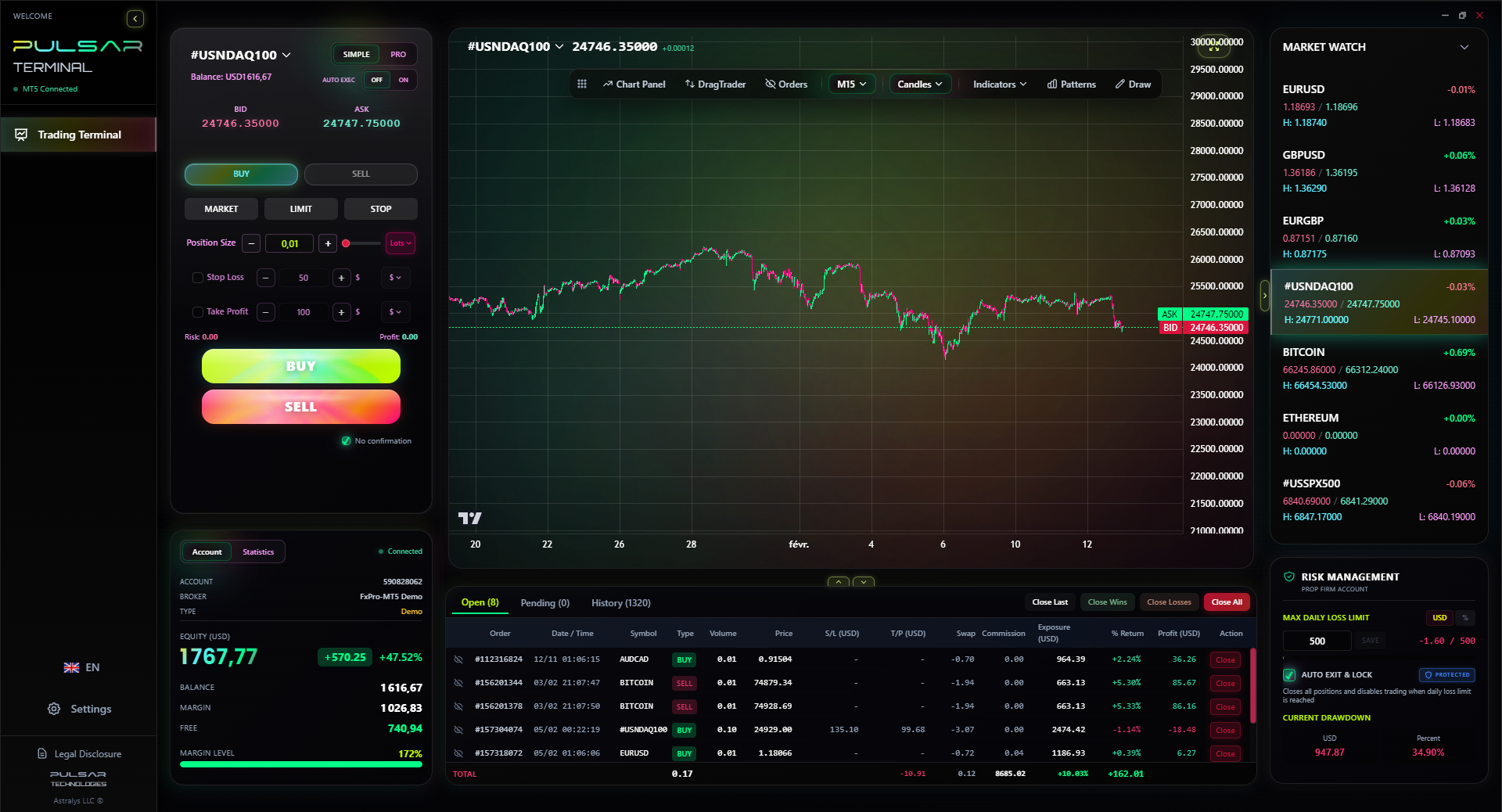
Manually managing complex exits on volatile pairs like USD/ZAR is stressful, but tools like Pulsar Terminal automate trailing stops and multi-level take-profits directly on your MT5 charts.
Pulsar Terminal
Das All-in-One MT5-Tool: Drag-and-Drop-Orders, Multi-TP/SL, Trailing Stop, Grid Trading, Volume Profile und Prop-Firm-Schutz. Täglich von 1.000+ Tradern genutzt.
FAQ
Q1Is it illegal to use FNB for forex trading?
No, it's not illegal. It's just wildly inefficient and expensive. They are an authorised dealer for currency exchange, so the transaction itself is legal. But it's like using a cargo ship to enter a speedboat race - you're using the wrong tool entirely, and you'll lose every time.
Q2Can I get use from FNB?
Absolutely not. FNB provides no use. You put up 100% of the value of the currency you're buying. This destroys any potential for meaningful returns from typical daily forex volatility and ties up huge amounts of your capital.
Q3What is the best alternative to 'call FNB forex' for a beginner?
Open a demo account with an FSCA-regulated international broker like IC Markets or Exness. Learn on their MT5 platform with virtual money. Practice for months. Then, start a live account with a small deposit (e.g., R2000) and trade micro-lots. This is the actual, professional path.
Q4How do I fund an international broker from South Africa?
You use your bank's forex transfer service (yes, FNB) for this one specific purpose. You'll make an international wire transfer (SWIFT) from your ZAR account to the broker's USD or EUR account. You'll pay FNB's fee and margin once to get the money there. Then, you trade with the broker's tight spreads.
Q5Are my forex trading profits taxable in South Africa?
Yes. The South African Revenue Service (SARS) views net profits from trading as income, not capital gains. You must declare this income in your annual tax return. Keep all your broker statements and records of deposits/withdrawals.
Q6Can FNB advise me on my forex trades?
No. They have no mandate, capability, or license to provide trading advice. Any 'advice' from a call centre agent about currency direction is an opinion, not analysis, and could be financially disastrous to follow.
Prof. Winstons Lektion
Wichtige Erkenntnisse:
- ✓Bank forex margins (2-4.5%) are 100x larger than broker spreads.
- ✓FNB charges commission minimums (R275) that destroy small trade profits.
- ✓Zero use at banks kills return potential on market moves.
- ✓Use banks only for profit withdrawals, not trade execution.
Wie nützlich war dieser Artikel?
Klicken Sie auf einen Stern
Wöchentliche Trading-Einblicke
Kostenlose wöchentliche Analysen & Strategien. Kein Spam.
Über den Autor
David van der Merwe
Schwellenland-Trader
In Johannesburg ansässiger Trader mit 11 Jahren Erfahrung in Schwellenländerwährungen. Spezialisiert auf ZAR-Paare, FSCA-regulierten Handel und Analyse des südafrikanischen Marktes.
Kommentare
Risikohinweis
Der Handel mit Finanzinstrumenten birgt erhebliche Risiken und ist möglicherweise nicht für alle Anleger geeignet. Vergangene Ergebnisse garantieren keine zukünftigen Renditen. Dieser Inhalt dient ausschließlich Bildungszwecken und stellt keine Anlageberatung dar. Führen Sie immer Ihre eigene Recherche durch, bevor Sie handeln.
Das könnte Sie auch interessieren

Cara Trading Forex Sukses: 7 Prinsip dari Trader Profesional
Cara trading forex sukses dengan 7 prinsip trader pro: manajemen modal, disiplin, journal trading, backtest. Data nyata, bukan janji profit palsu.
Jam Trading Forex Terbaik untuk Trader Indonesia: Panduan Lengkap dengan Tabel Waktu
Panduan jam trading forex untuk trader Indonesia. Tabel 4 sesi dunia, jam emas 20:00-00:00, sesi mana yang harus dihindari. Data akurat + tips dari trader berpengalaman.
Top 5 Sàn Forex Uy Tín Nhất 2026: Review Jujur dari Trader Indonesia
Top 5 sàn forex uy tín 2026 untuk trader Indonesia. Review jujur: spread, deposit, withdraw, dukungan lokal. Exness, XM, IC Markets & lebih.
Pulsar Terminal herunterladen
Alle diese Rechner sind in Pulsar Terminal mit Echtzeit-Daten Ihres MT5-Kontos integriert.
Pulsar Terminal herunterladen