


It was 3:15 PM on a Tuesday, and the USD/ZAR chart was doing its usual afternoon dance.

David van der Merwe
Schwellenland-Trader ·  South Africa
☕ 10 Min. Lesezeit
Was Sie lernen werden:
It was 3:15 PM on a Tuesday, and the USD/ZAR chart was doing its usual afternoon dance. My screen showed a tidy R1,200 paper profit on a short position I'd opened that morning. The next fifteen minutes wiped it all out, plus another R800 of my capital. That trade, back in 2019, cost me two grand and taught me more about this question than any book ever did. So, can you actually make money from forex? The short answer is yes, but it's a qualified, messy, and brutally difficult yes. Let's strip away the hype and look at what making money from forex really means for a South African trader.
First, let's kill the fantasy. You're not going to turn R5,000 into a million in a year. The guys selling that dream on social media are either lying, using simulated accounts, or about to blow up. The real landscape here is governed by the Financial Sector Conduct Authority (FSCA), which actually does a decent job. They capped use at 30:1 for retail traders a few years back, which was a good move. It stops you from obliterating your account in two bad trades.
But regulation doesn't guarantee profits. It just means you're less likely to get scammed by your broker. The profitability stats are grim globally, and South Africa is no different. A common cited figure is that only around 40% of traders are profitable over time. I'd argue the number of consistently profitable traders is far lower, maybe 10-15%. The rest are either losing or stuck in a cycle of making a bit and then giving it all back.
Why is it so hard? Your competition isn't just other guys in Sandton on their laptops. You're up against algorithmic funds, bank dealing desks, and institutional traders with technology and information you simply cannot access. Your edge has to come from discipline, psychology, and a rock-solid process. Not from a secret indicator.

Warning: If a 'mentor' or signal service promises guaranteed returns or downplays the risk, run. They are violating FSCA rules and are almost certainly a scam. Real trading involves real, painful losses.
Let's talk rands and cents. These figures assume you're treating this seriously, not as a lottery ticket.
The Beginner Phase (First 1-2 Years): You will likely lose money. Your goal here is to lose as little as possible while you learn. If you start with a R5,000 account, blowing it all is a real possibility. Some months you might scrape a R1,000 to R2,000 profit. Other months you'll give it back. Net result? Often zero or a slight loss. This phase is about survival, not income.
The Intermediate Grind (Years 2-4): If you've developed a working strategy and iron-clad discipline, you might start seeing consistent monthly returns. We're not talking percentages of your account, but of your risk. A good, realistic target is to aim for a 2-5% return on your trading capital per month. That means:
- On a R20,000 account: R400 - R1,000 per month.
- On a R50,000 account: R1,000 - R2,500 per month.
This is where most aspiring full-timers get stuck. R2,500 a month isn't quitting-your-job money. It's side-hustle money. To make more, you need a larger bankroll, which brings exponentially larger psychological pressure.
The Experienced Trader: This is where the answer to 'can you actually make money from forex' becomes a clearer 'yes'. With a six-figure account and proven process, targeting 3-5% monthly is realistic. That's R3,000-R5,000 per month on a R100k account, or R15,000-R25,000 on a R500k account. I know a handful of local traders operating at this level. Their key trait? They protect their capital like a lion protects its cubs. They use tools like a position size calculator for every single trade.
Here's a personal number for you: my best trading month ever was a 14% return. It was also the most stressful period of my life, and the following month I gave back 8%. Chasing high returns usually ends in tears. Sustainable wealth is built slowly, through compounding and relentless risk management.

💡 Winstons Tipp
Your first R10,000 profit is the most dangerous money you'll ever make. It convinces you you're smarter than the market. That's when the real lesson begins.
“For every person who makes a consistent income, there are a hundred who tried and quit.”
Your broker isn't running a charity. They make money from you, even when you lose. Understanding these costs is non-negotiable.
The Spread
This is the difference between the buy and sell price. It's your immediate cost of entry. On the EUR/USD, a good raw spread from a broker like IC Markets or Pepperstone can be 0.0 pips, but you pay a commission (say $7 per lot). On a standard account with a broker like XM, you might pay no commission but have a 0.8 pip spread.
Let's do the math. If you're scalping and make 10 trades a day on EUR/USD, buying 1 mini lot (10,000 units) each time:
- At 0.8 pips cost: 0.8 pips * 10 trades * $1 per pip = $8 daily cost.
- That's about R150 per day, or R3,000 a month just in spreads. You have to make more than that just to break even.
Swap Rates (Overnight Financing)
If you hold a trade overnight, you pay or receive interest. Going long a high-yielding currency against a low-yielding one might earn you a small credit. Doing the opposite costs you money. For swing trading positions held for weeks, this can add up.
The Rand Conversion Trap
If you fund a USD account with rands, your broker does the conversion. Their rate is almost always worse than the interbank rate. A 1-2% haircut on deposit and withdrawal is common. This is why many local traders use FSCA-regulated brokers that offer ZAR-denominated accounts – it cuts out this hidden fee.

Example: You deposit R10,000. The interbank rate is 18.50 USD/ZAR, so you should get $540.54. Your broker's rate might be 18.85, giving you only $530.50. You've lost $10 (about R185) before placing a single trade.
Copying a US or European strategy won't cut it. You need a plan built for our market, our psychology, and our unique advantages.
Use Your Time Zone
This is our biggest edge. The South African day overlaps with London, Europe, and the New York open. The 8 AM to 5 PM SAST window covers the most liquid periods of the global forex day. You don't need to trade at 2 AM. I made the mistake of trying to trade the Asian session early on. The spreads were wide, the moves were slow, and I was exhausted. Focus on the London open (10 AM SAST) and the London-New York overlap (3 PM - 5 PM SAST).
Trade What You Know: The ZAR Pairs
You live in this economy. You feel the petrol price hikes, you hear the SARB news, you understand load-shedding's impact. This local knowledge is an informational edge when trading USD/ZAR, EUR/ZAR, or GBP/ZAR. Just remember the FSCA rule: you can't speculate directly against the Rand. This means you can't short ZAR against another currency with the sole aim of betting on ZAR weakness. In practice, this means your trades need a rationale beyond 'Rand go down.'
Keep It Simple, Seriously
I blew up my first account by putting 12 indicators on a chart. It was a rainbow of confusion. Now, I might use one or two, like the RSI indicator to spot potential reversals or the MACD indicator for trend momentum. Price action, support/resistance, and a clear understanding of risk-to-reward are 90% of the game. A clean chart lets you see what the market is actually doing.
Your strategy must include:
- A Clear Trigger: What specific condition tells you to enter? (e.g., 'Price pulls back to the 50-day EMA and forms a bullish pin bar').
- A Defined Stop-Loss: Always. Before you enter. This is non-negotiable.
- A Realistic Take-Profit: Based on a measured move or key level, not a random number.
- A Risk Limit: Never risk more than 1-2% of your account on a single trade. A margin call is a failure of planning, not bad luck.
💡 Winstons Tipp
If you can't explain your trade setup in one simple sentence, you don't have a setup. You have a hope.
“The money isn't just the number in your account. It's the money you don't lose.”
Your broker is your business partner. Pick a bad one, and your journey ends before it starts.
FSCA Regulation is the Baseline. Check the FSP number on the regulator's website. Brokers like Exness, IC Markets, and Pepperstone have local FSCA entities. This protects you. Your funds should be segregated, and you have a local recourse if something goes wrong.
Platform Matters. MetaTrader 4 or 5 is the standard here for a reason. It's stable, and everyone uses it. But the native order management is clunky. This is where advanced tools come in. Having a platform that lets you drag and drop orders, set multiple take-profits, and automate a trailing stop isn't a luxury, it's a force multiplier. It takes emotion out of the execution, which is half the battle.
Account Type. If you trade frequently, a raw spread account with a commission is almost always cheaper. If you trade less often, a commission-free account with a slightly wider spread might be simpler. Do the math based on your typical trade volume.
Deposits and Withdrawals. Use a broker that offers instant EFT or a local bank transfer in rands. Waiting 5 business days for an international SWIFT transfer to clear while you see a perfect setup is a special kind of torture.
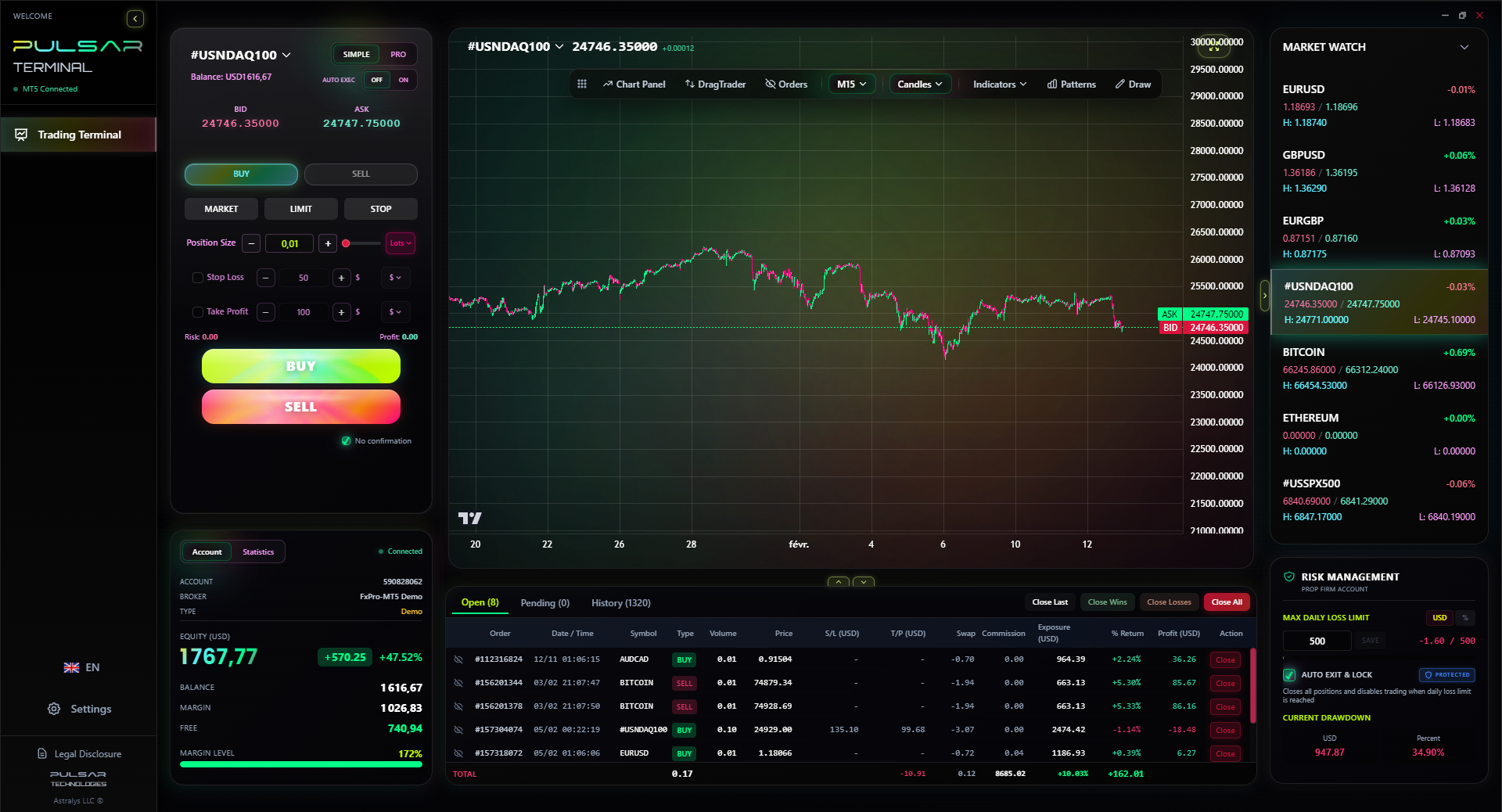
Managing complex trades and strict prop firm rules is where most fail, but a tool like Pulsar Terminal automates your risk management and order execution directly on MT5, turning your plan into disciplined action.
Pulsar Terminal
Das All-in-One MT5-Tool: Drag-and-Drop-Orders, Multi-TP/SL, Trailing Stop, Grid Trading, Volume Profile und Prop-Firm-Schutz. Täglich von 1.000+ Tradern genutzt.
This is the final, and most important, layer. You can have the best strategy in the world, but if your head isn't right, you'll lose.
You Will Have Losses. A lot of them. A 40% win rate can be highly profitable if your winning trades are much bigger than your losers. The moment you start trying to avoid a loss by moving your stop, you've broken the system. I've done it. I watched USD/JPY blow through my stop, thought 'it'll come back,' and proceeded to lose three times my planned risk. That single trade set me back a month.
Beware of the 'Winner's High.' Making R5,000 in a day feels incredible. The danger is thinking you've cracked the code. That's when you start increasing your position size recklessly. The market humbles you fast. Treat profits with the same emotional detachment as losses. They're just data points in a long-term curve.
Track Everything. Not just your P&L. Journal every trade. Why did you enter? What did you feel? Did you follow your plan? This feedback loop is how you improve. Looking back at my journals from 2017, I see the same stupid mistakes repeated for months until they finally sank in.
So, can you actually make money from forex? You can. But the money isn't just the number in your account. It's the money you don't lose. It's the discipline you build. It's the patience you learn. For every person who makes a consistent income, there are a hundred who tried and quit. Your job is to do the brutally hard, boring work to be in that first group. Start small, risk tiny, and focus on the process. The profits, if they come, will be a byproduct of getting everything else right.
FAQ
Q1Is forex trading legal and taxable in South Africa?
Yes, it's completely legal when done through a licensed provider. The FSCA is the main regulator. And yes, it's absolutely taxable. SARS considers your net trading profits (profits minus losses and expenses) as income. You must declare it, even if you trade through an offshore broker. Keep detailed records of all your trades, deposits, and withdrawals.
Q2What is a realistic amount to start forex trading with in South Africa?
You can technically start with R500 or less at some brokers. But realistically, that's a great way to lose R500. To properly practice risk management (not risking more than 1-2% per trade), you need a buffer. I'd say a minimum of R5,000-R10,000 is a more serious starting point. It allows you to trade micro lots and survive the inevitable learning-curve losses without blowing up.
Q3Can I trade forex with a full-time job in South Africa?
Absolutely, and I'd recommend it. Our time zone is perfect for it. You can analyze the markets before work, set alerts, and manage swing trades in the evening. Trying to jump into full-time trading with no income and a small account is a recipe for panic and poor decisions. Keep your job, trade with money you can afford to lose, and let your skills compound over time.
Q4What are the best currency pairs for South African beginners?
Start with the major pairs that have low spreads and high liquidity: EUR/USD, GBP/USD, USD/JPY. They're less volatile and cheaper to trade. Avoid exotic pairs (which include the ZAR) at the beginning. The spreads are wider, and the moves can be erratic. Once you're consistently profitable on the majors, then you can consider using your local knowledge on USD/ZAR.
Q5How much money do I need to make a living from forex in SA?
This is the wrong first question. Focus on becoming consistently profitable on a small account first. But to give you a number: if you could reliably make 3% per month (a very good return), you'd need a trading capital of about R330,000 to generate a pre-tax income of R10,000 per month. This highlights why building capital through other means first is crucial. Forex is not a get-rich-quick scheme.
Q6Are prop firms a good way to start trading forex with less capital?
They can be, but they're an advanced test, not a beginner's tool. Prop firms like FTMO or The Funded Trader give you a simulated account to trade. If you pass their profit target and risk rules, they give you a larger live account and split the profits. The catch? Their rules are extremely strict (daily loss limits, max drawdown). You need a already-profitable, disciplined strategy to pass. It's a high-pressure shortcut that only works if you're already a competent trader.
Prof. Winstons Lektion
Wichtige Erkenntnisse:
- ✓Realistic earnings are 2-5% monthly on trading capital.
- ✓FSCA regulation is your first layer of protection.
- ✓Time zone is a major strategic advantage for SA traders.
- ✓Over 90% of your success is psychology and risk management.
Wie nützlich war dieser Artikel?
Klicken Sie auf einen Stern
Wöchentliche Trading-Einblicke
Kostenlose wöchentliche Analysen & Strategien. Kein Spam.
Über den Autor
David van der Merwe
Schwellenland-Trader
In Johannesburg ansässiger Trader mit 11 Jahren Erfahrung in Schwellenländerwährungen. Spezialisiert auf ZAR-Paare, FSCA-regulierten Handel und Analyse des südafrikanischen Marktes.
Kommentare
Risikohinweis
Der Handel mit Finanzinstrumenten birgt erhebliche Risiken und ist möglicherweise nicht für alle Anleger geeignet. Vergangene Ergebnisse garantieren keine zukünftigen Renditen. Dieser Inhalt dient ausschließlich Bildungszwecken und stellt keine Anlageberatung dar. Führen Sie immer Ihre eigene Recherche durch, bevor Sie handeln.
Das könnte Sie auch interessieren

Cara Trading Forex Sukses: 7 Prinsip dari Trader Profesional
Cara trading forex sukses dengan 7 prinsip trader pro: manajemen modal, disiplin, journal trading, backtest. Data nyata, bukan janji profit palsu.
Jam Trading Forex Terbaik untuk Trader Indonesia: Panduan Lengkap dengan Tabel Waktu
Panduan jam trading forex untuk trader Indonesia. Tabel 4 sesi dunia, jam emas 20:00-00:00, sesi mana yang harus dihindari. Data akurat + tips dari trader berpengalaman.
Top 5 Sàn Forex Uy Tín Nhất 2026: Review Jujur dari Trader Indonesia
Top 5 sàn forex uy tín 2026 untuk trader Indonesia. Review jujur: spread, deposit, withdraw, dukungan lokal. Exness, XM, IC Markets & lebih.
Pulsar Terminal herunterladen
Alle diese Rechner sind in Pulsar Terminal mit Echtzeit-Daten Ihres MT5-Kontos integriert.
Pulsar Terminal herunterladen