


Let's cut through the noise.

David van der Merwe
Schwellenland-Trader ·  South Africa
☕ 11 Min. Lesezeit
Was Sie lernen werden:
- 1The Empire (Doesn't) Strike Back: FSCA Warnings You Can't Ignore
- 2How Forex Trading *Actually* Works in South Africa
- 3The Real Numbers: Costs, Fees, and Who's Actually Legit
- 4Trading the ZAR: Local Market Specifics You Need to Know
- 5How to Spot a Scam a Mile Away (And Protect Your Capital)
- 6Forget Get-Rich-Quick: Building a Real SA Trading Plan
- 7The Future of Forex in South Africa: Tighter Rules, Smarter Trading
Let's cut through the noise. If you're searching for 'Empire Forex Capital' in South Africa, you're not looking for a broker. You're likely staring down the barrel of a classic, high-yield investment scam. I've seen this movie before, and it doesn't end with you buying a new BMW. It ends with an empty trading account and a lesson learned the hard way. In this guide, I'm going to show you exactly why names like this are red flags, how the FSCA is trying to protect you, and where you should actually be putting your hard-earned Rand if you want to trade forex.
Alright, let's get straight to it. 'Empire Forex Capital' and its various cousins - Empire Forex Penetrators, EmpireFX_Nasdaq - are not your friends. They're not regulated brokers. They're entities that have been explicitly called out by our financial watchdog, the Financial Sector Conduct Authority (FSCA).
Back in November 2021, the FSCA issued a public warning against Tshepo Ernest Mohlala and Empire Forex Penetrators. The language was clear: they were not authorized to give financial advice or act as intermediaries. Fast forward to April 2024, and EmpireFX_Nasdaq gets the same treatment. These aren't coincidences. They're patterns.
Now, you might find a listing for an 'Empire Forex Capital' in Newtown, Johannesburg, calling itself a 'professional forex brokerage.' This is where it gets messy and dangerous. That listing directly contradicts the official warnings. In my book, when the regulator says 'stay away' and a Google search says 'maybe,' you listen to the regulator. Every single time.

Warning: Distinguish between names. 'Empire FX Trade Limited' is regulated in Kenya. 'FXEM' (with Empire Markets) is regulated in Mauritius. They explicitly say they don't serve South Africans. If someone using an 'Empire' brand is actively soliciting you here, they're almost certainly operating outside the law.
The bottom line? Searching for Empire Forex Capital should be your first clue that you're venturing into unregulated, dangerous territory. The FSCA issues these warnings for a reason - because people get burned. I once had a client come to me after losing R80,000 to a similar 'educational group' that promised managed accounts. The returns looked amazing on paper, until the withdrawals stopped. Don't let that be you.
Your first step in any trading journey is verifying FSP number on the FSCA's website. It takes two minutes and can save you a fortune.

💡 Winstons Tipp
A name like 'Empire' or 'Capital' is often marketing fluff. Real financial strength is shown by an FSP number on the regulator's website, not a grandiose title.
“Searching for Empire Forex Capital should be your first clue that you're venturing into unregulated, dangerous territory.”
So, if Empire Forex Capital is off the table, what does the real, regulated landscape look like? It's structured, it's protected, and it has clear rules. Trading forex here is completely legal, but you're playing in a field with very specific boundary lines set by the FSCA.
The Rulebook: FAIS Act and Exchange Control
Every legitimate broker serving South African clients must be licensed as a Financial Services Provider (FSP) under the FAIS Act. This isn't optional. It's the law. This license means they have to meet capital requirements, keep your money in segregated accounts (so they can't use your deposit to pay their office rent), and have proper complaint procedures.
Then there's the big one for us: Exchange Control. You can't just speculate against the Rand willy-nilly. The rules are:
- Single Discretionary Allowance: You can move R1 million per calendar year abroad for investment.
- Foreign Capital Allowance: You can move up to R10 million per year, but this requires tax clearance from SARS. All of this has to go through an Authorised Dealer (your bank). A proper, FSCA-regulated broker will help guide you through this process correctly. A scam broker will tell you to ignore it or use shady payment channels.
The use Cap
Since 2021, the FSCA capped use for retail traders at 30:1. This was a huge deal. You'll still see offshore brokers offering 500:1 or even 1000:1 to South Africans. That's a massive red flag - they are either ignoring our laws or aren't set up to comply with them. While high use can amplify gains, it's a guaranteed account destroyer for new traders. I learned this the hard way early on, blowing a R5,000 account in a week using 100:1 on a volatile XAU/USD trade. The 30:1 cap forces a bit of discipline, and that's a good thing.

Pro Tip: Use a position size calculator religiously. With a 30:1 max use, proper position sizing is your primary tool for managing risk. Don't just max it out on every trade.
“The fantasy sold by unregulated groups is 'massive returns, no risk.' The reality is spreads, commissions, and sensible minimums.”
Let's talk numbers, because this is where the rubber meets the road. The fantasy sold by unregulated groups is 'massive returns, no risk.' The reality is spreads, commissions, and sensible minimums.
First, the scary stat: South Africans lost over R500 million to forex and crypto scams in 2023. Ponzi schemes made up 65% of that. That's half a billion Rand gone. That's the environment an operation like Empire Forex Capital thrives in.
Now, the real market stats:
- Typical Spreads: On a standard account, expect the EUR/USD spread to average around 0.9 to 1.5 pips. On a raw/ECN account, you can get 0.0 pips, but you'll pay a commission (e.g., $6 per lot round turn). A 'good' spread is under 2 pips for majors.
- Minimum Deposits: They vary wildly. You can start with as little as $5 at XM or $10 at Exness. Others like IC Markets or Pepperstone might ask for $200. The key is the minimum should let you trade safely, not just be low as a marketing gimmick.
Here’s a quick comparison of some top FSCA-regulated brokers (this is a snapshot, always check their sites for latest offers):
| Broker | FSCA Regulated? | Min. Deposit | Avg. EUR/USD Spread (Standard) | Key Feature for SA Traders |
|---|---|---|---|---|
| IG | Yes | £250 (ZAR equiv.) | 0.98 pips | Massive global brand, great research |
| AvaTrade | Yes (FSP 45984) | $100 | Fixed, competitive | Wide range of instruments, user-friendly |
| Tickmill | Yes (ODP Approved) | $100 | 0.1 pips + $6 commission | Excellent raw spreads, low latency |
| Exness | Yes | From $10 | 0.1-0.2 pips (Raw) | Very low minimum deposit, local support |
| HF Markets | Yes (FSP 46632) | 75 ZAR | From 0.3 pips + comm (Zero Acc) | Offers ZAR-denominated accounts |
| XM | Yes | $5 | From 0.8 pips | Strong educational resources, low barrier |
Notice something? They're all transparent about their regulation and costs. You won't find that with an Empire Forex Capital.
💡 Winstons Tipp
The 30:1 use cap isn't a limitation; it's a governor on your engine. It prevents you from blowing your account in one spectacular, emotionally charged trade.
“The fantasy sold by unregulated groups is 'massive returns, no risk.' The reality is spreads, commissions, and sensible minimums.”
Trading from South Africa isn't the same as trading from London or New York. We have our own quirks, and working with them makes life easier.
The ZAR Account Advantage Many of the brokers above offer ZAR-denominated trading accounts. This is a game-simplifier. You deposit in Rands, your profit and loss is displayed in Rands, and you withdraw in Rands. It cuts out the hidden forex conversion fees your bank might slap on a USD withdrawal. If you're starting out, a ZAR account removes one layer of complexity.
Payment Methods That Work
- Debit/Credit Cards (Visa/Mastercard): Instant, but some brokers charge a small fee (e.g., IG charges 2.1%).
- EFT/Bank Wire: The classic. Can take 1-3 business days, but fees are usually low.
- E-Wallets (Skrill, Neteller): Fast and often fee-free from the broker's side. Widely accepted. Note: While M-Pesa is huge in East Africa, it's not a common funding method for forex brokers here yet.
Platforms of Choice MetaTrader 4 and MetaTrader 5 are king. Most South African traders I know live on MT4/5. They're reliable, have every indicator you could dream of (like the RSI indicator or MACD indicator), and support automated trading. cTrader is a sleek alternative gaining fans for its pure ECN feel. A legit broker will offer you a choice. A shady one might push you to use only their proprietary, un-auditable platform.
“Your capital protection starts with skepticism. Ask more questions than they're comfortable answering.”
This is the most important section. After 12 years, I've seen every trick in the book. Here’s how the 'Empire Forex Capital' model works and how to avoid it.
The Playbook of a Forex Scam:
- The Hook: Glossy social media ads, WhatsApp groups, or 'seminars' promising guaranteed returns, 'risk-free' trading, or monthly payouts of 5-10%. They often use fake screenshots of massive profits.
- The Story: They present themselves as elite traders or educators with a 'secret system.' They'll name-drop 'Empire Forex Capital' or something similarly grandiose to sound established.
- The Pressure: Urgency. 'This offer closes tonight!' 'Only 10 spots left in our managed fund!'
- The Ask: They want you to deposit money into an account they control, or into a broker you've never heard of. Withdrawal requests are met with delays, excuses, or demands for more fees ('tax clearance' fees are a favorite).
Your Defense Checklist:
- Check the FSCA Register: No FSP number? Immediate 'no.'
- Google the Name + 'Scam' or 'FSCA Warning': If others have been burned, you'll find threads.
- Beware of Unrealistic Promises: If it sounds too good to be true in a market where professionals struggle for 20% annual returns, it is.
- You Control the Account, Always: Never give your login details or trading capital to a 'fund manager' you met online. Use a proper, regulated broker where you are the sole account holder.
- Understand What a Margin Call Really Is: Scammers often blow through your capital with reckless trades, leading to a margin call. Knowing how use and margin work is your first line of defense.
Your capital protection starts with skepticism. Ask more questions than they're comfortable answering.
“Your capital protection starts with skepticism. Ask more questions than they're comfortable answering.”
Let's replace the scam fantasy with a real, actionable plan. This is what you should be doing instead of chasing Empire Forex Capital.
Start with a Regulated Broker: Pick one from the list above. Open a demo account. Get a feel for their platform. Then, start with the smallest live account you can. That $5 or $100 account isn't for making money. It's for learning without panic. I treat every small live account as paid tuition.
Choose Your Style (And Stick to It):
- Scalping: Requires intense focus, low spreads, and a rock-solid mindset. Not for beginners.
- Swing Trading: More suited to most South Africans with day jobs. You hold trades for days or weeks, catching larger market moves.
Risk Management is Non-Negotiable: This is your survival kit. Never risk more than 1-2% of your account on a single trade. Use stop-losses on EVERY trade, no exceptions. I once watched a R15,000 trade turn into a R45,000 loss because I thought 'it'll come back.' It didn't. That lesson cost me R30,000.
Keep a Trading Journal: Note every trade: entry, exit, why you took it, your emotional state. Review it weekly. Your biggest improvements will come from analyzing your own mistakes, not from buying a 'secret system.'

Example: You have a R10,000 account. Your risk per trade is 1% = R100. You're buying EUR/USD and your stop-loss is 20 pips away. A pip definition on a standard lot is ~$10, but on a mini lot (0.1) it's ~$1. So, R100 risk / 20 pips = R5 per pip. You'd trade a position size of roughly 0.05 lots. This is the boring, essential math that keeps you in the game.
💡 Winstons Tipp
Your trading journal is your most valuable tool. The market's patterns are reflected in your own repeated mistakes. Identify them, and you've found your edge.
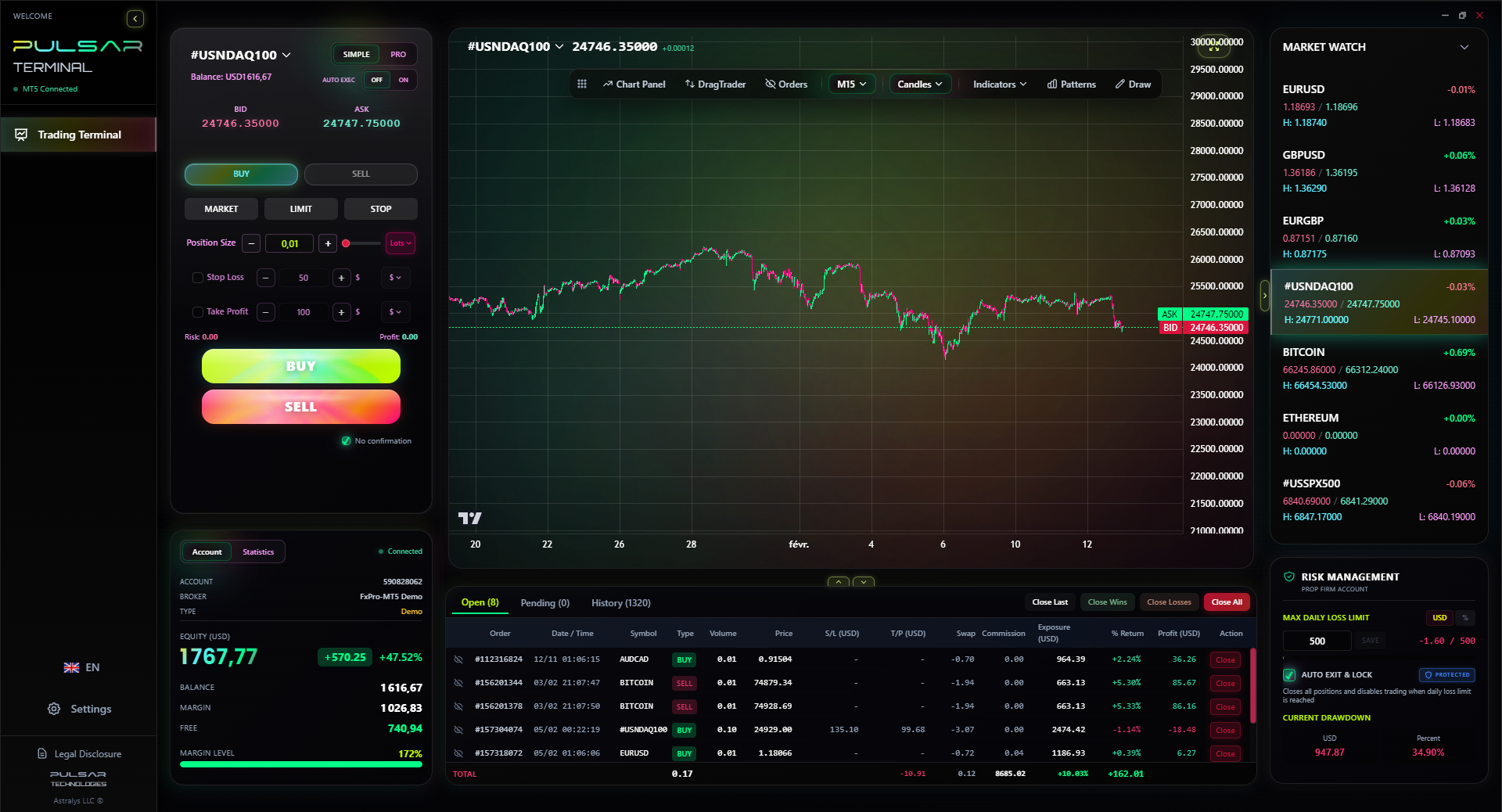
Executing a disciplined trading plan with precise stop-loss and take-profit levels is easier with tools that automate order management directly on your MT5 charts.
Pulsar Terminal
Das All-in-One MT5-Tool: Drag-and-Drop-Orders, Multi-TP/SL, Trailing Stop, Grid Trading, Volume Profile und Prop-Firm-Schutz. Täglich von 1.000+ Tradern genutzt.
“The era of the wild west, fly-by-night 'Empire' is ending. The future is professional, regulated, and requires real skill.”
The landscape is changing, fast. The FSCA isn't messing around anymore, and that's good for honest traders.
The ODP Regime is a Big Deal: The Over-the-Counter Derivatives Provider license is a stricter tier of regulation. It means more capital behind the broker, better reporting, and higher conduct standards. We're moving towards a market where only serious, well-capitalized players can operate. The cowboys are being pushed out.
Enforcement is Ramping Up: In late 2025, the FSCA fined two individuals R2.1 million and banned them for 20 years for running an unauthorized forex scheme. This is the new normal. The regulator has teeth and is using them.
What This Means for You:
- Safer Brokers: The pool of brokers is consolidating around regulated, compliant entities.
- More Transparency: You have a better chance of getting clear pricing and fair treatment.
- Your Responsibility Increases: With a safer environment, the onus is on you to develop your skills. The excuse of 'the broker ripped me off' holds less water when you're with an FSCA-licensed firm.
The era of the wild west, fly-by-night 'Empire' is ending. The future is professional, regulated, and requires real skill. Your job is to build that skill on a foundation of real brokers and real market knowledge.
FAQ
Q1Is Empire Forex Capital a regulated broker in South Africa?
No. Entities using names like 'Empire Forex Capital,' 'Empire Forex Penetrators,' and 'EmpireFX_Nasdaq' have been the subject of explicit public warnings from the Financial Sector Conduct Authority (FSCA) for operating without the required license. You should avoid them entirely.
Q2What is the best forex broker for South African beginners?
Look for an FSCA-regulated broker with a low minimum deposit, strong educational resources, and local support. Brokers like XM (min $5 deposit) or Exness (min $10) are popular starting points because they let you practice with real money without a huge upfront commitment. Always prioritize regulation over flashy offers.
Q3What is the maximum use I can use in South Africa?
The FSCA has capped use for retail forex traders at 30:1. If a broker offers you much higher use (like 500:1 or 1000:1), it is a major red flag that they are not complying with South African law and your funds may be at risk.
Q4Can I trade with a ZAR account?
Yes, many FSCA-regulated brokers like HF Markets (HotForex) offer ZAR-denominated trading accounts. This allows you to deposit, trade, and withdraw in Rands, avoiding currency conversion fees and simplifying your accounting.
Q5How much money do I need to start forex trading in South Africa?
You can start with as little as $5 (roughly R90) at some brokers. However, I strongly advise starting with an amount you can afford to lose completely - view it as tuition. A more realistic starter account for proper position sizing is between R2,000 and R5,000.
Q6How do I check if a broker is regulated by the FSCA?
Go to the official FSCA website (www.fsca.co.za) and use their 'Search for an FSP' function. Enter the broker's name or their claimed FSP number. If they don't appear, or the details don't match, do not deposit any money with them.
Q7What are the biggest forex trading scams in South Africa?
The two biggest are Ponzi schemes (65% of losses in 2023), where returns are paid from new investors' money, and fake/unregulated brokers (25% of losses). Both often use social media, promise guaranteed high returns, and pressure you to invest quickly.
Prof. Winstons Lektion
Wichtige Erkenntnisse:
- ✓Verify the FSP number on the FSCA website before depositing a single cent.
- ✓Never risk more than 1-2% of your trading account on any single trade.
- ✓The 30:1 use cap is a protective rule, not a target to be maxed out.
- ✓If an 'opportunity' uses urgency or guarantees, it is almost certainly a scam.
Wie nützlich war dieser Artikel?
Klicken Sie auf einen Stern
Wöchentliche Trading-Einblicke
Kostenlose wöchentliche Analysen & Strategien. Kein Spam.
Über den Autor
David van der Merwe
Schwellenland-Trader
In Johannesburg ansässiger Trader mit 11 Jahren Erfahrung in Schwellenländerwährungen. Spezialisiert auf ZAR-Paare, FSCA-regulierten Handel und Analyse des südafrikanischen Marktes.
Kommentare
Risikohinweis
Der Handel mit Finanzinstrumenten birgt erhebliche Risiken und ist möglicherweise nicht für alle Anleger geeignet. Vergangene Ergebnisse garantieren keine zukünftigen Renditen. Dieser Inhalt dient ausschließlich Bildungszwecken und stellt keine Anlageberatung dar. Führen Sie immer Ihre eigene Recherche durch, bevor Sie handeln.
Das könnte Sie auch interessieren

Cara Trading Forex Sukses: 7 Prinsip dari Trader Profesional
Cara trading forex sukses dengan 7 prinsip trader pro: manajemen modal, disiplin, journal trading, backtest. Data nyata, bukan janji profit palsu.
Jam Trading Forex Terbaik untuk Trader Indonesia: Panduan Lengkap dengan Tabel Waktu
Panduan jam trading forex untuk trader Indonesia. Tabel 4 sesi dunia, jam emas 20:00-00:00, sesi mana yang harus dihindari. Data akurat + tips dari trader berpengalaman.
Top 5 Sàn Forex Uy Tín Nhất 2026: Review Jujur dari Trader Indonesia
Top 5 sàn forex uy tín 2026 untuk trader Indonesia. Review jujur: spread, deposit, withdraw, dukungan lokal. Exness, XM, IC Markets & lebih.
Pulsar Terminal herunterladen
Alle diese Rechner sind in Pulsar Terminal mit Echtzeit-Daten Ihres MT5-Kontos integriert.
Pulsar Terminal herunterladen