


Here's a brutal truth that wipes out more South African trading accounts than load-shedding: most new traders have no clue what their equity is.

David van der Merwe
Schwellenland-Trader ·  South Africa
☕ 9 Min. Lesezeit
Was Sie lernen werden:

Here's a brutal truth that wipes out more South African trading accounts than load-shedding: most new traders have no clue what their equity is. They stare at their 'balance' and think they're winning, right up until their broker sends a margin call and closes everything. Your balance is a lie. Your equity is the only honest number on your screen. It's the difference between gambling with rand and trading with a plan. Let's cut through the noise.
Your platform shows two numbers that look similar but tell completely different stories. Getting them mixed up is like confusing your bank statement with your live betting slip.
Your Balance is your account's net worth from all closed trades. It's historical. It's what you had before you opened your current positions. It doesn't give a damn about the open trade that's currently R500 in the red.
Your Equity is your real-time, live account value. It's your balance plus or minus the floating profit or loss of all your open trades. This is the number your broker uses to decide if you're still solvent. This is the equity meaning in forex you must internalise.

Warning: Your broker's margin call and stop out levels are calculated using your Equity, not your Balance. If you only watch your balance, you'll get liquidated by surprise.
I learned this the hard way back in 2012. I had a R10,000 balance and a short EUR/USD trade that was R1,200 in profit. My equity was R11,200. I got cocky, opened another position without a stop loss, and the market reversed violently. Within an hour, my floating loss on the new trade hit R2,800. My equity crashed to R8,400. Because my broker's stop-out level was 50% margin, they automatically closed my profitable trade to cover the loss on the bad one. I was left with a locked-in loss and a shattered strategy. I was watching the wrong number.

💡 Winstons Tipp
Your equity is your truth-teller. Your balance is a storyteller, often telling tales of past glory. Listen to the truth-teller.

“Your balance is a lie. Your equity is the only honest number on your screen.”
Forget complex formulas. The calculation is straightforward, but its implications are everything.
Equity = Account Balance + Floating Profit (or – Floating Loss)
Let's use a real rand example. Say you deposit R20,000 with a broker like Exness or IC Markets.
- Scenario 1: You haven't traded yet. Your Balance is R20,000. Your Floating P/L is R0. Your Equity is R20,000.
- Scenario 2: You buy 1 lot of USD/ZAR (yes, you can trade the rand) and it moves in your favour by 50 pips, making a floating profit of R1,000. Your Balance is still R20,000. Your Equity is now R21,000.
- Scenario 3: That same trade moves against you by 100 pips, creating a floating loss of R2,000. Your Balance remains R20,000. Your Equity is now R18,000.
Why This Calculation is a Lifesaver
This isn't just arithmetic. It's your primary risk dashboard. If your equity starts falling faster than your balance, it means your open trades are losing. It's the earliest warning signal you have, long before a margin call. Monitoring this in real-time forces discipline. It answers the critical question: "What is my account worth right now if I closed everything?"

Example: You start with R50,000. You have three open trades: Trade A is +R2,000, Trade B is -R1,500, Trade C is -R500. Your total floating P/L is R0 (2000 - 1500 - 500). Your Balance is R50,000. Your Equity is also R50,000. You're break-even on paper, but you have significant risk exposed. A sharp move against Trade B could crater your equity.
“If your equity starts falling faster than your balance, it's the earliest warning signal you have.”
This is where the rubber meets the road for South African traders. Your equity directly determines how much breathing room you have before your broker steps in and takes over.
Free Margin is the oxygen in your account. It's calculated as: Free Margin = Equity – Used Margin.
Used Margin is the collateral your broker locks up to keep your positions open. If your equity falls too close to your used margin, your free margin approaches zero. You're out of oxygen.
Brokers have two key levels:
- Margin Call Level (e.g., 100%): This is a warning. When your Equity equals your Used Margin (Free Margin = 0), you'll get a pop-up or email. You can't open new trades, but you might be able to add funds or close positions yourself.
- Stop Out Level (e.g., 50%): This is the execution. If your equity falls to, say, 50% of your used margin, the broker will automatically start closing your losing positions, starting with the biggest loser, until your free margin is positive again. This is a margin call in its final, brutal form.
A high-equity, low-used-margin account is a healthy account. It can withstand volatility. A low-equity, high-used-margin account is a heart attack waiting to happen. Always use a position size calculator to ensure you're not using too much margin relative to your equity.
“If your equity starts falling faster than your balance, it's the earliest warning signal you have.”
I've seen these destroy accounts time and again.
Mistake 1: Adding to Losing Positions to 'Average Down'. This is the killer. Your equity is dropping, so you throw good money after bad, increasing your used margin on a losing trade. You're doubling down on a mistake, tying up more capital, and accelerating your journey to a stop out. Don't do it.
Mistake 2: Ignoring Equity During Drawdowns. During a losing streak, traders become obsessed with their balance ('I'm down R5,000!'). But the equity is what matters. If your equity drawdown hits 20% of your starting capital, that's your signal to stop trading, review, and reset. Not your balance.
Mistake 3: Confusing a High Balance with Safety. You make a few great scalping trades, run your balance up to R100,000, and think you're a genius. Then you open a massive swing trading position using R80,000 as margin. A 5% move against you wipes R4,000 from your equity. Suddenly, you're dangerously close to a margin call despite having a "high" balance. Your risk is a function of equity, not past glory.

Pro Tip: Set a hard rule. If your equity falls 15-20% from its peak in your current trading cycle, you stop. Full stop. Close all positions, take a day off, and analyse what went wrong. This rule has saved me more times than I can count.
💡 Winstons Tipp
If you can't state your current equity and your max daily equity drawdown limit within 5 seconds, you're driving blindfolded. Fix that before your next trade.

“A high-equity, low-used-margin account is healthy. A low-equity, high-used-margin account is a heart attack waiting to happen.”
Your equity isn't just a number to watch, it's the foundation of your entire risk management system.
1. The 1-2% Rule (Applied to Equity): The old adage is to risk 1-2% of your account per trade. The smart money applies that to your current equity, not your starting balance. If you start with R100,000 and lose R10,000, your equity is R90,000. Your new per-trade risk should be R900-R1,800, not R1,000-R2,000. This reduces risk as you lose, preserving capital.
2. Equity-Based Position Sizing: This is non-negotiable. The size of your trade (number of lots) should be determined by your stop-loss distance and your acceptable risk as a percentage of equity. Never trade a fixed lot size. As your equity grows, your position size can grow proportionally. As it shrinks, your positions must shrink. Tools like our position size calculator automate this.
3. Equity Curves for Performance Review: At the end of each week, chart your equity. Not your balance. You want to see a smooth equity curve that generally trends upward. Sharp drawdowns (large dips) are a red flag, even if your balance recovered by week's end. They indicate your strategy is too volatile and risky.
A real example from my trading: I was trading XAU/USD during a volatile period. My rule was to risk 1.5% of equity per trade. My equity was R85,000, so my risk was R1,275. My stop loss was 50 points away. Using the standard pip value, that dictated my position size. The trade went against me and hit my stop. My equity dropped to R83,725. My next trade's risk was calculated based on R83,725, automatically reducing my exposure. This is how you survive.
“A high-equity, low-used-margin account is healthy. A low-equity, high-used-margin account is a heart attack waiting to happen.”
For South Africans trying to get funded through proprietary trading firms, understanding equity is the entire game. These challenges have strict daily and overall loss limits based on your starting balance or your equity high watermark.
Most firms use a trailing drawdown model. Your maximum allowed loss isn't fixed. It 'trails' your peak equity. If you start a R$100,000 challenge with a 5% max drawdown, you can initially lose R$5,000. But if you make R$2,000 profit first, your equity peaks at R$102,000. Your new loss limit is now R$102,000 - R$5,000 = R$97,000. Your allowable loss has effectively increased to R$7,000 from your start.
The killer? If your equity then drops back to R$100,000, your drawdown limit is still trailing at R$97,000. You now have only R$3,000 of breathing room left, not the original R$5,000. You must watch your current equity relative to this trailing threshold every single second. A single bad trade can breach it. This is why automated tools that track this in real-time are useful for prop traders.
💡 Winstons Tipp
Prop firm challenges are a game of equity management, not profit chasing. The fastest way to fail is to forget that for even one trade.
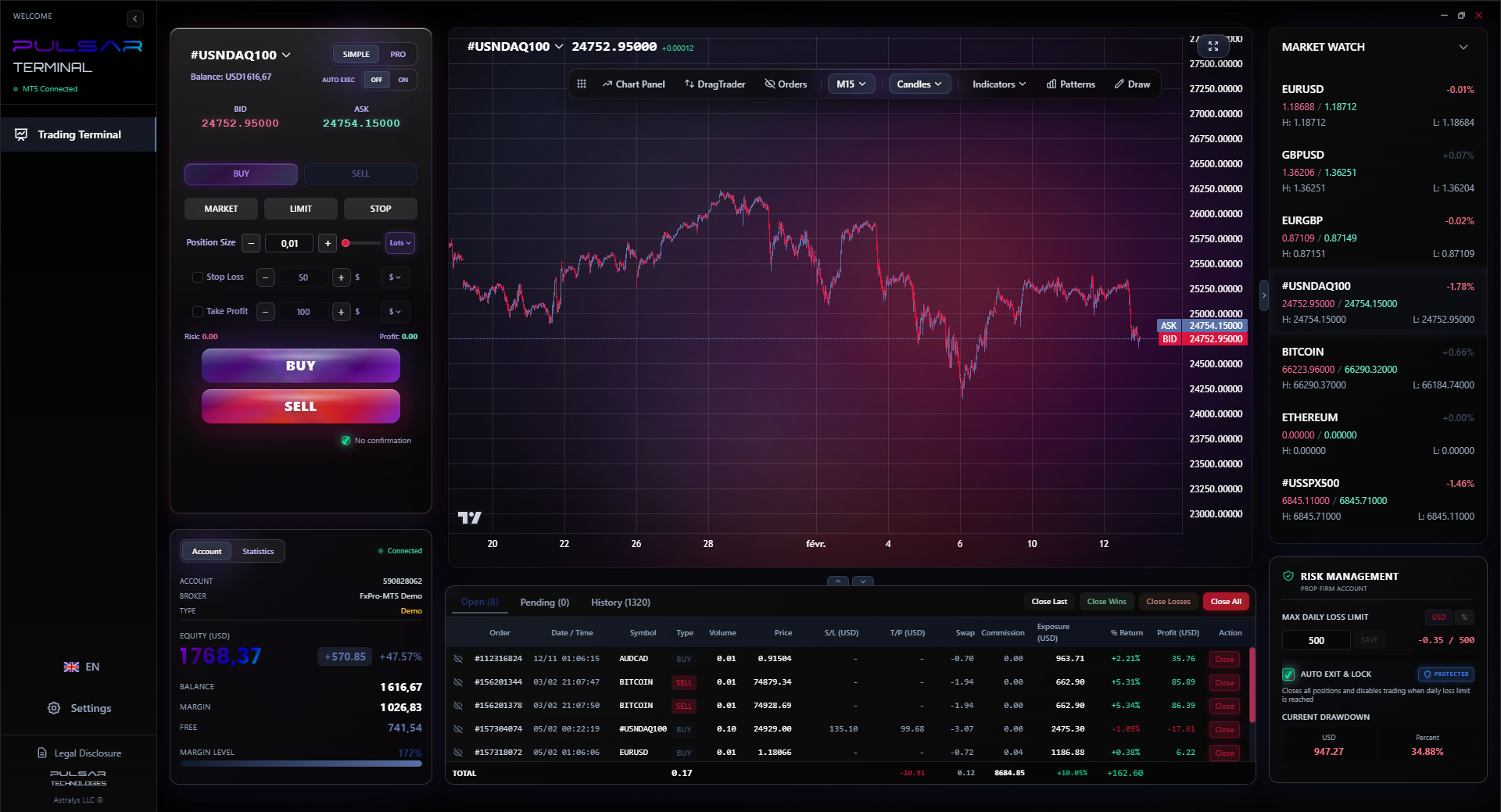
Managing equity drawdowns in a prop firm challenge requires laser focus, which is why tools like Pulsar Terminal can automatically track your equity against a trailing threshold directly on your MT5 chart.
Pulsar Terminal
Das All-in-One MT5-Tool: Drag-and-Drop-Orders, Multi-TP/SL, Trailing Stop, Grid Trading, Volume Profile und Prop-Firm-Schutz. Täglich von 1.000+ Tradern genutzt.
“The smart money risks 1-2% of their current equity, not their starting balance. This reduces risk as you lose.”
You can't manage what you don't measure. Staring at the MT4/MT5 terminal isn't enough.
-
Your Trading Journal: The first entry for every trade should be your equity at the moment of entry. The exit note should include equity at closure. This links your trading decisions directly to their impact on your real account value.
-
Custom Indicators & Terminals: Advanced platforms and tools allow you to display your equity, margin level, and drawdown as prominent on-screen widgets. Some, like Pulsar Terminal, can even set visual or audible alerts when your equity drops by a certain percentage. This turns passive monitoring into active management.
-
The Mental Check: Before you click 'buy' or 'sell', make it a ritual. Look at your equity. Ask: "Am I willing to risk X% of this exact number on this trade?" If the answer isn't a confident yes, walk away. This one habit will filter out 80% of your impulsive, doomed trades.
Tracking equity religiously shifts your focus from chasing profits to protecting capital. And in this game, the traders who protect their capital are the ones who get to keep playing.
FAQ
Q1Is equity the same as my profit?
No. Profit is what you've made from closed trades and is reflected in your Balance. Equity is your balance PLUS any unrealised profit or loss from open trades. You only 'own' the profit in your equity once you close the trade.
Q2What happens if my equity goes to zero?
If your equity hits or falls below your broker's stop-out level, they will automatically close your positions. If your equity goes negative (rare, but possible with extreme volatility or gaps), you could owe your broker money. This is why using stop losses is mandatory.
Q3Should I focus on balance or equity?
Focus on equity. It's the real-time value of your account. Your balance is just a history book. All your risk management and broker calculations are based on equity.
Q4How does equity affect my margin?
Directly. Your Free Margin = Equity - Used Margin. As your equity drops, your free margin drops. If equity gets too low relative to your used margin, you get a margin call or stop out.
Q5Can I withdraw my equity?
You can only withdraw funds based on your balance (from closed trades), minus any margin required for open positions. You cannot withdraw the floating profit portion of your equity until you close the trade and it converts to balance.
Q6Why did my equity change when I didn't trade?
Because the market moved. Your equity updates in real-time with the price of your open positions. If you're holding a trade overnight and the global market moves, your equity will change even while you're sleeping.
Q7Is a higher equity always better?
A higher equity is good, but the trend and stability of your equity curve are more important. A consistently rising equity with small drawdowns is the goal. A wildly volatile equity curve that happens to end higher is a sign of excessive risk.
Prof. Winstons Lektion
Wichtige Erkenntnisse:
- ✓Equity = Balance + Floating P/L. It's your live account value.
- ✓Margin calls use Equity, not Balance. Watch the right number.
- ✓Risk a percentage of current Equity, not starting capital.
- ✓A 15-20% equity drawdown is your signal to stop and review.
Wie nützlich war dieser Artikel?
Klicken Sie auf einen Stern
Wöchentliche Trading-Einblicke
Kostenlose wöchentliche Analysen & Strategien. Kein Spam.
Über den Autor
David van der Merwe
Schwellenland-Trader
In Johannesburg ansässiger Trader mit 11 Jahren Erfahrung in Schwellenländerwährungen. Spezialisiert auf ZAR-Paare, FSCA-regulierten Handel und Analyse des südafrikanischen Marktes.
Kommentare
Risikohinweis
Der Handel mit Finanzinstrumenten birgt erhebliche Risiken und ist möglicherweise nicht für alle Anleger geeignet. Vergangene Ergebnisse garantieren keine zukünftigen Renditen. Dieser Inhalt dient ausschließlich Bildungszwecken und stellt keine Anlageberatung dar. Führen Sie immer Ihre eigene Recherche durch, bevor Sie handeln.
Das könnte Sie auch interessieren

Cara Trading Forex Sukses: 7 Prinsip dari Trader Profesional
Cara trading forex sukses dengan 7 prinsip trader pro: manajemen modal, disiplin, journal trading, backtest. Data nyata, bukan janji profit palsu.
Jam Trading Forex Terbaik untuk Trader Indonesia: Panduan Lengkap dengan Tabel Waktu
Panduan jam trading forex untuk trader Indonesia. Tabel 4 sesi dunia, jam emas 20:00-00:00, sesi mana yang harus dihindari. Data akurat + tips dari trader berpengalaman.
Top 5 Sàn Forex Uy Tín Nhất 2026: Review Jujur dari Trader Indonesia
Top 5 sàn forex uy tín 2026 untuk trader Indonesia. Review jujur: spread, deposit, withdraw, dukungan lokal. Exness, XM, IC Markets & lebih.
Pulsar Terminal herunterladen
Alle diese Rechner sind in Pulsar Terminal mit Echtzeit-Daten Ihres MT5-Kontos integriert.
Pulsar Terminal herunterladen