


You've probably seen the ads.

Olumide Adeyemi
Pionier des Tradings in Westafrika ·  Nigeria
☕ 9 Min. Lesezeit
Was Sie lernen werden:
You've probably seen the ads. 'Falcon Forex' promises fast money, secret signals, and a life of luxury. Let me be straight with you: that's a fantasy. The real 'Falcon Forex' isn't a magic platform. It's the skill of trading itself, navigating Nigeria's unique market with sharp eyes and discipline. I've seen too many guys in Lagos and Port Harcourt blow their accounts chasing that dream. This guide cuts through the hype. We'll talk real regulations, actual broker spreads, and how to handle the Naira's wild swings. I'll share my own wins and painful losses so you can start on solid ground.
First things first. If you're searching for 'Falcon Forex,' you're likely looking for one of two things: a specific, maybe unregulated, local trading group or platform, or a metaphor for successful trading. Based on the research, there's no major, widely-recognized international broker by that name. That's your first warning sign.
In Nigeria's bustling trading scene, names pop up all the time. Some are just marketing - flashy names to attract deposits. The real 'falcon' mindset is about precision, patience, and striking when the opportunity is right. It's about finding a strategy that works for you and sticking to it through the market's chaos.
I learned this the hard way early on. I chased a 'sure thing' from a group with a fancy name, ignoring the crazy 1:2000 use they offered. I turned $500 into $2,000 in two days on GBP/JPY trades. I felt like a king. Then one volatile London session wiped out the entire account before I could blink. That's not falcon trading. That's gambling.
The foundation you need is a legitimate, well-regulated broker that accepts Nigerian clients. Firms like Exness review, IC Markets review, and XM review have established reputations. They might not have the flashiest local name, but they offer the stability and tools you actually need to build real skill.

💡 Winstons Tipp
The market doesn't care about your patriotism. Trading NGN/USD requires the same cold, analytical detachment as any other pair. Bet on the price, not your hopes for the nation.
“The real 'falcon' mindset is about precision, patience, and striking when the opportunity is right.”
This is the most important section. Getting this wrong can freeze your funds or land you in trouble with the CBN. Trading forex as an individual in Nigeria is legal. Full stop. But there are critical rules you must follow.
The Central Bank's Stance
The CBN's main concern is protecting the Naira. They've made it very clear: you cannot use the official CBN window or bank FX allocations to fund a trading account. They see that as economic sabotage. This is why funding your broker can be tricky. Many Nigerian banks have also restricted Naira debit cards for international broker deposits.
How to Fund Your Account Legally
You fund your account using your own existing foreign currency (from remittances, export earnings, etc.) or through autonomous market sources. Brokers now offer local payment channels like direct bank transfers in Naira, which they convert on their end. This is the safest path. Always keep records of all your transactions.
Taxes on Your Profits
If you make money, the Federal Inland Revenue Service (FIRS) will want its share. Forex trading profits are typically subject to a 10% Capital Gains Tax. You are responsible for declaring this income. It's not fun, but treating it as a business cost keeps you on the right side of the law. I set aside 10% of every profitable withdrawal immediately into a separate account. It hurts less that way.

Warning: Never try to circumvent CBN rules on FX sourcing. The penalties are severe, and it risks the entire legitimacy of your trading business. Use the local deposit methods your broker provides.
“High use is the fastest route to a margin call.”
Forget the 'Falcon Forex' label. Look for these concrete features. Your broker is your lifeline; a bad one will cost you money even when you're right on the trade.
Regulation is Your Safety Net
Since Nigeria's online retail forex scene is still developing its specific rules, you want a broker regulated elsewhere by a reputable authority. Think CySEC (Cyprus), FSCA (South Africa), ASIC (Australia), or the FCA (UK). This gives you a layer of protection. Brokers like Pepperstone review operate under strong frameworks like the Kenyan CMA for Nigerian clients.
The Real Cost: Spreads & Commissions
This is where your profit gets eaten. You need to look at the full picture. A broker might advertise 'Falcon-like' speed but have wide spreads.
| Broker Example | Min. Deposit | Avg. EUR/USD Spread | Key Feature for Nigeria |
|---|---|---|---|
| IC Markets | $200 | 0.0 pips + commission | Raw spreads, great for scalping strategy |
| Exness | $10 | From 0.1 pips | Offers NGN accounts, very high use available |
| XM | $5 | From 0.8 pips | Low minimum, good for beginners |
A spread definition of 0.8 pips vs. 0.1 pips might not sound like much, but over 100 trades, it's a huge difference. I once compared two accounts on the same EUR/USD swing trading idea. On a standard account with a 1.2 pip spread, my profit was $420. On a raw spread account with a 0.3 pip average, the same trade made $480. That's lunch money saved.
use: A Double-Edged Sword
Brokers in Nigeria often offer high use - up to 1:2000. This is incredibly dangerous. I never use more than 1:50 on my main account, no matter what the broker allows. High use is the fastest route to a margin call. Always use a position size calculator.
“High use is the fastest route to a margin call.”
This is our home game. The NGN/USD pair is incredibly popular here, but it's a different beast than EUR/USD. You're trading the direct value of your local currency, which comes with emotional and practical baggage.
The pair is highly sensitive to local CBN announcements, oil prices, and political news. The volatility can be massive. In 2023, we saw the Naira lose over 50% of its value after reforms. For a trader, that's both opportunity and extreme risk.
A Personal Trade
In early 2024, after a CBN rate hike, I took a short position on NGN/USD (meaning I bet the Naira would weaken further) at 1,350. My analysis was based on continuing inflation pressures. I used a very small position because of the volatility. It moved to 1,420 over three weeks, and I took profit. The key? I ignored the emotional desire for the Naira to 'win.' I just followed the price action and news flow.

Pro Tip: When trading NGN/USD, keep a separate news feed for Nigerian financial and political news. A single tweet from a government official can move the pair 5% in minutes. Your standard forex calendar won't capture this.
It's often smarter for beginners to master major pairs like EUR/USD guide or XAU/USD guide first, where the markets are deeper and more predictable, before tackling the emotional rollercoaster of your own currency.
💡 Winstons Tipp
Your first profitable month is your most dangerous. It breeds overconfidence. Immediately reinvest that profit into education or better tools, not into larger, reckless trades.
“You will have losing trades. I have them every week. The difference is how you manage them.”
This is where you forge your own 'Falcon Forex' discipline. A strategy isn't a secret signal. It's a repeatable process.
Start with the Charts
Most Nigerian traders I meet are glued to news and rumors. Price action tells the real story. Learn to read candlestick patterns and key support/resistance levels. I combine this with one or two indicators for confirmation, like the RSI indicator for overbought/oversold conditions or the MACD indicator for trend momentum. Don't overload your chart with 10 indicators; it creates confusion, not clarity.
The Non-Negotiable: Risk Management
You will have losing trades. I have them every week. The difference between survival and blowing up is how you manage them.
- Risk per Trade: Never risk more than 1-2% of your account on a single trade. If you have a $1,000 account, that's $10-$20 max risk.
- Stop-Loss Orders: ALWAYS use one. Before you even enter a trade, know where you're wrong and place the stop. This is your lifeline.
- Profit Targets: Have a plan for taking profit. A common method is a 1:2 risk-to-reward ratio. If you risk $10 (pip definition), aim for a $20 profit.
Here's a real example from last month on GBP/USD:
- Entry: 1.2650
- Stop Loss: 1.2625 (25 pips risk)
- Take Profit: 1.2700 (50 pips target)
- My account size was $2,000. My 1% risk was $20. A 25-pip risk meant my position size could only be 0.08 lots. I used a calculator to figure that out. The trade hit my take profit. That's the boring, disciplined process that works.
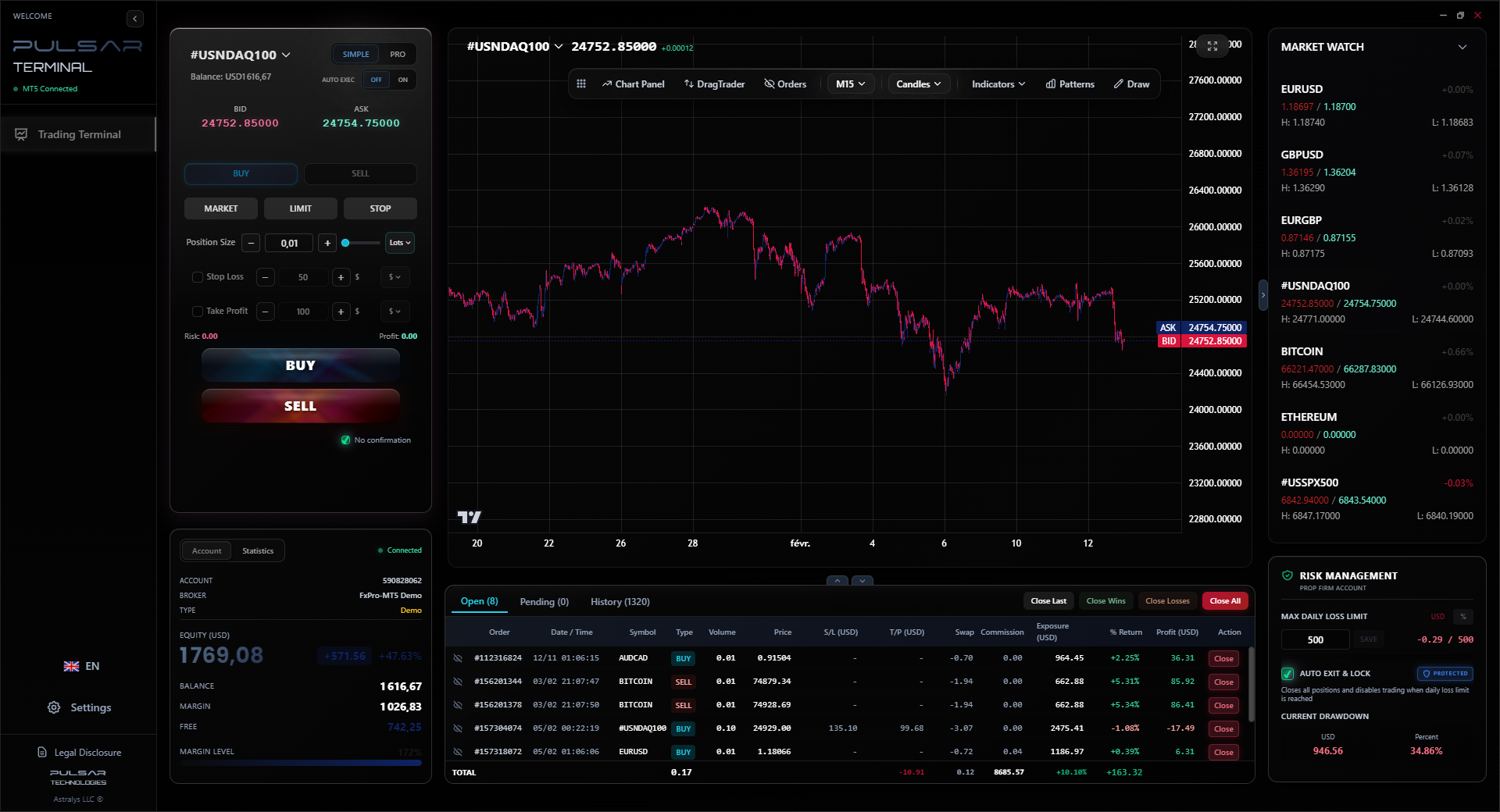
Managing multiple trades and precise stop-losses is key to the disciplined approach we discussed, and tools like Pulsar Terminal automate this directly on your MT5 platform.
Pulsar Terminal
Das All-in-One MT5-Tool: Drag-and-Drop-Orders, Multi-TP/SL, Trailing Stop, Grid Trading, Volume Profile und Prop-Firm-Schutz. Täglich von 1.000+ Tradern genutzt.
“You will have losing trades. I have them every week. The difference is how you manage them.”
I've made most of these mistakes so you don't have to.
Chasing 'Falcon' Signals or Robot Gurus: Anyone selling a '100% win rate' system is lying. Full stop. These are rampant in Nigerian WhatsApp groups. I paid $300 for one once. It was just a repackaged moving average crossover that failed miserably in a ranging market.
Over-leveraging Because You Can: Just because Exness or HFM offers 1:2000 use doesn't mean you should use it. That's for institutional hedging, not a $500 retail account. It's a tool for brokers to attract clients, not for you to get rich quick.
Trading Without a Clear Plan: Entering a trade because you 'have a feeling' is gambling. Your plan should be written down: Why are you entering? Where is your stop? Where is your profit target? What time of day are you trading? The London/New York overlap (1 PM - 6 PM WAT) is often the best for volatility.
Ignoring the Global Market: Don't just focus on NGN/USD. The Dollar's strength (DXY index) and major pair movements drive global flows that eventually hit the Naira. Understanding EUR/USD guide dynamics makes you a better trader of all USD pairs.
“There's no 'Falcon Forex' shortcut. It's about consistent, disciplined execution.”
Let's wrap this up with a clear action plan.
- Education First, Money Second: Spend at least 2-3 months on a demo account. Treat the virtual $10,000 as real money. Practice your strategy and risk rules until they're habit.
- Choose a Regulated Broker: Pick one from the list earlier based on your budget. Start with a low minimum deposit like XM's $5 or Exness's $10. Your goal is to learn the platform, not get rich on the first deposit.
- Start Small, painfully Small: When you go live, fund your account with money you can afford to lose completely. Your first real trades should be at micro-lot sizes (0.01 lots). Your goal is to validate your process, not make profit.
- Keep a Trading Journal: Write down every trade. Entry, exit, reason, emotion. Review it weekly. This is how you improve. My journal showed me I lost 70% of my trades on Mondays. Now I rarely trade then.
- Be Patient: This is a skill that takes years to master. There's no 'Falcon Forex' shortcut. It's about consistent, disciplined execution, day after day. The falcon doesn't hunt constantly; it waits for the right moment with immense patience. You should too.
FAQ
Q1Is Falcon Forex a registered broker in Nigeria?
Based on available regulatory information, there is no widely recognized, major international forex broker by the name 'Falcon Forex' that is registered with the Nigerian SEC or CBN for retail online trading. The term is more commonly used as marketing by various groups or as a metaphor. Always verify a broker's actual regulatory license with the issuing authority (like CySEC, FSCA, etc.).
Q2What is the best time to trade forex in Nigeria?
The most active and volatile trading sessions overlap between 1:00 PM and 6:00 PM West Africa Time (WAT). This covers the late London session and the opening of the New York session, creating the highest liquidity and best opportunities for major pairs like EUR/USD and GBP/USD.
Q3How do I pay taxes on my forex trading profits in Nigeria?
You are required to declare your trading profits to the Federal Inland Revenue Service (FIRS). Profits are typically subject to a 10% Capital Gains Tax. You should keep detailed records of all your trades, deposits, and withdrawals. It's advisable to consult with a local accountant familiar with forex trading to ensure proper compliance.
Q4Can I use my Nigerian bank card to fund an international broker?
It has become increasingly difficult due to CBN restrictions and bank policies limiting Naira card use for international transactions. The most reliable method is to use a broker that offers local Naira deposit options through bank transfer or local payment processors. Brokers like Exness and HFM provide these local funding channels.
Q5Is use of 1:1000 safe for a beginner?
No, it is extremely dangerous. High use magnifies both profits and losses. For a beginner, it significantly increases the risk of losing your entire deposit very quickly. I recommend starting with use no higher than 1:50 while you learn proper risk management and position sizing.
Q6What's more important, a good strategy or good risk management?
Good risk management, 100%. You can have a mediocre strategy with excellent risk management and survive to trade another day. A brilliant strategy with poor risk management will blow up your account on a string of losses. Always define your risk per trade and use stop-loss orders.
Prof. Winstons Lektion
Wichtige Erkenntnisse:
- ✓Verify broker regulation, not just the name.
- ✓Never risk more than 2% of your account per trade.
- ✓The London/NY overlap (1-6 PM WAT) offers the best action.
- ✓Pay your 10% Capital Gains Tax to FIRS.
- ✓Use local broker deposit options to avoid CBN issues.
Wie nützlich war dieser Artikel?
Klicken Sie auf einen Stern
Wöchentliche Trading-Einblicke
Kostenlose wöchentliche Analysen & Strategien. Kein Spam.
Über den Autor
Olumide Adeyemi
Pionier des Tradings in Westafrika
Einer der aktivsten Forex-Trading-Ausbilder Nigerias. 8 Jahre Trading-Erfahrung aus Lagos. Spezialisiert auf Strategien mit geringem Kapital und Prop-Firm-Challenges für afrikanische Trader.
Kommentare
Risikohinweis
Der Handel mit Finanzinstrumenten birgt erhebliche Risiken und ist möglicherweise nicht für alle Anleger geeignet. Vergangene Ergebnisse garantieren keine zukünftigen Renditen. Dieser Inhalt dient ausschließlich Bildungszwecken und stellt keine Anlageberatung dar. Führen Sie immer Ihre eigene Recherche durch, bevor Sie handeln.
Das könnte Sie auch interessieren

Cara Trading Forex Sukses: 7 Prinsip dari Trader Profesional
Cara trading forex sukses dengan 7 prinsip trader pro: manajemen modal, disiplin, journal trading, backtest. Data nyata, bukan janji profit palsu.
Jam Trading Forex Terbaik untuk Trader Indonesia: Panduan Lengkap dengan Tabel Waktu
Panduan jam trading forex untuk trader Indonesia. Tabel 4 sesi dunia, jam emas 20:00-00:00, sesi mana yang harus dihindari. Data akurat + tips dari trader berpengalaman.
Top 5 Sàn Forex Uy Tín Nhất 2026: Review Jujur dari Trader Indonesia
Top 5 sàn forex uy tín 2026 untuk trader Indonesia. Review jujur: spread, deposit, withdraw, dukungan lokal. Exness, XM, IC Markets & lebih.
Pulsar Terminal herunterladen
Alle diese Rechner sind in Pulsar Terminal mit Echtzeit-Daten Ihres MT5-Kontos integriert.
Pulsar Terminal herunterladen