


I remember the trade that made me swear off variable spreads for a while.

David van der Merwe
Schwellenland-Trader ·  South Africa
☕ 12 Min. Lesezeit
Was Sie lernen werden:
- 1What Exactly Is a Fixed Spread Broker?
- 2The FSCA Rulebook: Your Safety Net (or Lack Thereof)
- 3The Real Pros and Cons (From Someone Who's Used Them)
- 4Broker Breakdown: Who Offers What in SA
- 5The Real Costs: Spreads, Commissions, and Minimums
- 6So, Should YOU Use a Fixed Spread Broker?
- 7Your Final Checklist Before You Sign Up
I remember the trade that made me swear off variable spreads for a while. It was a big NFP (Non-Farm Payrolls) announcement on USD/ZAR. My strategy was solid, my entry was perfect. But the moment the news hit, the spread on my usual broker's account blew out from 15 pips to over 80. My stop-loss, which I thought was a safe 20 pips away, got taken out instantly. I lost R1,200 on a trade that, under normal conditions, would have been a winner. That's when I started seriously looking at fixed spread forex brokers. The promise was simple: no surprises. But as I learned, that certainty comes with its own price tag and a few hidden catches you need to know about.
Let's cut through the jargon. In forex trading, the spread is the difference between the buy (ask) and sell (bid) price. It's your primary cost of doing business, like a broker's fee baked into every trade.
With a variable spread broker, this gap changes constantly. It's usually tight when the markets are sleepy - think 0.7 pips on EUR/USD - but can widen dramatically during news events or low liquidity. My USD/ZAR disaster is a classic example.
A fixed spread broker, on the other hand, guarantees that spread won't change. If they advertise EUR/USD at 1.2 pips, it stays at 1.2 pips whether you're trading at 3 AM or during a central bank announcement. The cost is predictable, which is fantastic for budgeting and for certain strategies, especially scalping strategy where precise entry and exit costs are critical.

Warning: The key word is advertised. That 'fixed' spread is the minimum they promise. Some brokers have clauses allowing them to widen it under 'exceptional market conditions,' which basically means whenever they want. Always read the fine print in the client agreement.
Here’s the trade-off in a nutshell:
| Feature | Variable Spread Broker | Fixed Spread Broker |
|---|---|---|
| Typical Cost | Lower spread + often a commission per trade. | Higher, all-inclusive spread (no commission). |
| Predictability | Low. Costs can spike. | High. You know your exact cost upfront. |
| Best For | Swing traders, position traders who avoid news. | Scalpers, news traders, beginners on a tight budget. |
| Risk | Slippage & widened spreads on news. | Potential for order rejection or requotes during volatility. |
The biggest misconception? That fixed spreads are always more expensive. Sometimes, a variable spread that averages 0.8 pips plus a $7 commission can end up costing more than a simple 1.5 pip fixed spread, especially on smaller trade sizes. You've got to do the math using a position size calculator.

💡 Winstons Tipp
A 'fixed' spread is a broker's promise, not a law of physics. During a market meltdown, that promise is the first thing they'll look to bend. Always have a plan for rejected orders.
This is the most important part for any South African trader. Trading with an unregulated broker is like driving without insurance - you might be fine until you're not.
The Financial Sector Conduct Authority (FSCA) is our local watchdog. They don't run the markets, but they regulate how brokers behave in them. An FSCA license means the broker has met specific capital requirements and agrees to play by rules designed to protect you.
Why FSCA Regulation Matters for Fixed Spreads
When a broker offers a fixed spread, they're taking on risk. If the market moves against their quoted price, they eat the loss. A shady, undercapitalized broker might be tempted to 'cheat' to survive - by rejecting your orders ('requoting'), causing unfair slippage, or even manipulating prices. FSCA oversight makes this less likely. They mandate client fund segregation, meaning your money is held in a separate bank account from the broker's operating funds. If the broker goes bust, your capital isn't automatically gone to pay their creditors.

Pro Tip: Always verify the FSP number. A real FSCA-regulated broker like Pepperstone (FSP No. 53453) or Exness will display this number prominently on their South African website. Go to the FSCA's website and punch that number into their public register. It takes two minutes and confirms you're dealing with the real entity.
Here's the tricky part: many international brokers popular with South Africans (think IC Markets, XM) are not FSCA-regulated. They're regulated by top-tier bodies like ASIC (Australia) or CySEC (Cyprus). This isn't necessarily bad - these are strong regulators. However, it means if you have a dispute, you're dealing with a foreign financial ombudsman, not the FSCA in Pretoria. The FSCA itself recommends using an FSCA-licensed broker for this exact reason: local recourse is easier.
I made the mistake early on of choosing a broker solely for its tight fixed spreads, ignoring its offshore regulation from a dubious jurisdiction. When I had a withdrawal delay, getting help was a nightmare. Lesson learned: regulation isn't just a checkbox; it's your first line of defense.
“The fixed spread was a great training wheel, but the variable account was the faster bike.”
Let's get honest about the daily grind of trading with fixed spreads.
The Good Stuff:
- Budgeting is a Breeze: This is the killer feature. When I was starting out and trading with a R5,000 account, knowing my exact cost per trade let me manage my risk down to the rand. I could use my position size calculator and know the calculated risk was accurate, with no hidden spread-widening monsters.
- News Trading is Less Scary: Want to trade a SARB (South African Reserve Bank) interest rate decision? With a fixed spread, you're not competing against a 50-pip widening on USD/ZAR. Your cost is locked in. I once caught a nice 120-pip move on GBP/USD during a BoE announcement with a fixed 1.8-pip spread. On my variable account, the spread shot to 12 pips at the same moment.
- Simpler for Beginners: One less variable to worry about. You can focus on your strategy and RSI indicator readings without constantly checking if your broker's spread is eating your potential profit.
The Not-So-Good Stuff:
- The 'Fixed' Premium: You pay for that certainty. The fixed spread is almost always higher than the average variable spread. For example, a broker's fixed EUR/USD might be 1.5 pips, while their variable account averages 0.8. Over 100 trades, that difference adds up.
- Requotes and Rejections: This is the dark side. During extreme volatility, the broker can't always fill you at their promised price without losing money. So instead of widening the spread, they might just say 'no.' You'll get a 'requote' pop-up with a worse price, or your order will be rejected entirely. I've missed entries because of this.
- Less Suitable for Patient Traders: If you're a swing trading enthusiast who holds trades for days or weeks, the higher fixed spread becomes a bigger drag on your potential returns compared to a low variable spread. Your holding cost is simply higher from the get-go.

Example: Let's say you buy 1 standard lot (100,000 units) of EUR/USD.
- Fixed Spread Broker: Cost = 1.5 pips. 1.5 pips * 100,000 units = $15 cost to open the trade.
- Variable Spread Broker (with commission): Spread = 0.2 pips + $10 commission. Cost = (0.2 pips * 100,000 = $2) + $10 = $12. In this case, the variable account is actually cheaper. You have to check the math for your typical trade size.
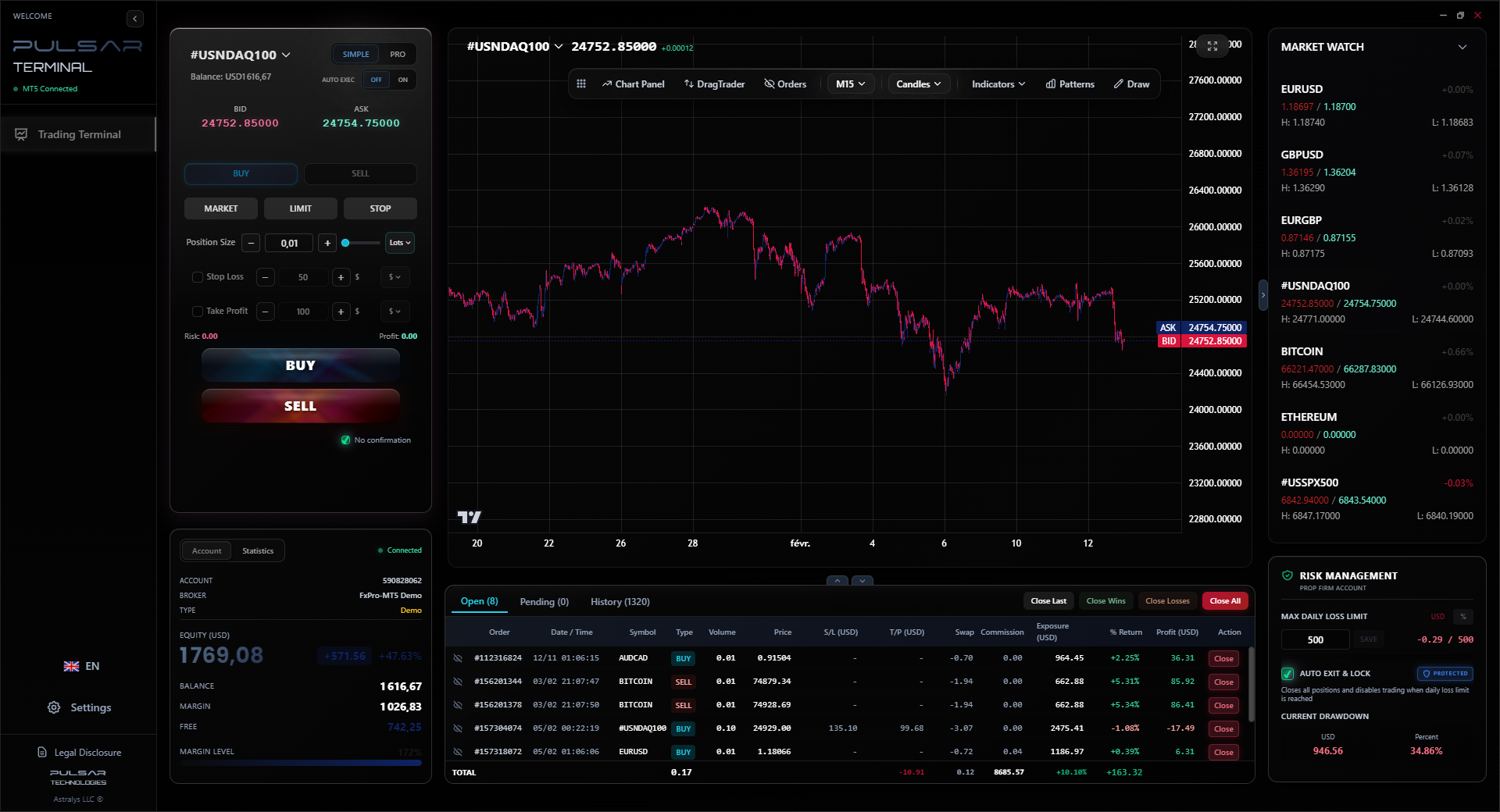
When scalping with a fixed spread broker, managing multiple quick trades is key, and Pulsar Terminal's drag-and-drop order entry on MT5 makes opening and closing those positions lightning fast.
Pulsar Terminal
Das All-in-One MT5-Tool: Drag-and-Drop-Orders, Multi-TP/SL, Trailing Stop, Grid Trading, Volume Profile und Prop-Firm-Schutz. Täglich von 1.000+ Tradern genutzt.
Based on my experience and the current market, here’s a look at some key players for South Africans interested in fixed or predictable spreads. Remember, offerings change, so always check their latest SA website.
AvaTrade: A major name that's properly FSCA-regulated (FSP No. 45984). They offer a fixed spread account. Their advertised fixed spread for EUR/USD starts around 0.9 pips, which is very competitive. They're a solid, all-round broker with a good local presence. Execution is generally reliable.
EasyMarkets: They've built their brand around risk-free trading and fixed spreads. Also FSCA-regulated. They offer fixed spreads from 0.7 pips on majors, which is about as low as you'll find in the fixed-spread world. They have a unique 'dealCancellation' feature (like a trade insurance) which can be useful for beginners.
FxPro: They offer a specific 'Fixed Spread' MT4 account. The catch? The spreads are higher. We're talking about 1.94 pips for EUR/USD. You're paying a hefty premium for that fix. For most traders, their variable accounts are a better deal.
What About the Big Variable Spread Brokers? Brokers like IC Markets or XM are hugely popular here for their raw spreads and low commissions. They don't offer traditional fixed spreads, but their variable spreads on major pairs are so tight and stable during normal hours that they feel almost fixed. During the Asian session, I've seen EUR/USD at 0.1 pips on IC Markets. The trade-off is you must be extra cautious around high-impact news.
My Personal Experience: I ran a small R4,000 account with a fixed-spread broker (1.2 pips on EUR/USD) for three months of pure scalping strategy. The cost predictability helped me be consistent, and I grew it to R5,800. However, I then switched the same strategy to a raw spread account (0.1 pips + $3.50 commission) on a broker like Pepperstone. My profitability increased by about 15% purely because the lower trading costs meant my winning trades netted more, and my losing trades lost less. The fixed spread was a great training wheel, but the variable account was the faster bike.
💡 Winstons Tipp
The spread is just one part of the cost equation. A 1-pip fixed spread is more expensive than a 0.1-pip variable spread with a $3 commission if you're trading 3 standard lots. Do the full calculation every time.
“Trading with an unregulated broker is like driving without insurance - you might be fine until you're not.”
Let's talk numbers in Rands and sense.
Fixed Spreads (The Headline Figures):
- EUR/USD: Expect to pay between 0.7 pips and 2.0 pips on a fixed account. Anything over 1.5 is getting expensive.
- USD/ZAR: This is where it gets interesting for us. Fixed spreads on the Rand pairs are much wider due to lower liquidity. You might see fixed spreads of 45-80 pips on USD/ZAR. Compare that to a variable spread that can be as low as 15-20 pips in calm markets.
The 'No Commission' Myth: Fixed spread brokers shout "no commission!" from the rooftops. Don't be fooled. The commission isn't gone; it's just bundled into that wider spread. The broker makes their money from the difference. It's like buying a car with a single sticker price versus one with a lower price but a hefty 'admin fee.'
Minimum Deposits: This is where South Africans have great options. You don't need a fortune to start.
- EasyMarkets: Lets you start with about $25 (roughly R450).
- Many Others (AvaTrade, etc.): Typically $100 (R1,800) is a common minimum.
- Variable Spread Brokers: Tickmill, IC Markets, and others often have a $200 (R3,600) minimum for their standard accounts.
- Cent Accounts: Some brokers offer these with miniscule minimums (like $5/R90). These are fantastic for practicing with real money without real risk. A R100 deposit can let you make 20 trades and learn about margin call mechanics the cheap way.
The Hidden Fee to Watch: Inactivity fees. If you open an account, deposit R2,000, and then don't trade for 3-6 months, many brokers will start charging a monthly fee (e.g., $10/R180). Always check the fee schedule.
It's not a one-size-fits-all answer. It depends entirely on your trading personality and strategy.
You're Probably a Good Fit If:
- You're a beginner who gets stressed by fluctuating costs. The simplicity helps you focus on learning.
- You're a scalper who executes many trades per day. Knowing your exact cost per pip definition is crucial for a strategy with small profit targets.
- You love trading news events like CPI prints or central bank meetings, where variable spreads go wild.
- You trade with a very small account (under R10,000). The predictability prevents a single spread-widening event from blowing a disproportionate hole in your capital.
You Might Be Better Off With a Variable Spread Broker If:
- You're a swing or position trader holding trades for days. You'll benefit more from the lower average spreads over time.
- You trade mostly during liquid sessions (London/N.Y. overlap) and avoid high-impact news.
- You have a larger account where you can absorb the occasional spread spike without it breaking your risk model.
- You're cost-obsessive and are willing to manage the extra variable for potentially better net returns.
My final take? Use a fixed spread broker as a strategic tool, not a permanent home. I keep an account with one specifically for news-based strategies. For my everyday swing trading on pairs like XAU/USD guide or EUR/USD guide, I'm on a low variable spread account. It's about using the right tool for the job.
“The commission isn't gone; it's just bundled into that wider spread.”
Before you deposit a single cent, run through this list.
- Verify the FSP Number: Is the broker FSCA-regulated? Check the register. If not, which regulator oversees them (ASIC, CySEC, FCA)? Are you comfortable with that?
- Test the Spreads Live: Don't just look at the marketing page. Open a demo account. Watch the fixed spread during a volatile period (like when the JSE opens or during European data). Does it hold? Or do you see requotes?
- Read the Client Agreement: I know, it's boring. But search for the words "exceptional market conditions," "requote," and "order execution." Understand their policy.
- Check Deposit/Withdrawal Methods: Do they offer Instant EFT, Ozow, or direct bank transfer to South African banks? How long do withdrawals take? Are there fees? I once waited 7 business days for a withdrawal from an offshore broker; local FSCA brokers are often faster.
- Calculate the All-In Cost: For your typical trade size, what is the total cost in Rands? Compare this directly to a variable spread + commission model using a position size calculator.
- Start Small: Even if the minimum is R1,800, consider starting with just that. Test the platform, execution, and support with real money before funding it more heavily.
Choosing a broker is one of the most important decisions you'll make. It's the foundation your entire trading business is built on. A fixed spread forex broker can be a fantastic part of that foundation, offering stability and predictability. Just make sure you're not paying too high a premium for that peace of mind, and always, always make sure that foundation is built on the solid rock of proper regulation.
FAQ
Q1Are fixed spreads really fixed during major news events?
Not always, and this is the critical detail. While most reputable brokers will maintain the fixed spread, their execution may suffer. You are much more likely to experience order delays, requotes (where you're offered a worse price), or outright rejections during events like the US Non-Farm Payrolls or a SARB announcement. The spread number stays the same, but your ability to get filled at that price isn't guaranteed.
Q2Which is cheaper overall: fixed spread or variable spread accounts?
It depends on your trading style. For high-frequency scalpers, a good fixed spread can be cheaper than a variable spread plus commission on a per-trade basis. For swing traders who hold positions longer, the lower average variable spread usually wins out. You must do the math: (Fixed Spread in pips) vs. (Average Variable Spread + Commission in pip equivalent). Use a position size calculator to convert everything to Rands for a clear comparison.
Q3Is it legal for South Africans to use international brokers not regulated by the FSCA?
Yes, it is legal. There is no law prohibiting you from opening an account with a broker regulated in Australia (ASIC), Cyprus (CySEC), etc. However, the FSCA strongly recommends using an FSCA-licensed provider. The advantage of a local license is easier legal recourse, segregated funds held in SA banks, and customer support that understands local payment methods and time zones.
Q4What is a requote and why does it happen with fixed spreads?
A requote is when you click to buy or sell at the advertised price, but the broker's trading server cannot fill the order at that exact price. Instead of filling you with slippage (which would break the 'fixed' promise), they pop up a message asking if you'll accept a slightly worse price. It happens on fixed spread accounts during fast markets because the broker is trying to avoid a loss by filling you at their guaranteed, but now outdated, price.
Q5Can I trade USD/ZAR with a fixed spread broker?
Yes, many fixed spread brokers offer USD/ZAR. However, be prepared for much wider fixed spreads on exotic pairs like this. Where the variable spread might be 15-25 pips, the fixed spread could be 50-80 pips or more. This high cost can make many short-term strategies on the Rand unprofitable, so always check the specific costs for the pairs you want to trade.
Q6Do fixed spread brokers allow the use of Expert Advisors (EAs) for automated trading?
Most do, especially those offering the MetaTrader platforms (MT4/MT5). However, you must test your EA thoroughly on their demo server. Some fixed-spread brokers' execution models can cause issues with fast EAs that rely on instant, precise order fills. The EA might receive more requotes or rejections than on a variable spread broker's ECN-style account.
Prof. Winstons Lektion
Wichtige Erkenntnisse:
- ✓Verify the FSCA FSP number. Every time.
- ✓Fixed spreads on exotics like USD/ZAR are prohibitively wide.
- ✓Requotes are the hidden cost of fixed spreads in volatile markets.
- ✓Calculate the all-in cost in Rands, not just pips.
Wie nützlich war dieser Artikel?
Klicken Sie auf einen Stern
Wöchentliche Trading-Einblicke
Kostenlose wöchentliche Analysen & Strategien. Kein Spam.
Über den Autor
David van der Merwe
Schwellenland-Trader
In Johannesburg ansässiger Trader mit 11 Jahren Erfahrung in Schwellenländerwährungen. Spezialisiert auf ZAR-Paare, FSCA-regulierten Handel und Analyse des südafrikanischen Marktes.
Kommentare
Risikohinweis
Der Handel mit Finanzinstrumenten birgt erhebliche Risiken und ist möglicherweise nicht für alle Anleger geeignet. Vergangene Ergebnisse garantieren keine zukünftigen Renditen. Dieser Inhalt dient ausschließlich Bildungszwecken und stellt keine Anlageberatung dar. Führen Sie immer Ihre eigene Recherche durch, bevor Sie handeln.
Das könnte Sie auch interessieren

Cara Trading Forex Sukses: 7 Prinsip dari Trader Profesional
Cara trading forex sukses dengan 7 prinsip trader pro: manajemen modal, disiplin, journal trading, backtest. Data nyata, bukan janji profit palsu.
Jam Trading Forex Terbaik untuk Trader Indonesia: Panduan Lengkap dengan Tabel Waktu
Panduan jam trading forex untuk trader Indonesia. Tabel 4 sesi dunia, jam emas 20:00-00:00, sesi mana yang harus dihindari. Data akurat + tips dari trader berpengalaman.
Top 5 Sàn Forex Uy Tín Nhất 2026: Review Jujur dari Trader Indonesia
Top 5 sàn forex uy tín 2026 untuk trader Indonesia. Review jujur: spread, deposit, withdraw, dukungan lokal. Exness, XM, IC Markets & lebih.
Pulsar Terminal herunterladen
Alle diese Rechner sind in Pulsar Terminal mit Echtzeit-Daten Ihres MT5-Kontos integriert.
Pulsar Terminal herunterladen