


Here's a number that made me wince: a 4.5% margin on the exchange rate.

David van der Merwe
Schwellenland-Trader ·  South Africa
☕ 10 Min. Lesezeit
Was Sie lernen werden:
- 1FNB Forex vs. Real Trading: They're Not the Same Game
- 2The Real Cost Breakdown: Where Your Money Disappears
- 3When FNB Shines: Business Hedging & FCAs
- 4How to Actually Contact FNB Forex (And What to Ask)
- 5SARB's Tightening Grip: The 2025 Rules You Must Know
- 6Why I Switched to a Real Broker (And What Changed)
- 7Final Verdict: Who Should Use FNB Forex?
Here's a number that made me wince: a 4.5% margin on the exchange rate. That's what FNB quietly adds when you 'trade' forex through their platform. I learned this the hard way after a seemingly profitable trade on EUR/ZAR netted me almost nothing. Most South Africans see their bank as the safest option for everything, including currency. But when it comes to active forex trading, using FNB is like trying to win a Formula 1 race in a family sedan. It's built for a different purpose. This guide isn't about bashing FNB; they provide a crucial service for international payments and hedging. This is about understanding the massive difference between a bank's forex service and a dedicated trading broker, so you don't make the same expensive mistakes I did.
Let's get this straight from the start. When you log into your FNB app and see the 'Buy/Sell Currency' option, you're not accessing the same market I am when I open my MT5 terminal. FNB is an Authorised Dealer, a gatekeeper for the South African Reserve Bank (SARB). Their primary job is to help legitimate international payments - sending money for imports, tuition, or investments - within the strict exchange control framework.
Their platform is designed for that. It's a retail foreign exchange service. When you 'buy' USD, you're buying it from FNB. They set the price (their interbank rate plus their margin), and you take delivery of the currency, usually into a Foreign Currency Account. There's no use, no charts, and certainly no short-selling the Rand.
Real forex trading, or speculative trading, is about profiting from price movements. You never take delivery of the physical currency. You use use, you can go long or short, and you're trading against other participants in a global, decentralized market through a broker. The costs, tools, and speed are worlds apart. Confusing the two cost me my first R5,000. I tried to scalp what I thought was a sure thing on GBP/ZAR through FNB. By the time the rate loaded, was confirmed, and the 3% margin was applied, my anticipated profit was completely erased.

Warning: Using FNB for short-term speculative trades is financially suicidal. The built-in costs are so high you need a monumental move just to break even. It's designed for transfers, not trading.
If you need to make an international payment or hedge a business invoice, FNB's services are structured for that. If you want to trade, you need a broker like IC Markets or Pepperstone.
FNB publishes a fee schedule, but the real killer is often hidden in the exchange rate. You have to add up both to see the total damage.
The Stated Fees
For sending money overseas (which is what their platform does), FNB charges a commission. For amounts over R10,000, it's 0.55% with a minimum of R275. So, on a R50,000 transfer to pay for imports, you're paying R275 in commission. That's clear. Receiving money costs a similar 0.55%, min R175.
The Hidden Margin: The Real Killer
This is what they don't advertise on the main page. FNB applies a margin to the mid-market exchange rate. This isn't a fee; it's a worse price. My research and painful experience show this margin is typically between 2% and 4.5%. Let's do the math they don't want you to see.

Example: You want to buy $5,000. The real mid-market rate is ZAR 18.50/USD. Fair value is R92,500. With a 3.5% margin, FNB offers you a rate of ~ZAR 19.15/USD. Your cost: R95,750. The R3,250 difference isn't a line-item fee; it's just a worse price. Add the R275 commission, and your total cost is R3,525, or about 3.8% of the transaction value.
For a trader, this is an insurmountable spread. In the broker world, a spread on EUR/USD might be 0.6 pips. On EUR/ZAR through FNB, you're starting 300-450 pips in the hole before the market even moves. Your trade is doomed from the start. I learned to always, always use a position size calculator that includes the true cost of the spread, which for bank rates, is enormous.

💡 Winstons Tipp
A bank's 'exchange rate' is a price tag, not a market. The margin is their profit. Always ask for it.
“Using FNB for short-term speculative trades is financially suicidal. The built-in costs are so high you need a monumental move just to break even.”
This is where FNB's forex services are actually valuable and what they're built for. If you run a business that imports goods or has overseas expenses, currency volatility can wipe out your margins. FNB provides legitimate hedging tools.
You can open a Foreign Currency Account (FCA) in USD, EUR, GBP, and others. No monthly fees. This lets you hold foreign currency, which is smart if you get paid in USD but have ZAR expenses, or vice-versa. You can avoid converting back and forth constantly.
For serious risk management, they offer forward exchange contracts. Let's say you're an importer and know you need to pay $100,000 to a supplier in 90 days. You're terrified the Rand will weaken. You can call FNB's Corporate Forex desk and lock in an exchange rate today for that future date. It costs a margin, but it turns an unknown future cost into a known one. That's proper financial management.
I used this for my own trading business when I had to pay for a overseas software subscription annually. I bought a forward contract when the ZAR was strong, saving me about 8% compared to the spot rate when the payment was due. That's a win. But again, this is hedging a known future cash flow, not speculative swing trading on a hunch.
If you need their services for legitimate purposes, here’s how to reach them. Don't waste your time asking about trading charts or use.
- For Individuals & Premier Banking: The easiest way is through your FNB App or Online Banking. For larger transactions or queries, call the Forex Service Centre. The number is in your app under 'Contact Us' and changes, so I won't list an outdated one here. Expect hold times.
- For Business & Corporate Clients: This is where you get dedicated service. You should have a relationship manager. If you don't, call the main business banking line and ask for the Forex or International Trade desk. For complex hedges (forwards, options), you'll need to speak to a specialist.
What to Have Ready:
- Your FNB account details.
- The exact purpose of the transaction (you'll need a Balance of Payments code: S for services, I for investment, etc.).
- For investments using your R10 million allowance, your SARS Tax Compliance Status (TCS) PIN.
- The beneficiary's full banking details (SWIFT/BIC, IBAN, physical address).
The One Question to Always Ask: "What is your margin on the exchange rate for this transaction?" Don't just ask for the rate. Ask for the margin. If they won't tell you, you have your answer. Getting this in writing is tough, but asking the question changes the dynamic.
💡 Winstons Tipp
Your R1 million discretionary allowance is your lifeline to global markets. Fund a real broker with it, not a bank's retail FX service.
“The real killer is often hidden in the exchange rate. A 3.5% margin isn't a fee; it's just a worse price.”
The regulatory landscape shifted in October 2025. SARB's new rules (Circular 16/2025) slammed the door on easy outflows for non-residents. This affects anyone sending South African-source income offshore - think dividends, rent, royalties.
The big change: Authorised Dealers like FNB must now verify the non-resident recipient is tax compliant with SARS before sending the money. They need a special TCS-AIT PIN or a Manual Letter of Compliance. This adds days, if not weeks, of delay and paperwork.
What this means for you:
- If you're a SA company paying a foreign consultant: Your process just got longer. Factor this in.
- If you're a non-resident receiving income from SA: Get your SARS compliance in order. Now.
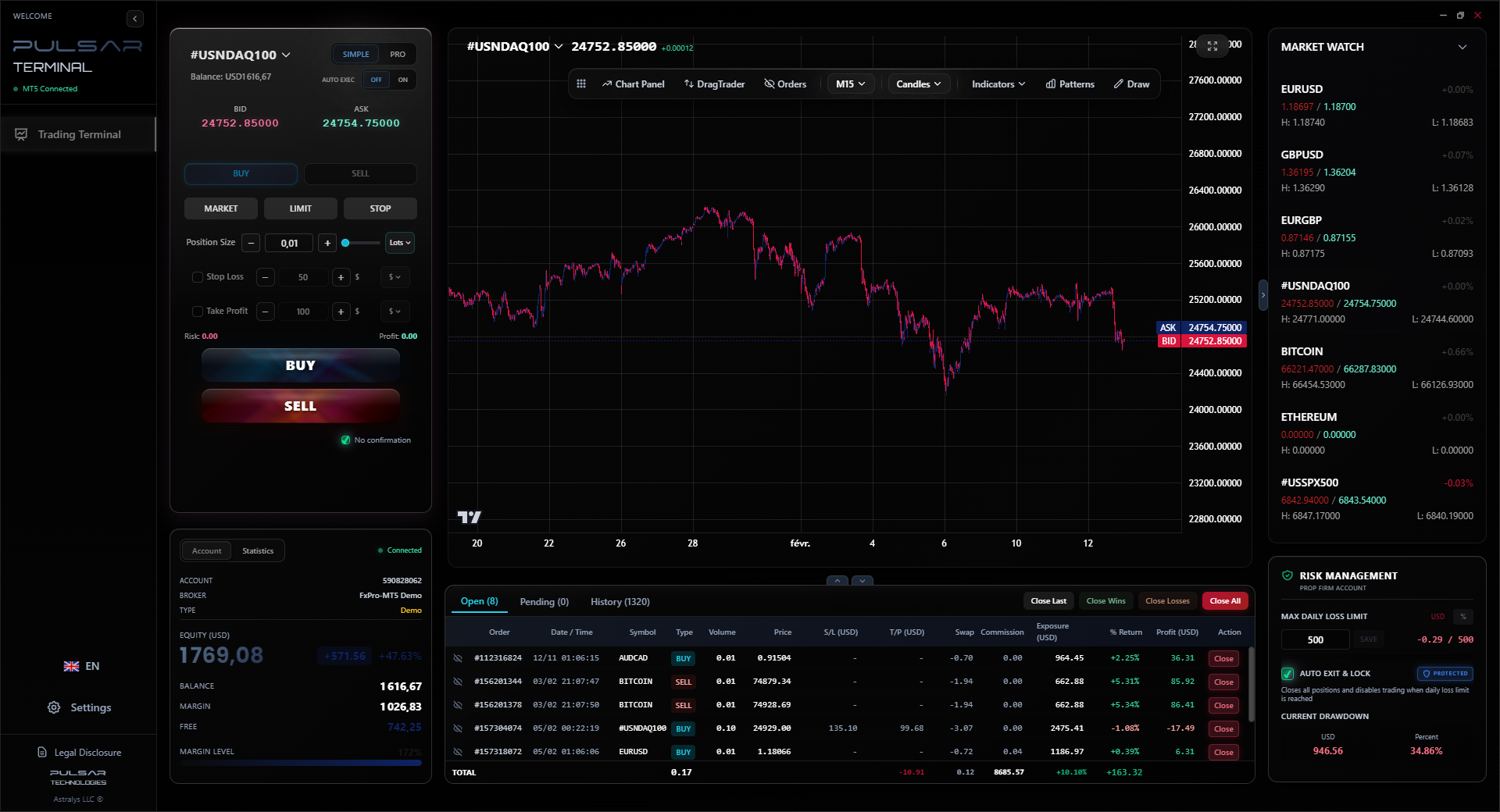
- If you're an investor: This reinforces that SA is serious about controlling capital outflows. It makes the R1 million discretionary allowance even more precious. This regulatory complexity is another reason why active trading through a bank is a nightmare. A proper international broker handles regulation on their side, giving you cleaner access to the market. For prop firm traders, managing daily loss limits under such a restrictive system would be impossible, whereas a tool like Pulsar Terminal can automate that protection seamlessly on MT5.
Managing complex trades and strict risk rules under South Africa's tight regulations is tough, but tools like Pulsar Terminal automate advanced order types and prop firm loss protection directly on your MT5 platform.
Pulsar Terminal
Das All-in-One MT5-Tool: Drag-and-Drop-Orders, Multi-TP/SL, Trailing Stop, Grid Trading, Volume Profile und Prop-Firm-Schutz. Täglich von 1.000+ Tradern genutzt.
After my FNB fiasco, I funded an account with R20,000 at a well-regulated international broker operating in SA. The difference wasn't just noticeable; it was like seeing in color for the first time.
The Cost Difference: On EUR/USD, my cost was a 0.6 pip spread. That's about ZAR 1.50 per standard lot on my broker, versus the equivalent of 300+ pips (ZAR 750+) on a similar notional value through FNB. I could finally make scalping strategies work because the market didn't have to move miles in my favor just to cover costs.
The Tools: I had MT5 with real-time charts, the RSI indicator, MACD, and proper order types. I could set stop-losses and take-profits instantly. FNB's platform offered none of this.
The Speed & use: Orders executed in milliseconds, not the minutes it took for a bank rate to be 'confirmed'. With responsible use, I could control larger positions with less capital (understanding the margin call risks completely).
My first successful trade on the new platform was on XAU/USD. I went long at $1832.50 with a 1 pip spread. I took half profit at $1841 and let the rest run with a trailing stop. The total gain was R4,800. After broker costs of about R45, I netted R4,755. The same move, trying to 'buy gold' via a bank's currency conversion with a 3% margin, would have netted me maybe R800. The difference is your profit.

“I learned to use the right tool for the job. FNB for moving money, a broker for trading money.”
Use FNB Forex if:
- You need to send or receive an international payment for tuition, family support, or importing goods.
- You run a business and need to hedge a known foreign currency invoice with a forward contract.
- You want to open a Foreign Currency Account to hold USD or EUR for future use.
- You're using your annual R1 million or R10 million investment allowance.
Avoid FNB Forex for trading if:
- You want to speculate on currency movements for short-term profit.
- You use technical analysis and need charts, indicators, and fast execution.
- You want to use any form of use or trade more than a handful of major currency pairs.
- You value low transaction costs above all else.
My journey taught me to use the right tool for the job. I keep my FNB account for my local banking and the occasional international transfer. All my trading capital sits with a dedicated broker where the costs are transparent and the tools are built for the task. It's the only way to give yourself a fighting chance in the markets.
💡 Winstons Tipp
If you're not taking delivery of a currency for a real invoice or travel, you're not a client of bank forex. You're a trader. Act like one.
FAQ
Q1Can I actually trade forex through my FNB bank account?
Not in the way a trader understands it. You can buy and sell foreign currency through their platform for delivery into a Foreign Currency Account, but it's designed for international payments, not speculative trading. The costs (3-4.5% margins) and lack of trading tools make it impractical and expensive for active trading.
Q2What is the cheapest way to send money overseas with FNB?
Always use the FNB App or Online Banking, not a branch. For amounts over R10,000, the fee is 0.55% (min R275). But remember, the real cost is the exchange rate margin (2-4.5%). To save, send larger amounts less frequently, as the commission is capped. For very large amounts, negotiate the margin with their forex desk.
Q3What are the new 2025 SARB rules for forex?
As of October 2025, SARB requires banks like FNB to verify that non-residents receiving South African-source income (dividends, rent, royalties) are tax compliant with SARS before sending funds. This requires a special TCS PIN or letter, adding significant paperwork and delay to such transactions.
Q4Is it illegal to use international forex brokers in South Africa?
No, it is not illegal for South African residents to use international brokers that are regulated in their home jurisdictions (like ASIC, FCA, CySEC) to trade forex. However, you must still use your annual foreign investment allowances (R1m or R10m) to fund your trading account. The illegal activity is using unauthorized, unregulated dealers or trying to circumvent exchange controls.
Q5Does FNB offer use for forex trading?
No. FNB's forex services do not offer any use. You are converting one physical currency for another at the full value. This is another key difference from leveraged speculative trading through a broker, where you can control a larger position with a smaller deposit (which magnifies both gains and losses).
Q6How long does an international transfer with FNB take?
Typically 1 to 5 business days, depending on the destination country, currency, and intermediary banks involved. It's rarely instant. This is another reason it's useless for trading, where you need to enter and exit positions in seconds or minutes.
Q7Can I open a US Dollar account with FNB?
Yes. FNB offers Foreign Currency Accounts (FCAs) in USD, EUR, GBP, and several other major currencies. There are no monthly fees to hold the account. This is useful if you receive income in foreign currency or want to hold it for a future payment, avoiding repeated conversion costs.
Prof. Winstons Lektion
Wichtige Erkenntnisse:
- ✓Bank forex margins are 300-450 pips wide, killing any trade.
- ✓Always add the hidden margin to the stated fee for true cost.
- ✓Use FCAs and forwards for business, not speculation.
- ✓SARB's 2025 rules add major delays for non-resident payments.
- ✓A real broker's cost is often less than 1% of a bank's.
Wie nützlich war dieser Artikel?
Klicken Sie auf einen Stern
Wöchentliche Trading-Einblicke
Kostenlose wöchentliche Analysen & Strategien. Kein Spam.
Über den Autor
David van der Merwe
Schwellenland-Trader
In Johannesburg ansässiger Trader mit 11 Jahren Erfahrung in Schwellenländerwährungen. Spezialisiert auf ZAR-Paare, FSCA-regulierten Handel und Analyse des südafrikanischen Marktes.
Kommentare
Risikohinweis
Der Handel mit Finanzinstrumenten birgt erhebliche Risiken und ist möglicherweise nicht für alle Anleger geeignet. Vergangene Ergebnisse garantieren keine zukünftigen Renditen. Dieser Inhalt dient ausschließlich Bildungszwecken und stellt keine Anlageberatung dar. Führen Sie immer Ihre eigene Recherche durch, bevor Sie handeln.
Das könnte Sie auch interessieren

Cara Trading Forex Sukses: 7 Prinsip dari Trader Profesional
Cara trading forex sukses dengan 7 prinsip trader pro: manajemen modal, disiplin, journal trading, backtest. Data nyata, bukan janji profit palsu.
Jam Trading Forex Terbaik untuk Trader Indonesia: Panduan Lengkap dengan Tabel Waktu
Panduan jam trading forex untuk trader Indonesia. Tabel 4 sesi dunia, jam emas 20:00-00:00, sesi mana yang harus dihindari. Data akurat + tips dari trader berpengalaman.
Top 5 Sàn Forex Uy Tín Nhất 2026: Review Jujur dari Trader Indonesia
Top 5 sàn forex uy tín 2026 untuk trader Indonesia. Review jujur: spread, deposit, withdraw, dukungan lokal. Exness, XM, IC Markets & lebih.
Pulsar Terminal herunterladen
Alle diese Rechner sind in Pulsar Terminal mit Echtzeit-Daten Ihres MT5-Kontos integriert.
Pulsar Terminal herunterladen