


My screen froze on the MT5 login screen.

Olumide Adeyemi
Pionier des Tradings in Westafrika ·  Nigeria
☕ 9 Min. Lesezeit
Was Sie lernen werden:
- 1Why Your Login Ritual is Your First Trade
- 2Login Hazards Every Nigerian Trader Faces
- 3Security: It's Not Just About Your Password
- 4The Two Fatal Login Mindsets That Blow Accounts
- 5Platform Navigation: Where Pips Get Lost
- 6Your Post-Login Routine: A 5-Point Checklist
- 7The Most Important Rule: When NOT to Log In
My screen froze on the MT5 login screen. It was March 2020, the day oil crashed below $30 and the Naira was getting hammered. My hands were sweating, not from excitement, but from pure panic. I couldn't remember which of my three demo accounts had the 'safe' strategy I was supposed to switch to. I'd been logging in and out so much, chasing losses across platforms, that I'd become a passenger in my own disaster. That moment, staring at the login field, taught me more about risk than any losing trade ever did. Your forex account login isn't just a gateway to the markets, it's the first and most repeated test of your discipline.
You probably think logging in is just typing a password. It's not. It's the trigger for your entire trading session's mental state. Logging in while distracted - checking your phone, half-listening to a meeting - primes your brain for impulsive decisions. I learned this the hard way. In 2019, I logged in quickly during a lunch break to 'just check' on a EUR/USD position. I wasn't focused. I saw a 15-pip dip against me, panicked, and closed the trade for a $120 loss. The trade then reversed and would have hit my 40-pip profit target. That loss wasn't from analysis, it was from a careless forex account login.
Your login is the border between your normal life and the trading arena. Cross it with intention. Have a pre-login checklist: Are you mentally prepared? Is your trading plan for the day next to you? Have you checked the economic calendar? If not, you're just gambling with better charts. This ritual is your first line of defense against the emotional volatility that kills accounts. A disciplined entry to your platform sets the tone for disciplined exits from your trades.

Warning: Logging in 'just to see' is a trap. You wouldn't walk into a casino just to look at the roulette wheel. The moment you see your P&L, you are in the game, emotionally invested. Decide your session purpose before you authenticate.
“Your forex account login isn't just a gateway to the markets, it's the first and most repeated test of your discipline.”
Our trading environment here isn't like trading in London or New York. We have unique friction points that start at the login screen, and ignoring them is a sure way to leak money.
Power and Data: The Silent Account Killers
Nothing spikes your cortisol like trying to log in during a crucial setup and seeing 'Network Error'. Or worse, you get in, place a trade, and then NEPA takes light. I've had trades go rogue because my internet dropped during entry, resulting in a misclicked lot size. Now, I use a simple UPS for my router and PC. It's a non-negotiable business expense. For mobile login, have a primary and a backup data provider. That ₦500 extra for a second SIM can save you thousands in a bad trade.
Broker Platform Choice: More Than Just a Login Page
Many Nigerian traders gravitate towards brokers with flashy bonuses or easy sign-up. The real test is login reliability during high volatility. Does your broker's server freeze when the US Non-Farm Payrolls data drops? I've used platforms where the login page itself would time out during high traffic, locking me out of risk management. This is where reviews from other local traders are gold. A platform like Exness or IC Markets is popular here not just for funding, but for stable server connections that don't fail you at the login stage when you need them most.
The Demo-to-Live Transition Trap
This is a classic psychological pitfall. You practice on a demo account with a login like 'TraderJay_Demo'. You build fake confidence. Then you fund a live account, and the moment you type that live forex account login, everything changes. The numbers feel real because they are. The solution? Make your demo login ritual identical to your live one. Use the same platform, same login time, same checklist. It bridges the psychological gap.

💡 Winstons Tipp
The market will be there tomorrow. If you're hesitating at the login screen, that's your intuition telling you to walk away. Listen to it.
“Logging in 'just to see' is a trap. The moment you see your P&L, you are in the game, emotionally invested.”
Using your birthday or 'password123' is asking for trouble. But security is deeper than a strong password. It's about controlling access to your emotional state and capital.
First, enable two-factor authentication (2FA) on every account. Every single one. If your broker doesn't offer it, question why. This is the biggest technical step to prevent disaster. Second, never, ever save your login credentials on a public or shared computer. That cyber café login could cost you your entire account.
But there's a deeper layer: session security. Do you leave your platform logged in all day? It's a vulnerability. Not just to others, but to yourself. An open platform is an invitation to overtrade. Get in the habit of logging out after your planned trading session ends. It's a physical barrier to impulsive 'revenge trading' later in the night. Think of logging out as putting your money back in the vault.

Pro Tip: Use a password manager. It lets you create and store complex, unique passwords for each broker and your email. Your email recovery is the backdoor to everything. Protect it like your main trading capital.
“Logging in 'just to see' is a trap. The moment you see your P&L, you are in the game, emotionally invested.”
I've coached enough traders to see two distinct, dangerous approaches to the simple act of logging in.
The Gambler's Login: This trader logs in with a feeling of 'What can I catch today?'. There's no plan, only opportunity-seeking. The eyes go straight to the charts, scanning wildly. This mindset is reactive. It leads to chasing price, FOMO trades, and ignoring pre-defined levels. The login is an act of excitement.
The Anxious Login: This trader hesitates at the password screen. They're logging in to check on a floating loss, their stomach in knots. They've been avoiding the platform. This login is driven by fear and hope - 'Please let it be back in profit'. It leads to moving stop losses out, breaking all rules, and turning a small loss into a margin call.
The correct mindset? The Manager's Login. You log in as the CEO of your trading business. You're there to execute a pre-defined plan, monitor open positions against that plan, and manage risk. Your first action shouldn't be placing a trade; it should be reviewing your journal and checking if market conditions still match your strategy's criteria. This shift alone will save you more money than any indicator.
💡 Winstons Tipp
Treat your login password like the PIN to your bank account. Because that's exactly what it is.
“The ability to stay logged out is a measure of your maturity as a trader.”
You've logged in safely. Now, the interface itself can cause costly errors, especially under pressure. Misclicking a order size, setting a stop loss in the wrong direction, or confusing buy and sell limits are rookie mistakes that stay with pros who get sloppy.
I once meant to sell 0.5 lots on GBP/USD. In a volatile spike, I mis-clicked and entered 5.0 lots. I realized it instantly, but the 2-second panic felt like an hour. I closed it for a $150 loss on the spread and slippage. A costly lesson in slowing down. This is where knowing your platform's order entry shortcuts is crucial. Practice on demo until entering, modifying, and closing trades is muscle memory.
This is also the stage where tools that integrate with your platform can be a force multiplier. Manual trailing stops are hard to manage perfectly. Having a tool that can automate that based on your rules removes emotion and error. The same goes for setting multiple take-profit levels on a single trade - trying to manually close partial lots while watching price action is a recipe for mistakes.

Example: You buy XAU/USD (Gold) at $1830. Your plan is to take 50% off at +$15, trail the rest. Manually, you're glued to the screen. Automatically, you're free to analyze the next opportunity or step away. That mental capital is priceless.
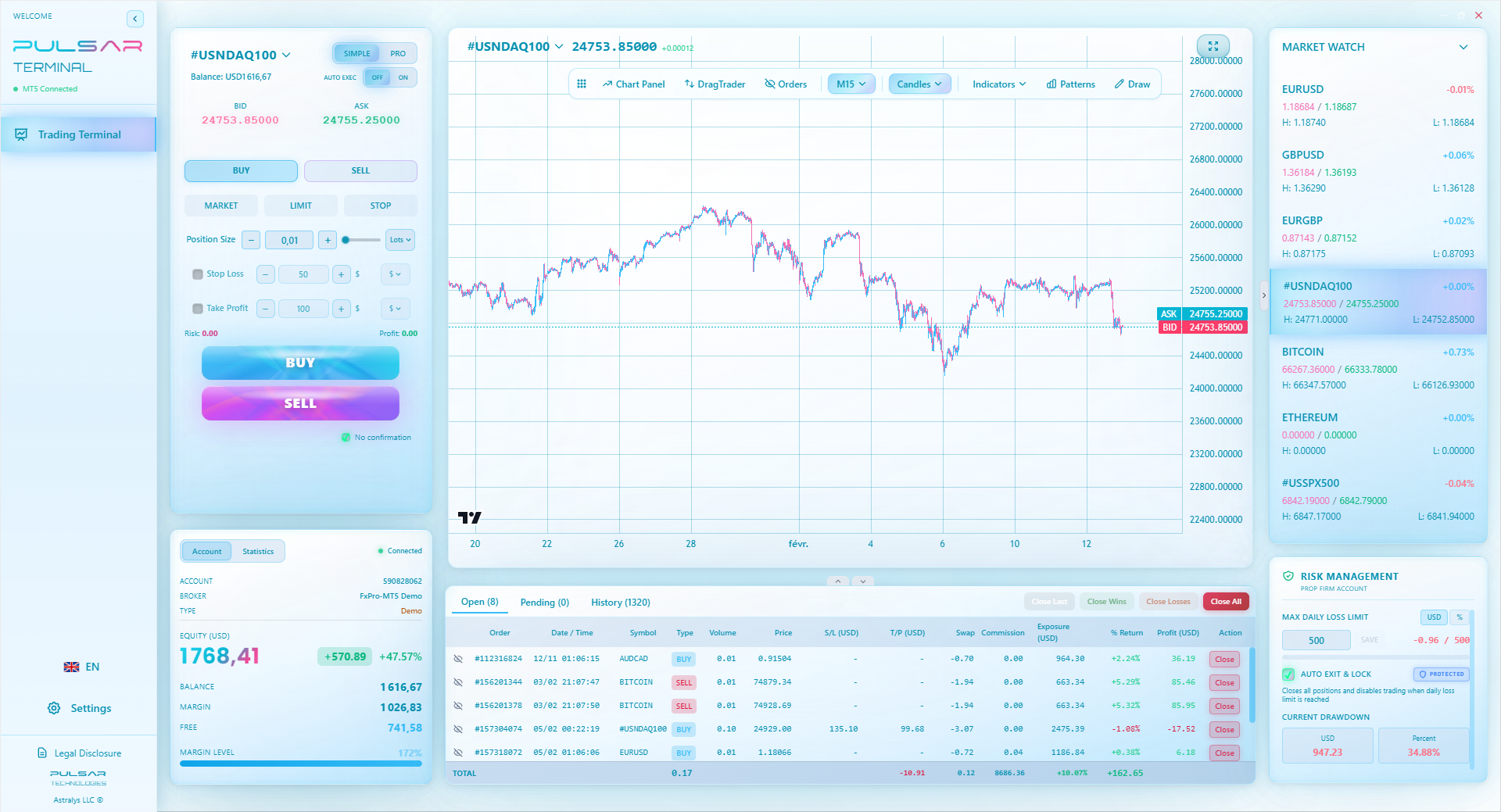
Eliminating manual order errors and managing complex exits is critical, which is why tools like Pulsar Terminal integrate directly with MT5 to automate stops, take-profits, and trade management with a single click.
Pulsar Terminal
Das All-in-One MT5-Tool: Drag-and-Drop-Orders, Multi-TP/SL, Trailing Stop, Grid Trading, Volume Profile und Prop-Firm-Schutz. Täglich von 1.000+ Tradern genutzt.
“The ability to stay logged out is a measure of your maturity as a trader.”
Don't touch a chart until you do this. Write it down and follow it every single time.
- Check for Open Positions: Before anything else, review every open trade. Does the reason for entry still hold? Are stops and targets appropriate for current market conditions (e.g., has volatility changed)?
- Review the Economic Calendar: What news is due during your session? Are you holding positions into high-impact events? This determines if you should adjust stops to breakeven or reduce size.
- Assess Market State: Is the market trending or ranging? A quick look at a higher timeframe (like the 4Hr) frames the day. Don't get lost in the 5-minute noise right away.
- Consult Your Trading Plan: What setups are you looking for today? What instruments? If it's not on the plan, it's not a trade. This is your filter.
- Set Your Maximum Risk: Use a position size calculator to determine your lot size for the day based on your account balance and where your stop losses will be. Do this before you see a tempting setup.
This routine takes 3-5 minutes. It forces you from reactive to proactive mode. It turns your forex account login from a gamble into a business audit.
“Protecting your account from yourself is 80% of the battle.”
This is the ultimate discipline. There are times when the most profitable action is to not log in at all. Your ability to stay logged out is a measure of your maturity as a trader.
- After a Big Loss: Your emotional capital is depleted. Logging in to 'make it back' is revenge trading. The market doesn't care about your feelings. Take the day off.
- When You're Tired or Emotional: Bad day at work? Argument with your spouse? Your judgment is impaired. You will see patterns that aren't there.
- When Your Plan Says 'No Trade': If your swing trading plan says the market is in a no-trade zone, respect it. Logging in 'just to look' will tempt you to force a trade.
- During Major, Scheduled News: Unless you are a dedicated news trader, logging in 5 minutes before a major Central Bank announcement is volatility gambling. The spreads will widen, orders may freeze, and emotions run high.
I have a sticky note on my monitor: 'Can you state your objective?' If I can't, I don't type my password. Protecting your account from yourself is 80% of the battle.
FAQ
Q1What is the most secure way to handle my forex account login in Nigeria?
Use a strong, unique password combined with Two-Factor Authentication (2FA) on both your broker account and the email linked to it. Never use public Wi-Fi for trading logins. Consider a VPN for an added layer of encryption, and always log out completely after your session.
Q2I keep getting logged out of my trading platform. What should I do?
Frequent disconnections are often a server or internet issue. First, rule out your local internet by testing other sites. If it's only your platform, it could be your broker's server distance. Consider brokers like IC Markets or Pepperstone which have servers in London and New York with good connectivity here. Also, check if you have a 'timeout' setting in your platform that can be extended.
Q3Is it safe to use mobile data for forex trading login in Nigeria?
Generally, yes, and it's often more reliable than some fixed lines. However, ensure you have a stable signal (4G/LTE preferably). Avoid trading during peak network congestion times. Always have a backup data source (a second network's SIM) ready, especially if you're in a trade.
Q4How many trading accounts should I have logged in at once?
As few as possible. More than two active trading accounts, especially on the same platform, is a recipe for confusion and risk management errors. I recommend one main live account and one dedicated demo account for testing. Logging into multiple accounts scatters your focus and makes consistent strategy execution nearly impossible.
Q5What should I do immediately after a successful forex account login?
Do not immediately look for trades. Follow your post-login routine: check open positions, review the economic calendar, assess the overall market state on a higher timeframe, and confirm your daily risk limit. This 5-minute discipline prevents impulsive action.
Q6Can I save my login details on my browser for faster access?
No. Never save your broker login credentials in your browser, especially on a shared or personal computer that isn't fully secured. The convenience is not worth the risk. Use a dedicated, reputable password manager if you need help storing complex passwords.
Prof. Winstons Lektion
Wichtige Erkenntnisse:
- ✓Your login ritual sets your trading mindset.
- ✓Nigerian traders must plan for power and data fails.
- ✓Enable 2FA on every account, no exceptions.
- ✓Log out after your session to prevent revenge trades.
- ✓Have a 5-point post-login checklist and use it.
Wie nützlich war dieser Artikel?
Klicken Sie auf einen Stern
Wöchentliche Trading-Einblicke
Kostenlose wöchentliche Analysen & Strategien. Kein Spam.
Über den Autor
Olumide Adeyemi
Pionier des Tradings in Westafrika
Einer der aktivsten Forex-Trading-Ausbilder Nigerias. 8 Jahre Trading-Erfahrung aus Lagos. Spezialisiert auf Strategien mit geringem Kapital und Prop-Firm-Challenges für afrikanische Trader.
Kommentare
Risikohinweis
Der Handel mit Finanzinstrumenten birgt erhebliche Risiken und ist möglicherweise nicht für alle Anleger geeignet. Vergangene Ergebnisse garantieren keine zukünftigen Renditen. Dieser Inhalt dient ausschließlich Bildungszwecken und stellt keine Anlageberatung dar. Führen Sie immer Ihre eigene Recherche durch, bevor Sie handeln.
Das könnte Sie auch interessieren

Cara Trading Forex Sukses: 7 Prinsip dari Trader Profesional
Cara trading forex sukses dengan 7 prinsip trader pro: manajemen modal, disiplin, journal trading, backtest. Data nyata, bukan janji profit palsu.
Jam Trading Forex Terbaik untuk Trader Indonesia: Panduan Lengkap dengan Tabel Waktu
Panduan jam trading forex untuk trader Indonesia. Tabel 4 sesi dunia, jam emas 20:00-00:00, sesi mana yang harus dihindari. Data akurat + tips dari trader berpengalaman.
Top 5 Sàn Forex Uy Tín Nhất 2026: Review Jujur dari Trader Indonesia
Top 5 sàn forex uy tín 2026 untuk trader Indonesia. Review jujur: spread, deposit, withdraw, dukungan lokal. Exness, XM, IC Markets & lebih.
Pulsar Terminal herunterladen
Alle diese Rechner sind in Pulsar Terminal mit Echtzeit-Daten Ihres MT5-Kontos integriert.
Pulsar Terminal herunterladen