


You've probably seen the ads.

David van der Merwe
Schwellenland-Trader ·  South Africa
☕ 10 Min. Lesezeit
Was Sie lernen werden:
- 1What Forex Algorithmic Trading Actually Is (And Isn't)
- 2Building vs. Buying: The Eternal South African Dilemma
- 3The Non-Negotiable Components of a Successful Algo
- 4South African Specifics: ZAR, Latency, and Brokers
- 5Why Most Forex Algorithms Fail (And How to Avoid It)
- 6A Practical, Step-by-Step Plan to Get Started
- 7Looking Ahead: Machine Learning & The Prop Firm Path

You've probably seen the ads. The ones promising a 'set-and-forget' forex robot that prints money while you braai. Let me stop you right there. That's a fantasy, and chasing it will cost you every rand in your trading account. I've seen more traders lose their shirts to poorly understood algorithmic trading than to any market crash. This guide isn't about selling you a dream. It's about giving you the cold, hard facts of what forex algorithmic trading actually is, how it can work for you in South Africa, and the specific pitfalls that will destroy you if you're not careful.
Let's clear the air. Forex algorithmic trading isn't magic. It's simply using a set of coded instructions (an algorithm) to execute trades. The algorithm defines the rules: when to buy, when to sell, how much to risk. It removes emotion, which is its biggest strength and, ironically, its most dangerous weakness if the logic is flawed.
For us in South Africa, it's not about competing with Wall Street's high-frequency trading (HFT) firms. Their servers are milliseconds from the exchange; ours are in Johannesburg or Cape Town dealing with international latency. Trying to scalp like they do is a sure way to get picked off. Our edge lies in systematic, rules-based approaches on slightly longer timeframes where a 50ms delay doesn't matter.

Warning: An algorithm is only as good as the trader who built or bought it. Garbage in, garbage out. A fancy name like 'Gold Hunter Pro EA' means nothing if the underlying strategy is based on hope, not statistical edge.
I learned this the hard way early on. I bought a 'guaranteed' robot for $500. It traded EUR/ZAR beautifully for two weeks, making a steady R15,000. Then, one Thursday during a SARB announcement, it went haywire. It placed 12 consecutive losing trades on EUR/USD (an instrument it wasn't even supposed to trade!), ignoring all stop-loss rules. I lost R42,000 in 90 seconds before I could manually shut it down. The vendor's response? 'Market conditions changed.' That was my R42,000 lesson: you must understand every line of logic governing your money.

“An algorithm is only as good as the trader who built or bought it. Garbage in, garbage out.”
This is the crossroads every trader faces. Do you build your own system or buy a commercial Expert Advisor (EA)?
Building Your Own (The Hard Way) This is the path of mastery. You learn a language like MQL4/5 (for MetaTrader) or Python, and you code your strategy. The pros? Total control. You know every parameter, every condition. The cons? It takes years to get good. You need programming skill and trading acumen. Most retail traders have one, not both.
Buying a Commercial EA (The Minefield) The market is 95% scams. Vendors show incredible backtests on perfectly curated historical data. What they don't show is the R1,000,000 drawdown that happens once every five years. They sell you the dream of passive income.
Here’s a quick comparison of the realities:
| Aspect | Building Your Own | Buying a Commercial EA |
|---|---|---|
| Upfront Cost | Time (hundreds of hours) | R2,000 - R50,000+ |
| Control | Complete. You adjust everything. | Minimal. Often 'black box.' |
| Understanding | Deep. You know why every trade is taken. | Superficial. You trust the marketing. |
| Long-term Viability | High. You can adapt it. | Very Low. Most are abandoned. |
| Suitability | Disciplined traders with coding patience. | Beginners looking for a shortcut (dangerous). |
My advice? If you're serious, you have to learn to build or at least seriously modify. Start by automating a simple strategy you already trade manually, like a basic MACD indicator crossover. Don't jump straight to a complex grid system.

Pro Tip: Before you spend a cent on an EA, demand a verified live track record (Myfxbook or similar) of at least 18 months, through multiple market conditions like SARB rate hikes or US NFP reports. If they can't provide it, walk away.

💡 Winstons Tipp
Your first algorithm should be the most boring strategy you can imagine. Excitement in algo trading usually precedes a massive loss.
“Failure in algorithmic trading isn't an accident, it's a design flaw.”
A profitable algorithm isn't about a secret indicator. It's a strong system built on boring, essential pillars. Miss one, and the whole thing collapses.
1. A Defined, Logical Strategy
This is the core. 'Buy low, sell high' is not a strategy. A strategy is: "Go long on USD/ZAR on a 4-hour chart when the price closes above the 50-period EMA, the RSI indicator is above 50 but not overbought (below 70), and only if the trade aligns with the broader daily trend." Specific, testable rules.
2. Rigorous Backtesting & Forward Testing
Backtesting is running your algorithm on historical data. But beware of 'overfitting' - creating a system that works perfectly on past data but fails in the future. It's like designing a key that only fits one specific lock that no longer exists.
You must then forward test (paper trade) in real-time market conditions for months. I once spent 3 months coding and backtesting a scalping strategy for GBP/USD. The backtest showed a 65% win rate. In one month of forward testing, it barely broke even because it couldn't handle the real-time spread definition widening during London open.
3. Rock-Solid Risk Management
This is the most important component, full stop. Your algorithm must have precise, unbreakable rules for position sizing and stop losses. It should never risk more than 1-2% of your capital on a single trade. Use a position size calculator religiously. The algorithm's number one job is to protect you from yourself and from a string of losses. Without this, you're one bad week from a margin call.
“Failure in algorithmic trading isn't an accident, it's a design flaw.”
Trading from SA isn't the same as trading from London or New York. We have unique challenges and opportunities.
Trading the ZAR Pairs (USD/ZAR, EUR/ZAR) These pairs are your home-field advantage. You understand the local news, the political climate, and when the SARB might move. However, they are notoriously volatile and can have massive spreads. An algorithm trading these must have ultra-wide stop losses (think 300-500 pips definition) and account for sudden liquidity gaps. Don't try to scalp them with a tight algo.
The Latency Problem Your internet connection to an international broker's server adds delay. For a day trader or scalper, this can be fatal. For a swing trading algorithm holding trades for days, it's irrelevant. Choose your strategy's timeframe with this in mind.
Choosing the Right Broker Not all brokers are created equal for algorithmic trading. You need:
- Reliable Execution: Slippage on your entries and exits will kill a precise algorithm.
- Low, Fixed Spreads: Variable spreads that balloon during news can trigger false entries or destroy your risk/reward.
- VPS Hosting: You should run your EA on a Virtual Private Server (VPS) hosted near your broker's data center (e.g., London). This ensures it runs 24/5 without your PC being on and reduces latency. Many top brokers like IC Markets review and Pepperstone review offer affordable or free VPS services for active traders.
Brokers like Exness review or XM review might be great for manual trading, but you need to check their specific policy on EAs and their average execution speeds.
💡 Winstons Tipp
If you wouldn't sit and manually execute the trades your algo is making, the logic is wrong. The computer is just a faster, more disciplined version of you.
“You must be a systems manager, not an absentee landlord. 'Set and forget' is the fastest way to 'set and regret'.”
Failure isn't an accident, it's a design flaw. Here are the guaranteed paths to ruin.
Over-Optimization (Curve-Fitting): This is tweaking your algorithm's parameters so it fits historical data perfectly. You end up with a system that 'predicts' the past but has no predictive power for the future. If your strategy has 15 complicated conditions, you're probably guilty of this.
Ignoring Transaction Costs: Every trade costs you the spread. An algorithm that makes 100 trades a day needs a massive edge just to cover costs. That R20 round-turn cost adds up to R2,000 per 100 trades. If your average winning trade is only R50, you're already fighting a huge battle.
No Strategy for Drawdowns: Every system has losing periods. If your algorithm hasn't been stress-tested for a 30% drawdown, you will panic and shut it off at the worst possible time - right before it recovers. You must know your system's maximum historical drawdown and have the psychological capital to withstand it.
Setting and Forgetting: The biggest lie in algorithmic trading. You can't just launch it and go to the beach. You must monitor it daily. Is it executing orders correctly? Has market volatility changed dramatically (like during a COVID-style crisis)? You need to be a systems manager, not an absentee landlord.
I made the 'ignoring costs' mistake. I built a mean-reversion algo for XAU/USD guide (gold). It was right about direction 60% of the time. But the high spreads on gold, combined with its frequent small wins, meant all profits were eaten by costs. After 3 months and 200 trades, I was up a grand total of $87. My time wasn't worth it.
“You must be a systems manager, not an absentee landlord. 'Set and forget' is the fastest way to 'set and regret'.”
Okay, you're still reading. You're serious. Here's how to start without lighting your money on fire.
Step 1: Trade Manually First. Pick one major pair like EUR/USD guide. Develop and document a simple, rule-based strategy. Trade it in a demo account for 3 months. Keep a detailed journal. You need a profitable manual strategy before you can automate a profitable one.
Step 2: Learn the Basics of MQL5. Don't aim to be a master coder. Use the MetaTrader 5 strategy tester. Learn how to code your basic entry/exit rules and your risk management. There are thousands of free tutorials. Start by modifying simple free scripts.
Step 3: Code Your Simple Strategy. Automate the strategy from Step 1. Just the basic logic. Ignore fancy filters for now.
Step 4: Backtest & Analyze. Run it on 5-10 years of data. Look at the equity curve. Is it smooth or a rollercoaster? What's the max drawdown? If the drawdown is 40%, you'd need nerves of steel to run it live. That's a red flag.
Step 5: Forward Test for 3-6 Months. Run it on a demo account in real-time. Compare its performance to your manual trading. Does it follow the rules exactly?
Step 6: Go Live with Tiny Capital. When you finally go live, use the smallest possible position size. Risk 0.5% per trade, not 2%. Let it run for 6 months. Only after it survives a live market cycle should you consider scaling up.
This process will take you a minimum of 9-12 months. If that sounds too long, then algorithmic trading isn't for you. It's a marathon, not a sprint.
💡 Winstons Tipp
The best metric to judge an algo isn't total profit, but the consistency of its equity curve. A smooth, slow climb beats a jagged mountain range every time.

“The algorithm's number one job is to protect you from yourself.”
Once you've mastered the basics, you can explore more advanced avenues.
Machine Learning (ML) in Trading: This is the next level, using algorithms that can 'learn' and adapt from new data. It's incredibly powerful and equally dangerous. You need strong data science skills. For a retail trader, I'd be very cautious. It's easy to create a model that finds meaningless patterns in noise. This is a field for quants, not most of us.
Algorithmic Trading for Prop Firms: This is a fascinating application. Many proprietary trading firms (prop firms) offer evaluation challenges where you trade their capital for a share of profits. Using a well-tested, disciplined algorithm is a great way to pass these challenges consistently, as it removes emotion during the test.
The key here is that the algorithm must be built to pass their specific rules - like maximum daily loss limits. You can't just use any EA. It has to be tailored to their risk parameters. The upside is significant: passing a $100,000 challenge could give you a funded account to trade with your algo.

Example: A prop firm has a 5% max daily loss rule on a $100,000 account. That's $5,000. Your algorithm's worst-case daily loss in backtesting must be far below that, say $2,000, to give you a safety buffer. You code that hard stop into the EA itself.
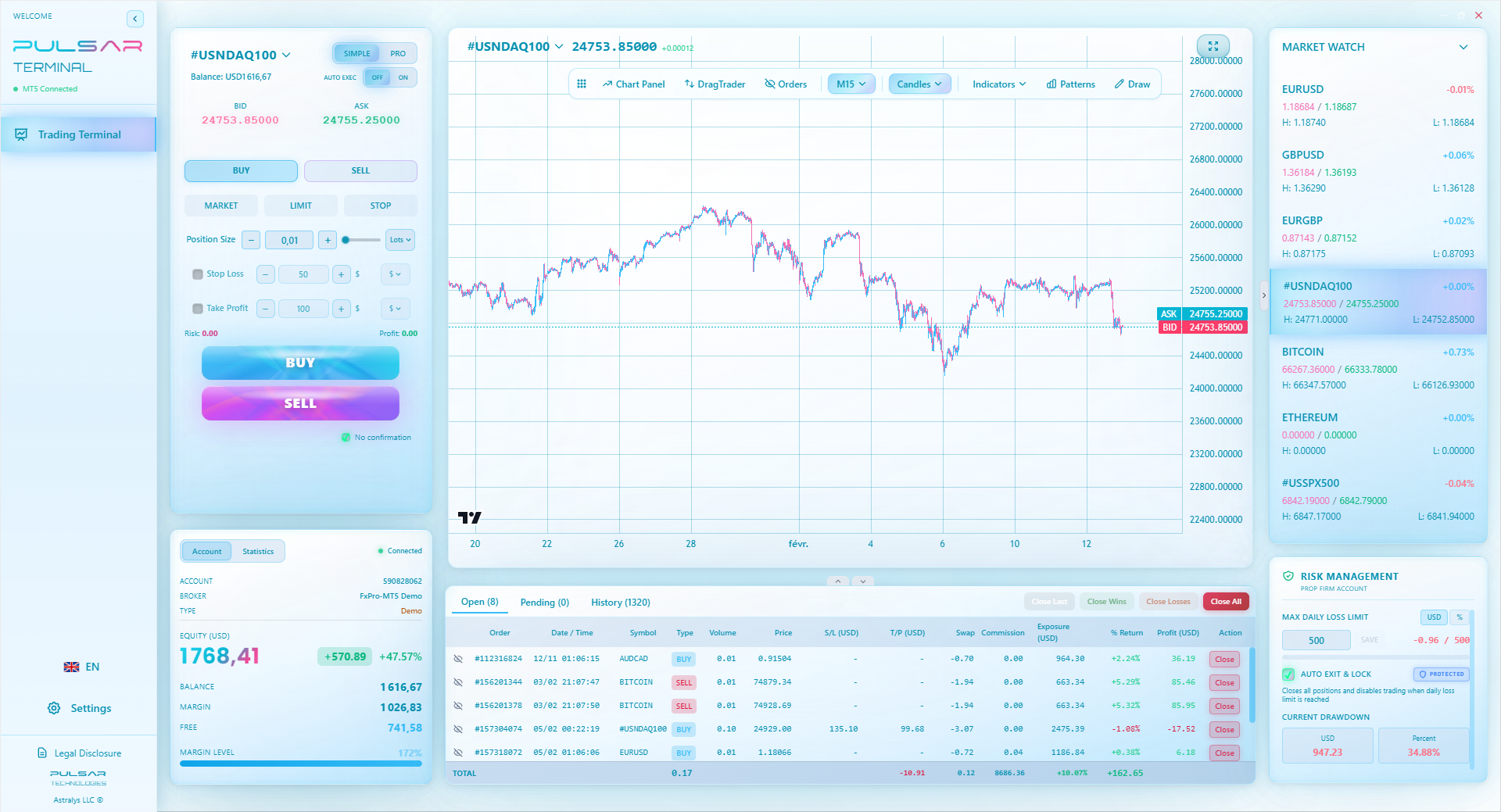
Managing the complex rules and daily loss limits of a prop firm challenge is stressful; Pulsar Terminal automates this protection directly on your MT5, so your algorithm can't breach the rules.
Pulsar Terminal
Das All-in-One MT5-Tool: Drag-and-Drop-Orders, Multi-TP/SL, Trailing Stop, Grid Trading, Volume Profile und Prop-Firm-Schutz. Täglich von 1.000+ Tradern genutzt.
FAQ
Q1How much money do I need to start forex algorithmic trading in South Africa?
Technically, you can start with a few thousand rand. Realistically, you need enough to withstand drawdowns without blowing your account. For a serious live attempt with proper risk management (1% risk per trade), a minimum of R20,000-R50,000 is a more sensible starting capital. Remember, most of the cost is in time and learning, not the initial deposit.
Q2Is it legal for South Africans to use forex trading algorithms?
Yes, it is completely legal. There are no South African laws prohibiting the use of Expert Advisors or automated trading systems on international forex brokers. The legal responsibility lies in declaring any profits to SARS for income tax purposes. Always use a reputable, regulated international broker.
Q3Can I run a forex EA on my phone or home PC?
You can, but you shouldn't for live trading. Your home PC turns off, your internet drops, loadshedding hits. For 24/5 reliability, you must run your algorithm on a Virtual Private Server (VPS). Most credible brokers offer this service for a small monthly fee (or free if your volume is high). It's non-negotiable for serious algorithmic trading.
Q4What's the biggest difference between algo trading USD/ZAR and major pairs like EUR/USD?
Liquidity and volatility. EUR/USD is the most liquid market in the world, with tight, stable spreads. USD/ZAR is an emerging market currency pair. It's less liquid, has much wider spreads (often 50-100 pips vs. 1 pip), and can experience sudden, sharp moves on local political or economic news. Your algorithm needs to be much more strong and patient for ZAR pairs.
Q5How do I know if my backtest results are realistic or overfitted?
Use out-of-sample testing. Split your historical data: use 70% to build and optimize your algorithm, and then test it on the unseen 30% of data. If the performance on the unseen data collapses, you've overfitted. Also, look for too many complex rules and an unrealistically high win rate (e.g., above 80%). Real, strong strategies are often simple and have win rates between 40-60%.
Q6Do I need to be a programmer to succeed?
Not a master programmer, but you absolutely need to understand the logic of coding. You need to be able to read, modify, and troubleshoot code (like MQL5). If you buy a 'black box' EA, you are completely at the mercy of the developer. To have true control and adaptability, you must be able to get your hands dirty with the code. Think of it as learning basic car maintenance; you don't need to build an engine, but you should know how to change a tyre.
Prof. Winstons Lektion
Wichtige Erkenntnisse:
- ✓Master a manual strategy before you try to automate it.
- ✓Risk management isn't a feature; it's the foundation. Never risk >2% per trade.
- ✓Forward test for 3-6 months minimum before going live.
- ✓Run your live EA on a VPS, not your home PC.
- ✓Judge systems by drawdown, not just profit.
Wie nützlich war dieser Artikel?
Klicken Sie auf einen Stern
Wöchentliche Trading-Einblicke
Kostenlose wöchentliche Analysen & Strategien. Kein Spam.
Über den Autor
David van der Merwe
Schwellenland-Trader
In Johannesburg ansässiger Trader mit 11 Jahren Erfahrung in Schwellenländerwährungen. Spezialisiert auf ZAR-Paare, FSCA-regulierten Handel und Analyse des südafrikanischen Marktes.
Kommentare
Risikohinweis
Der Handel mit Finanzinstrumenten birgt erhebliche Risiken und ist möglicherweise nicht für alle Anleger geeignet. Vergangene Ergebnisse garantieren keine zukünftigen Renditen. Dieser Inhalt dient ausschließlich Bildungszwecken und stellt keine Anlageberatung dar. Führen Sie immer Ihre eigene Recherche durch, bevor Sie handeln.
Das könnte Sie auch interessieren

Cara Trading Forex Sukses: 7 Prinsip dari Trader Profesional
Cara trading forex sukses dengan 7 prinsip trader pro: manajemen modal, disiplin, journal trading, backtest. Data nyata, bukan janji profit palsu.
Jam Trading Forex Terbaik untuk Trader Indonesia: Panduan Lengkap dengan Tabel Waktu
Panduan jam trading forex untuk trader Indonesia. Tabel 4 sesi dunia, jam emas 20:00-00:00, sesi mana yang harus dihindari. Data akurat + tips dari trader berpengalaman.
Top 5 Sàn Forex Uy Tín Nhất 2026: Review Jujur dari Trader Indonesia
Top 5 sàn forex uy tín 2026 untuk trader Indonesia. Review jujur: spread, deposit, withdraw, dukungan lokal. Exness, XM, IC Markets & lebih.
Pulsar Terminal herunterladen
Alle diese Rechner sind in Pulsar Terminal mit Echtzeit-Daten Ihres MT5-Kontos integriert.
Pulsar Terminal herunterladen