


I was staring at my screen in 2015, EUR/ZAR at 16.85, convinced my ‘can’t lose’ setup from a popular trading book was about to print.

David van der Merwe
Schwellenland-Trader ·  South Africa
☕ 10 Min. Lesezeit
Was Sie lernen werden:
- 1Why Most Forex Books Set You Up to Fail
- 2The Only 3 Books You Need to Start (And What Each Actually Gives You)
- 3What Those Books Won't Tell You: The South African Reality
- 4How to Actually Read & Apply These Books (The Right Way)
- 5Your First Steps After Finishing the Books
- 6The Classic Beginner Pitfalls (And How to Sidestep Them)
I was staring at my screen in 2015, EUR/ZAR at 16.85, convinced my ‘can’t lose’ setup from a popular trading book was about to print. I’d risked 3% of my account, exactly as prescribed. The trade went 20 pips my way, then reversed and didn’t stop. I watched, frozen, as it took out my stop loss and kept going. That single trade wiped out two weeks of paper-trading profits. The book gave me the rules, but it completely failed to prepare me for the emotional avalanche of seeing real money disappear. That’s the gap most forex books for beginners leave wide open, especially here where the rand’s volatility eats polite strategies for breakfast.
Let's be blunt. Most introductory trading books are written by people who make more money selling books than trading. They present trading as a neat, logical puzzle you can solve with the right indicator or pattern. The reality in Cape Town or Johannesburg is messier. Your internet drops during load-shedding right as price hits your stop. The USD/ZAR spread widens from 50 to 150 pips during a political announcement, skewing your risk. The book doesn't mention that.
They preach 'cut your losses,' but they don't teach you how to handle the gut-punch when you have to do it six times in a row before breakfast. I've been there. After that EUR/ZAR loss, I broke the cardinal rule: I doubled down on the next trade trying to win it back. Lost another 5%. The book's perfect risk management chapter was useless against my own panic.
The biggest failure? Context. A strategy built for the steady EUR/USD might hemorrhage money on the volatile ZAR pairs that South Africans naturally gravitate towards. You need books that teach principles flexible enough for our market.

Warning: If a forex book promises a 'secret' high-win-rate system or guaranteed profits, close it. The only guarantee in this game is that you will have losing trades. The skill is in managing them.
A good book is a coach, not a cheat sheet. It should make you think, question, and develop your own process, not blindly follow a set of signals. The best ones I've read spend as much time on psychology and risk as they do on chart patterns.
Forget the 20-book reading list. You'll get overwhelmed and confused. Master these three in order. They build on each other like a proper foundation.
1. The Foundation: "Trading in the Zone" by Mark Douglas
Most lists put a technical analysis book first. That's wrong. You need the right mindset before you learn a single chart pattern. Douglas isn't about motivation; he's about the probabilistic nature of markets. This book drills one core idea into your head: It's not about being right on a single trade. It's about executing your edge consistently over a series of trades.
When I finally internalized this, my trading changed. I stopped judging each trade as a success or failure and started focusing on whether I followed my plan. A stopped-out trade became 'correct' if my process was right. This mental shift is non-negotiable. It's the armor you need against the rand's inevitable shocks.
2. The Toolkit: "Technical Analysis of the Financial Markets" by John J. Murphy
This is the bible. Don't get the abridged version. Murphy systematically explains everything from basic trends and chart patterns to volume and intermarket analysis. Its value isn't in giving you a strategy, but in giving you the vocabulary and understanding to evaluate any strategy you come across.
Here’s the practical way to read it as a beginner: Don't try to memorize every pattern. Focus on the core concepts - support/resistance, trend lines, and momentum (using the RSI indicator or MACD indicator). When you understand why a head-and-shoulders pattern is significant, you can start to see supply and demand in action on your USD/ZAR chart.
3. The Reality Check: "Market Wizards" by Jack D. Schwager
After theory, you need reality. This book interviews legendary traders. You'll notice none of them use the same system. A trend follower, a scalper, a fundamentalist - they all succeeded. The common thread? Extreme discipline, rigorous risk management, and a deep self-awareness about what style suited their personality.
This book shatters the myth of the one true path. It lets you see that a successful scalping strategy and a successful swing trading approach can both be valid. Your job is to find what fits you. For a South African, maybe that's focusing on commodity-driven ZAR pairs if you follow mining news.

Example: Let's say you read about a trader risking 1% per trade. You have a R10,000 account. That's R100 risk. On USD/ZAR, with a 50-pip stop loss, your position size calculator tells you that's a micro lot (1,000 units). A beginner's book might just state the 1% rule. These books teach you why it's sacred, and how to apply it when you're down R500 for the month and want to 'go big' to recover.

💡 Winstons Tipp
A library of books won't save you from a single moment of indiscipline. The best book is your own trading journal, where you're the main character making all the mistakes.
“Your goal for the first six months is not to make money. Your goal is to not blow up.”
You can master every concept in those books and still get wrecked here if you ignore local specifics. This is the unwritten chapter.
use & Regulation: The global books talk about 500:1 use like it's normal. In South Africa, the FSCA caps use for retail traders at 30:1 on major pairs. This is a good thing. It's a forced risk management tool. But some offshore brokers accessible to South Africans still offer 500:1. A beginner reading a foreign book might think that's the standard and seek out those brokers, not realizing they're stepping into a much riskier, less regulated environment. Always check if your broker is FSCA-regulated, like the ones in our Exness review or IC Markets review.
Costs That Eat Profits: Books mention the spread definition, but not the real numbers. Trading USD/ZAR? The spread isn't 0.8 like on EUR/USD. On a good day, it's 40-50 pips. On a volatile day, it can blow past 150. That means your trade is down R150 on a micro lot the second you enter. Your strategy must account for this huge friction. A ‘scalp’ for 20 pips is impossible.
Tax (SARS): This is the big one. The books are silent on it. In South Africa, your forex trading profits are subject to Capital Gains Tax (CGT). It's not a ‘tax-free’ side hustle. You need to keep careful records of every trade - entry, exit, profit/loss in Rands. SARS views this as income-generating activity. I learned this the hard way after my first profitable year and had to scramble for statements. Factor this into your actual take-home profit.
The Rand is a Beast: Trading EUR/USD in a demo is a smooth ride compared to ZAR pairs. The rand is a high-beta, commodity-driven currency. It reacts violently to local politics, Eskom news, and global risk sentiment. A strategy based on calm, slow trends will get stopped out constantly. You need a strategy with wider stops, lower use, and a stomach for bigger swings. Understanding this volatility is your first piece of fundamental analysis.
Don't just read. Do this instead.
- Read with a Demo Account Open: When Murphy explains support and resistance, immediately pull up a USD/ZAR chart on your demo platform (from a broker like XM or Pepperstone). Draw the lines yourself. Don't just look at the pretty examples in the book.
- One Concept at a Time: After reading about moving averages, spend a week just watching how price interacts with the 50 and 200 EMA on different timeframes. Don't add RSI, don't add MACD. Just observe. Mastery comes from depth, not breadth.
- Journal Relentlessly: This is the most important step books gloss over. For every demo trade, write down:
- The setup (e.g., "bounce off daily support").
- Your emotional state ("felt impatient, entered early").
- The outcome. I still have my journal from 2016. The pattern was clear: 80% of my losses came from trades taken out of boredom, not from my planned strategy. The books gave me the plan; the journal showed me I wasn't following it.
- Connect it to Local News: When "Market Wizards" talks about fundamental analysis, don't just think about US interest rates. Start watching how the USD/ZAR reacts to SARB repo rate announcements or platinum price movements. Build your own context.

Pro Tip: Read 'Trading in the Zone' twice. Read it once now, and once again after you've blown up your first demo account (you will). The lessons will hit completely differently after you've felt the simulated pain of a losing streak.
💡 Winstons Tipp
The rand doesn't care about your cleverness. It responds to flows, commodities, and fear. Trade the reality on the chart, not the story in your head from a book.
“A 1-2% risk per trade isn't a suggestion; it's the law.”
You've read the books. Your demo account is set up. Now what? This is where the real separation happens.
Step 1: Choose a Broker Wisely. Use your new knowledge to scrutinize brokers. Don't just look for the highest use. Look for FSCA regulation, tight spreads on ZAR pairs, and reliable platforms that work during load-shedding (MT4/MT5 are strong). Check if they offer ZAR accounts to avoid conversion fees. Our FP Markets review covers a good example of a regulated broker with local support.
Step 2: Define Your ONE Strategy. Based on your reading and journaling, pick a single, simple approach. Maybe it's trading pullbacks to the 20-period EMA on the 1-hour chart of XAU/USD (gold, which many South Africans follow). Define everything: entry rules, exact stop loss placement, profit target. Write it down as a checklist.
Step 3: Backtest & Forward-Test. Don't risk money yet. Go back on your charts and manually test your strategy on 50-100 past trades. Then, trade it in your demo account for at least 2 months, through different market conditions. Your goal is not profit, but to see if you can execute the plan consistently.
Step 4: Start Small, Live. When you go live, start with a capital amount you can afford to lose completely - R2,000, R5,000 max. Your goal for the first six months is not to make money. Your goal is to not blow up. Trade your smallest possible size (micro lots). The pressure of real money is a different teacher. Your job is to prove you can stick to your rules under fire.
This process filters out 95% of people who just read books and jump in. It's slow, boring, and absolutely essential. It’s the difference between being a reader and being a trader.
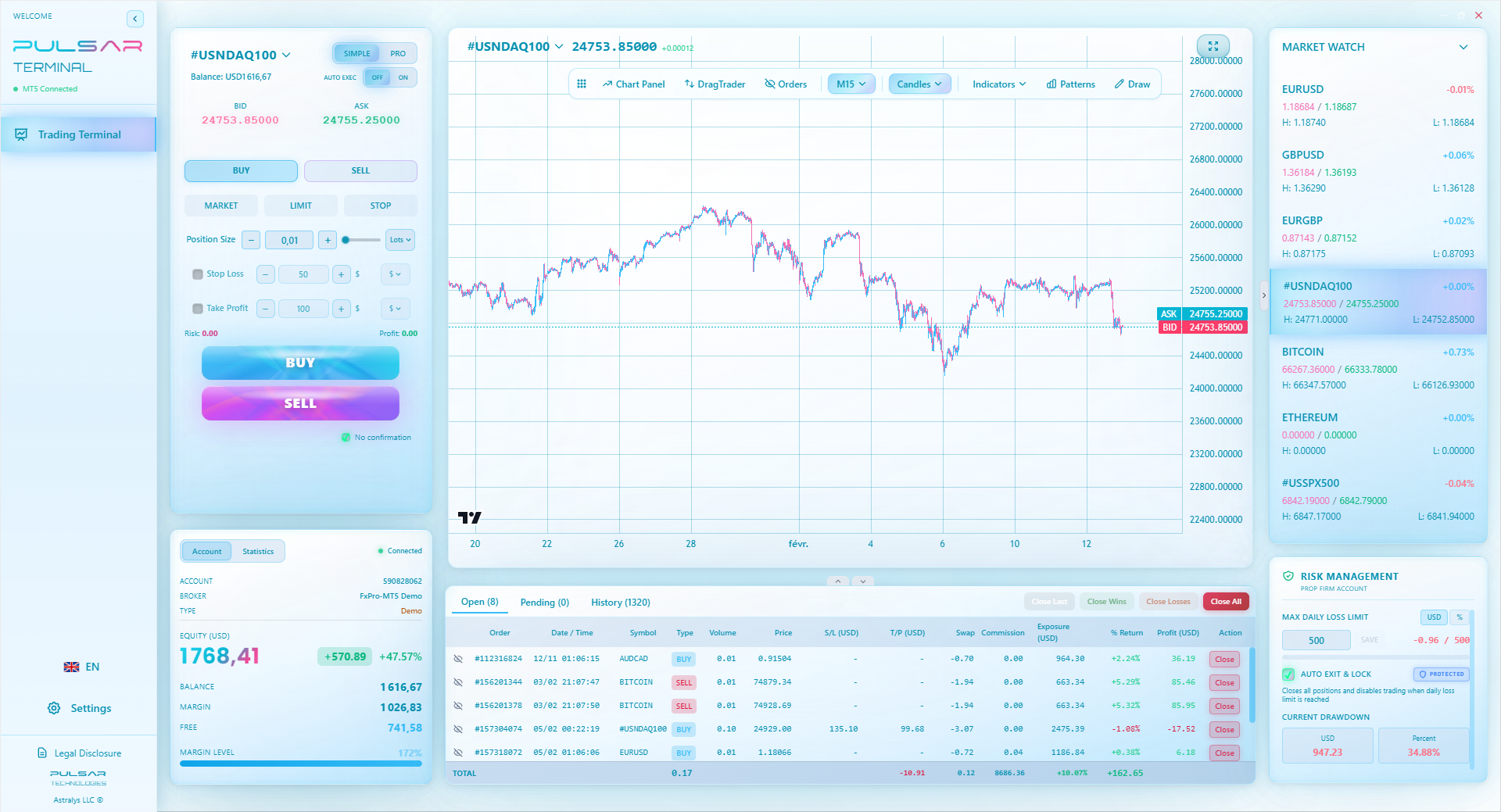
Once you have a defined strategy, executing it without emotional interference is key; tools like Pulsar Terminal let you set multi-level take-profits and stop-losses on MT5 before you even enter the trade, automating your book-learned rules.
Pulsar Terminal
Das All-in-One MT5-Tool: Drag-and-Drop-Orders, Multi-TP/SL, Trailing Stop, Grid Trading, Volume Profile und Prop-Firm-Schutz. Täglich von 1.000+ Tradern genutzt.
I've made these mistakes so you don't have to.
Pitfall 1: Overcomplicating the Chart. You read Murphy and load up your chart with 10 indicators. It looks like a spaceship dashboard. You get conflicting signals and freeze. Solution: Start with a clean chart. Price action, volume, and maybe one or two indicators max. Clarity beats complexity.
Pitfall 2: Changing Strategies Every Week. You have a losing week, so you abandon your plan for a new 'better' one from a forum. This is a guaranteed path to ruin. Solution: Commit to your tested strategy for a minimum of 50 live trades before you even think about tweaking it. Markets have random losing periods; you need to know if it's you or the strategy.
Pitfall 3: Ignoring Position Sizing. You risk R500 on one trade because you're 'sure.' That's 10% of a R5,000 account. One string of losses and you're facing a 50% drawdown. Solution: Use a position size calculator for EVERY trade. Never deviate. A 1-2% risk per trade isn't a suggestion; it's the law.
Pitfall 4: Not Planning for the Worst. What happens if your trade goes badly? A beginner holds on, hoping it comes back, turning a small loss into a margin call. Solution: Before you enter, know your exact exit point for a loss. Place the stop-loss order immediately. No exceptions. Your survival depends on this.
Remember, the goal of your first year isn't a Lamborghini. It's survival. It's learning to lose small and consistently. The books give you the map, but you have to walk the rocky path yourself, especially when the rand is throwing stones.
FAQ
Q1I'm a complete beginner in South Africa. Which single forex book should I read first?
Start with 'Trading in the Zone' by Mark Douglas. It has almost no charts. It's all about the mental game and understanding probability. Getting your head right is more important than learning a single pattern. If you don't master the psychology, all the technical knowledge in the world won't save you from yourself.
Q2Are the trading strategies in US/UK books applicable to South African Rand pairs?
The core principles are, but the parameters often aren't. A strategy designed for the low-volatility EUR/USD will fail on USD/ZAR if you use the same stop-loss distances. The spread alone on ZAR pairs can be 10 times wider. You must adapt any strategy from a book by testing it with the higher volatility and wider spreads of our local market on a demo account first.
Q3How much money do I realistically need to start trading forex in South Africa?
Realistically, you should start with money you are prepared to lose completely while learning. For a live account, R2,000-R5,000 is a common starting point. This lets you trade micro lots (1,000 units) and practice proper risk management of 1-2% per trade. Remember, with FSCA use capped at 30:1, you need more margin per trade than books talking about 500:1 might imply.
Q4Do I need to pay tax on my forex trading profits in South Africa?
Yes. Absolutely. SARS considers forex trading profits as taxable income under Capital Gains Tax (CGT). You are legally required to declare your net profit (total profits minus total losses) in your annual tax return. Keep detailed records of every single trade from day one.
Q5What's more important for a beginner: books or a demo account?
They are useless without each other. The books provide the theory and framework. The demo account is the lab where you test that theory without risk. You must do both simultaneously. Reading without practicing is just entertainment. Practicing without foundational knowledge is gambling.
Q6Why do I keep blowing up my demo account even after reading books?
This is normal and the whole point of a demo. You're likely breaking the rules you read about: over-leveraging, not using stop losses, trading out of boredom. This is the perfect, cost-free time to make those mistakes. Analyze your demo trades. Your losing patterns will show you exactly which psychological lessons from 'Trading in the Zone' you haven't internalized yet.
Prof. Winstons Lektion
Wichtige Erkenntnisse:
- ✓Mindset before charts. Read psychology first.
- ✓Test every strategy on ZAR's volatile spreads.
- ✓Journal every trade to find your real weakness.
- ✓Start live with capital you can afford to lose 100%.
Wie nützlich war dieser Artikel?
Klicken Sie auf einen Stern
Wöchentliche Trading-Einblicke
Kostenlose wöchentliche Analysen & Strategien. Kein Spam.
Über den Autor
David van der Merwe
Schwellenland-Trader
In Johannesburg ansässiger Trader mit 11 Jahren Erfahrung in Schwellenländerwährungen. Spezialisiert auf ZAR-Paare, FSCA-regulierten Handel und Analyse des südafrikanischen Marktes.
Kommentare
Risikohinweis
Der Handel mit Finanzinstrumenten birgt erhebliche Risiken und ist möglicherweise nicht für alle Anleger geeignet. Vergangene Ergebnisse garantieren keine zukünftigen Renditen. Dieser Inhalt dient ausschließlich Bildungszwecken und stellt keine Anlageberatung dar. Führen Sie immer Ihre eigene Recherche durch, bevor Sie handeln.
Das könnte Sie auch interessieren

Cara Trading Forex Sukses: 7 Prinsip dari Trader Profesional
Cara trading forex sukses dengan 7 prinsip trader pro: manajemen modal, disiplin, journal trading, backtest. Data nyata, bukan janji profit palsu.
Jam Trading Forex Terbaik untuk Trader Indonesia: Panduan Lengkap dengan Tabel Waktu
Panduan jam trading forex untuk trader Indonesia. Tabel 4 sesi dunia, jam emas 20:00-00:00, sesi mana yang harus dihindari. Data akurat + tips dari trader berpengalaman.
Top 5 Sàn Forex Uy Tín Nhất 2026: Review Jujur dari Trader Indonesia
Top 5 sàn forex uy tín 2026 untuk trader Indonesia. Review jujur: spread, deposit, withdraw, dukungan lokal. Exness, XM, IC Markets & lebih.
Pulsar Terminal herunterladen
Alle diese Rechner sind in Pulsar Terminal mit Echtzeit-Daten Ihres MT5-Kontos integriert.
Pulsar Terminal herunterladen