


Let's be blunt: most Nigerian traders think a forex broker license is just a fancy logo on a website.

Olumide Adeyemi
Pionier des Tradings in Westafrika ·  Nigeria
☕ 10 Min. Lesezeit
Was Sie lernen werden:
- 1What a Forex Broker License Actually Is (And Isn't)
- 2The Nigerian Scene: SEC vs. CBN and Why It's Murky
- 3The Gold Standard Licenses You Should Look For
- 4How to Actually Verify a License (Step-by-Step)
- 5The Murky World of Offshore Licenses
- 6Red Flags: When a "License" is a Lie
- 7Putting It All Together: Making Your Choice
Let's be blunt: most Nigerian traders think a forex broker license is just a fancy logo on a website. They're wrong, and that mistake costs people millions of Naira every year. I've seen friends lose deposits to slick operations that looked legit but were basically digital pickpockets. A license isn't a guarantee of safety, but trading without checking for one is like driving in Lagos without checking your brakes. In this guide, I'll show you exactly what a real license means, how to spot the fakes, and why the most important regulator for you might not be in Nigeria at all.
Think of a broker's license as their permission slip from a government authority to hold your money. It's not a quality stamp or a profit guarantee. It's a set of rules they have to follow, with someone watching.
A licensed broker has to keep client funds in segregated bank accounts. This means your Naira deposit is legally separate from the company's operating money. If the broker goes bankrupt, your capital should be safe and returned. An unlicensed broker can mix everything together, and when things go south, your money vanishes. I learned this the hard way early on. I deposited $500 with an offshore broker offering insane use. They had a "registration" certificate from some island I'd never heard of. When I tried to withdraw my profits, they froze my account. That "certificate" was worthless. Poof. Money gone.
A license also forces brokers to maintain a certain level of capital, report their transactions, and submit to audits. It creates a paper trail and accountability. Without it, they're operating in the shadows.

Warning: A license does NOT protect you from your own bad trades. You can still blow your account with a perfectly regulated broker. It also doesn't guarantee the best spreads or execution speeds. Some of the tightest spreads come from brokers regulated in jurisdictions with lighter touch rules. It's a trade-off between cost and security that you need to understand.
The core function is client protection. It's the difference between having a legal claim and just shouting into the void on social media when something goes wrong.

💡 Winstons Tipp
A license is a necessary condition for safety, but not a sufficient one. Your own discipline in risk management is the final, and most important, layer of protection.
This is where it gets confusing for local traders. In Nigeria, two big bodies seem relevant: the Securities and Exchange Commission (SEC) and the Central Bank of Nigeria (CBN).
The Securities and Exchange Commission (SEC) is the primary capital markets regulator. In 2022, they made a big move by requiring all foreign exchange trading platforms (CFDs, forex brokers) operating in Nigeria to register with them. The idea was to bring order to a wild market. In theory, this means a broker like Exness or XM should get SEC approval to market to Nigerians.
The Central Bank of Nigeria (CBN) has historically been the watchdog for banks and official forex transactions. They've been famously hostile to retail forex trading, seeing it as a pressure point on the Naira. They haven't been in the business of licensing international CFD brokers.
Here's the messy reality I've observed. Many international brokers simply don't have an SEC Nigeria license. They operate from their home country regulation (like CySEC in Cyprus or ASIC in Australia) and accept Nigerian clients. Your relationship is with their overseas entity. The SEC rule is tough to enforce across borders. So, you'll see brokers loudly promoting their FCA or ASIC license, but silence on SEC Nigeria.
What This Means For You
Don't spend your energy hunting for a broker's SEC Nigeria certificate. It's rare. Instead, your focus must be on their primary international license. That's the one that will determine how your complaint is handled if your deposit disappears. The Nigerian rule is evolving, but for now, the real muscle is in those foreign financial authorities.
Your protection as a Nigerian trader often lies thousands of miles away. That's just the current state of the landscape.
“Your protection as a Nigerian trader often lies thousands of miles away, in the offices of a foreign regulator.”
Not all regulators are created equal. Some are rigorous, others are known for being lax. If a broker holds one of these top-tier licenses, it's a very strong positive signal.
| Regulator | Country/Jurisdiction | Why It's Strong | Key Protection |
|---|---|---|---|
| FCA (Financial Conduct Authority) | United Kingdom | Extremely strict rules, high capital requirements. | Up to £85,000 compensation via FSCS if broker fails. |
| ASIC (Australian Securities & Investments Commission) | Australia | strong framework, mandates professional indemnity insurance. | Strong dispute resolution, segregated accounts enforced. |
| CySEC (Cyprus Securities and Exchange Commission) | Cyprus (EU) | Common EU standard, provides passporting across Europe. | Investor Compensation Fund (up to €20,000). |
| MAS (Monetary Authority of Singapore) | Singapore | Highly reputable, stringent application process. | Strong enforcement and client money rules. |
Brokers like IC Markets (regulated by ASIC and CySEC) or Pepperstone (FCA, ASIC) operate under these frameworks. When you open an account, you must choose which entity to open with. Always choose the entity under the strongest regulator they offer, even if it means slightly higher minimum deposits.

Pro Tip: If a broker's website says "regulated" but doesn't clearly state the regulator and license number on their homepage or 'About Us' page, be suspicious. A real licensed broker is proud of it and makes it easy to find.
There are other decent regulators (like the FSCA in South Africa or the FSA in Japan), but the four above are the heavyweights you'll encounter most. A broker holding one of these isn't a saint, but they have a lot more to lose by cheating you.
Seeing a license number on a website isn't enough. You must cross-check it. Here's my routine, every single time before I fund a new account.
- Get the Details: Find the broker's regulated company name and license/registration number on their website. It's usually at the very bottom of the homepage.
- Go to the Source: Open a new browser tab and search for the official register of the claimed regulator (e.g., "FCA register," "ASIC connect professional register").
- Search the Register: Enter the company name or license number into the official database.
- Scrutinize the Match: The entry must match exactly. Check:
- Is the company name identical?
- Is the listed address correct?
- Does the license permit the activities they're offering (e.g., CFD trading)?
- Is the license status "Authorised" or "Active," not "Appointed Representative" or "Pending"?
Let me give you a real example. When I checked Exness, I looked up their CySEC license. I went to the CySEC website, searched for "Exness," and found their entity "Exness (EU) Ltd" with status "Authorised." It showed their permitted activities and confirmed they were legit under that regulator.
This process takes five minutes. Skipping it is pure negligence with your money. If anything doesn't line up, walk away. There are plenty of fish in the sea.

Example: A broker claims FCA regulation #123456. You search the FCA register. It shows the license belongs to "ABC Investments Ltd" which only has permission for insurance mediation, not derivative trading. That's a massive red flag. They're implying a legitimacy they don't have.
💡 Winstons Tipp
The most expensive lesson is learning that a regulator's 'Investor Compensation Fund' has a maximum limit. Never keep all your capital with one broker, no matter how reputable.
“An SVG license is basically a business registration, not a guarantee of safety.”
Now let's talk about the dark side. To offer crazy use like 1:1000 or bonuses that seem too good to be true, many brokers get licensed in offshore jurisdictions.
Places like Saint Vincent and the Grenadines (SVG), Mauritius, the British Virgin Islands (BVI), or the Cayman Islands. These are often called "light-touch" regulators.
Here's the truth: an SVG license is basically a business registration. There's little to no oversight, no mandatory compensation schemes, and minimal capital requirements. The broker sets up a company there because it's easy and cheap.
I'm not saying every broker with an offshore license is a scam. Some reputable international brokers have offshore entities for clients in regions where their main license doesn't cover. But the risk profile is completely different.
If you choose to trade with a broker only regulated offshore, you must accept two things:
- You are unprotected. If they decide not to process your withdrawal, your legal recourse is weak and expensive.
- You are trading on their terms. Their "bonus" likely has impossible withdrawal conditions. Their high use will make a margin call happen faster.
I used an SVG-regulated broker once for a specific scalping strategy that needed ultra-low latency. I made 22% in a week. Then the requotes started on every winning trade, and the slippage became ridiculous. I got my initial deposit out and left the "profits." It was a calculated risk that I knew I was taking. Never put all your capital in an offshore entity. Consider it the high-risk, high-reward (and high-drama) segment of your trading.
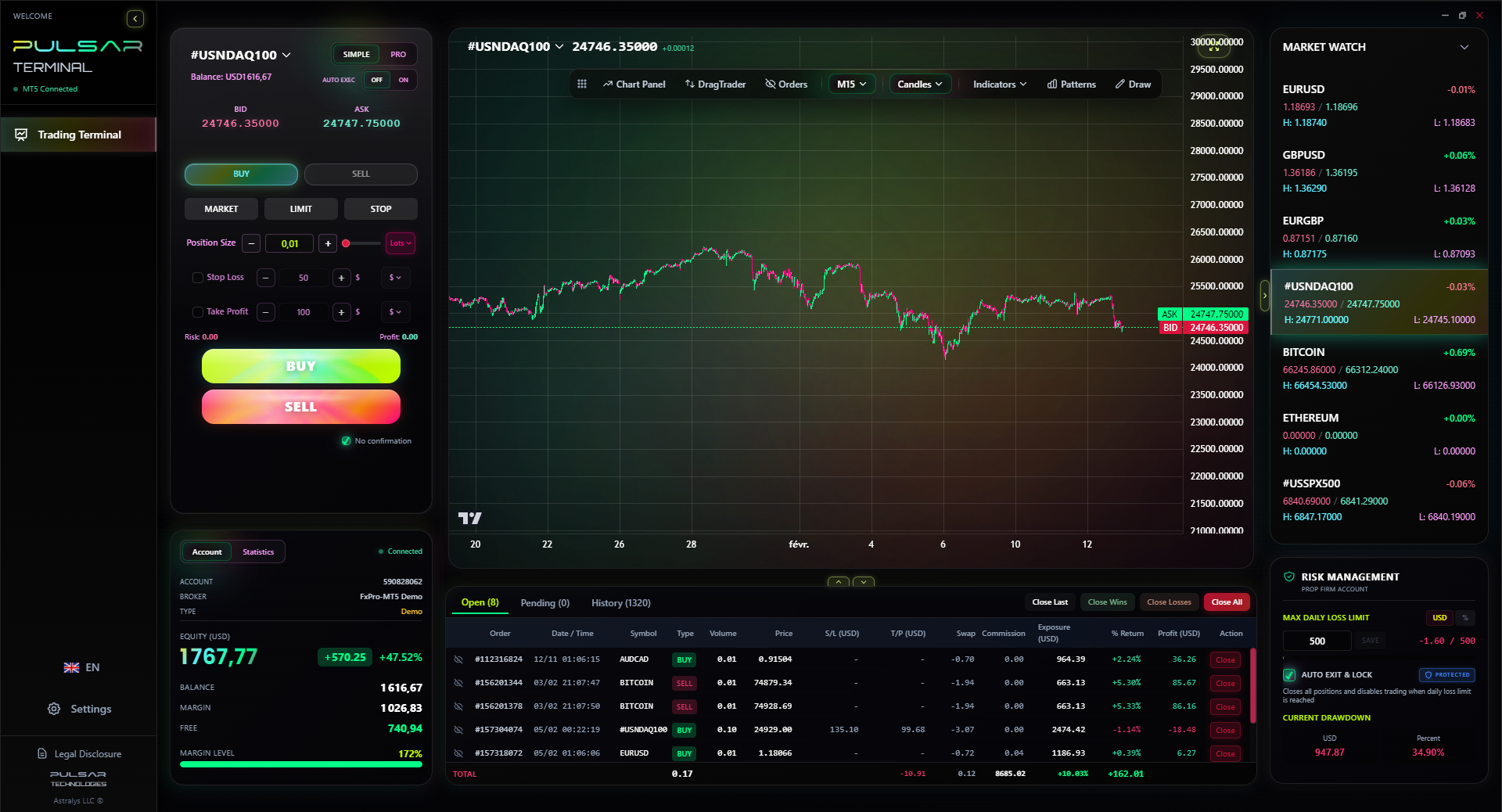
When trading with higher-risk, offshore brokers, precise order management and instant risk controls are non-negotiable, which is where tools like Pulsar Terminal for MT5 give you an edge.
Pulsar Terminal
Das All-in-One MT5-Tool: Drag-and-Drop-Orders, Multi-TP/SL, Trailing Stop, Grid Trading, Volume Profile und Prop-Firm-Schutz. Täglich von 1.000+ Tradern genutzt.
Scammers are clever. They fake licenses. Here’s how to spot the cons.
- The Vague Claim: "Regulated in the EU" or "Licensed internationally." Real brokers state the exact authority and number.
- The Fake Regulator: They invent names like "International Financial Commission (IFC)" or "World Forex Regulation Bureau." Cross-check any regulator name you don't recognize. If it's not on a sovereign government's website, it's fake.
- The Clone Firm: They use a name or license number very similar to a real, reputable broker. You might see "iCMarkets" instead of "IC Markets." Always use the official register link from the regulator's own .gov website, not a link the broker provides.
- Pressure to Deposit: You get unsolicited calls or WhatsApp messages from "account managers" pushing you to deposit quickly before a "bonus offer expires." Licensed brokers don't operate like this.
- Withdrawal Problems: The first sign of a scam is often when you try to take money out. Excuses about fees, taxes, or needing to trade more volume appear. With a properly licensed broker, withdrawals are routine.
If you see one red flag, be cautious. If you see two, run. There are too many honest brokers out there to waste time on a questionable one. Your first job as a trader is capital preservation, and that starts with who holds your capital.
“Your first job as a trader is capital preservation, and that starts with who holds your capital.”
So, how do you choose? Here's my personal hierarchy for a Nigerian trader, especially when starting.
- Priority 1: Global Broker with Top-Tier License. This is the safest path. Open an account with the FCA, ASIC, or CySEC entity of a major international broker. You get strong protection, even if the sign-up process is more thorough (they'll ask for proof of address, ID). Use this for your main, serious capital.
- Priority 2: Broker with a Solid Secondary License. Maybe a well-known broker with solid reputation but regulated by a respected mid-tier regulator (like FSCA in SA). Do extra due diligence on user reviews, specifically about withdrawal experiences.
- High-Risk Segment: Offshore for Specific Needs. Only if you have a strategy that demands conditions only they offer (e.g., certain crypto pairs, micro lots on exotic instruments). Never deposit more than you are 100% willing to lose. Treat it like casino money.
Your broker is your business partner. You wouldn't go into business with someone without checking their background. Don't do it with your trading.
Finally, remember that regulation changes. A broker's license can be suspended. Make verifying your broker's status a quarterly habit, just like reviewing your trades. It's boring admin work, but it protects everything you're working for.
Pro Tip: Once you've chosen a broker, start small. Deposit the minimum, make a few trades, and then request a small withdrawal. This "withdrawal test" is the ultimate check on their operations. If they process a $50 withdrawal smoothly, it's a good sign. If they create obstacles, you've just saved the rest of your capital.
💡 Winstons Tipp
If you wouldn't hand the CEO of the brokerage firm N500,000 in cash on a street corner, don't deposit it into an account with only an offshore license. The principle is the same.
FAQ
Q1Is a CBN license required for forex brokers in Nigeria?
No. The CBN licenses banks and oversees the official forex market, not international retail CFD/Forex brokers. The more relevant local body is the SEC Nigeria, but most international brokers operate under their home country's license (like FCA or CySEC) when serving Nigerian clients.
Q2What is the best forex broker license for Nigerian traders?
The strongest protections come from top-tier international regulators: the UK's FCA, Australia's ASIC, or Cyprus's CySEC (for EU coverage). Always choose to open an account under a broker's entity that holds one of these licenses, even if it requires a slightly higher minimum deposit.
Q3How can I check if a forex broker is truly regulated?
Never trust the broker's website alone. Take the license number and regulated company name they provide, and look it up on the official public register of the claimed regulator (e.g., the FCA's Financial Services Register). Verify that the name, address, and permitted activities match exactly.
Q4Are brokers with offshore licenses (like SVG) safe?
They carry significantly higher risk. Jurisdictions like Saint Vincent and the Grenadines (SVG) provide minimal oversight and no investor compensation schemes. While not all are scams, you have little recourse if problems arise. Only use them with capital you can afford to lose and for very specific trading needs.
Q5What should I do if my regulated broker refuses my withdrawal?
First, contact their support formally. If unresolved, file a formal complaint with their compliance department. If still no result, escalate to their regulator (e.g., the FCA). Having a top-tier license gives you this escalation path. With an offshore broker, you have virtually no recourse.
Q6Does a broker's license affect trading conditions like spreads?
Often, yes. Brokers under strict regulators like the FCA have lower use limits (like 1:30 for retail), which can affect your position size calculator results. They may also have slightly wider spreads than unregulated counterparts, as compliance costs money. It's the trade-off for security.
Prof. Winstons Lektion
Wichtige Erkenntnisse:
- ✓Always verify licenses on the official regulator's website.
- ✓Prioritize FCA, ASIC, or CySEC regulation for your main account.
- ✓Treat offshore-licensed brokers as high-risk ventures.
- ✓Perform a small withdrawal test before committing large capital.
Wie nützlich war dieser Artikel?
Klicken Sie auf einen Stern
Wöchentliche Trading-Einblicke
Kostenlose wöchentliche Analysen & Strategien. Kein Spam.
Über den Autor
Olumide Adeyemi
Pionier des Tradings in Westafrika
Einer der aktivsten Forex-Trading-Ausbilder Nigerias. 8 Jahre Trading-Erfahrung aus Lagos. Spezialisiert auf Strategien mit geringem Kapital und Prop-Firm-Challenges für afrikanische Trader.
Kommentare
Risikohinweis
Der Handel mit Finanzinstrumenten birgt erhebliche Risiken und ist möglicherweise nicht für alle Anleger geeignet. Vergangene Ergebnisse garantieren keine zukünftigen Renditen. Dieser Inhalt dient ausschließlich Bildungszwecken und stellt keine Anlageberatung dar. Führen Sie immer Ihre eigene Recherche durch, bevor Sie handeln.
Das könnte Sie auch interessieren

Cara Trading Forex Sukses: 7 Prinsip dari Trader Profesional
Cara trading forex sukses dengan 7 prinsip trader pro: manajemen modal, disiplin, journal trading, backtest. Data nyata, bukan janji profit palsu.
Jam Trading Forex Terbaik untuk Trader Indonesia: Panduan Lengkap dengan Tabel Waktu
Panduan jam trading forex untuk trader Indonesia. Tabel 4 sesi dunia, jam emas 20:00-00:00, sesi mana yang harus dihindari. Data akurat + tips dari trader berpengalaman.
Top 5 Sàn Forex Uy Tín Nhất 2026: Review Jujur dari Trader Indonesia
Top 5 sàn forex uy tín 2026 untuk trader Indonesia. Review jujur: spread, deposit, withdraw, dukungan lokal. Exness, XM, IC Markets & lebih.
Pulsar Terminal herunterladen
Alle diese Rechner sind in Pulsar Terminal mit Echtzeit-Daten Ihres MT5-Kontos integriert.
Pulsar Terminal herunterladen