


I lost R4,200 in under an hour trading a 'Volatility 100' index.

David van der Merwe
Schwellenland-Trader ·  South Africa
☕ 9 Min. Lesezeit
Was Sie lernen werden:
- 1What Are You Actually Trading? VIX vs. Synthetic Indices
- 2FSCA Regulation: Your Safety Net (And Its Limits)
- 3Brokers Offering the Real VIX (FSCA-Regulated)
- 4The Synthetic Index Scene: Derib, and Others
- 5Costs, Fees, and Getting Your Rands In and Out
- 6How to Trade Volatility Indices (The Safe Way)
- 7My Final Verdict and Recommendation

I lost R4,200 in under an hour trading a 'Volatility 100' index. The screen froze, the price spiked wildly against me, and my stop-loss was ignored. I thought I was trading a simple index, but I was actually in a synthetic product on an offshore broker's platform. That painful lesson taught me that finding forex brokers with volatility index offerings isn't just about who has it, but what you're actually trading and who's watching over it. For South African traders, the distinction between a regulated CFD on the real VIX and an unregulated synthetic game is the difference between trading and gambling.
This is the most important part, so listen up. When you see 'volatility index' on a broker's list, you're likely looking at one of two completely different beasts.
The first is the real deal: a Contract for Difference (CFD) on the CBOE Volatility Index, or VIX. It's often called the 'fear gauge' of the US stock market. It tracks the expected volatility of the S&P 500 over the next 30 days. When traders get nervous, the VIX goes up. It's a real, traded index with massive liquidity. Trading a CFD on it means you're speculating on the price movement of that established index.
The second type is a synthetic volatility index. These are proprietary products created by brokers themselves, like the infamous 'Volatility 75 Index' or 'Volatility 100 Index'. They aren't traded on any real exchange. Instead, they're generated by an algorithm that simulates market volatility, often with insane use and around-the-clock trading. I got burned on one of these. The spreads can be enormous (think 50-100 pips), and during news events, the pricing can become... questionable. The liquidity isn't real market liquidity; it's just the broker's model.

Warning: Synthetic indices are not regulated by the FSCA in South Africa, even if the broker has an FSCA license for other products. You are trading against the broker's algorithm, not a real market. This changes the entire risk profile.

💡 Winstons Tipp
A synthetic index's 24/7 market isn't a feature, it's a trap. Real markets close, giving you time to think. Constant action just burns capital.
The Financial Sector Conduct Authority (FSCA) is our local watchdog. If a broker is FSCA-licensed (you can check their FSP number on the FSCA website), it means they have to follow certain rules for client fund segregation, reporting, and fair treatment. This is non-negotiable for your main trading account in my book.
However, here's the critical nuance most miss. An FSCA-regulated broker like IG or HFM can offer CFDs on the real VIX under that license. But when that same broker, or more commonly a separate international entity like Deriv, offers synthetic volatility indices, that specific product line usually falls under a different license from Mauritius or Vanuatu. Your trade is not protected by South African regulations.
This means if you have a dispute about a slippage or stop-loss on a synthetic Volatility 75 trade, you can't go crying to the FSCA. Your recourse is with the foreign regulator, which is a much longer and more difficult process. I learned this the hard way after my R4,200 loss; my complaints went into a black hole with the international entity. Always, always check which entity of the broker is offering the product and under which license. For core trading, stick to the FSCA-regulated side of the house. For a deeper look at a popular broker's structure, our Exness review breaks down their different entities clearly.

“The distinction between a regulated CFD on the real VIX and an unregulated synthetic game is the difference between trading and gambling.”
These are brokers where you can trade CFDs on the actual CBOE VIX with the comfort of FSCA oversight. You'll find it listed usually under 'Indices' as 'US Volatility Index' or 'VIX'.
| Broker | FSCA License (FSP No.) | Minimum Deposit (Approx.) | Key Point on VIX/Indices |
|---|---|---|---|
| IG Markets SA | 41393 | ~ZAR 300 (card) | One of the most established. Direct access to VIX CFDs on their strong platform. |
| HFM | 46632 | $5 (or ZAR equivalent) | Offers VIX, often with competitive spreads on their premium accounts. |
| XM | 49976 | $5 | VIX is available on MT4/MT5. Good for smaller accounts wanting access. |
| Exness | 51024 | $1 | Offers VIX CFDs. Known for very low minimums and flexible accounts. |
My experience? I use IG for my VIX trades. The spreads are reasonable for an index (often 0.3-0.5 points during active US hours), and the execution is reliable. I once caught a fear spike during a banking scare, buying a VIX CFD at 18.75 and selling at 24.20. The profit was clean, and the settlement was straightforward. That's the difference with a regulated, real asset. Remember, these are still CFDs and are leveraged, so your risk is magnified. Never forget to use a position size calculator before entering.
A Note on Platforms
All these brokers offer MetaTrader 4 or 5. For trading the VIX, I strongly prefer MT5. It handles indices better, and the depth of market feature (when available) can give you a better feel for order flow. If you're doing any kind of swing trading on volatility, the charting tools on MT5 are superior.
This is where the 'Volatility 75/100' lives. The biggest name here is Deriv (formerly Binary.com). They are not FSCA-regulated for these synthetic products. They operate under licenses from Mauritius and Vanuatu.
Why do people use them? Two reasons: accessibility and the promise of constant action. The minimum deposit can be as low as $5. The markets are open 24/7, even on weekends. The charts look familiar, and it feels like trading.
Let me be brutally honest about my experience. It feels like trading, but it isn't, not in the traditional sense. The spreads are built into the model. I've seen the Volatility 100 index have a typical spread of 80 pips. That means it has to move 80 pips just for you to break even on a round trip. That's horrific. My failed trade happened because a simulated 'news event' in the algorithm caused a 300-pip spike in seconds, blowing straight through my stop.

Pro Tip: If you must explore synthetic indices, treat it like casino money. Use the smallest possible position size. Assume any money you deposit is already lost. Do not, under any circumstances, use strategies or money management you'd apply to real forex pairs like EUR/USD. The rules of the game are different.
💡 Winstons Tipp
If you can't explain the underlying asset of your 'volatility index' in one sentence, you shouldn't be trading it. Complexity is often a mask for risk.
“My failed trade happened because a simulated 'news event' in the algorithm caused a 300-pip spike in seconds, blowing straight through my stop.”
For trading the real VIX with an FSCA broker, the costs are standard for CFDs.
- Spreads: On the VIX itself, expect variable spreads. During calm market hours (Asian session), it might be 0.2-0.4 points. When US markets open or during stress, it can widen to 1 point or more. Compare this to the 50+ pip spread on a synthetic index – it's night and day.
- Commissions: If you're on an ECN/Pro account, you'll pay a commission per lot. On a standard account, the cost is built into a wider spread. For example, a broker might charge $5 per standard lot per side for index CFDs.
- Swap Fees: Holding a VIX CFD overnight incurs a swap fee. It can be negative or positive, but it's usually not a long-term hold asset. It's more for short-term scalping or swing plays.
For South Africans, funding is easy. All the FSCA-regulated brokers accept:
- Local EFT (FNB, Standard Bank, Absa, etc.). Usually takes 1-2 business days.
- Instant EFT via Ozow or PayFast (my preferred method – it's in within minutes).
- Credit/debit cards.
- E-wallets like Skrill. Some brokers, like IC Markets, have very smooth local payment integrations. Withdrawals back to your bank account are generally processed within a day or two. This local convenience is a huge plus for sticking with FSCA-regulated brokers.
If you're trading the real VIX, you need a specific mindset. It's not a buy-and-hold asset. It's a tactical tool.
- Understand What Moves It: The VIX rises when the S&P 500 falls sharply, and vice-versa. It's about fear and uncertainty. Watch for key US economic data, Fed announcements, and geopolitical events. I use the RSI indicator and MACD indicator on the VIX chart itself to look for overbought or oversold conditions within a trend.
- Position Size Tiny: Volatility can explode. I never risk more than 0.5% of my account on a single VIX trade. That R4,200 loss was 2% – a mistake that hurt.
- Use Wide Stops: Because it's volatile, tight stops will get taken out by noise. Give your trade room to breathe, but that means your position size must be smaller to compensate for the wider stop in rand terms.
- Have a Clear Exit: It's a momentum play. I'm usually in and out within a few hours to a couple of days. If the fear spike happens and you're in profit, take it. Don't get greedy waiting for it to double.
- Hedge, Don't Speculate: Some experienced traders use long VIX positions as a hedge against a portfolio of US stock CFDs. If their stocks fall, the VIX rise offsets some losses. This is an advanced use.
Remember, a margin call comes quickly if you're over-leveraged on a fast-moving index. The safety of an FSCA broker won't save you from your own poor risk management.

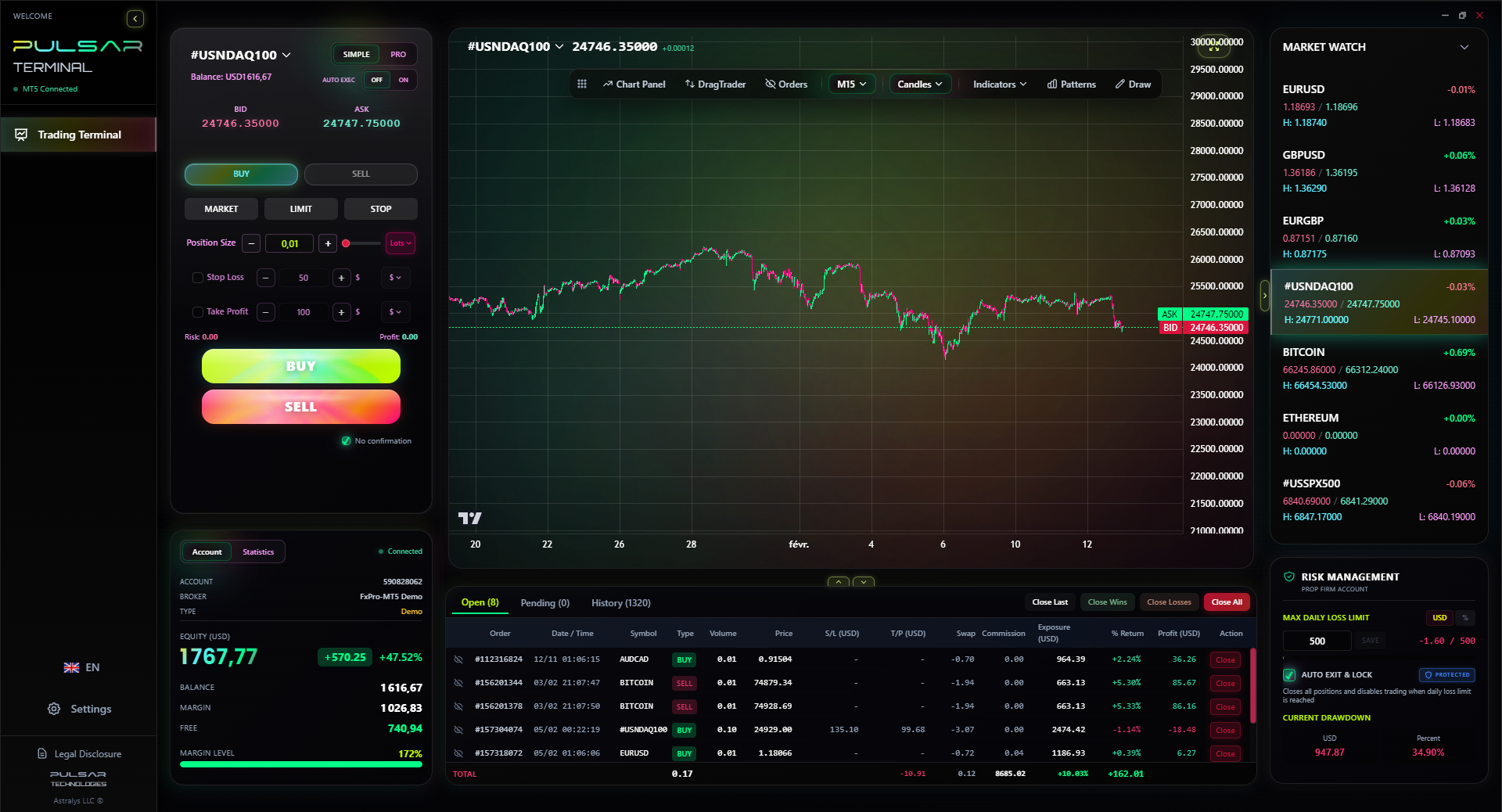
Managing fast-moving VIX trades requires precision; Pulsar Terminal's drag-and-drop orders and multi-TP/SL tools on MT5 let you enter and adjust exits in a flash when volatility spikes.
Pulsar Terminal
Das All-in-One MT5-Tool: Drag-and-Drop-Orders, Multi-TP/SL, Trailing Stop, Grid Trading, Volume Profile und Prop-Firm-Schutz. Täglich von 1.000+ Tradern genutzt.
“Avoid synthetic volatility indices as a serious trading instrument. If you dabble, use money you can afford to lose.”
After 12 years and that expensive synthetic index lesson, here's my straightforward advice for South African traders.
If you want exposure to market volatility, use an FSCA-regulated broker and trade the CFD on the real CBOE VIX. Start with a broker like IG or HFM where the regulatory framework is clear. Fund your account with local EFT, keep your position sizes ridiculously small, and trade it as a short-term tactical instrument. The spread definition and costs are transparent.
Avoid synthetic volatility indices as a serious trading instrument. If you want to dabble for fun with money you can afford to lose, that's a personal choice, but understand you are not 'trading the markets' in any conventional sense. You are participating in a broker-generated simulation.
Your priority should always be the security of your capital. That starts with a regulated broker, solid risk management, and trading instruments that have a real-world anchor. The allure of 24/7 synthetic trading is a siren song that has wrecked many accounts, mine included. Stick to the real world, where the rules are clearer and your protections are stronger.
FAQ
Q1Can I legally trade volatility indices in South Africa?
Yes, it's legal. You can trade CFDs on the real VIX through FSCA-regulated brokers. You can also access synthetic indices from international brokers, but those specific products are not regulated or protected by the FSCA.
Q2Which South African broker has the lowest spread on the VIX?
Spreads vary by market conditions and account type. FSCA-regulated brokers like IG, HFM, and Exness typically offer competitive spreads on VIX CFDs, often between 0.2 and 0.8 points during active hours. You need to check their live accounts. Synthetic indices have vastly wider, fixed spreads (e.g., 50-100 pips).
Q3Is the Volatility 75 Index the same as the VIX?
No, they are completely different. The VIX is a real, traded index measuring S&P 500 volatility. The Volatility 75 Index is a synthetic product created by a broker, algorithmically simulating volatility. It is not traded on any exchange and is not regulated by the FSCA.
Q4What is the minimum deposit to trade VIX in South Africa?
With FSCA brokers, it can be very low. XM and HFM start around $5, Exness at $1, and IG at roughly ZAR 300. This gets you access to CFDs on the real VIX. Minimums for synthetic index platforms are also low, often $5-$10.
Q5Do I pay tax on profits from trading volatility indices in South Africa?
Yes. The South African Revenue Service (SARS) views profits from CFD trading (including on the VIX) as capital gains. These must be declared in your annual tax return. It's your responsibility to keep accurate records of all trades and profits/losses.
Q6Can I use a prop firm to trade volatility indices?
Most proprietary trading firms that accept South African traders focus on forex and major indices. They often restrict or prohibit trading of volatility indices (especially synthetics) due to their extreme risk. Always check a prop firm's allowed instruments list first.
Prof. Winstons Lektion
Wichtige Erkenntnisse:
- ✓Real VIX CFDs are FSCA-regulated; synthetics are not.
- ✓Synthetic index spreads can be 80+ pips vs. 0.2 on VIX.
- ✓Use a position size calculator for every VIX trade.
- ✓Local EFT funding is a sign of a legit SA broker.
Wie nützlich war dieser Artikel?
Klicken Sie auf einen Stern
Wöchentliche Trading-Einblicke
Kostenlose wöchentliche Analysen & Strategien. Kein Spam.
Über den Autor
David van der Merwe
Schwellenland-Trader
In Johannesburg ansässiger Trader mit 11 Jahren Erfahrung in Schwellenländerwährungen. Spezialisiert auf ZAR-Paare, FSCA-regulierten Handel und Analyse des südafrikanischen Marktes.
Kommentare
Risikohinweis
Der Handel mit Finanzinstrumenten birgt erhebliche Risiken und ist möglicherweise nicht für alle Anleger geeignet. Vergangene Ergebnisse garantieren keine zukünftigen Renditen. Dieser Inhalt dient ausschließlich Bildungszwecken und stellt keine Anlageberatung dar. Führen Sie immer Ihre eigene Recherche durch, bevor Sie handeln.
Das könnte Sie auch interessieren

Cara Trading Forex Sukses: 7 Prinsip dari Trader Profesional
Cara trading forex sukses dengan 7 prinsip trader pro: manajemen modal, disiplin, journal trading, backtest. Data nyata, bukan janji profit palsu.
Jam Trading Forex Terbaik untuk Trader Indonesia: Panduan Lengkap dengan Tabel Waktu
Panduan jam trading forex untuk trader Indonesia. Tabel 4 sesi dunia, jam emas 20:00-00:00, sesi mana yang harus dihindari. Data akurat + tips dari trader berpengalaman.
Top 5 Sàn Forex Uy Tín Nhất 2026: Review Jujur dari Trader Indonesia
Top 5 sàn forex uy tín 2026 untuk trader Indonesia. Review jujur: spread, deposit, withdraw, dukungan lokal. Exness, XM, IC Markets & lebih.
Pulsar Terminal herunterladen
Alle diese Rechner sind in Pulsar Terminal mit Echtzeit-Daten Ihres MT5-Kontos integriert.
Pulsar Terminal herunterladen