


I once needed to send €5,000 to a European supplier back in 2021.

David van der Merwe
Schwellenland-Trader ·  South Africa
☕ 9 Min. Lesezeit
Was Sie lernen werden:
- 1Capitec is NOT a Forex Broker (Let's Get This Straight)
- 2The Real Cost of Capitec's 'Forex'
- 3How to Actually Fund a Real Trading Account from SA
- 4Capitec Transfer vs. Real Forex Brokers: A Brutal Comparison
- 5Common Mistakes South Africans Make (I Made #3)
- 6Best Practices for South African Forex Traders
- 7When You SHOULD Use Capitec for Forex

I once needed to send €5,000 to a European supplier back in 2021. Thinking it was simple, I walked into my local Capitec. The teller gave me a rate, I approved it, and the money was sent. A week later, my supplier asked why the amount was short. After digging, I realized the spread Capitec baked into the exchange rate cost me over R1,100 on that single transaction, on top of the R175 fee. That hidden cost was a brutal lesson: using your bank for forex is often the most expensive option. Let's break down why 'forex Capitec' isn't trading, and what you should actually be doing with your money.
This is the most important point, and I see students get it wrong all the time. Capitec Bank does not offer leveraged forex trading. You cannot log into an MT5 platform through Capitec, open a buy position on EUR/USD with 1:30 use, and close it for a profit 20 minutes later.
What Capitec offers is an international money transfer service. You give them Rands, they convert it to another currency (like USD, EUR, or GBP) at their rate, and send it to a foreign bank account. It's a once-off conversion for a practical purpose: paying an invoice, sending money to family, or buying something overseas.
The confusion happens because both services involve currency exchange. But one is a utility (the bank transfer), and the other is a speculative financial activity (trading). Trying to use Capitec for trading would be like using a spanner to hammer in a nail. It's the wrong tool, and you'll hurt yourself financially.

Warning: If you see any website or person claiming to offer 'forex trading through Capitec,' it's a scam. Capitec does not provide trading platforms or margin accounts. Full stop.
Let's use the numbers from the briefing, because they tell a painful story. Everyone sees the R175 flat fee. That's the sticker price. The real killer is the spread they add to the exchange rate.
The Spread is Where They Get You
Say you need to send R10,000 to USD. The mid-market rate (the real rate you see on Google or Reuters) might be 1 USD = 18.50 ZAR. That means your R10,000 should get you about $540.54.
Capitec won't give you that rate. They'll give you a worse rate, say 1 USD = 18.90 ZAR. Now your R10,000 only gets you $529.10. That difference of $11.44? At the mid-market rate, that's worth about R211. You've just paid a R211 fee hidden in the exchange rate, plus your R175. Your total cost is R386 on a R10,000 transfer.

Example: R10,000 Transfer to USD
- Mid-Market Value: ~$540.54
- Capitec's Likely Value: ~$529.10
- Hidden Spread Cost: ~R211
- Fixed Fee: R175
- Total Cost: ~R386
That's a 3.86% cost just to move your own money. For larger amounts, the Rand value of that hidden spread grows.
The (Small) Bright Side
On international card payments, Capitec has removed conversion fees. If you're shopping online or traveling and swipe your Capitec card, you'll get a decent rate. But this is for spending, not for moving large sums or trading. Don't confuse the two.

💡 Winstons Tipp
A bank's exchange rate is like a car salesman's first offer. It's designed to make them profit, not to be fair. Never accept it without knowing the real market price.
“Using Capitec for forex trading is like using a spanner to hammer in a nail. It's the wrong tool, and you'll hurt yourself financially.”
So you want to trade forex properly? You need a regulated broker. Here’s the practical, step-by-step process I use and teach.
- Open an account with an FSCA-regulated broker. This is non-negotiable for safety. Brokers like Exness, IC Markets, or XM have local licenses. Do not use an unregulated offshore bucket shop.
- In your broker's client portal, select 'Deposit'. Choose International Bank Transfer (SWIFT) or sometimes a local EFT option if they have a South African banking partner.
- Use your online banking to send the ZAR amount. You'll log into Capitec (or your bank) and make a normal EFT to the broker's provided South African bank details, or an international SWIFT payment to their foreign account.
- The broker converts and credits your account. Once they receive your ZAR, they convert it to USD, EUR, or your account currency and credit your trading platform.
The Critical Part: You are sending Rands to the broker. The broker does the currency conversion, often at a far better interbank rate than Capitec would give you for a direct international transfer. Your cost is typically just your local bank's EFT fee (maybe R50-R100) and the broker's tiny spread on the conversion.
I funded my IC Markets account with R20,000 this way last month. Capitec EFT fee: R85. The conversion loss via the broker's system was negligible compared to what Capitec would have charged me to send USD directly. I saved hundreds before I even placed a trade.
Let's put them side-by-side so the difference is crystal clear. This table isn't even close.
| Feature | Capitec Bank International Transfer | FSCA-Regulated Forex Broker (e.g., Exness, XM) |
|---|---|---|
| Primary Service | Currency conversion & int'l payment | Leveraged speculative trading via CFDs |
| Platform | Online Banking / Branch | MT4, MT5, cTrader, Proprietary apps |
| use | None (1:1) | Up to 1:30 for retail clients under FSCA rules |
| Cost to Convert/Transact | High (R175 fee + large hidden spread) | Very Low (Tight spreads from 0.0 pips + possible commission) |
| Can You Profit from Rate Moves? | No. You just send money. | Yes. You go long or short on currency pairs. |
| Ideal For | Paying bills, sending money abroad, travel. | Active trading, hedging, speculation. |
| Regulation for Activity | SARB Exchange Controls | Financial Sector Conduct Authority (FSCA) |
The key takeaway? They are for completely different needs. Using Capitec for trading is impossible. Using a broker to send money to your aunt in London is inefficient. Know your tool.

Pro Tip: Need to send a large amount overseas for emigration or an investment? Use a dedicated forex intermediary, not your retail bank. Their job is to get you better rates on bulk conversions, often beating Capitec by a significant margin. Banks have the worst rates for this.
“The R175 fee is the sticker price. The real killer is the spread they add to the exchange rate.”
Let's learn from the collective pain.
Mistake 1: Thinking bank rates are competitive. They're not. Banks make a huge chunk of profit from forex services for individuals. They rely on your lack of alternatives and convenience. Always check the mid-market rate first (use XE.com) and see how far off your bank's offer is.
Mistake 2: Using your trading account as a bank account. I had a student who needed to pay for a holiday. He tried to withdraw USD from his broker to his Capitec USD account. It was a compliance nightmare, took weeks, and incurred fees. Your trading account is for trading. Use your local bank for living expenses. Keep the functions separate.
Mistake 3: Not accounting for the total cost in Rands. This was my error from the introduction. I looked at the fee, not the effective rate. Now, I always calculate the total cost in ZAR: (Amount Sent in ZAR) / (Amount Received in Foreign Currency). That gives you your real effective exchange rate. Compare that to the mid-market rate. The difference is your true cost.
Mistake 4: Chasing use without understanding margin calls. Because brokers offer use, new traders see R5,000 and think they can control R150,000. They forget that a 2% move against them wipes out their entire deposit. A 2% move on a Capitec transfer is irrelevant. A 2% move on a leveraged trade is a catastrophe. Always use a position size calculator.
Your psychology has to match your instrument. Sending money is passive. Trading is a violent, active fight.
💡 Winstons Tipp
Your biggest enemy in trading isn't the market. It's your own refusal to admit a trade is wrong. A losing transfer with Capitec is just a fee. A losing trade you refuse to exit is a funeral for your account.
Here’s the blueprint I wish I had when I started.
Funding & Withdrawals:
- Fund your broker in ZAR via the local EFT method if available. It's cheaper and faster than international SWIFT.
- When you profit and withdraw, the broker will send USD/EUR back. Capitec will charge you R50 to receive it and convert it to ZAR at their poor rate. Factor this into your profit targets. A R50 fee on a R1,000 profit is 5%. That hurts.
- Keep clear records for SARS. Trading profits are considered capital gains, not income, but you must declare them.
Trading Itself:
- Start with the majors. USD/ZAR is volatile and can be brutal. Pairs like EUR/USD or XAU/USD (Gold) often have cleaner trends and lower spreads.
- Your first goal isn't to make money. It's to not lose your deposit. Practice with a demo account until your strategy is boringly mechanical.
- Understand the time zones. London session (10:00-19:00 SAST) is when the real volume hits forex. Trading at 2 AM SAST on a Sunday is a recipe for getting stopped out by random noise.
Mindset: You are at a massive informational disadvantage. The banks and hedge funds have better data, faster connections, and smarter people. Your edge is patience, risk management, and not being greedy. A 2% return per month is phenomenal. Capitec's savings account gives you what, 7% a year? Beating that consistently through trading is a huge success.
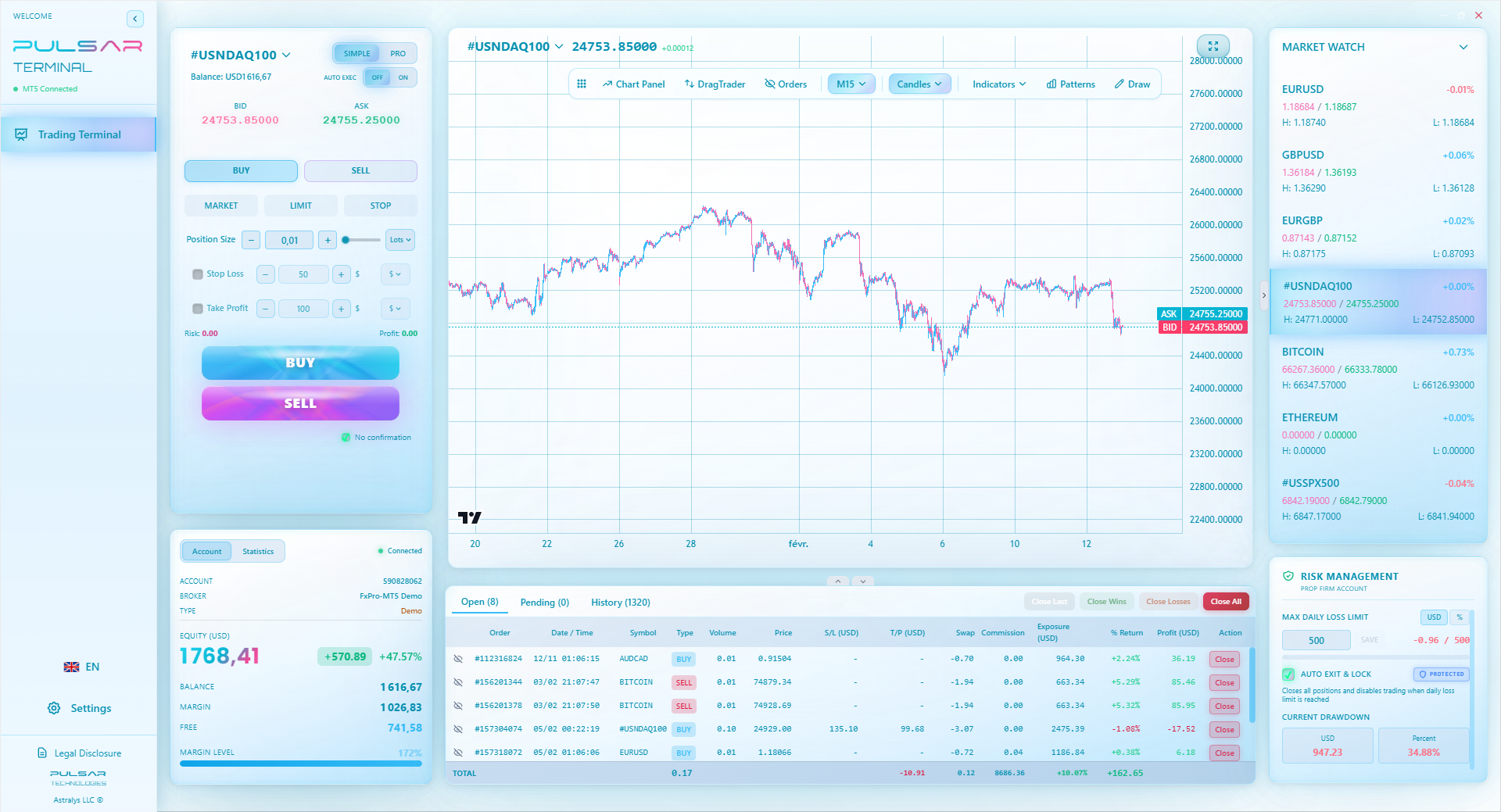
Once you're with a real broker on MT5, managing multiple trades and complex strategies manually is a headache; Pulsar Terminal automates this with drag-and-drop orders and one-click multi-TP/SL setups.
Pulsar Terminal
Das All-in-One MT5-Tool: Drag-and-Drop-Orders, Multi-TP/SL, Trailing Stop, Grid Trading, Volume Profile und Prop-Firm-Schutz. Täglich von 1.000+ Tradern genutzt.
“Your first goal isn't to make money. It's to not lose your deposit. Practice until your strategy is boringly mechanical.”
It's not all bad. Capitec has its place in your financial life, just not in your trading life.
Use Capitec When:
- You're traveling or shopping online. The zero fees on international card payments are genuinely good. Use your card abroad, let them handle the conversion at point-of-sale.
- You need to send a one-off, urgent payment to a person or company overseas and the amount isn't huge (under R50,000). The convenience outweighs the cost.
- You're receiving foreign currency payments (like freelance work). The R50 receipt fee is standard. Just convert it to ZAR quickly if you think the Rand will strengthen.
Do NOT Use Capitec When:
- You are trying to execute a trading strategy.
- You are converting large sums (e.g., for property, emigration).
- You want to hold foreign currency for a long time (open a USD-dominated account with a broker or investment platform instead).
Think of Capitec as the corner cafe. Great for a quick coffee. You wouldn't cater your wedding there. Use the right service for the scale of the job.

FAQ
Q1Can I trade forex directly with my Capitec bank account?
No. Absolutely not. Capitec does not offer a trading platform, use, or the ability to buy and sell currency pairs for speculative gain. You can only use them to convert and send money internationally as a transfer.
Q2What is cheaper: sending money via Capitec or funding a broker?
Funding a broker is almost always cheaper. With Capitec, you pay a R175 fee plus a large hidden spread (costing maybe 2-4%). Funding a broker is usually a local EFT (R0-R100 fee) and the broker's minimal conversion spread, which is much tighter than a bank's.
Q3Is forex trading legal in South Africa?
Yes, it is completely legal. It is regulated by the Financial Sector Conduct Authority (FSCA). You must use an FSCA-licensed broker to ensure your funds are protected under South African law.
Q4What is the minimum amount I need to start forex trading?
Technically, some brokers accept as little as $5 (about R90). Practically, I tell my students to start with no less than R5,000. This allows for proper position size and can withstand a few losses without a margin call. Starting with R500 is a guaranteed way to lose it all to fees and one bad trade.
Q5Does Capitec offer better rates for large forex transfers?
Not really. They are a retail bank. For transfers over R100,000, you must contact a dedicated forex dealer or corporate treasury service. They negotiate rates directly on the interbank market and will significantly beat any rate Capitec's website offers you.
Q6Can I use my forex trading profits to pay my Capitec credit card?
Yes, but with steps. You withdraw profits from your broker to your Capitec account (in ZAR). This can take 1-3 business days and Capitec will charge a receipt fee. Once the ZAR is in your current account, you can pay your credit card as normal.
Prof. Winstons Lektion
Wichtige Erkenntnisse:
- ✓Capitec is for transfers, not trading.
- ✓The hidden spread cost often exceeds the fixed fee.
- ✓Always fund FSCA brokers via local EFT.
- ✓Start with at least R5,000 for realistic trading.
Wie nützlich war dieser Artikel?
Klicken Sie auf einen Stern
Wöchentliche Trading-Einblicke
Kostenlose wöchentliche Analysen & Strategien. Kein Spam.
Über den Autor
David van der Merwe
Schwellenland-Trader
In Johannesburg ansässiger Trader mit 11 Jahren Erfahrung in Schwellenländerwährungen. Spezialisiert auf ZAR-Paare, FSCA-regulierten Handel und Analyse des südafrikanischen Marktes.
Kommentare
Risikohinweis
Der Handel mit Finanzinstrumenten birgt erhebliche Risiken und ist möglicherweise nicht für alle Anleger geeignet. Vergangene Ergebnisse garantieren keine zukünftigen Renditen. Dieser Inhalt dient ausschließlich Bildungszwecken und stellt keine Anlageberatung dar. Führen Sie immer Ihre eigene Recherche durch, bevor Sie handeln.
Das könnte Sie auch interessieren

Cara Trading Forex Sukses: 7 Prinsip dari Trader Profesional
Cara trading forex sukses dengan 7 prinsip trader pro: manajemen modal, disiplin, journal trading, backtest. Data nyata, bukan janji profit palsu.
Jam Trading Forex Terbaik untuk Trader Indonesia: Panduan Lengkap dengan Tabel Waktu
Panduan jam trading forex untuk trader Indonesia. Tabel 4 sesi dunia, jam emas 20:00-00:00, sesi mana yang harus dihindari. Data akurat + tips dari trader berpengalaman.
Top 5 Sàn Forex Uy Tín Nhất 2026: Review Jujur dari Trader Indonesia
Top 5 sàn forex uy tín 2026 untuk trader Indonesia. Review jujur: spread, deposit, withdraw, dukungan lokal. Exness, XM, IC Markets & lebih.
Pulsar Terminal herunterladen
Alle diese Rechner sind in Pulsar Terminal mit Echtzeit-Daten Ihres MT5-Kontos integriert.
Pulsar Terminal herunterladen