


You've seen the ads, haven't you? The ones on Facebook or Instagram promising a 'forex cheat code' that prints money while you sleep.

David van der Merwe
Schwellenland-Trader ·  South Africa
☕ 10 Min. Lesezeit
Was Sie lernen werden:
- 1The 'Cheat Code' is a Scam. Here's the Proof.
- 2Your Real Advantage: FSCA Regulation
- 3Knowing the Real Costs (Your Second 'Cheat Code')
- 4The Only 'Cheat Code' That Works: Risk Management
- 5Building a Simple, Repeatable Strategy
- 6South African Market Savvy: ZAR, Platforms, and Timing
- 7Putting It All Together: Your Daily Checklist
You've seen the ads, haven't you? The ones on Facebook or Instagram promising a 'forex cheat code' that prints money while you sleep. Maybe a friend sent you a WhatsApp forward about a robot that guarantees 20% returns a month. Let me be straight with you: that's not a cheat code. That's a one-way ticket to losing your hard-earned Rand. The real 'cheat' isn't a secret; it's the boring, disciplined work of trading with a regulated broker, managing your risk, and knowing exactly how the local market works. I learned this the hard way, and I'm here to save you the tuition fee.
Let's kill this fantasy right now. In 2023 alone, South African traders lost over R500 million to financial fraud. The FSCA issued more than 150 warnings. Think about that number. R500 million. That's not bad luck; it's a targeted industry built on the dream of an easy win.
The scam formula is always the same. They find you on social media - Instagram, Telegram, WhatsApp. They show you fake screenshots of massive profits, offer you 'signals' or a 'robot' that's a 'game-changer' (see, I told you I wouldn't use that word). They pressure you: "Deposit now, the market is moving!" They might even let you win a little on a demo account they control. Then you deposit real money, and poof. The returns vanish, the 'account manager' ghosts you, and your money is gone.
The FSCA has been busy in 2026, naming and shaming operations like 'Peace Finisher,' 'EFX Trades,' and individuals like Nhlanhla Shabalala pushing signal scams. If someone promises you a cheat code, they're cheating you. The first rule of real trading is this: if it sounds too good to be true, it's a lie. Your greatest weapon is skepticism.

Warning: The FSCA says 65% of complaints are Ponzi schemes, and 25% are fake brokers. If you're being offered a profit-sharing plan or pressured to recruit friends, run. That's the hallmark of a Ponzi, not a trading strategy.
“The real 'cheat code' isn't a secret signal; it's the FSCA license number.”
Okay, so the fake cheat code is out. What's the real one? It's the FSCA license number. This is your single most important piece of due diligence. Trading with an FSCA-licensed broker isn't just a suggestion; it's your primary layer of protection.
What does FSCA regulation actually mean for you? It means the broker has met strict requirements. They have to keep your money in a segregated bank account (so they can't use your deposit to pay their office rent). They need a physical presence in South Africa. They're subject to audits and have to follow fair practice rules. If something goes wrong, you have a local regulatory body to complain to. You have recourse.
I made my first big mistake in 2015. I was lured by a 'broker' offering 1:1000 use and insane bonuses. They weren't regulated here. I made a R15,000 deposit. When I tried to withdraw R5,000 of my profits, they hit me with endless 'verification' delays and then impossible bonus rollover requirements. I never saw that money again. That loss taught me more than any winning trade ever did. Always, always check the FSCA's website to verify the license. Brokers like IG, XM, and AvaTrade have legitimate FSCA licenses - that's the baseline for even considering them.
What to Look For on a Broker's Site
Don't just take their word for it. They should display their FSP number prominently. It'll look something like 'FSP No. 12345'. Go to the FSCA's website, pop that number into their search tool, and confirm the name matches exactly. This two-minute check could save you thousands.

💡 Winstons Tipp
The market's favorite prey is the impatient trader. The desire for quick profits blinds you to obvious risks. Slow down. The opportunities will still be there tomorrow.
“If someone promises you a forex cheat code, they're cheating *you*.”
The market doesn't give you anything for free. Every trade has a cost, and if you don't know what it is, you're already behind. Let's break down what it really costs to trade in South Africa.
Spreads: This is the difference between the buy and sell price. For USD/ZAR, spreads can be wide and volatile - 50 pips isn't unusual. For majors like EUR/USD, you want it tight. On a standard account, look for 0.6 to 1.5 pips. On a raw/ECN account, you might see 0.0 pips but pay a commission. IC Markets is famous for their raw spreads, often at 0.0 pips.
Commissions: Usually charged per lot. It might be $3.50 per side, so $7 total to open and close a 1-lot trade. You need to factor this into your profit target.
Swap/Overnight Fees: This is the interest for holding a position past 10 PM SA time. It can work for or against you depending on the currency pair's interest rate differential. If you're a swing trader holding for days, this adds up.
The Hidden Killer: Currency Conversion. This one stung me early on. If you fund your account in Rands but trade USD pairs, your broker converts your ZAR to USD. They often add a 1-2% markup to the interbank rate. On a R10,000 deposit, that's R200 gone before you place a single trade. The fix? Some brokers, like Khwezi Trade, offer ZAR-denominated accounts. Or, use a broker like Exness that accepts local EFTs and has low minimum deposits, so you can fund in smaller amounts.

Example: Let's say you buy 1 mini lot (0.1) of EUR/USD.
- Spread: 1.0 pip = $1.00 cost
- Commission (if applicable): $0.70
- Total cost to enter: ~$1.70 You need the price to move over 1.7 pips in your favor just to break even. That's why understanding your pip value and costs is non-negotiable.
“If someone promises you a forex cheat code, they're cheating *you*.”
Here's the truth no signal seller will tell you: you will be wrong. A lot. I'm wrong about 40-45% of the time. The difference between me and a blown account is that my losses are small, and my winners are bigger. That's not magic; it's a system.
The 1% Rule: Never, ever risk more than 1% of your account balance on a single trade. Got R20,000? Your max risk is R200 per trade. This is the golden rule. It lets you survive a losing streak without a margin call. I use a simple position size calculator for every single trade. No exceptions.
Stop-Losses Are Your Best Friend: Your stop-loss isn't a suggestion; it's a law. Before you click buy, you must know exactly where you'll get out if you're wrong. Place it at a logical level where your trade idea is invalidated. And then leave it alone. The number one amateur mistake is moving a stop-loss further away because 'it'll come back.' It usually doesn't.
Profit Targets: Have one. A common strategy is to aim for a risk-to-reward ratio of at least 1:2. If you're risking R200 (10 pips), you should be aiming to make R400 (20 pips). This means you can be wrong half the time and still break even. This simple math is more powerful than any indicator.
My most painful lesson was on GBP/JPY. I risked 3% of my account on a 'sure thing' based on news. It went against me instantly. I didn't have a tight stop. I watched it bleed, frozen, hoping for a reversal. I lost 8% in one trade. It took me two months of disciplined 1% trades just to dig out of that hole. Never again.
💡 Winstons Tipp
Your trading plan is a contract with your future self. Breaking it is a betrayal. The money you save by sticking to your stop-loss is profit you don't have to make back later.
“I'm wrong about 40-45% of the time. The difference is my losses are small, and my winners are bigger.”
You don't need 20 indicators flashing on your screen. You need one or two you understand deeply, and a clear set of rules. Complexity is the enemy of execution.
Start with Price Action: Learn to read support and resistance. Where has the price bounced or broken before? Those are your key areas for entries and stops. Most of my trades are based on price reacting to these levels.
Add One Confirmation Tool: This could be the RSI indicator to spot overbought/oversold conditions, or the MACD indicator for trend momentum. Don't use both at once when you're starting. Master one.
Define Your Trade Type: Are you a scalping fiend, in and out in minutes? Or do you have the patience for swing trading, holding for days? Your personality matters. I'm a swing trader at heart. I tried scalping and my nerves were shot in a week; I overtraded and broke all my rules.
Backtest and Journal: This is the boring work that makes you money. Take your simple strategy - e.g., "Buy when price touches the rising trendline and RSI is above 30." Go back on your MT4/MT5 chart and see how it would have performed for the last 100 times. Write down every trade you take: entry, exit, why you took it, your emotion. Review it weekly. Your journal will tell you more about yourself than any guru ever could.
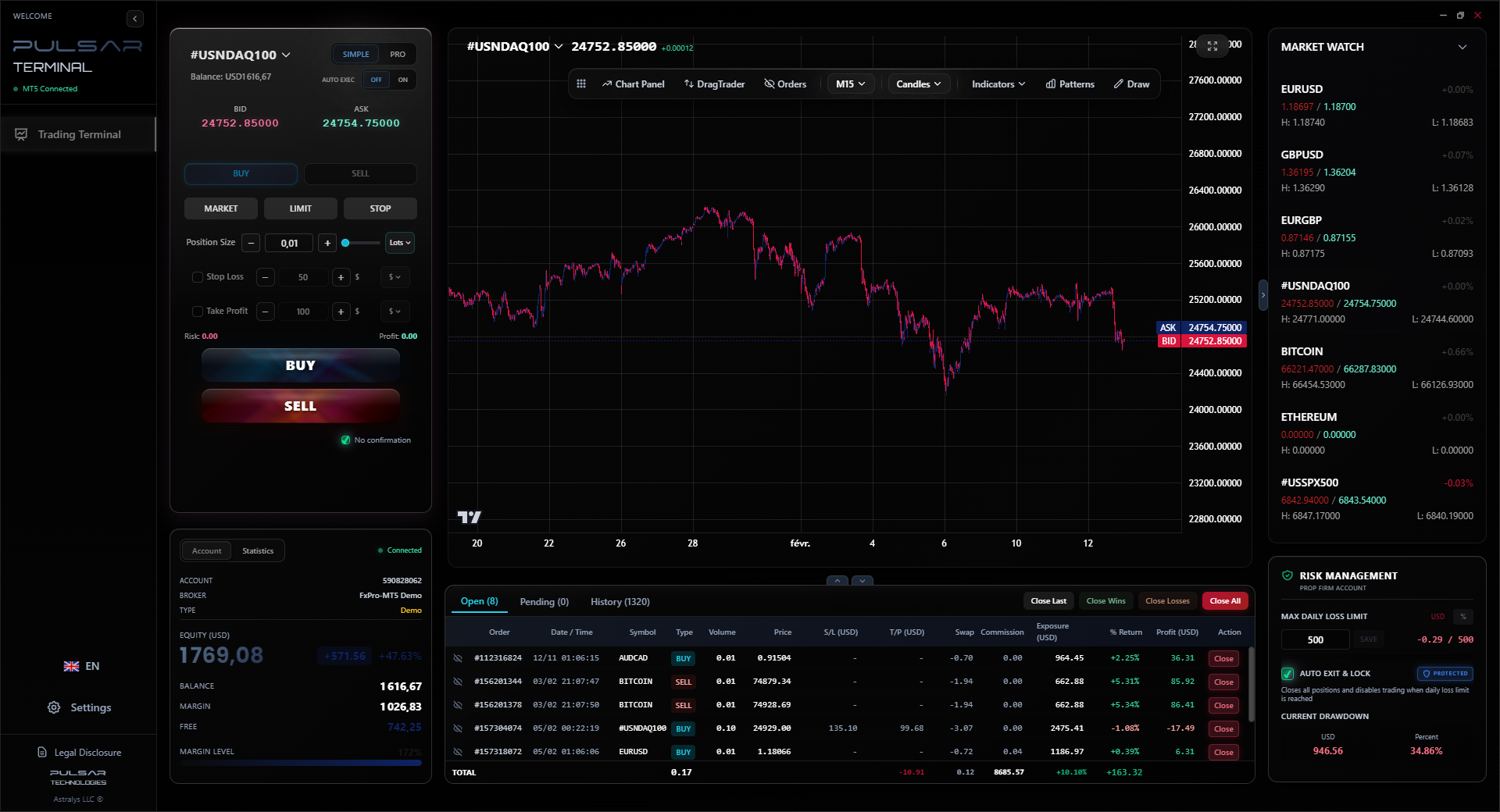
When you're building a disciplined strategy, tools that help you execute your plan mechanically—like setting multiple take-profit levels or a trailing stop—are invaluable for removing emotion.
Pulsar Terminal
Das All-in-One MT5-Tool: Drag-and-Drop-Orders, Multi-TP/SL, Trailing Stop, Grid Trading, Volume Profile und Prop-Firm-Schutz. Täglich von 1.000+ Tradern genutzt.
“I'm wrong about 40-45% of the time. The difference is my losses are small, and my winners are bigger.”
Trading from SA has its own quirks. Knowing them is a local advantage.
The Rand is a Beast: USD/ZAR is one of the most volatile major pairs in the world. Spreads are wide, moves are huge. It's not for beginners. If you trade it, you need wider stops and a stomach for turbulence. It's heavily influenced by commodity prices (gold, platinum) and local politics.
Platform of Choice: MetaTrader 4 and 5 are king here. Most local brokers support them. They're reliable, and everyone uses them, which means you can find plenty of local help. cTrader is also excellent, offered by brokers like FP Markets.
Trading Hours: The sweet spot for liquidity is when London and New York overlap (4 PM - 6 PM SA time). That's when spreads on pairs like EUR/USD are tightest and moves can be strong. Trading the Asian session (early morning SA time) is often slower and rangier.
Funding Your Account: EFT (Electronic Funds Transfer) is the standard. It can take 1-2 business days. Some brokers offer instant deposits via Ozow or SiD. Withdrawals back to your South African bank account are usually smooth with regulated brokers but can take 2-5 days.

Pro Tip: If you trade gold (XAU/USD), pay attention to SA mining news and the Rand's strength. There's often a correlation. A weak ZAR can sometimes coincide with stronger gold prices in USD, as it's a dollar-denominated safe haven.
💡 Winstons Tipp
A journal isn't a diary. It's a forensic audit of your decision-making. The pattern of your mistakes is your most valuable data set. Study it more than any chart.
“Complexity is the enemy of execution. You don't need 20 indicators flashing on your screen.”
This is your actual 'cheat code' – a routine that removes emotion and enforces discipline.
- Broker Check: Am I logged into my FSCA-regulated broker? (Yes/No)
- Market State: What's the overall trend? (Check higher timeframes first).
- Economic Calendar: Any high-impact news (SARB interest rate decisions, US Non-Farm Payrolls) due today? If yes, I might stay out until after the volatility.
- Trade Plan: I will only trade if my setup (e.g., pullback to support + RSI signal) appears. No forcing trades.
- Risk Calculation: If I get a signal, I use my calculator. 1% risk. Stop-loss placed. Profit target set.
- Execute & Walk Away: Place the trade with stop and limit orders. Then I close the platform for an hour. Staring at it causes mistakes.
- Journal: At day's end, I record the trade and my mental state.
This process is boring. It's mechanical. It won't make for exciting Instagram stories. But it's what keeps you in the game long enough to learn, adapt, and grow your account slowly and sustainably. That's the only 'fast track' that exists.
FAQ
Q1Is there a real forex robot that works?
I've tested dozens over 12 years. The ones sold publicly almost always fail in live markets. They're curve-fitted to past data. The only 'robots' that work are complex algorithms used by hedge funds, not something you buy for R500 on Telegram. Focus on building your own skill instead.
Q2What's the minimum amount I need to start trading forex in South Africa?
You can start with as little as R500 or $10 with some brokers like Exness. But realistically, to properly practice risk management (the 1% rule), you should start with at least R5,000 - R10,000. This allows you to trade micro lots and experience real psychology without blowing up from a single trade.
Q3Why is USD/ZAR so difficult to trade?
It's highly volatile and sensitive to local political news, commodity prices, and global risk sentiment. The spread is often very wide (30-80 pips), meaning the price has to move significantly just for you to break even. It's a pair for experienced traders with strong risk controls.
Q4How do I know if a broker is really FSCA regulated?
Go directly to the FSCA's website (www.fsca.co.za). Use their 'Search for an FSP' tool. Enter the FSP number the broker provides. Verify the company name and the authorised services listed match what they're offering you. Don't rely on a logo on their website.
Q5I lost money to a scam broker. What can I do?
First, report it to the FSCA immediately with all your evidence (emails, WhatsApp chats, payment receipts). Also, report it to the South African Police Service's Commercial Crime Unit. Unfortunately, recovery rates are low, which is why prevention through regulation is absolutely critical.
Q6Can I make a living trading forex in South Africa?
It's possible, but it's incredibly hard and takes years of disciplined practice. Don't quit your job. Start part-time. Most professional traders go through multiple years of losses and small gains before they become consistent. Treat it as a serious business venture, not a get-rich-quick scheme.
Prof. Winstons Lektion
Wichtige Erkenntnisse:
- ✓Verify FSCA regulation before depositing a single cent.
- ✓Never risk more than 1% of your capital on any trade.
- ✓A 1:2 risk-to-reward ratio lets you be wrong half the time and still break even.
- ✓USD/ZAR's 50-pip spreads require expert-level risk management.
- ✓Your trade journal is your most important analytical tool.
Wie nützlich war dieser Artikel?
Klicken Sie auf einen Stern
Wöchentliche Trading-Einblicke
Kostenlose wöchentliche Analysen & Strategien. Kein Spam.
Über den Autor
David van der Merwe
Schwellenland-Trader
In Johannesburg ansässiger Trader mit 11 Jahren Erfahrung in Schwellenländerwährungen. Spezialisiert auf ZAR-Paare, FSCA-regulierten Handel und Analyse des südafrikanischen Marktes.
Kommentare
Risikohinweis
Der Handel mit Finanzinstrumenten birgt erhebliche Risiken und ist möglicherweise nicht für alle Anleger geeignet. Vergangene Ergebnisse garantieren keine zukünftigen Renditen. Dieser Inhalt dient ausschließlich Bildungszwecken und stellt keine Anlageberatung dar. Führen Sie immer Ihre eigene Recherche durch, bevor Sie handeln.
Das könnte Sie auch interessieren

Cara Trading Forex Sukses: 7 Prinsip dari Trader Profesional
Cara trading forex sukses dengan 7 prinsip trader pro: manajemen modal, disiplin, journal trading, backtest. Data nyata, bukan janji profit palsu.
Jam Trading Forex Terbaik untuk Trader Indonesia: Panduan Lengkap dengan Tabel Waktu
Panduan jam trading forex untuk trader Indonesia. Tabel 4 sesi dunia, jam emas 20:00-00:00, sesi mana yang harus dihindari. Data akurat + tips dari trader berpengalaman.
Top 5 Sàn Forex Uy Tín Nhất 2026: Review Jujur dari Trader Indonesia
Top 5 sàn forex uy tín 2026 untuk trader Indonesia. Review jujur: spread, deposit, withdraw, dukungan lokal. Exness, XM, IC Markets & lebih.
Pulsar Terminal herunterladen
Alle diese Rechner sind in Pulsar Terminal mit Echtzeit-Daten Ihres MT5-Kontos integriert.
Pulsar Terminal herunterladen