


Most traders in Lagos think diversification means trading EUR/USD, GBP/USD, and AUD/USD.

Olumide Adeyemi
Pionier des Tradings in Westafrika ·  Nigeria
☕ 9 Min. Lesezeit
Was Sie lernen werden:
- 1What Forex Correlation Actually Means (It's Not What You Think)
- 2The Usual Suspects: How Major Pairs Really Relate
- 3How to Calculate and Find Current Correlation Coefficients
- 4How Correlation Becomes a Portfolio Killer
- 5Using Correlation Strategically: Beyond Just Avoiding Disaster
- 6Common Correlation Mistakes by Nigerian Traders
- 7Your Action Plan: How to Implement This Today
- 8The Final Word: Correlation is a Tool, Not a Crystal Ball

Most traders in Lagos think diversification means trading EUR/USD, GBP/USD, and AUD/USD. They're wrong. They're trading the same thing three times. This illusion of safety is why so many accounts here get margin-called in one bad move. I'll show you how currency pairs move together (and apart), how to spot these relationships, and most importantly, how to stop doubling your risk without knowing it.
Correlation in forex isn't about news or sentiment. It's pure, cold math. It measures how often two currency pairs move in the same direction over a set period. The number ranges from +1.0 to -1.0.
A correlation of +0.80 means if Pair A goes up, Pair B goes up with it about 80% of the time. They're best friends. A correlation of -0.80 means they move in opposite directions 80% of the time. They're rivals. Anything between -0.20 and +0.20 is basically noise, no real relationship.
The trap? These numbers aren't fixed. A pair can be strongly correlated for months (like EUR/USD and GBP/USD often are), then suddenly decouple. If you're over-leveraged in both, that decoupling is where you get slaughtered.

Warning: The biggest mistake is assuming correlation equals causation. Just because EUR/USD and AUD/USD often move together doesn't mean one causes the other. They're both often reacting to a third factor: the US Dollar's strength or weakness.
Let's get specific. You need to know the usual relationships, especially if you're trading with common brokers like Exness or IC Markets where these are the most liquid.
The Dollar Pairs (USD as Quote Currency): EUR/USD, GBP/USD, AUD/USD, NZD/USD. These often have positive correlation. When the US Dollar weakens, they all tend to go up. When it strengthens, they fall. This is the diversification illusion.
The Dollar Index (DXY) is your cheat code here. If DXY is rallying, think twice before buying any of these pairs.
The Yen Pairs (JPY as Quote Currency): USD/JPY, GBP/JPY, EUR/JPY. These are famous for their positive correlation with global risk sentiment. When stocks are up (risk-on), these pairs tend to rise. When fear hits the market (risk-off), they fall as traders buy the safe-haven Yen. This makes them behave differently from the standard dollar pairs.
The Commodity Bloc: AUD/USD, NZD/USD, USD/CAD. These are tied to their respective commodities (iron ore, dairy, oil). Their correlation with each other can be strong, but they can also wildly diverge based on commodity-specific news. I learned this the hard way.
Personal Experience: In 2019, I was long AUD/USD and long USD/CAD, thinking I was 'hedged'. What I missed was that both trades were bets against the US Dollar. When a surprise Fed statement crushed the dollar, both positions went against me. I wasn't hedged, I was double-exposed. Lost about 3.2% of the account in an hour. A proper position size calculator would have flagged the combined risk.

💡 Winstons Tipp
If you can't explain your net exposure to the US Dollar in one sentence, you're over-complicated and under-managed.

“The diversification trap isn't trading different pairs; it's trading the same market narrative with different symbols.”
You don't need a PhD. There are two practical ways to get this data.
1. Use a Correlation Matrix Tool: Most decent trading platforms (like TradingView) or financial websites have a live forex correlation matrix. It's a simple grid. You look for the intersection of two pairs and see the number. Look for periods of 20, 50, and 100 days to see if the relationship is stable.
2. The Manual Check (For Skeptics Like Me): Sometimes I just open two charts, like EUR/USD and GBP/USD, on the same time frame. I remove all indicators and just look. Do the major swing highs and lows line up? If they do, consistently, the correlation is high. This visual check keeps you grounded.
Why Time Frame Matters
A pair can be +0.90 correlated on the daily chart but only +0.40 on the 1-hour chart. For a scalping strategy, the lower time frame correlation is what matters. For swing trading, use the daily or weekly. Ignoring this is a classic error.

Example: Let's say you check and find:
- EUR/USD vs. GBP/USD: +0.85 (Daily)
- EUR/USD vs. USD/CHF: -0.90 (Daily) This tells you that going long EUR/USD and short USD/CHF is nearly the same as going double long EUR/USD. Your risk is doubled, not hedged.
This is where accounts die. You think you have three separate trades open. Your risk management says "never risk more than 2% per trade." So you put on Trade A (2% risk), Trade B (2% risk), and Trade C (2% risk). You feel safe.
But if Trades A, B, and C are all +0.80 correlated, you're not risking 2%. You're effectively risking something much closer to 2% * 3 = 6% on one market move. A single adverse swing can now wipe out a month's profits.
The Margin Call Scenario: You're long EUR/USD, GBP/USD, and AUD/USD. A strong US NFP report hits. The dollar rockets. All three pairs plummet simultaneously. Your losses compound instantly. Your equity drops, your used margin stays the same, and your broker's system triggers a margin call. This happens in seconds.
I've seen it in prop firm challenges, where the daily loss limit is sacred. A trader passes the first phase, gets overconfident, opens three correlated trades, and gets knocked out on a Tuesday morning. It's brutal. Tools that manage aggregate exposure, like some features in prop firm-focused platforms, exist to prevent this self-sabotage.

“Correlation doesn't cause your losses; your ignorance of correlation does.”
Once you understand the danger, you can flip it into an advantage. Here’s how.
1. Confirming Trade Signals: You see a bullish setup on EUR/USD using the MACD indicator. Before entering, check GBP/USD and AUD/USD. Are they also showing strength, or is EUR/USD alone? If its correlated pairs are also bullish, it strengthens the signal that this is a broad-based USD weakness move, not just euro noise.
2. Hedging (The Right Way): A true hedge involves negatively correlated pairs. If you are long EUR/USD (+0.85 vs GBP/USD), a better hedge isn't another long position. You could look for a pair with a strong negative correlation to the euro, or simply reduce your position size. Sometimes, the best hedge is a smaller trade.
3. Finding Divergence Opportunities: This is the gold mine. When two highly correlated pairs suddenly start to diverge - one makes a new high, the other doesn't - it signals a potential reversal or a shift in fundamentals. For instance, if XAU/USD (gold) is soaring as a safe haven, but USD/JPY (typically risk-on) is also rising, something is off. That divergence can be a powerful counter-trade signal.
Personal Experience: In early 2022, EUR/USD and GBP/USD were locked in step. Then, GBP/USD broke sharply lower on UK-specific political chaos, while EUR/USD held its ground. That divergence was a clear signal to avoid any long GBP trades until it resolved. I stayed out, while others who just traded 'the correlation' got burned.
💡 Winstons Tipp
A correlation matrix is a mirror, not a map. It shows you what you've already done, not where you should go. Look at it to see your mistakes, not to find your next trade.
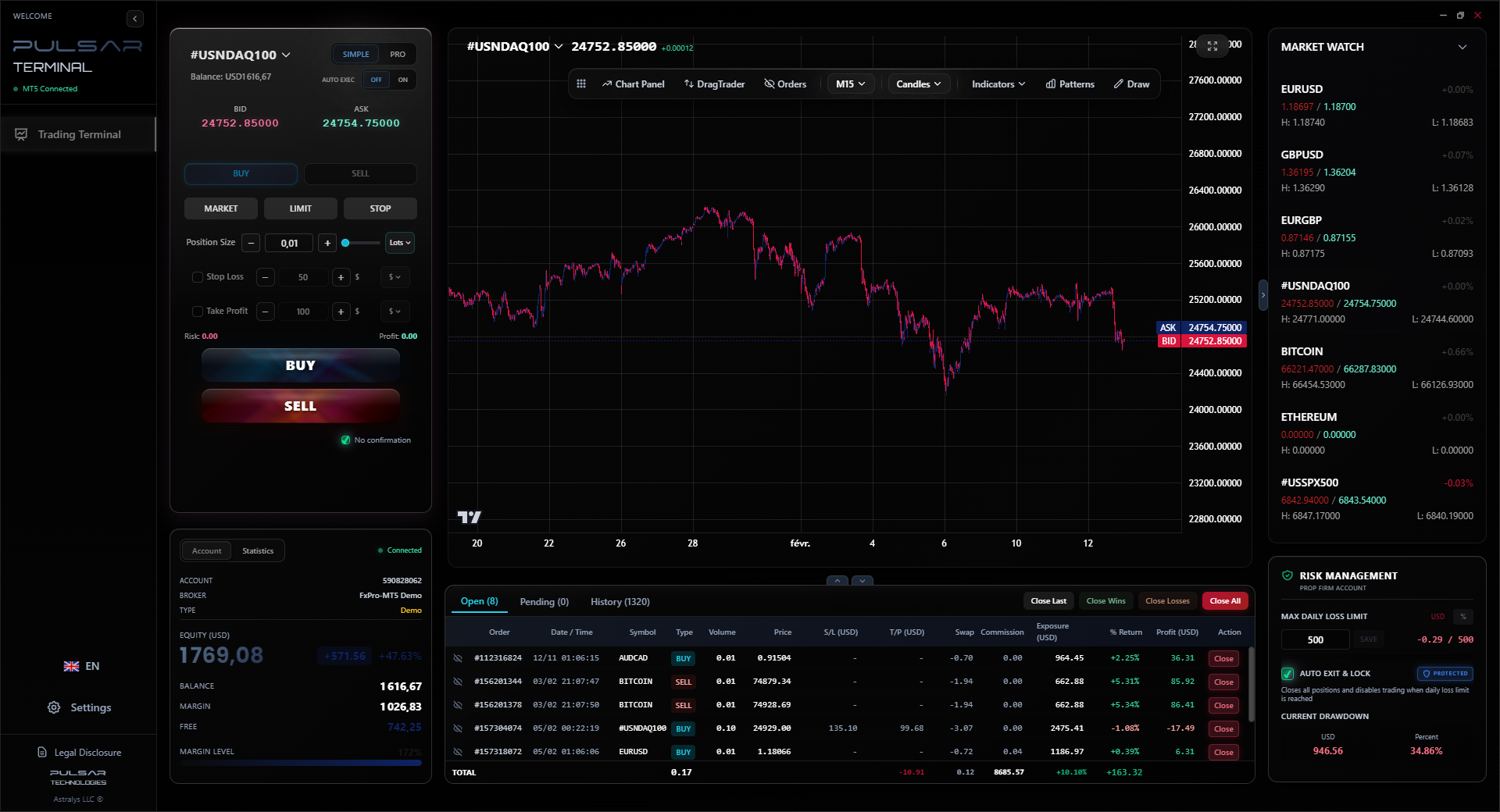
Managing the aggregate risk of multiple correlated positions is complex, which is why tools that provide a unified view of your portfolio exposure are essential for survival.
Pulsar Terminal
Das All-in-One MT5-Tool: Drag-and-Drop-Orders, Multi-TP/SL, Trailing Stop, Grid Trading, Volume Profile und Prop-Firm-Schutz. Täglich von 1.000+ Tradern genutzt.
Our market has unique pitfalls. Here’s what I see constantly in trading groups from Abuja to Port Harcourt.
Mistake 1: Trading Multiple USD Pairs with Naira Anxiety. We're naturally dollar-focused. So a trader will go long EUR/USD, long GBP/USD, and maybe dabble in US30 (Dow Jones), thinking they're diversified. They're not. They've tripled down on a 'weak dollar' bet. If the dollar strengthens, everything turns red, and the panic to convert losses back to Naira mentality kicks in, leading to emotional exits.
Mistake 2: Ignoring the Impact of Oil on USD/CAD and NGN. Nigeria is an oil economy. When oil prices move, it affects global pairs like USD/CAD (inversely) and, of course, the Naira. A trader might see a falling USD/CAD (CAD strengthening) due to oil and think it's a dollar story, missing the commodity driver. Understanding that helps avoid false signals.
Mistake 3: Overcomplicating with Exotic Pairs. Brokers like XM or Pepperstone offer exotic pairs involving ZAR or MXN. A novice sees a high spread and thinks 'opportunity.' They then pair it with a major, not knowing the correlation is chaotic and unreliable. The combination becomes unmanageable.

Pro Tip: Keep it simple early on. Master the correlations between 4-5 major pairs first (EUR/USD, GBP/USD, USD/JPY, USD/CHF, AUD/USD). Your pip value and risk calculations remain clearer, and the correlations are more stable and predictable.

“Your biggest risk isn't the trade you're about to take, it's the one you already have open that's secretly its twin.”
Theory is useless without action. Do these four things this week.
1. Audit Your Current Trades. List every open position and pending order. Use a free online correlation matrix. Write down the correlation coefficient between each pair. If you have two trades with a +0.70 or higher correlation, you've likely over-exposed yourself. Close or reduce one.
2. Set a Correlation Rule. Make a personal rule. Mine is: "I will not have more than 1.5x my standard position size exposed to a single currency (usually the USD) via multiple correlated pairs." This forces me to add up my effective exposure.
3. Create a Watchlist Dashboard. On your trading platform, create a watchlist with your favorite 6-8 pairs. Next to it, keep a simple notepad document or spreadsheet noting the current key correlations (e.g., "EUR/USD & GBP/USD: Strong Pos. // EUR/USD & USD/CHF: Strong Neg."). Update it weekly.
4. Backtest with Correlation in Mind. Review your last 20 trades. How many were concurrent trades in highly correlated pairs? Calculate what your actual combined risk was in those moments versus what you thought it was. The number will scare you, and that's good. Fear teaches where theory fails.

Don't become the trader who sees a -0.90 correlation and thinks it's a law of physics. It's a historical observation, not a future guarantee. Correlations break down. They snap during black swan events, major central bank interventions, or geopolitical shocks.
The goal isn't to trade correlation blindly. The goal is to use it for one primary purpose: awareness of your aggregate risk.
It stops you from accidentally putting all your eggs in one basket while congratulating yourself on having three baskets. It's the difference between thinking you're a diversified fund manager and realizing you're a gambler with a fancy charting software.
Start by using it defensively. Protect your capital. Once you consistently avoid blowing up your account from compounded correlated losses, then you can start exploring the advanced strategic uses. Survival comes first. Always.
Final personal note: The most profitable year of my trading didn't come from finding a magical correlation edge. It came from the year I had the fewest margin warnings, because I finally understood how my trades were secretly working together against me.

FAQ
Q1What is a strong correlation in forex?
A coefficient above +0.70 or below -0.70 is generally considered strong. +0.80 to +1.0 means pairs move together most of the time. -0.80 to -1.0 means they move opposite most of the time. Between -0.30 and +0.30, the relationship is weak and not useful for planning.
Q2Can I hedge by trading two positively correlated pairs in opposite directions?
This is a terrible idea, often called a 'correlation hedge.' You're not hedging market risk; you're just betting on which pair will outperform the other (a relative value trade). It's highly speculative, and both positions can still go against you if the underlying trend is powerful. It's a great way to lose money on both sides while paying double the spread.
Q3How often do forex correlations change?
They can shift gradually over months or break down violently in days. Major policy changes (like one central bank hiking rates while another holds) can permanently alter a relationship. You should check your correlation matrix at least once a month, and always be aware of the potential for a breakdown during high-volatility news events.
Q4Is EUR/USD and GBP/USD always correlated?
No. While they often have a strong positive correlation (typically +0.70 to +0.90), it's not constant. UK-specific issues like Brexit or Bank of England policy surprises can cause them to decouple completely. Always check the current data, don't assume.
Q5What's the most important correlation for a beginner to know?
The inverse relationship between EUR/USD and USD/CHF. They are often near-perfect negative correlates (around -0.90). This means if you are long EUR/USD, you are effectively short USD/CHF. Opening positions in both is like doubling your size on one trade.
Q6How does correlation affect my position sizing?
Dramatically. If you risk 1% on each of two trades with a +0.80 correlation, your effective portfolio risk isn't 2%, it's closer to 1.8%. You must adjust your position sizes down when opening correlated trades, or use a portfolio-level position size calculator that accounts for correlation.
Q7Where can I find a free, reliable correlation matrix?
Many financial data websites like Investing.com or Myfxbook offer free live correlation matrices. Also, the TradingView platform has correlation indicators you can apply to charts. Start with a simple 30-day period on the daily timeframe for a clear picture.
Prof. Winstons Lektion
Wichtige Erkenntnisse:
- ✓Check correlation before adding any new position to your portfolio.
- ✓A +0.80 correlation between two trades means you're 80% duplicated.
- ✓Correlation breakdowns cause the fastest, most confusing losses.
- ✓Use correlation defensively first; for risk management, not signals.
Wie nützlich war dieser Artikel?
Klicken Sie auf einen Stern
Wöchentliche Trading-Einblicke
Kostenlose wöchentliche Analysen & Strategien. Kein Spam.
Über den Autor
Olumide Adeyemi
Pionier des Tradings in Westafrika
Einer der aktivsten Forex-Trading-Ausbilder Nigerias. 8 Jahre Trading-Erfahrung aus Lagos. Spezialisiert auf Strategien mit geringem Kapital und Prop-Firm-Challenges für afrikanische Trader.
Kommentare
Risikohinweis
Der Handel mit Finanzinstrumenten birgt erhebliche Risiken und ist möglicherweise nicht für alle Anleger geeignet. Vergangene Ergebnisse garantieren keine zukünftigen Renditen. Dieser Inhalt dient ausschließlich Bildungszwecken und stellt keine Anlageberatung dar. Führen Sie immer Ihre eigene Recherche durch, bevor Sie handeln.
Das könnte Sie auch interessieren

Cara Trading Forex Sukses: 7 Prinsip dari Trader Profesional
Cara trading forex sukses dengan 7 prinsip trader pro: manajemen modal, disiplin, journal trading, backtest. Data nyata, bukan janji profit palsu.
Jam Trading Forex Terbaik untuk Trader Indonesia: Panduan Lengkap dengan Tabel Waktu
Panduan jam trading forex untuk trader Indonesia. Tabel 4 sesi dunia, jam emas 20:00-00:00, sesi mana yang harus dihindari. Data akurat + tips dari trader berpengalaman.
Top 5 Sàn Forex Uy Tín Nhất 2026: Review Jujur dari Trader Indonesia
Top 5 sàn forex uy tín 2026 untuk trader Indonesia. Review jujur: spread, deposit, withdraw, dukungan lokal. Exness, XM, IC Markets & lebih.
Pulsar Terminal herunterladen
Alle diese Rechner sind in Pulsar Terminal mit Echtzeit-Daten Ihres MT5-Kontos integriert.
Pulsar Terminal herunterladen