


I remember staring at my screen in late 2023, watching the USD/NGN pair on a local platform.

Olumide Adeyemi
Pionier des Tradings in Westafrika ·  Nigeria
☕ 9 Min. Lesezeit
Was Sie lernen werden:
- 1The Two-Faced Market: Official vs. Parallel
- 2The Legal Landscape and Finding a Real Broker
- 3The Naira Journey: Funding and Withdrawing
- 4Building a Strategy for Double Volatility
- 5Psychology and the Local Challenges
- 6Pitfalls to Avoid: The Nigerian Trader's Trap List
- 7Your First Steps: A Practical Action Plan
I remember staring at my screen in late 2023, watching the USD/NGN pair on a local platform. It wasn't a normal chart. It was a jagged line of pure stress, jumping from 750 to 950 in what felt like minutes after another Central Bank announcement. My friend in Lagos was on the phone, half-panicked, asking if he should buy dollars now. That moment, more than any EUR/USD trade, taught me what forex exchange in Nigeria really is: a high-stakes game played on two separate fields - the official international market and our own volatile backyard. This guide is about learning to play on both.
You can't understand forex here without understanding this split personality. There's the official CBN rate, and then there's the 'street rate' or parallel market rate. The gap between them isn't just a number; it's a measure of economic pressure and a real-world risk for traders.
When you fund an international broker, you're converting your Naira at a rate that's often closer to the parallel market than the official one. That means your trading capital takes a hit before you even place a trade. I learned this the hard way in 2021. I deposited 500,000 Naira expecting a rate around 410. By the time the transfer went through, the effective rate was 480. I lost over 70,000 Naira in value just on the deposit. That's a 14% loss before the market opened.
This duality affects everything. Your profit in dollars might look great, but converting it back to Naira is another adventure. You're not just trading currency pairs; you're constantly hedging against the Naira's own instability.

Warning: Never, ever use the official CBN rate for your personal profit calculations. Your real-world rate is what the banks or transfer services give you, which shadows the parallel market. Basing a trade plan on the wrong rate is a sure way to blow your account.

💡 Winstons Tipp
Your first profit isn't the one on your MT5 screen. It's the one that lands back in your Naira account. Always factor the round-trip currency conversion cost into your profit targets.
Let's be clear: trading forex with international brokers is legal for Nigerians. The confusion comes from the CBN's restrictions on Bureau de Change (BDCs) and its efforts to manage the Naira's official exchange. As an individual, you're free to open an account with a regulated overseas broker.
The real trick is finding one that works seamlessly from Nigeria. You need a broker that accepts deposits from Nigerian banks, processes withdrawals back to Naira accounts without endless drama, and has a platform that stays up when the lights go out (or the network gets shaky).
What to Look For in a Broker
First, regulation is non-negotiable. Look for licenses from bodies like ASIC (Australia), FCA (UK), or CySEC (Cyprus). This protects your funds. Second, check their deposit methods. Brokers like Exness and XM have historically had good local bank transfer options and even local agent support in some cases.
Third, mind the spreads on major pairs. With our currency challenges, you don't need the extra cost of wide spreads eating into your profits. A good EUR/USD guide will tell you what a competitive spread looks like.
I made a mistake early on with a flashy broker that had "easy deposits" but terrible withdrawal terms. It took 3 weeks and two rejected attempts to get my money back. Now I only use well-established names with clear, proven tracks for Nigerian clients, like IC Markets or Pepperstone.

Pro Tip: Before you deposit a large amount, do a test withdrawal of a small profit. The ease and speed of getting your money out is the ultimate test of a broker's reliability for Nigerian traders.
“Trading from Nigeria means dealing with volatility squared: the market's and your currency's.”
This is the most practical headache. You have Naira in your GTB or Zenith account. You need USD, EUR, or GBP in your trading account. How?
- International Wire Transfer: The most formal route. You'll need to fill out a Form A at your bank. The rate will be poor, fees high (often $30-$50), and it can take 3-7 business days. The bank will use their own rate, not the CBN's.
- Cryptocurrency Transfers: This has become the go-to method for many. You buy USDT (Tether) on a local peer-to-peer (P2P) platform, send it to your broker's crypto wallet (if they support it), and it's converted. It's faster and often gives you a better effective exchange rate. But you must understand crypto wallets and be wary of P2P scams.
- E-payment/Online Processors: Some brokers integrate with payment processors that handle the currency conversion. It's usually instant.
My current method? I use a hybrid. For larger, less frequent deposits, I might use a wire. For regular, smaller top-ups, I use crypto. It's about balancing convenience, cost, and speed.
📊 Example: Let's say you want to deposit $500.
- Bank Wire: Your bank's rate is 1,450 NGN/$1. Cost = 725,000 Naira + 25,000 Naira transfer fee = 750,000 Naira total.
- Crypto P2P: You buy USDT at 1,420 NGN/$1. Cost = 710,000 Naira + minimal network fee (~500 Naira) = ~710,500 Naira. You just saved nearly 40,000 Naira on the deposit. That's extra trading capital.
Trading from Nigeria means dealing with volatility squared. There's the normal market volatility of your EUR/USD or XAU/USD (Gold) trade, and then there's the underlying volatility of your base currency, the Naira. Your strategy must account for both.
First, your position sizing becomes even more critical. If your Naira value is swinging wildly against the dollar, a 2% risk model based on your account balance in USD can quickly become 3% or 4% in Naira terms. You must be conservative. I never risk more than 1% of my account on a single trade here. Use a position size calculator religiously.
Second, consider longer timeframes. Swing trading over days or weeks often makes more sense than frantic scalping when you might be dealing with power outages or network lag. I shifted from day trading to swing trading in 2022, and my consistency improved dramatically.
Third, use technical indicators that help filter noise. The MACD indicator on a 4-hour chart can give clearer trend signals than a 5-minute chart full of market jitters. Combine it with the RSI indicator to spot overbought or oversold conditions on a daily chart. My best trades have come from waiting for the MACD to cross on the 4H chart while the daily RSI is recovering from below 30.
Finally, have a Naira hedge mindset. Sometimes, a simple long position on USD/NGN (if your broker offers it) isn't just a trade; it's a hedge against your local currency depreciation. But tread carefully, it's incredibly volatile.
💡 Winstons Tipp
In a market of two rates, your edge isn't predicting the CBN's next move. It's having a rock-solid risk management rule that works regardless of which rate is moving. Protect your capital first, last, and always.
“The ease of getting your money out is the ultimate test of a broker's reliability for Nigerian traders.”
The mental game is different here. Your friends and family will hear you 'trade forex' and immediately ask about dollars. There's a social pressure to 'beat the system' and profit from the Naira's fall. This is a dangerous mindset. Trading should be about disciplined strategy, not currency speculation born of desperation.
You'll also face infrastructure challenges. I've been in a profitable trade only for the power to go out and my generator to take a minute to kick in. By then, my stop-loss had been hit. Now, I use a UPS for my router and laptop, and I have a mobile data hotspot as a permanent backup. It's an extra cost, but it's a cost of doing business here.
The fear of a margin call is sharper when you know how hard it was to get that money into the account in the first place. This can make you risk-averse at the wrong times. The key is to have your risk management so automated and tight that you remove the emotion. Set your stop-loss the second you enter the trade, and don't move it.
Pro Tip: Keep two separate numbers in your head: your account balance in USD (for trading decisions) and its approximate Naira value (for reality checks). Never let the emotional weight of the Naira figure influence your trading plan based on the USD figure.
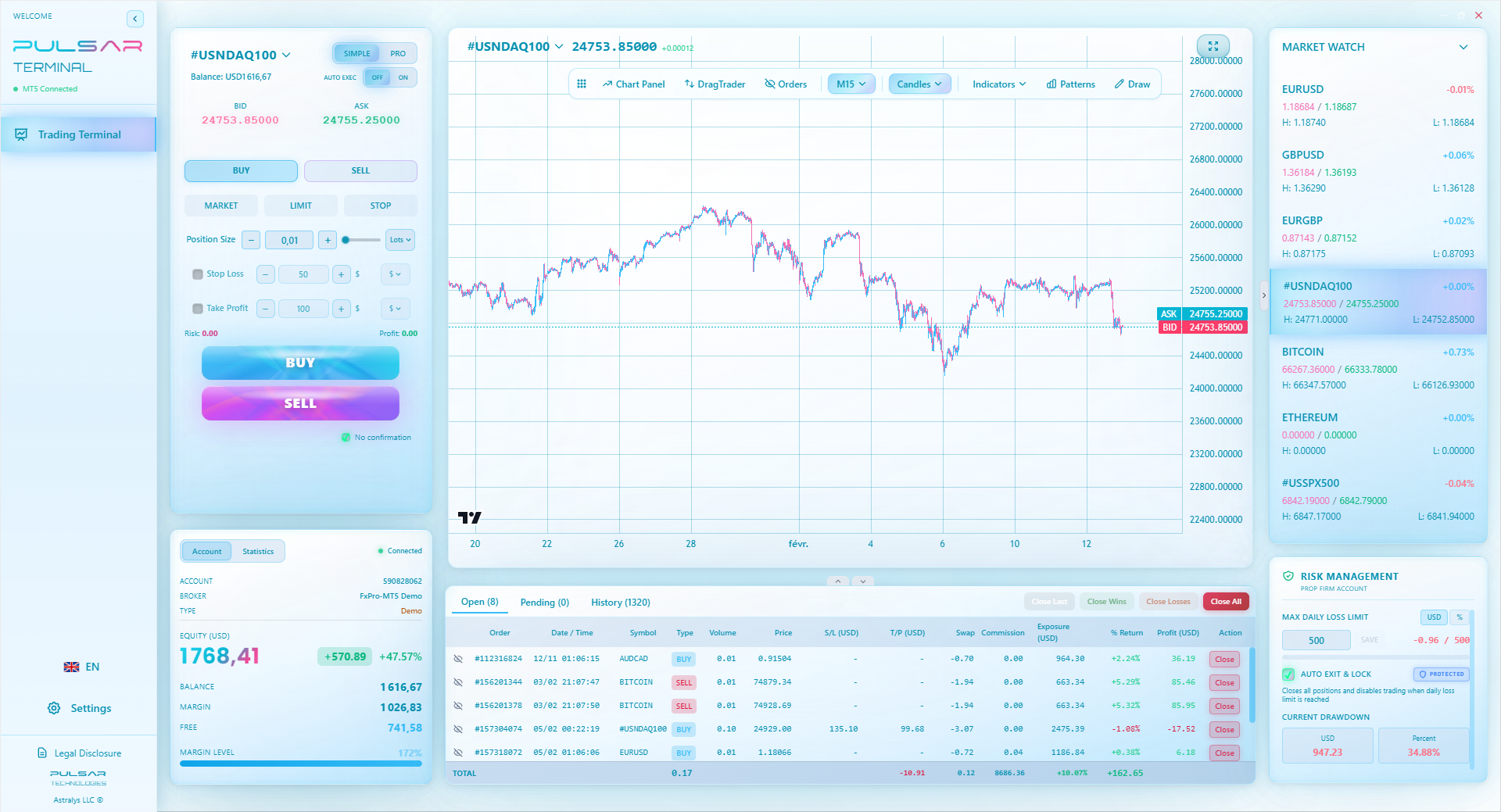
When a power flicker or network lag can hit your stop-loss, having a platform with robust, one-click order tools and automated risk management isn't a luxury—it's a necessity for survival.
Pulsar Terminal
Das All-in-One MT5-Tool: Drag-and-Drop-Orders, Multi-TP/SL, Trailing Stop, Grid Trading, Volume Profile und Prop-Firm-Schutz. Täglich von 1.000+ Tradern genutzt.
We have our own unique set of traps. Here's what to steer clear of:
- The 'Get-Rich-Quick' Forex Guru: Anyone selling a 'secret system' to profit from the Naira/dollar problem is preying on fear. Real trading education doesn't have silver bullets.
- Trading Based on Naira Anxiety: Don't enter a trade just because you feel the Naira will weaken further. That's gambling, not analysis. Stick to your charts and economic calendars.
- Ignoring Total Cost: Look beyond the spread. Calculate the total cost of a trade: spread + commission + the hidden cost of your deposit/withdrawal exchange rate loss.
- Using Unregulated "Local" Platforms: Stick to internationally regulated brokers. Some local platforms offering direct Naira trading have opaque pricing and are not subject to strict oversight.
- Not Accounting for Inflation: Your trading profits need to outpace Nigerian inflation (20%+) to generate real wealth growth. A 10% annual return in dollars might still be a loss in real Naira purchasing power. Aim higher in your goals.
I fell for the guru trap early on. Paid 150,000 Naira for a 'signal service' that just chased news. Lost that and more in two weeks. The only mentor you need is your own trading journal and a commitment to learning from your mistakes.
“Never let the emotional weight of the Naira figure influence your trading plan based on the USD figure.”
Let's make this concrete. Here's how to start, step-by-step:
- Education First, Money Later: Spend 3 months learning. Understand a pip, what a spread is, and how to read a basic candlestick chart. Paper trade.
- Choose Your Broker: Research 3 brokers from the list of reputable ones. Open demo accounts with all of them. Test their platforms.
- Plan Your Funding: Decide on your initial capital (start small, like $200). Research the current best method to send that amount. Talk to your bank about wire costs.
- Develop a Simple Strategy: Master one strategy. Maybe it's trading pullbacks to the 50-day EMA on the daily chart of EUR/USD. Write down every rule.
- Risk Management is Your Bible: Decide your risk-per-trade (I suggest 0.5-1%). Set your stop-loss on every entry. Never risk money you can't afford to lose completely.
- Start a Journal: Log every trade, your reasoning, your emotion, and the outcome. This is your most valuable tool.
The forex exchange in Nigeria environment is tough, but it's not impossible. It forces a level of discipline and realism that traders in more stable economies might never learn. That can be your ultimate edge.
FAQ
Q1Is forex trading illegal in Nigeria?
No, it is not illegal for individuals to trade forex with internationally regulated brokers. The Central Bank of Nigeria's regulations target Bureau de Change operations and the flow of forex for imports, not individual retail trading on global platforms.
Q2What is the best way to fund my forex trading account from Nigeria?
Currently, using cryptocurrency (like buying USDT on a P2P platform and sending it to a broker that accepts crypto) is often the fastest and most cost-effective method in terms of exchange rate. Traditional bank wire transfers are reliable but slower and usually have a worse effective rate and higher fees.
Q3How much money do I need to start forex trading in Nigeria?
You can start with a very small amount, even $50 or $100, with many brokers. However, given the costs of funding and the need to properly manage risk, a more practical starting point is $200-$500. This allows for meaningful position sizing without over-leveraging.
Q4Why is there a difference between the official and parallel market exchange rates?
The difference, or premium, arises due to high demand for dollars that the official market cannot meet, restrictions on access to official forex, and economic factors like inflation. The parallel market fills this gap, with its price reflecting the immediate, unregulated supply and demand.
Q5Can I trade the Naira (NGN) directly on forex platforms?
Most major international brokers do not offer Naira (NGN) as a tradable currency pair (like USD/NGN) due to its volatility and capital controls. You are primarily trading major pairs like EUR/USD or GBP/USD. Your interaction with the Naira is during deposit and withdrawal.
Q6How do I protect my profits from Naira devaluation?
This is a key challenge. Some traders keep a portion of their profits in USD within their trading account or in a USD-denominated asset. Others reinvest profits to grow their trading capital in dollar terms. The goal is to grow your capital faster than the Naira loses value.
Q7What is the biggest mistake new Nigerian forex traders make?
Two stand out: trading with money they desperately need (due to economic pressure) which destroys discipline, and not accounting for the full cost of trading - including the often-poor exchange rate they get when depositing Naira to buy dollars for their account.
Prof. Winstons Lektion
Wichtige Erkenntnisse:
- ✓The deposit exchange rate is your first hidden fee.
- ✓Swing trading beats scalping with unstable infrastructure.
- ✓Risk 1% or less per trade, not 2%.
- ✓A UPS and data backup are essential trading tools.
- ✓Your profit must outpace 20%+ inflation to be real.
Wie nützlich war dieser Artikel?
Klicken Sie auf einen Stern
Wöchentliche Trading-Einblicke
Kostenlose wöchentliche Analysen & Strategien. Kein Spam.
Über den Autor
Olumide Adeyemi
Pionier des Tradings in Westafrika
Einer der aktivsten Forex-Trading-Ausbilder Nigerias. 8 Jahre Trading-Erfahrung aus Lagos. Spezialisiert auf Strategien mit geringem Kapital und Prop-Firm-Challenges für afrikanische Trader.
Kommentare
Risikohinweis
Der Handel mit Finanzinstrumenten birgt erhebliche Risiken und ist möglicherweise nicht für alle Anleger geeignet. Vergangene Ergebnisse garantieren keine zukünftigen Renditen. Dieser Inhalt dient ausschließlich Bildungszwecken und stellt keine Anlageberatung dar. Führen Sie immer Ihre eigene Recherche durch, bevor Sie handeln.
Das könnte Sie auch interessieren

Cara Trading Forex Sukses: 7 Prinsip dari Trader Profesional
Cara trading forex sukses dengan 7 prinsip trader pro: manajemen modal, disiplin, journal trading, backtest. Data nyata, bukan janji profit palsu.
Jam Trading Forex Terbaik untuk Trader Indonesia: Panduan Lengkap dengan Tabel Waktu
Panduan jam trading forex untuk trader Indonesia. Tabel 4 sesi dunia, jam emas 20:00-00:00, sesi mana yang harus dihindari. Data akurat + tips dari trader berpengalaman.
Top 5 Sàn Forex Uy Tín Nhất 2026: Review Jujur dari Trader Indonesia
Top 5 sàn forex uy tín 2026 untuk trader Indonesia. Review jujur: spread, deposit, withdraw, dukungan lokal. Exness, XM, IC Markets & lebih.
Pulsar Terminal herunterladen
Alle diese Rechner sind in Pulsar Terminal mit Echtzeit-Daten Ihres MT5-Kontos integriert.
Pulsar Terminal herunterladen