


I thought I was a forex genius in 2015.

David van der Merwe
Schwellenland-Trader ·  South Africa
☕ 10 Min. Lesezeit
Was Sie lernen werden:
- 1The Genius Myth (And Why It Kills Accounts)
- 2The Non-Negotiable South African Rulebook
- 3Real Numbers: What It Actually Costs to Play
- 4The Genius is in The System (Not The Signal)
- 5Psychology & The Tax Reality Check
- 6Picking Your Tools: Broker & Platform Reality
- 7Your 12-Month Path (Forget Getting Rich Quick)
- 8The Final Truth About Forex Genius
I thought I was a forex genius in 2015. I'd nailed three perfect EUR/USD trades in a row, turning R15,000 into R28,000. The fourth trade was a 'sure thing' on USD/ZAR. I threw R20,000 at it with 50:1 use. A surprise SARB intervention wiped out my entire account in 90 minutes. That's when I learned the hard truth: there's no genius in predicting the market. The only real forex genius is the one who survives. This guide is about building that survival system, tailored for the ZAR trader.
Every new trader chases the same ghost: the secret indicator, the perfect entry, the guru's magic formula. We call this the 'forex genius' complex. It's a dangerous fantasy. The market doesn't reward prediction; it punishes poor risk management. In South Africa, with about 200,000 active traders, I'd bet my last rand that over 80% fail because they're searching for a crystal ball instead of building a bunker.
Real trading genius looks boring. It's a checklist. It's saying 'no' to 19 out of 20 setups. It's logging every trade in a spreadsheet for SARS, not just for your ego. The moment you believe you've outsmarted the market is the moment it's about to take your money. I've sat with prop firm traders who make consistent money, and not one of them talks about 'feeling' the market. They talk about their daily loss limit, their position size, and their weekly review process. That's the real swing trading edge, not some mystical insight.

Warning: The FSCA's 30:1 use limit for retail traders isn't there to spoil your fun. It's a lifeline. My USD/ZAR blow-up happened at 50:1. At 30:1, I would have been stopped out with a bad loss, not a catastrophic one. Ignoring this rule is the first sign you're chasing genius, not profits.
You can't be a genius if you're operating illegally or tax-ignorant. The framework here is strict for a reason.
FSCA is Your First Check: Before you deposit a cent, verify your broker's FSP number on the FSCA's website. A 'global' license means nothing if they aren't authorized here. Client money segregation is mandatory with FSCA-regulated brokers. This isn't just bureaucracy; it's what keeps your funds safe if the broker hits trouble.
The SARS Conversation: This is where most 'kitchen table' traders get destroyed. Profits from frequent trading are taxable income. Full stop. You must declare it. I keep a simple rule: 25% of every withdrawal goes into a separate savings account for my potential tax liability. You need records of every trade, every deposit, every withdrawal. A good broker like IC Markets or Pepperstone will give you detailed statements, but the onus is on you.
The ZAR Speculation Rule: You cannot directly speculate against the Rand with a foreign broker. You trade USD/ZAR, EUR/ZAR, etc., as CFDs. This is a crucial distinction. You're not buying the physical currency for delivery; you're trading a derivative contract. Understand the instrument you're actually using.
use: Your Controlled Detonator
The 30:1 retail cap is your best friend. Let's do the math so it sinks in.

Example: You have a R10,000 account. At 30:1 use, you control R300,000 worth of currency. On USD/ZAR, a move of just 33 pips (a common daily swing) against you would be a R1,000 loss (10% of your account!). That's at the legal maximum. Using less use isn't cowardly, it's smart. I rarely go above 10:1, even on my best-conviction trades.

💡 Winstons Tipp
A 'genius' trade is just one where your risk management was correct. The profit is a secondary confirmation.
“Trading exotics like EUR/ZAR means the market has to move 20-30 pips in your favor just for you to break even. That's a massive headwind.”
Forget the 'get rich quick' ads. Let's talk about the spread, the silent killer of small accounts. South Africa's daily volume is huge (nearly $21.4 billion), but that doesn't mean it's cheap to trade.
Spreads on ZAR Pairs: This is critical for local traders. You might love the idea of trading USD/ZAR, but look at the cost.
| Pair | Typical Raw/ECN Spread | Typical Standard Spread | What It Means For a R10k Trade |
|---|---|---|---|
| EUR/USD | 0.1 - 0.3 pips | 0.8 - 1.2 pips | Cost: ~R1.30 - R15.50 |
| USD/ZAR | 5 - 8 pips | 10 - 15 pips | Cost: ~R50 - R150 |
| EUR/ZAR | 12 - 18 pips | 20 - 30 pips | Cost: ~R120 - R300 |
See the difference? Trading exotics like EUR/ZAR means the market has to move 20-30 pips in your favor just for you to break even. That's a massive headwind. I made the mistake of scalping USD/ZAR early on; the spreads ate my tiny profits alive.
Broker Models: You have two choices. A 'commission-free' account (wider spread baked in) or a 'raw spread' account (tight spread + commission). For active traders, the raw spread account is almost always cheaper. A broker like Tickmill (FSCA regulated) might charge a $3 commission per lot but offer a 0.1 pip spread on EUR/USD. Your total cost is still lower than a 1.2 pip spread with no commission. Use a position size calculator that includes commission to see the true impact.
Minimum Deposits: They range from $0 to $100+. Here's my take: if you can't afford to risk losing a $100 deposit, you shouldn't be trading. That deposit isn't trading capital; it's the cost of admission to practice with real money in small sizes. Starting with R500 at Khwezi Trade is a legitimate, low-risk way to begin.
This is the core. Your trading plan is a risk management contract you sign with yourself.
The 1% Rule is Not a Suggestion: Risk 1% of your account per trade. Not 2%, not 5%. 1%. On a R10,000 account, that's R100. If your stop loss is 50 pips away on USD/ZAR, your position size must be calculated so that a 50-pip loss equals R100. This single rule would have saved 90% of the blown accounts I've seen. It forces you to be precise with your entries and stops.
Daily & Weekly Loss Limits: This was my game-changer. I set a hard daily loss limit of 3%. If I lose R300 on my R10k account, I'm done for the day. No revenge trading. Weekly limit is 7%. Hit it, take the rest of the week off. This protects you from yourself during a losing streak. Prop firms like FTMO enforce this ruthlessly; you should too. Tools like Pulsar Terminal can help automate this shutdown, which is smarter than relying on willpower.
Trade the Chart, Not the Story: You'll hear a hundred reasons why the Rand should strengthen or weaken. Most are noise. I once held a losing USD/ZAR trade because a 'major analyst' predicted a SARB rate hike. It didn't come, and my stop loss was way too wide because I was trading the story, not the price action. Your charts and a few key indicators like the RSI or MACD tell a more honest story.

Pro Tip: Your first profit target should always be to move your stop loss to breakeven once the trade is in profit by 1.5x your risk. This turns a risky bet into a free roll. Never let a winning trade turn into a loser.
💡 Winstons Tipp
If you can't immediately state your maximum loss on an open trade in Rand terms, you are not trading. You are gambling.
“Your first profit target should always be to move your stop loss to breakeven.”
Your biggest enemy is in the mirror. After a win, you feel invincible. After a loss, you feel stupid. Both feelings lead to bad decisions.
The Tax Mindset: Here's a brutal psychological trick: act as if SARS takes 45% of every profit immediately. It changes your entire approach. You stop chasing 'moon shot' trades and start focusing on consistent, smaller gains that are sustainable after tax. That R10,000 profit? It's R5,500 to you. Does that still make the risk you took worth it? This mindset kills reckless over-use.
Record Everything: Not just wins. Especially the losses. I have a 'Loss Journal' where I write the emotional reason for every bad trade: 'FOMO after missing the move,' 'Revenge trade after previous loss,' 'Ignored my own stop loss.' Patterns emerge. My most common pattern was impatience. Seeing it in writing forced me to fix it.
Surviving Drawdowns: A drawdown is a loss from your peak capital. A 20% drawdown requires a 25% gain just to get back to breakeven. A 50% drawdown requires a 100% gain. The math is cruel and non-negotiable. This is why the 1% rule and daily limits aren't conservative; they're the only way to ensure drawdowns stay small and recoverable. Understanding the margin call mechanics of your broker is part of this survival kit.
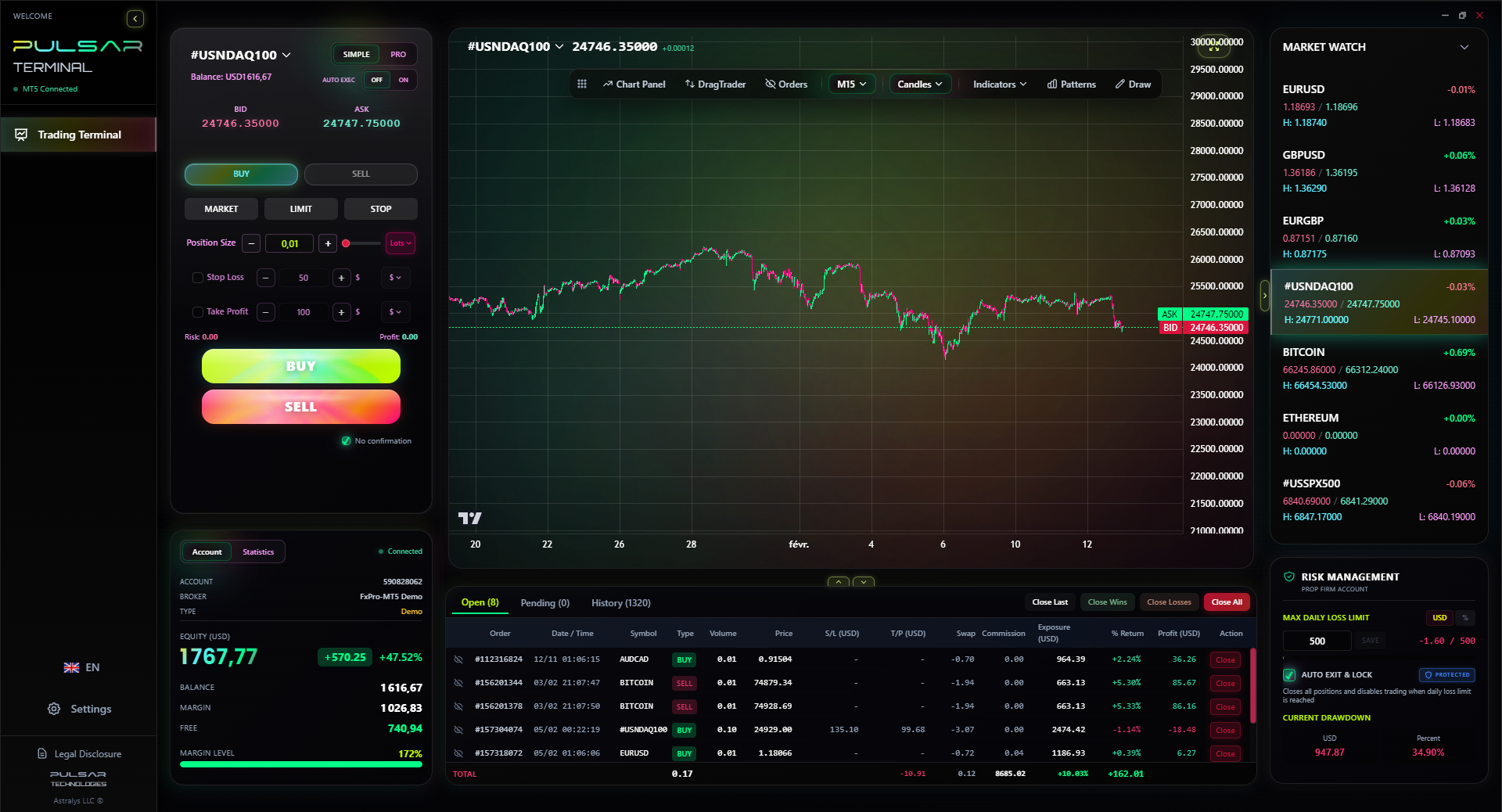
Sticking to daily loss limits is a core discipline, and Pulsar Terminal can automate this shutdown on your MT5 platform when your preset threshold is hit.
Pulsar Terminal
Das All-in-One MT5-Tool: Drag-and-Drop-Orders, Multi-TP/SL, Trailing Stop, Grid Trading, Volume Profile und Prop-Firm-Schutz. Täglich von 1.000+ Tradern genutzt.
Your broker is your mechanic. You don't need a fancy showroom, you need reliable, cheap, and compliant service.
FSCA Regulation is Table Stakes: I'll say it again. No FSP number, no trade. Brokers like Exness, XM, and Pepperstone have local regulation. This guarantees segregated funds, access to the ombudsman, and adherence to the 30:1 rule.
Platform: MetaTrader 4 or 5 is the standard for a reason. It works. Don't get distracted by flashy platforms with 100 indicators. You need reliability, especially during volatile news events like SARB announcements or budget speeches. All the brokers mentioned offer MT4/5. The real edge comes from how you use it. Learning to set alerts, use the market watch list efficiently, and manage trades quickly is more valuable than any add-on.
Execution & Slippage: On major pairs like EUR/USD, slippage should be minimal with a good ECN broker. On ZAR pairs, expect some slippage, especially around 3 PM SAST when liquidity can dip. Factor this into your stop loss placement. A mental stop placed 5 pips wider than your hard stop can save you from being whipsawed.
“A 50% drawdown requires a 100% gain just to get back to breakeven. The math is cruel and non-negotiable.”
Here's a realistic timeline for a dedicated beginner starting with R10,000.
Months 1-3: Paid Education. Expect to lose. Your goal is to lose as little as possible while learning. Practice on a demo, then switch to a real micro account. Risk 0.5% per trade. Focus on one or two pairs, like EUR/USD and USD/ZAR. Your only metric: consistency in following your rules, not P&L.
Months 4-6: Breakeven. You should be hitting your stop losses and take profits without emotion. Your journal is full. You're starting to see a few high-probability setups repeat. Your goal is to end this period with your initial capital intact. This is a massive win.
Months 7-12: Consistent Profit. You now have a small, statistical edge. You might aim for a 2-5% return per month. On R10k, that's R200 - R500. It sounds pathetic, but it's sustainable. This is where you prove you can make money after spreads, commissions, and accounting for taxes. Now you can consider scaling your capital.
Example: A true 'forex genius' at this stage might make R4,000 profit in a month on a R100,000 account (4%). After a conservative 30% tax provision, that's R2,800 net. It's not glamorous, but it compounds. It's a second income, not a lottery ticket. Compare that to the guy who made R20,000 one month and lost R30,000 the next.
💡 Winstons Tipp
Your annual review should have two key metrics: Net Profit/Loss after all costs, and Maximum Drawdown. If the second number scares you, fix it before trying to improve the first.
After 12 years, I've met one trader I'd call a genius. He's a quant in Cape Town who builds algorithmic models. For the rest of us, genius is a mirage.
The sustainable edge for the South African retail trader is a relentless focus on the boring stuff: FSCA compliance, SARS paperwork, precise position sizing, and emotional discipline. It's about treating trading like a small business, not a casino.
The market will have days where you feel like a genius. It will have more days where you feel like an idiot. Your system is what carries you through both. Stop looking for the secret. Start building the system. That's how you last long enough for compounding to actually work in your favor. Start with understanding the true cost of a single pip on your chosen pair, and build your entire plan from that one, unglamorous fact.
FAQ
Q1Is forex trading legal and taxable in South Africa?
Yes, it's legal through FSCA-regulated brokers. And yes, profits are absolutely taxable as income by SARS. You must keep detailed records of all trades for your tax return.
Q2What's the maximum use I can use?
For retail traders, the FSCA caps use at 30:1. This is a protective rule. Professional traders who meet specific criteria (like a large portfolio and experience) can apply for higher use, but starting out, 30:1 is your limit - and using less is wiser.
Q3Why are spreads on USD/ZAR so much higher than EUR/USD?
Liquidity. EUR/USD is the most traded pair globally. USD/ZAR is an exotic pair with lower trading volume, so the cost to trade (the spread) is wider to compensate the broker for the risk. This makes frequent trading or scalping ZAR pairs much more difficult.
Q4How much money do I realistically need to start?
You can technically start with R500. But realistically, you need enough so that 1% of your account (your risk per trade) is a meaningful amount to practice proper position sizing. R10,000 is a more practical starting point to learn with real stakes without being wiped out by a few small losses.
Q5Can I use international brokers like IC Markets or Pepperstone?
Yes, but only if they hold a specific FSCA license (an FSP number). Don't use their global entity. You must open an account under their South African-regulated entity to ensure your funds are protected under local law and use is capped correctly.
Q6What's the single most important rule for a beginner?
The 1% risk rule. Never risk more than 1% of your total account capital on a single trade. This rule alone will prevent account blow-ups and force you to develop discipline.
Q7How do I handle profits for SARS?
Set aside a portion (I use 25-30%) of every withdrawal into a separate savings account earmarked for tax. Maintain a simple spreadsheet tracking the date, profit/loss, and running total for the tax year. Your broker's monthly statements are your official backup.
Prof. Winstons Lektion
Wichtige Erkenntnisse:
- ✓Verify FSCA FSP number before any deposit.
- ✓Risk maximum 1% of account per trade.
- ✓Set a hard daily loss limit (e.g., 3%).
- ✓Reserve 25-30% of profits for SARS.
- ✓Trade liquidity: EUR/USD over exotics.
Wie nützlich war dieser Artikel?
Klicken Sie auf einen Stern
Wöchentliche Trading-Einblicke
Kostenlose wöchentliche Analysen & Strategien. Kein Spam.
Über den Autor
David van der Merwe
Schwellenland-Trader
In Johannesburg ansässiger Trader mit 11 Jahren Erfahrung in Schwellenländerwährungen. Spezialisiert auf ZAR-Paare, FSCA-regulierten Handel und Analyse des südafrikanischen Marktes.
Kommentare
Risikohinweis
Der Handel mit Finanzinstrumenten birgt erhebliche Risiken und ist möglicherweise nicht für alle Anleger geeignet. Vergangene Ergebnisse garantieren keine zukünftigen Renditen. Dieser Inhalt dient ausschließlich Bildungszwecken und stellt keine Anlageberatung dar. Führen Sie immer Ihre eigene Recherche durch, bevor Sie handeln.
Das könnte Sie auch interessieren

Cara Trading Forex Sukses: 7 Prinsip dari Trader Profesional
Cara trading forex sukses dengan 7 prinsip trader pro: manajemen modal, disiplin, journal trading, backtest. Data nyata, bukan janji profit palsu.
Jam Trading Forex Terbaik untuk Trader Indonesia: Panduan Lengkap dengan Tabel Waktu
Panduan jam trading forex untuk trader Indonesia. Tabel 4 sesi dunia, jam emas 20:00-00:00, sesi mana yang harus dihindari. Data akurat + tips dari trader berpengalaman.
Top 5 Sàn Forex Uy Tín Nhất 2026: Review Jujur dari Trader Indonesia
Top 5 sàn forex uy tín 2026 untuk trader Indonesia. Review jujur: spread, deposit, withdraw, dukungan lokal. Exness, XM, IC Markets & lebih.
Pulsar Terminal herunterladen
Alle diese Rechner sind in Pulsar Terminal mit Echtzeit-Daten Ihres MT5-Kontos integriert.
Pulsar Terminal herunterladen