


How many times have you placed a solid trade, only to see it blown to pieces by some random news announcement you didn't even know was coming? I've been there, and it's a sickening feeling.

David van der Merwe
Schwellenland-Trader ·  South Africa
☕ 12 Min. Lesezeit
Was Sie lernen werden:
- 1What Exactly Is a Forex Market Calendar?
- 2The Events That Actually Matter (For Us)
- 3How to Read the Calendar (Beyond the Headlines)
- 4Practical Trading Strategies for News Events
- 5The South African Context: Regulations & Reality
- 6Mistakes I've Made (So You Don't Have To)
- 7My Go-To Tools and Resources
- 8Building Your Weekly Trading Routine
How many times have you placed a solid trade, only to see it blown to pieces by some random news announcement you didn't even know was coming? I've been there, and it's a sickening feeling. The truth is, trading without a forex market calendar is like driving with a blindfold on. For us in South Africa, it's not just about global events. It's about understanding what makes the Rand tick, when our own SARB speaks, and how to position yourself before the volatility hits. This isn't about predicting the news; it's about managing your risk around it.
Let's strip away the jargon. A forex market calendar is simply a schedule of economic events that have the potential to move currency prices. Think of it as the market's diary. It tells you when major players like central banks are making announcements, when inflation or employment data is being released, and when political decisions are due.
For a South African trader, this tool is non-negotiable. Our market might be smaller, but with a daily volume pushing $21 billion, it reacts sharply. The calendar helps you answer two critical questions: When should I be extra cautious? And when might a major opportunity present itself?
It lists events with a forecast (what economists expect), a previous figure (what happened last time), and an actual result (what just got released). The real magic, and the source of volatility, is in the difference between the forecast and the actual. A big miss or beat can send pairs like USD/ZAR on a wild ride. I learned this the hard way early on, ignoring a US Non-Farm Payrolls release. My carefully plotted support level on EUR/USD meant nothing when the number came in double the forecast. The pair gapped 50 pips against me in a second. That was a R2,500 lesson in respecting the calendar.
You'll see dozens of events each week. Most are noise. Your job is to filter for the high-impact ones. Here’s my personal hierarchy, built from watching the ZAR for over a decade.
Global Heavy-Hitters (Move Everything)
These events cause ripples across all major pairs, which inevitably affect ZAR crosses.
- US Interest Rate Decisions (FOMC): The big one. The US Dollar is the world's reserve currency. When the Fed speaks, every other currency listens. This dictates global risk sentiment.
- US Non-Farm Payrolls (NFP): Released the first Friday of every month. It's the premier gauge of US economic health. Expect extreme volatility in USD pairs for about an hour after the release.
- US CPI (Inflation Data): The Fed's main guide for interest rates. A hot CPI print means higher rates for longer, boosting the USD.
- ECB & BOE Rate Decisions: Critical for EUR and GBP, which are major components of pairs like EUR/ZAR and GBP/ZAR.
Local ZAR Catalysts (Our Home Game)
This is where you can gain an edge. International traders might overlook these, but you shouldn't.
- SARB Interest Rate Decision: This is our Super Bowl. The South African Reserve Bank's Monetary Policy Committee (MPC) meets every two months. Their decision on the repo rate directly impacts the Rand's yield attractiveness. I always clear my ZAR positions 30 minutes before this announcement.
- South African CPI & PPI: Local inflation data. A high print increases pressure on the SARB to hike rates, which can temporarily strengthen the ZAR.
- South African Unemployment Rate: A key social and economic indicator. Surprisingly, the market reaction can be mixed - bad news sometimes weakens the ZAR, but it can also spark hope for government stimulus.
- Medium-Term Budget Policy Statement (MTBPS): Held around October. The finance minister outlines spending plans. A credible, fiscally responsible statement can support the ZAR; a loose one can hammer it.

Warning: Trading ZAR pairs around local events requires a broker with reliable execution and tight spreads. Slippage can be brutal. I've had good experiences with the execution speeds from brokers like FP Markets and Tickmill during these times.
“The real magic, and the source of volatility, is in the difference between the forecast and the actual.”
Seeing the event is step one. Interpreting it is step two. Here’s my process.
First, I look at the Volatility Forecast. Most calendars use a 1-3 bull or star system. I only adjust my trading for 2- or 3-star events. A 1-star event? I might just note it and carry on with my swing trading plan.
Second, I compare the Actual vs. Forecast. This is the engine of the move.
- Actual > Forecast: Typically good for the currency of the country releasing the data (e.g., a strong US Retail Sales figure is bullish for USD).
- Actual < Forecast: Typically bad for that currency.
But here’s the twist: Market Reaction vs. Economic Theory. Sometimes, the market has already "priced in" a certain outcome. A rate hike that was fully expected might cause the currency to fall ("sell the news"). You need to gauge market sentiment beforehand. I use tools like the COT (Commitments of Traders) report and simple price action to see if a move is over-extended before an event.
Third, I listen to the tone and language. For central bank decisions, the number itself is often less important than the accompanying statement and press conference. Is the SARB governor hawkish (hinting at future hikes) or dovish (suggesting a pause)? The nuance in the wording moves markets for days.

Pro Tip: Don't just trade the headline number. Wait for the initial 1-2 minute spike and settle. Often, the market overreacts initially, then reverses as smarter money digests the details. I’ve made more money fading the initial panic spike than I have trying to catch it.

💡 Winstons Tipp
The market's reaction to news is more important than the news itself. A 'good' number that sells off tells you everything about underlying sentiment.
You have three basic choices: avoid, trade the breakout, or trade the reversal. I've used all three.
1. The Safe Play: Avoidance & Position Management. This is my default for the biggest events (FOMC, NFP, SARB). I close all positions 30-60 minutes before the release. Why? Because spreads widen dramatically, and liquidity vanishes. Your 2-pip spread on USD/ZAR can blow out to 15 pips in a heartbeat. I use this time to review my position size calculator and plan for after the chaos. It's boring, but it protects capital.
2. The High-Risk Play: Trading the Breakout. This requires a fast broker and nerves of steel. The idea is to place buy-stop and sell-stop orders just above and below the pre-news range, anticipating a big directional move. Whichever order gets triggered, you ride the momentum.
Example: Before a high-impact US data release, EUR/USD is trading between 1.0850 and 1.0870.
- Place a buy-stop at 1.0875.
- Place a sell-stop at 1.0845.
- Set a tight stop-loss (e.g., 15 pips) and a take-profit target (e.g., 30-40 pips).
Once one order triggers, cancel the other. I used this strategy more in my early days, but it's prone to whipsaws (false breakouts).
3. The Contrarian Play: Fading the Initial Move. This is my preferred method for trading news now. After the initial violent spike (up or down), the market often retraces as liquidity returns and traders take profits. I wait for the momentum to stall, look for a rejection candle on the 1 or 5-minute chart, and enter in the opposite direction of the spike, aiming for a 50% retracement.
A Real Trade: During a SARB meeting, USD/ZAR spiked 150 pips higher on a hawkish hint. The 5-minute chart showed a massive bullish candle, then a doji, then a bearish engulfing candle. I went short at the close of the engulfing candle, with a stop above the spike high. The pair retraced 80 pips of the move over the next hour for a solid win.
Remember, no matter the strategy, your position size must be smaller for news trades. Volatility is not your friend if you're over-leveraged.
“If you missed the initial move, wait for a retracement or just let it go. There's always another trade.”
Trading the calendar here isn't just about charts; it's about operating within our unique framework. The FSCA's 30:1 use cap for retail traders is a blessing in disguise for news trading. High use around volatile events is a guaranteed account killer. That 30:1 forces a bit of discipline.
Also, remember the tax man. SARS wants its share. Any profits you make from these short-term news trades are considered income and are taxable. Keep a detailed trading journal - not just for your strategy, but for SARS. I log every trade, including the news catalyst that prompted it.
The recent SARB exchange control amendments (late 2025) also highlight something: moving money in and out of South Africa is being scrutinized. When you profit with an international broker, withdrawing those funds back to your South African bank account needs to be above board. Always use FSCA-licensed brokers or reputable international ones with a clear track record, like IC Markets or Pepperstone, to avoid any withdrawal hassles.
Finally, those stats about 51-89% of retail traders losing money? A huge chunk of those losses happen around unscheduled news or poorly managed scheduled news trades. The calendar is your first line of defense against being part of that statistic.
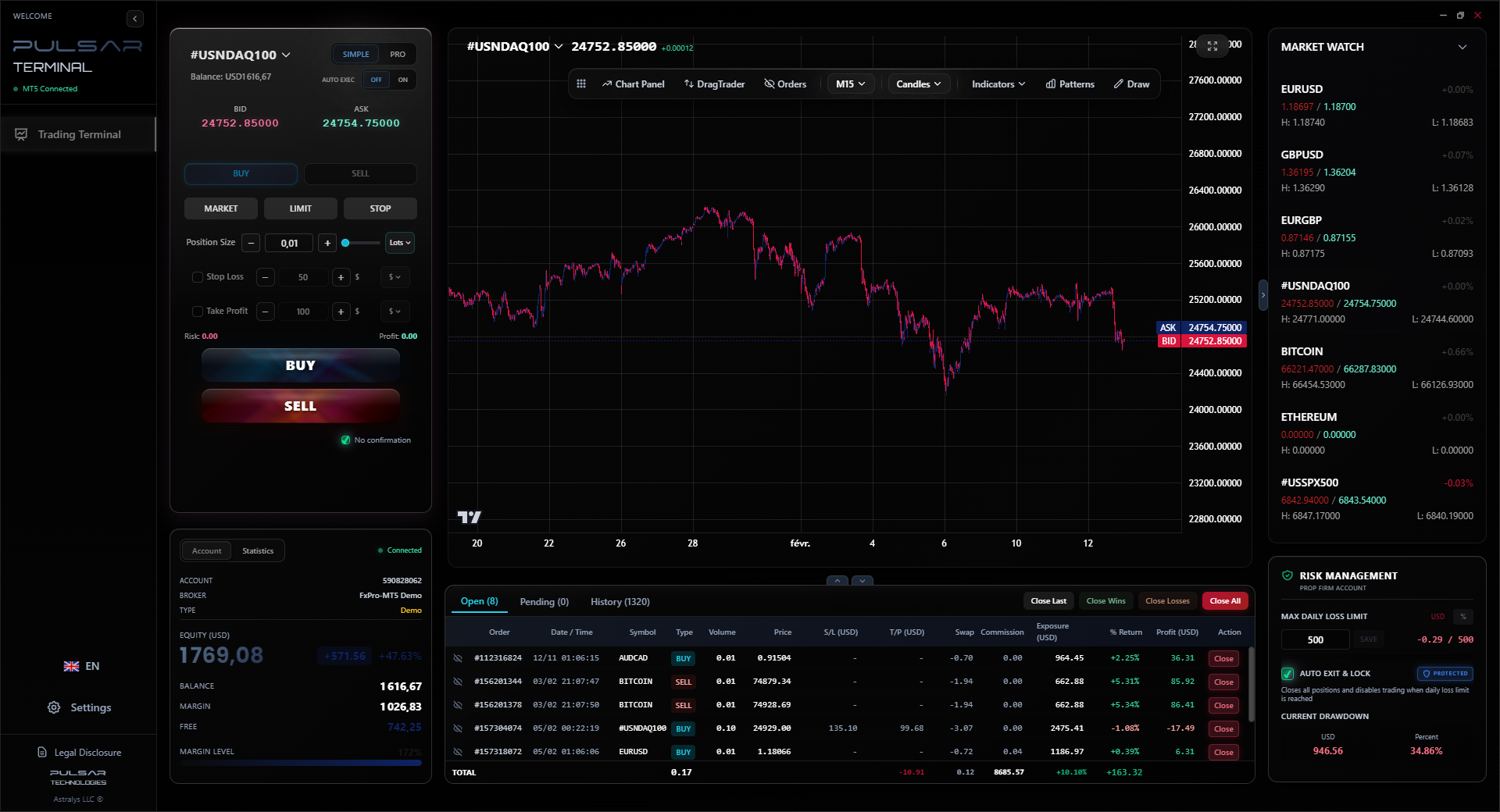
Managing multiple trades and setting precise stops around volatile news events is stressful, but tools like Pulsar Terminal automate this directly on your MT5 platform.
Pulsar Terminal
Das All-in-One MT5-Tool: Drag-and-Drop-Orders, Multi-TP/SL, Trailing Stop, Grid Trading, Volume Profile und Prop-Firm-Schutz. Täglich von 1.000+ Tradern genutzt.
Let me be brutally honest about my blunders. Learn from these.
Mistake 1: Trading Without a Stop-Loss Before News. Early in my career, I thought I could mentally manage the risk. Then a UK Brexit vote surprise happened. GBP/JPY crashed 800 pips in minutes. By the time I could click close, my loss was 5 times what I'd planned. Always. Use. A. Stop-Loss. A guaranteed margin call awaits those who don't.
Mistake 2: Chasing the News After the Move. You see USD/ZAR rally 200 pips on a rate hike. FOMO kicks in. You buy at the top, convinced it'll go higher. That's usually the exact moment the smart money is selling to you. The pair then drops 180 pips. If you missed the initial move, wait for a retracement or just let it go. There's always another trade.
Mistake 3: Overlooking Revisions. Sometimes, the market focuses less on the current release and more on the revision to the previous month's number. I once traded a positive US GDP print, only to see the USD fall because the prior month's stellar number was revised sharply lower. Always check the previous figure column on the calendar.
Mistake 4: Ignoring Confluence. A high-impact news event hitting right at a major technical support/resistance level or a key Fibonacci level is a powder keg. I used to look at news in isolation. Now, I only take the highest-probability trades when news aligns with a clear technical level. It increases the chance of a clean, sustained breakout.
💡 Winstons Tipp
Your best trade before a major event is often no trade at all. Preserving capital to fight another day is a strategic victory.
“This routine turns the forex market calendar from a source of anxiety into a structured part of your edge.”
You don't need to pay for an expensive service. These are the free resources I use every day.
1. Economic Calendars:
- ForexFactory: The old faithful. It's simple, customizable, and has a great community forum to gauge sentiment before events.
- Investing.com: My personal favourite. The interface is clean, you can filter for specific countries (crucial for SA data), and it integrates with their charts.
- MetaTrader 5 Terminal Calendar: Built right into the MT5 platform. It's basic, but having it right there is convenient.
2. Analysis Tools:
- Central Bank Calendars: Bookmark the SARB, Fed, ECB, and BOE websites. Their official calendars give the exact times of meetings and speeches.
- Real-Time News Wire: Some brokers, like those reviewed on this site (e.g., Exness), have integrated news feeds from Reuters or Dow Jones. Crucial for catching unscheduled headlines.
3. Practical Setup: I have two monitors. One runs my trading platform and charts. The other has my economic calendar open and a live news feed. This separation prevents me from getting tunnel vision on just the charts. Before I had this setup, I'd often miss a related event in another timezone that would affect my trade.
Consistency beats brilliance. Here’s the simple weekly routine that transformed my trading.
Sunday Evening: I spend 20 minutes scanning the forex market calendar for the week ahead. I highlight all 2- and 3-star events in my trading journal. I note the times (converted to SAST) and the currencies involved.
Each Morning (Before 8 AM SAST): I review the calendar for the day. I ask: What are the key events? Do any coincide with the London open (10 AM SAST) or New York open (3 PM SAST)? That’s a volatility double-whammy. I then adjust my trade plans accordingly. If I have a scalping strategy for EUR/USD, but ECB President Lagarde is speaking at 11 AM, I know not to trade that pair from 10:45 to 11:30.
30 Minutes Before a Key Event: I assess my open positions. If I have a trade in the currency being impacted, I close it. No exceptions. I then wait. I watch the price action, the news feed, and the updated calendar result.
After the Event: I assess the damage or the opportunity. Did the price break a key level? Did it reject a level? I don't jump in immediately. I wait for the 15-minute or 1-hour chart to print a few candles and show me where the new equilibrium might be.
This routine turns the forex market calendar from a source of anxiety into a structured part of your edge. It tells you when to be a hunter and when to be in a bunker. Master that rhythm, and you'll be ahead of most traders who are just reacting to the noise.
FAQ
Q1What is the most important economic event for the South African Rand (ZAR)?
Hands down, the South African Reserve Bank (SARB) Interest Rate Decision. It happens every two months and directly influences the Rand's yield. The statement and press conference that follow are often more important than the rate decision itself, as they guide future policy.
Q2What time do major forex news events happen in South African time (SAST)?
Most major US data is released at 3:30 PM SAST (like CPI, NFP). The FOMC rate decision is usually at 9:00 PM SAST. European data and ECB decisions typically hit between 11:00 AM and 1:00 PM SAST. The London Open at 10:00 AM SAST is a key volatility period even without scheduled news.
Q3Should I trade during high-impact news events?
As a beginner, absolutely not. Your first goal is survival. Close positions before major events and watch how the market reacts. Once you're experienced and have a proven, tested strategy for news volatility, you can consider it - but always with much smaller position sizes.
Q4Why did the price go down on good news?
This is called "buy the rumour, sell the news." The market often prices in an expected good outcome before the announcement. When the news is released, even if it's good, traders who bought earlier take profits, causing the price to fall. It's all about expectations versus reality.
Q5Are free economic calendars reliable?
Yes, the free ones from ForexFactory and Investing.com are extremely reliable for the timing and details of events. Where paid services might add value is in deeper analysis and forecasts, but for the raw data, free is perfectly fine.
Q6How does the FSCA's 30:1 use limit affect news trading?
It protects you. News trading with high use is incredibly dangerous. The 30:1 cap forces you to use more sensible position sizes, which reduces the risk of a single volatile spike wiping out your account. See it as a regulatory safety net.
Q7Do I need to pay attention to South African data if I only trade major pairs like EUR/USD?
Not directly, but you should be aware of it. Global risk sentiment drives majors, and if a major SA event causes a sharp move in ZAR pairs, it can affect liquidity and sentiment across emerging market currencies, which can have a knock-on effect. It's good context.
Prof. Winstons Lektion
Wichtige Erkenntnisse:
- ✓Always know when SARB announces (every 2 months).
- ✓Close ZAR positions 30 mins before high-impact news.
- ✓Trade news with 50% of your normal position size.
- ✓The initial 2-minute spike after news is often a trap.
- ✓Filter calendars: only act on 2-3 star events.
Wie nützlich war dieser Artikel?
Klicken Sie auf einen Stern
Wöchentliche Trading-Einblicke
Kostenlose wöchentliche Analysen & Strategien. Kein Spam.
Über den Autor
David van der Merwe
Schwellenland-Trader
In Johannesburg ansässiger Trader mit 11 Jahren Erfahrung in Schwellenländerwährungen. Spezialisiert auf ZAR-Paare, FSCA-regulierten Handel und Analyse des südafrikanischen Marktes.
Kommentare
Risikohinweis
Der Handel mit Finanzinstrumenten birgt erhebliche Risiken und ist möglicherweise nicht für alle Anleger geeignet. Vergangene Ergebnisse garantieren keine zukünftigen Renditen. Dieser Inhalt dient ausschließlich Bildungszwecken und stellt keine Anlageberatung dar. Führen Sie immer Ihre eigene Recherche durch, bevor Sie handeln.
Das könnte Sie auch interessieren

Cara Trading Forex Sukses: 7 Prinsip dari Trader Profesional
Cara trading forex sukses dengan 7 prinsip trader pro: manajemen modal, disiplin, journal trading, backtest. Data nyata, bukan janji profit palsu.
Jam Trading Forex Terbaik untuk Trader Indonesia: Panduan Lengkap dengan Tabel Waktu
Panduan jam trading forex untuk trader Indonesia. Tabel 4 sesi dunia, jam emas 20:00-00:00, sesi mana yang harus dihindari. Data akurat + tips dari trader berpengalaman.
Top 5 Sàn Forex Uy Tín Nhất 2026: Review Jujur dari Trader Indonesia
Top 5 sàn forex uy tín 2026 untuk trader Indonesia. Review jujur: spread, deposit, withdraw, dukungan lokal. Exness, XM, IC Markets & lebih.
Pulsar Terminal herunterladen
Alle diese Rechner sind in Pulsar Terminal mit Echtzeit-Daten Ihres MT5-Kontos integriert.
Pulsar Terminal herunterladen