


Everyone in Nigeria seems to have a forex 'guru' these days, promising Lambos from a 10k Naira deposit.

Olumide Adeyemi
Pionier des Tradings in Westafrika ·  Nigeria
☕ 12 Min. Lesezeit
Was Sie lernen werden:
- 1Is Forex Legal in Nigeria? (And What About Taxes?)
- 2Brokers & Payment Methods: Getting Money In and Out
- 3Trading the Naira: USD/NGN and Other Pairs
- 4use: Your Best Friend and Worst Enemy
- 5Analysis & Strategies: What Actually Works Here?
- 6Top 5 Nigerian Trader Mistakes (And How to Avoid Them)
- 7Your First 90 Days: A Realistic Plan
Everyone in Nigeria seems to have a forex 'guru' these days, promising Lambos from a 10k Naira deposit. Let me stop you right there. Most of what you hear in those WhatsApp groups is pure fantasy, designed to sell you a course or a signal service. The real forex questions and answers aren't about magic indicators, they're about surviving our volatile market, dealing with the CBN, and keeping your profits after the 10% tax man comes knocking. I've blown accounts, I've made comebacks, and I've learned what actually works here. Let's cut through the noise.
This is the first question everyone asks, and the answer is more complicated than a yes or no. For you and me, trading forex as individuals is legal. The Central Bank of Nigeria (CBN) and the SEC know we're doing it. But here's the kicker: there's no strong, clear rulebook for retail brokers operating here. It's not like the UK or Australia where they'll shut down a shady operation in a heartbeat.
That's why most serious Nigerian traders I know, myself included, use brokers regulated overseas. We're talking about firms like IC Markets review (regulated in Australia) or Exness review (Cyprus). They have to follow stricter rules about keeping client money safe. Trying to find a 'CBN-regulated' forex broker for retail trading is like looking for a snowball in Lagos.
Now, the tax part is crystal clear and non-negotiable. The Federal Inland Revenue Service (FIRS) wants 10% of your gross trading profits as Capital Gains Tax. Gross means your total profits before you subtract any losses. It doesn't matter if your broker is in Cyprus or your money is in a USD account. If you're a Nigerian resident making money, you owe the tax. I learned this the hard way after a great quarter in 2021. I made about ₦2.8 million in profit and had to write a cheque for ₦280,000. It stung, but it's the cost of doing legitimate business.

Warning: Ignoring the 10% capital gains tax is asking for trouble. The FIRS is getting smarter about tracking digital income. Set aside 10% of every withdrawal you make into your Nigerian bank account. Consider it your first trade expense.
Choosing a broker in Nigeria isn't just about spreads. It's about whether you can fund your account on a Tuesday without your bank blocking the transaction, and whether you can get your profits out before the Naira decides to take another dive.
What to Look For in a Broker
You need a broker that accepts Nigerian clients and, crucially, offers local payment channels. The big international names are popular for a reason. XM review and Pepperstone review have been in the game here for years. They offer Naira-denominated accounts or direct integration with local payment processors. This is a game-saver. Depositing in Naira and having it converted at the broker's rate is often smoother and sometimes cheaper than trying to send USD yourself through your bank.
The Payment Method Jungle
Bank transfers are the old faithful, but they can be slow and sometimes attract questions from your bank manager. Card deposits (Visa/Mastercard) are usually instant but check for fees. The real evolution has been in e-wallets and local processors.
- Paga, Opay, Interswitch: These are gold for local deposits. Fast, familiar, and usually low-cost.
- Neteller & Skrill: These international e-wallets are widely accepted by brokers and can be funded from Nigeria. They add an extra layer between your bank and your trading account.
- Cryptocurrency (USDT): This is the open secret. A growing number of traders use USD Tether (USDT) to fund accounts. You buy USDT on a local crypto exchange, send it to a broker that accepts crypto, and you're trading. Withdrawals work in reverse. It's often the fastest and most discreet method, but you need to be comfortable with crypto wallets.
My personal setup? I use a combination. For smaller, quick deposits, I use a local processor on my broker's platform. For larger transfers, I sometimes use USDT to avoid the whole bank forex approval drama. You need to find your own comfort zone.

Pro Tip: Always do a small test withdrawal before you commit large capital to a new broker. The real test of a broker isn't how easy it is to give them money, but how easy it is to get it back.

💡 Winstons Tipp
Your first profit target should always be to recover your initial learning capital. Once your account is back to your starting deposit, you're trading with the market's money. The psychological relief is enormous.
“Real skill is consistent risk management over hundreds of trades, not a lucky streak.”
If you want to feel the pulse of Nigeria's economy, just watch the USD/NGN rate. It's a rollercoaster driven by oil prices, CBN policy announcements, and pure market sentiment. Trading it is a different beast compared to something calm like EUR/USD.
First, you often can't trade the official CBN rate directly on most major retail platforms. You're trading the 'black market' or parallel market rate through CFDs (Contracts for Difference). The volatility is insane. I've seen the rate move 5% in a day based on a rumor about dollar inflows. This isn't for the faint-hearted.
How to Approach Naira Pairs
Don't think of it as a normal forex pair. Think of it as a volatility index for Nigerian economic stress. Because the underlying fundamentals are so powerful (oil revenue, dollar scarcity, inflation), technical analysis often gets blown out of the water by a single news headline.
I once tried to scalping strategy USD/NGN based on minor support and resistance. It was a disaster. A news break about a CBN meeting would cause a 200-pip gap in seconds, wiping out my tight stops. What works better is a broader swing trading approach, looking at weekly charts and major economic triggers. You need a wide stop-loss. A 500-pip stop on USD/NGN is not unusual, which means you have to adjust your position size calculator accordingly.
Other pairs like GBP/NGN or EUR/NGN follow USD/NGN's lead but add another layer of complexity from European or British economic news. My advice? Master the major pairs like EUR/USD guide first. Use them to learn discipline. Then, if you have the stomach for it, allocate a very small portion of your capital to speculate on Naira pairs. Never make it your main trade.
I see brokers advertising 1:1000 use to Nigerian traders and it makes me cringe. It's a trap dressed as an opportunity. Yes, with 1:1000 use, a ₦10,000 deposit can control a ₦10,000,000 position. Sounds amazing, right? Until the market moves 0.1% against you and your entire account is gone.
Here's the raw math that nobody in those flashy ads shows you. Let's say you buy 1 standard lot (100,000 units) of EUR/USD with a $1,000 account at 1:100 use. That's controlling $100,000. A move of just 100 pips (1 cent) against you is a $1,000 loss. That's a 100% loss. At 1:500 use, that same 100-pip move would wipe out an account five times larger.

Example:
- Account: $1,000
- Trade: 1 lot EUR/USD (100,000 units)
- use: 1:100
- Required Margin: ~$1,000
- If price moves 100 pips (1.0900 to 1.0800): Loss = $1,000. Account = $0.
I used to chase high use, thinking it was the fast track. My first major blow-up in 2015 was exactly this. I had a $2,000 account at 1:500 use, got overconfident on a gold trade (XAU/USD guide), and a sudden $20 spike against my position triggered a margin call before I could even react. Poof. Gone.
What's a sane level? For beginners, I wouldn't go above 1:10. Even experienced traders should rarely exceed 1:30. The real pros use use to free up capital, not to magnify bets. They use it so they don't have to tie up $10,000 to control a $100,000 position, allowing them to place other trades or withstand volatility. The use isn't the trade; it's just the tool to execute your plan. If your trade idea needs 1:200 use to be profitable, it's a bad trade.
“If your trade idea needs 1:200 use to be profitable, it's a bad trade.”
Nigerian traders have a unique challenge: we're trading global markets, but living in an economy with its own wild rhythm that can distract you. The key is to find strategies that are strong and simple enough to survive both London market opens and local diesel generator noise.
Keep It Simple on the Charts
You don't need 15 indicators. I've been there, my charts looked like a rainbow threw up. It's noise. Focus on price action and a couple of key tools.
- Support & Resistance: This is universal language. Draw horizontal lines where the price has bounced before. These areas mean something to traders in New York, London, and Lagos.
- One Trend Indicator: A simple moving average, like the 50-period or 200-period on the daily chart. Is price above it (potential uptrend) or below it (downtrend)? Don't overcomplicate it.
- One Momentum Oscillator: The RSI indicator or MACD indicator is plenty. Use it to spot potential reversions when price is at those support/resistance levels. For example, if price hits a major resistance level and the RSI is above 70 (overbought), it might be a signal to look for a sell, not a guarantee.
The Nigerian Mindset Edge
Our real advantage isn't a secret indicator. It's mindset. We understand volatility and uncertainty better than a trader in a stable economy. We know that things can change fast. Apply that to trading: be quick to admit you're wrong. Use stop-losses religiously. Protect your capital like it's the last generator fuel in a blackout.
My most consistent strategy now is a boring one. I wait for price to approach a clear weekly support or resistance zone. I look for a confirmation candle (like a pin bar or a strong engulfing candle) and then enter with a stop-loss on the other side of the zone. My profit target is usually 1.5 to 2 times my risk. It's not glamorous, but it's kept me in the game for over a decade. Fancy strategies come and go. Price respecting key levels is forever.
💡 Winstons Tipp
If you can't explain your trade setup in one simple sentence ('Price bounced off the weekly support with a bullish pin bar'), it's too complicated. Complexity is the enemy of execution.
After mentoring dozens of traders here, I see the same errors on repeat. Let's break them down.
- Trading Without a Stop-Loss: This is suicide, especially with our market volatility. "I'll just watch it" is famous last words. Your phone will ring, NEPA will take light, or you'll get emotional. Always have an automatic stop in place. Every. Single. Time.
- Over-trading to Recover Losses: You lose ₦20,000 on a bad trade. The instinct is to jump right back in with a ₦40,000 trade to recover it fast. This is how you turn a small loss into a catastrophic one. After a loss, step away. Review what went wrong. Trade smaller next time.
- Following 'Gurus' Blindly: That guy on Instagram with the rented Lambo? He makes money from selling you dreams, not from trading. If his signals were so good, he'd be trading with his own millions, not hustling for your ₦5,000 subscription. Do your own analysis.
- Ignoring the Cost of Trading: The spread definition is your first enemy. If you're a scalper entering and exiting trades constantly, a 3-pip spread on EUR/USD means you start every trade 3 pips in the hole. You need the market to move 3 pips just to break even. Choose brokers with tight spreads on your preferred pairs.
- Confusing Luck with Skill: This is the big one. You make three winning trades in a row with huge use. You feel invincible. You increase your position size tenfold. Then the market reminds you it's random, and you give back all your profits plus your capital. Real skill is consistent risk management over hundreds of trades, not a lucky streak.
Sticking to a trading plan requires iron discipline, which is where tools like Pulsar Terminal's drag-and-drop order management and automated stop-loss features become a trader's best friend, especially in volatile markets.
Pulsar Terminal
Das All-in-One MT5-Tool: Drag-and-Drop-Orders, Multi-TP/SL, Trailing Stop, Grid Trading, Volume Profile und Prop-Firm-Schutz. Täglich von 1.000+ Tradern genutzt.
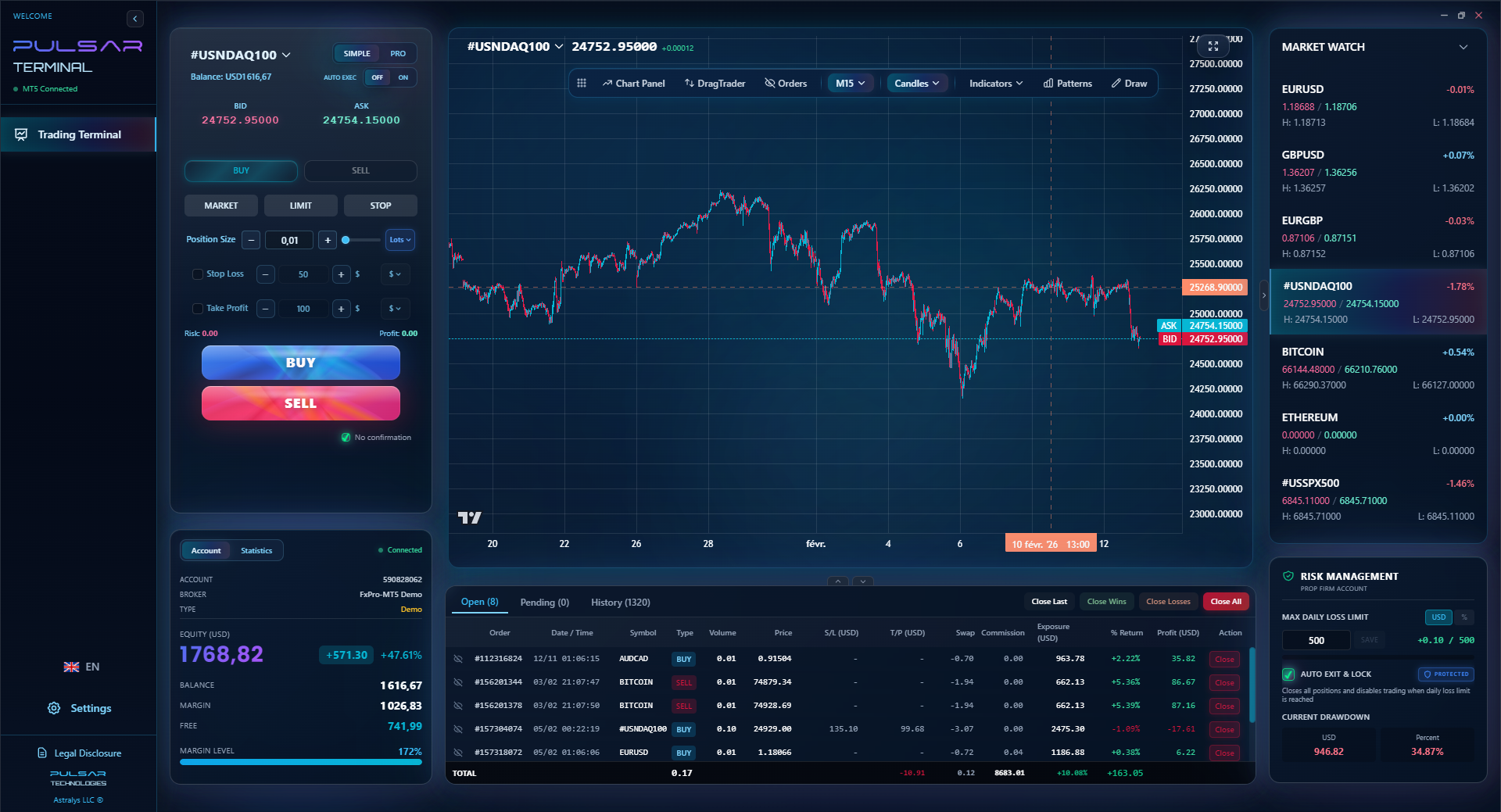
“The real forex questions and answers aren't about magic indicators, they're about surviving our volatile market.”
If you're starting from zero, forget about profits for the first three months. Your only goal is to not blow up your account while you learn. Here's the roadmap.
Phase 1: Education & Paper Trading (Weeks 1-4) Don't deposit real money. Open a demo account with a broker like IC Markets or XM. Learn what a pip definition is. Learn how to place a buy and sell order. Practice setting stop-losses and take-profits. Try out the simple strategy I mentioned earlier on the demo. Get comfortable with the platform. It should feel like a video game at this stage.
Phase 2: Micro-Live Trading (Weeks 5-12) Now, deposit the smallest amount you can. I'm talking ₦10,000 - ₦20,000. This is real money, so the psychology changes. Your goal is to make 10 small trades (0.01 lots max) following your plan. Your success metric is NOT profit. It's: Did I follow my rules on every trade? Did I use my stop-loss? Did I avoid over-trading? If you lose 30% of this starter account, you've paid a cheap tuition fee for a vital lesson. If you end flat or slightly up, you're ahead of 90% of beginners.
Phase 3: Review & Scale (After 90 Days) After three months, review all your trades. What patterns worked? What didn't? Only then should you consider adding more capital. And when you do, don't increase your position size proportionally. If you traded 0.01 lots with ₦20,000, and you add ₦80,000 to make ₦100,000 total, don't jump to 0.05 lots. Move to 0.02 lots. Grow slowly. The market isn't going anywhere.
The biggest resource you need isn't capital, it's patience. The forex questions and answers that matter are the ones you ask yourself after each trade: 'Did I stick to my plan?' and 'What can I learn from this?' Answer those honestly, and you've got a fighting chance.
FAQ
Q1What is the minimum amount I need to start forex trading in Nigeria?
Technically, you can start with as little as ₦5,000 on some brokers. But realistically, I'd say ₦20,000 is a more sensible minimum for a live account. This allows you to trade micro-lots (0.01) and actually practice risk management without being wiped out by a single small move. Remember, the minimum to learn is ₦0 – use a demo account first.
Q2Can I trade forex with my Nigerian bank account?
Yes, but not directly on a trading platform. You use your Nigerian bank account (or card, or mobile wallet) to send Naira to your broker's designated local payment processor. The broker then converts it and credits your trading account in USD, EUR, etc. Some brokers offer Naira-denominated accounts, so your profit/loss is displayed in Naira, which can simplify things.
Q3How do I pay the 10% tax on forex profits?
You are responsible for declaring and paying the tax yourself. The FIRS may not automatically track it. You should keep detailed records of all your trades (statements from your broker). Calculate your total gross profit for the year, and pay 10% of that to the FIRS. It's wise to consult a local accountant familiar with digital asset taxation to ensure you comply correctly.
Q4Is forex trading a sure way to make money?
Absolutely not. It's a high-risk activity where the majority of retail traders lose money. Think of it as a skilled profession, not a lottery or a side hustle. It requires education, discipline, emotional control, and a significant amount of time to learn. Anyone telling you it's a 'sure way' is lying to you.
Q5What time is best to trade forex in Nigeria?
The most liquid and volatile sessions overlap with our afternoon/evening. The London session opens at 8 AM GMT (9 AM Nigerian time), and the US session opens at 1:30 PM GMT (2:30 PM Nigerian time). The overlap between London and New York (2:30 PM - 5 PM Nigerian time) typically has the highest volume and best trading opportunities for major pairs like EUR/USD and GBP/USD.
Q6Should I trade cryptocurrencies or forex?
They are different beasts. Forex markets (major pairs) are generally more liquid and influenced by macroeconomic data. Cryptocurrency is far more volatile and driven by speculation and sentiment. As a beginner, forex is a more structured environment to learn trading principles. Crypto's wild swings can teach bad habits. Start with forex, master risk management, then you can explore crypto with a tiny portion of your capital if you wish.
Prof. Winstons Lektion
Wichtige Erkenntnisse:
- ✓Tax comes first: Set aside 10% of every withdrawal for FIRS.
- ✓use above 1:30 is usually a trap, not a tool.
- ✓Trade the demo until placing a stop-loss is automatic.
- ✓Your first live account should be money you're willing to lose for education.
Wie nützlich war dieser Artikel?
Klicken Sie auf einen Stern
Wöchentliche Trading-Einblicke
Kostenlose wöchentliche Analysen & Strategien. Kein Spam.
Über den Autor
Olumide Adeyemi
Pionier des Tradings in Westafrika
Einer der aktivsten Forex-Trading-Ausbilder Nigerias. 8 Jahre Trading-Erfahrung aus Lagos. Spezialisiert auf Strategien mit geringem Kapital und Prop-Firm-Challenges für afrikanische Trader.
Kommentare
Risikohinweis
Der Handel mit Finanzinstrumenten birgt erhebliche Risiken und ist möglicherweise nicht für alle Anleger geeignet. Vergangene Ergebnisse garantieren keine zukünftigen Renditen. Dieser Inhalt dient ausschließlich Bildungszwecken und stellt keine Anlageberatung dar. Führen Sie immer Ihre eigene Recherche durch, bevor Sie handeln.
Das könnte Sie auch interessieren

Cara Trading Forex Sukses: 7 Prinsip dari Trader Profesional
Cara trading forex sukses dengan 7 prinsip trader pro: manajemen modal, disiplin, journal trading, backtest. Data nyata, bukan janji profit palsu.
Jam Trading Forex Terbaik untuk Trader Indonesia: Panduan Lengkap dengan Tabel Waktu
Panduan jam trading forex untuk trader Indonesia. Tabel 4 sesi dunia, jam emas 20:00-00:00, sesi mana yang harus dihindari. Data akurat + tips dari trader berpengalaman.
Top 5 Sàn Forex Uy Tín Nhất 2026: Review Jujur dari Trader Indonesia
Top 5 sàn forex uy tín 2026 untuk trader Indonesia. Review jujur: spread, deposit, withdraw, dukungan lokal. Exness, XM, IC Markets & lebih.
Pulsar Terminal herunterladen
Alle diese Rechner sind in Pulsar Terminal mit Echtzeit-Daten Ihres MT5-Kontos integriert.
Pulsar Terminal herunterladen