


Here's a brutal truth most Nigerian trading 'gurus' won't tell you: over 70% of retail traders lose money, and a huge chunk of that failure is down to trading at the wrong time.

Olumide Adeyemi
Pionier des Tradings in Westafrika ·  Nigeria
☕ 10 Min. Lesezeit
Was Sie lernen werden:
- 1Why Session Times Aren't Just a Theory
- 2The Forex Session Schedule for Nigerian Traders (WAT)
- 3The Golden Hours: Session Overlaps
- 4What's the Best Time to Trade in Nigeria?
- 5Trading Strategies for Each Session
- 6Common Nigerian Trader Mistakes (And How to Avoid Them)
- 7Practical Tools & Broker Considerations in Nigeria
Here's a brutal truth most Nigerian trading 'gurus' won't tell you: over 70% of retail traders lose money, and a huge chunk of that failure is down to trading at the wrong time. You can have the best strategy in the world, but if you're trying to scalp the EUR/NGN when Lagos is asleep and London hasn't woken up, you're just donating your capital to the market. Your location in West Africa Time (WAT) isn't a disadvantage, it's a specific advantage if you know how to use it. This guide isn't about generic session times, it's about mapping the global forex market directly onto your Nigerian schedule.
Think of the forex market like a Lagos market. At 5 AM, it's quiet, with only a few stall owners setting up. That's the Asian session. By 10 AM, it's bustling, with people everywhere and prices moving fast. That's London opening. The chaos peaks when another huge crowd arrives at 2 PM. That's the New York overlap. If you try to buy a huge quantity of tomatoes at 5 AM, you'll get a weird price because there's no real market yet. It's the same with currency pairs.
The core variables that change with each session are liquidity and volatility. Liquidity is how easily you can buy or sell without moving the price. Volatility is how much the price moves in a given period. Low liquidity often leads to erratic, whippy price action that can stop you out on noise. High liquidity provides smoother trends but can also mean faster, more powerful moves against you if you're wrong.
I learned this the hard way early on. I was trading GBP/USD during the late Asian session (around 6 AM WAT). The spread was wide, and the price was barely moving. I got impatient, entered a large position, and then got absolutely wrecked by a 25-pip spike the moment London traders started hitting their desks at 8 AM. My stop-loss was a suggestion to the market at that moment of low liquidity. That trade cost me $420. Session times aren't academic, they're about real money.
“Your location in West Africa Time isn't a disadvantage, it's a specific advantage if you know how to use it.”
Forget GMT. Here’s the market clock set to your time. Remember, these times shift by one hour when other regions observe Daylight Saving Time (like the UK and US), but Nigeria does not. The times below are for when DST is not in effect, which is most of the year.
The Asian Session (Tokyo)
Approx. 1:00 AM – 10:00 AM WAT This is your quiet period. Major pairs like EUR/USD and GBP/USD often range. The action is in Asian proxies like AUD/USD, NZD/USD, and USD/JPY. Volatility is usually lowest here. It’s a time for analysis, planning your day, and maybe some longer-term swing trading setups. Don't expect big trends.
The London Session
Approx. 8:00 AM – 5:00 PM WAT The engine of the forex market starts. London alone does about 42% of all global volume. This is when the Euro and Pound truly come alive. EUR/USD, GBP/USD, and EUR/GBP get their direction. Liquidity floods in, spreads tighten, and real moves begin. If you're a day trader, this is when you should be at your screen.
The New York Session
Approx. 1:00 PM – 10:00 PM WAT The other heavyweight joins the fray. US economic data (like NFP) drops at 2:30 PM WAT, often causing instant, violent moves. The US dollar takes center stage. Pairs like USD/CAD and USD/CHF get active. For a Nigerian with a day job, this session starts just after lunch, offering a key trading window.

Warning: The market officially closes for the weekend at 11:00 PM WAT on Friday. Trading in the hour before this is extremely risky due to thin liquidity. Brokers widen spreads massively to protect themselves. Just don't do it.

💡 Winstons Tipp
Your first trade of the London session should be your best-planned one. The initial momentum often sets the tone for hours.
“The London-New York overlap is the Super Bowl of forex for Nigerian traders.”
This is where you make or lose your money. When two major financial centers are open simultaneously, trading volume can double. More volume means more orders, which means stronger, more sustained trends.
Tokyo-London Overlap: 8:00 AM – 9:00 AM WAT A short, one-hour window. Often sees a pickup in activity, especially in EUR/JPY and GBP/JPY. It can set the tone for the London session. It's a good warm-up, but not the main event.
London-New York Overlap: 1:00 PM – 5:00 PM WAT This is the Super Bowl of forex for Nigerian traders. For four solid hours, London and New York are both in full swing. This period consistently has the highest liquidity and volatility of the entire day. This is when major trends accelerate, breakouts are most likely to succeed, and scalping opportunities abound.
Let me give you a real example. On a Tuesday, I was watching a key resistance level on XAU/USD (Gold). The price had been testing it since 11 AM WAT but couldn't break. At 1:15 PM WAT, right as New York money started flowing, a huge volume candle smashed through. I entered long at $1834.50. The move was clean and powerful, riding the overlap liquidity. I took half profit at $1841.00 and let the rest run with a trailing stop, eventually exiting at $1845.80. The overlap provided the fuel.

Pro Tip: The absolute peak of this overlap is usually between 2:00 PM and 4:00 PM WAT. This is when you should be most focused. If you have a 9-5, this is your prime trading time. Schedule your 'breaks' accordingly.
“The London-New York overlap is the Super Bowl of forex for Nigerian traders.”
It depends entirely on your personality and strategy, but let's break it down.
| Your Profile | Recommended Session (WAT) | Why & What to Trade |
|---|---|---|
| The Full-Time Day Trader | 8:00 AM – 5:00 PM WAT | You can catch the entire London move and the crucial overlap. Focus on EUR/USD, GBP/USD, and indices. Use the Asian session for prep. |
| The 9-5 Worker (Scalper) | 1:00 PM – 3:00 PM WAT | Your lunch break and early afternoon align with the hottest part of the London-New York overlap. Perfect for quick, high-probability scalps. |
| The 9-5 Worker (Swing Trader) | Evenings & Weekends | Place your orders in the evening (after 8 PM WAT) or on weekends for the next day. Use pending orders to catch moves while you sleep or work. |
| The Night Owl | Asian Session (1 AM – 7 AM WAT) | Trade AUD/USD, NZD/USD, and USD/JPY. Expect slower, more technical moves. Avoid majors like EUR/USD which are asleep. |
Research suggests the most statistically optimal time for Nigerian traders is between 10:15 AM and 2:30 PM WAT. Why? The morning volatility from the London open has often settled into a direction by 10:15 AM, giving you clearer trends to trade right into the heart of the overlap.
My biggest consistent wins have come from trades entered between 10:30 AM and 12:00 PM WAT, aiming to ride the trend into the New York session. The worst? Trying to force trades after 8 PM WAT. The market is dying, and you're just gambling.
💡 Winstons Tipp
If you can't explain why your trade needs to be placed in the Asian session instead of waiting for London, you don't have a trade. You have a gamble.
“Boredom is not a trading signal. Just because the market is open doesn't mean you should trade.”
You don't trade the Asian session like you trade the Overlap. Here’s how to adapt.
Asian Session (WAT): The Range Player Price often moves in a 20-40 pip range for majors. Use range-bound strategies. Sell at the top of a clear range, buy at the bottom. Indicators like RSI (looking for overbought/oversold) work well here. Keep targets small (15-25 pips). A classic mistake is seeing a 20-pip move and thinking a breakout is starting. It usually isn't.
London Session (WAT): The Trend Follower This is when institutional orders flow. Look for breakouts of Asian session ranges. Use trend-following indicators like moving averages or the MACD on the 15-minute or 1-hour chart. Momentum is your friend. This is where you can aim for 40-80 pip runners.
London-New York Overlap (WAT): The Momentum Hunter This is pure price action territory. Support and Resistance levels break with authority. I often remove most indicators and just watch order flow and candle patterns. News trades happen here (at 2:30 PM WAT). If you're not comfortable with lightning-fast moves, observe for the first week. Use a strict position size calculator because volatility can blow through sloppy stops.
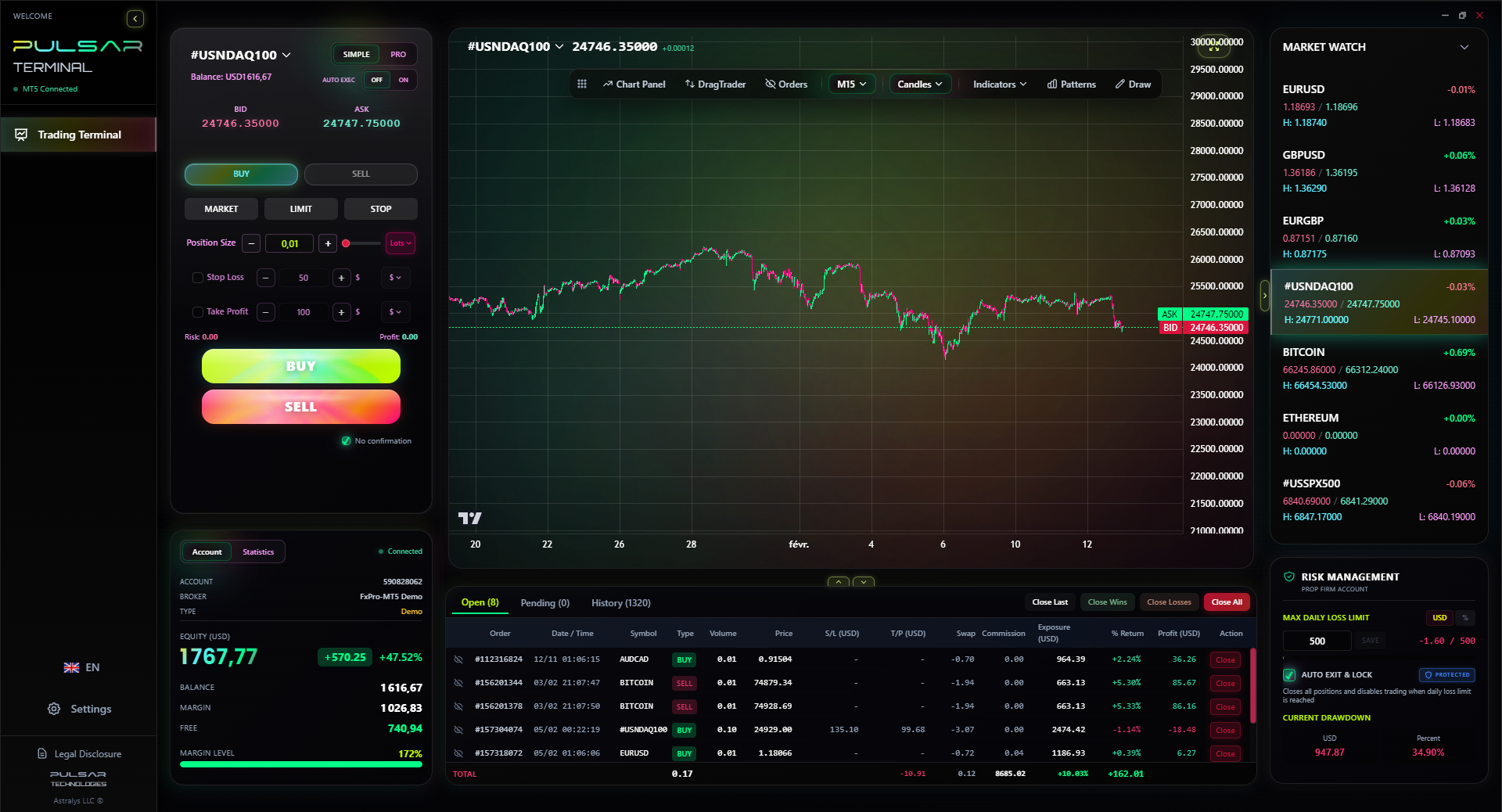
Managing trades across sessions is a pain on standard MT5. Manually moving stops to breakeven or trailing a stop requires constant attention. This is where a tool like Pulsar Terminal changes the game - you can set a breakeven or trailing stop rule when you enter, and it executes automatically, letting you manage risk without babysitting the trade during a work meeting.
Managing trades across volatile sessions is easier with automated tools like Pulsar Terminal, which can handle trailing stops and breakeven orders on MT5 while you focus on the next opportunity.
Pulsar Terminal
Das All-in-One MT5-Tool: Drag-and-Drop-Orders, Multi-TP/SL, Trailing Stop, Grid Trading, Volume Profile und Prop-Firm-Schutz. Täglich von 1.000+ Tradern genutzt.
“Boredom is not a trading signal. Just because the market is open doesn't mean you should trade.”
I've seen these destroy accounts, including my own in the early days.
1. Trading During Low Liquidity (Late Night WAT): This is suicide. Spreads on brokers like Exness or IC Markets can widen to 5-10 pips on EUR/USD. Your stop-loss becomes meaningless. A small news headline can cause a 30-pip spike that vanishes minutes later, but not before stopping you out.
2. Ignoring the Overlap: So many traders I mentor in Abuja and Lagos are active in the morning but shut down by 1 PM. They're missing the best 4 hours of the day. It's like leaving a football match at halftime.
3. Overtrading the Asian Session: Boredom is not a trading signal. Just because the market is open doesn't mean you should trade. The Asian session is for planning, not for forcing three scalps because you're bored.
4. Forgetting About DST: When the UK and US 'spring forward', their sessions start one hour earlier in WAT. So the London open shifts to 7:00 AM WAT, and the New York open to 12:00 PM WAT. Mark it on your calendar. I once missed a huge move because I was an hour late to my screen.
5. Not Accounting for Friday Close: Holding speculative positions over the weekend is asking for trouble. Gaps can open on Sunday. Always close your positions before 10 PM WAT on Friday. The margin call you avoid will be your own.
💡 Winstons Tipp
The 30 minutes after a major US news release (2:30 PM WAT) aren't for trading. They're for watching. Let the machines fight it out first.
“Over 70% of retail traders lose money, and a huge chunk of that failure is down to trading at the wrong time.”
Your broker choice directly impacts your session trading.
Economic Calendar: This is non-negotiable. You must know when high-impact news (like US CPI or Interest Rate decisions) is scheduled. These events, usually at 2:30 PM or 3:00 PM WAT, can override all technical analysis in seconds. Align your trading to avoid them or trade them with a specific plan.
Broker Spreads & Execution: During peak volatility (like the overlap), some brokers struggle. You need a broker with reliable execution and tight spreads. From my experience, international brokers like Pepperstone (with its Razor account) or XM generally handle volatility better during the London-New York crush than some local platforms. Always test your broker's execution with a demo account during the 2 PM WAT news rush.
Session Indicator Tools: Some platforms have plugins or indicators that shade the chart backgrounds for different sessions. Get one. Visually seeing the London session turn blue on your chart reinforces discipline.

Example: Let's say you trade during the overlap with a broker that has a 3-pip spread on EUR/USD instead of a 0.8-pip spread. If you're a scalper taking 10 trades a week, that's an extra 22 pips in cost you're giving away. Over a month, that's nearly 100 pips - a whole successful trade gone to fees.
FAQ
Q1What is the most volatile forex session for Nigerian traders?
Hands down, the London-New York overlap from 1:00 PM to 5:00 PM WAT. This four-hour window has the highest trading volume and the most dramatic price movements. It's when major trends are confirmed and accelerated. If you're looking for big moves, this is your time.
Q2Can I trade forex successfully in Nigeria with a 9-5 job?
Absolutely, but you have to be strategic. Your key window is the London-New York overlap, specifically 1:00 PM to 3:00 PM WAT (lunch and early afternoon). Focus on that. Use swing trading strategies with pending orders placed in the evening to capture moves while you're at work. Don't try to trade the Asian or late New York sessions; it's incompatible with a normal sleep schedule.
Q3Do forex session times change in Nigeria?
Nigeria's time (WAT) stays the same. However, the opening times of other centers change when they observe Daylight Saving Time (DST). Typically from late March to late October, London and New York sessions start one hour earlier from the Nigerian perspective. So London would open at 7:00 AM WAT instead of 8:00 AM.
Q4Is it safe to trade during the Asian session (1 AM - 10 AM WAT)?
It's 'safe' in terms of lower volatility, but it's also less profitable for trend-based strategies. The main risks are wider spreads and false, whippy breakouts due to lower liquidity. It's best for range trading specific pairs (AUD/USD, USD/JPY) or for placing longer-term swing trade orders that you expect to trigger during later sessions.
Q5What should I do as a Nigerian trader when the market is closed?
This is your golden time for the next three things: 1) Analysis: Review the past week's charts, mark key support/resistance levels. 2) Planning: Write your trading plan for Monday. Which levels will you watch? What news is coming? 3) Education: Work on your psychology, backtest a strategy, or study market structure. The weekend is for preparing to win, not regretting losses.
Q6How do I know which session is currently active on my charts?
The simplest way is to use a 'Session Indicator' on your MT4/MT5 platform. It will shade the chart background (e.g., yellow for Asia, blue for London, green for New York). If you don't have one, just remember the WAT times: Before 8 AM = Asia, 8 AM-1 PM = London solo, 1 PM-5 PM = Overlap, after 5 PM = New York solo (fading).
Prof. Winstons Lektion
Wichtige Erkenntnisse:
- ✓Trade the London-New York overlap (1-5 PM WAT) for maximum momentum.
- ✓Avoid trading majors during low-liquidity Asian sessions.
- ✓Always adjust for Daylight Saving Time shifts in March & October.
- ✓Use the 10:15 AM - 2:30 PM WAT window for highest-probability setups.
- ✓Never hold speculative positions over the weekend close (11 PM WAT Friday).
Wie nützlich war dieser Artikel?
Klicken Sie auf einen Stern
Wöchentliche Trading-Einblicke
Kostenlose wöchentliche Analysen & Strategien. Kein Spam.
Über den Autor
Olumide Adeyemi
Pionier des Tradings in Westafrika
Einer der aktivsten Forex-Trading-Ausbilder Nigerias. 8 Jahre Trading-Erfahrung aus Lagos. Spezialisiert auf Strategien mit geringem Kapital und Prop-Firm-Challenges für afrikanische Trader.
Kommentare
Risikohinweis
Der Handel mit Finanzinstrumenten birgt erhebliche Risiken und ist möglicherweise nicht für alle Anleger geeignet. Vergangene Ergebnisse garantieren keine zukünftigen Renditen. Dieser Inhalt dient ausschließlich Bildungszwecken und stellt keine Anlageberatung dar. Führen Sie immer Ihre eigene Recherche durch, bevor Sie handeln.
Das könnte Sie auch interessieren

Cara Trading Forex Sukses: 7 Prinsip dari Trader Profesional
Cara trading forex sukses dengan 7 prinsip trader pro: manajemen modal, disiplin, journal trading, backtest. Data nyata, bukan janji profit palsu.
Jam Trading Forex Terbaik untuk Trader Indonesia: Panduan Lengkap dengan Tabel Waktu
Panduan jam trading forex untuk trader Indonesia. Tabel 4 sesi dunia, jam emas 20:00-00:00, sesi mana yang harus dihindari. Data akurat + tips dari trader berpengalaman.
Top 5 Sàn Forex Uy Tín Nhất 2026: Review Jujur dari Trader Indonesia
Top 5 sàn forex uy tín 2026 untuk trader Indonesia. Review jujur: spread, deposit, withdraw, dukungan lokal. Exness, XM, IC Markets & lebih.
Pulsar Terminal herunterladen
Alle diese Rechner sind in Pulsar Terminal mit Echtzeit-Daten Ihres MT5-Kontos integriert.
Pulsar Terminal herunterladen