


Here's a hard truth: 90% of the 'free forex technical analysis PDF' downloads you find are outdated or just plain wrong for our market.

David van der Merwe
Schwellenland-Trader ·  South Africa
☕ 10 Min. Lesezeit
Was Sie lernen werden:
Here's a hard truth: 90% of the 'free forex technical analysis PDF' downloads you find are outdated or just plain wrong for our market. I've wasted more hours than I care to admit on fancy guides that assumed I was trading from London with unlimited capital. The reality for us in South Africa is different. Our Rand (ZAR) pairs move differently, our brokers have specific FSCA rules, and our costs are unique. This isn't another generic list of indicators. This is a local's guide to building a technical analysis system that actually works with a R10,000 account, ZAR-denominated spreads, and the 30:1 use limit we all live with.
Let's get this out of way first. That glossy 200-page forex technical analysis PDF you downloaded? It was probably written for a global audience. It doesn't account for the ZAR's unique volatility or the fact that your broker's spreads on USD/ZAR can widen to 50 pips during local news events.
I learned this the hard way. Early on, I followed a 'proven' support and resistance strategy from a popular PDF. It worked beautifully on EUR/USD in the guide. So, I tried it on USD/ZAR. I bought at what looked like solid support at R18.20. The problem? I didn't know that major local corporates were buying USD for offshore payments that afternoon. The 'support' broke like a twig, and I was stopped out for a 2% loss before London even opened. The PDF never mentioned local liquidity.

Warning: A strategy built for the steady, liquid EUR/USD will often fail on volatile EM pairs like USD/ZAR or EUR/ZAR unless you adjust for spread and local market hours.
The second big failure is use. Most international guides casually talk about 100:1 or 200:1. Our FSCA retail limit is 30:1. That's not a limitation, it's a lifesaver. But it changes your position sizing math completely. A strategy that suggests risking 2% on a 100:1 account can become dangerously over-leveraged if you blindly copy it at 30:1 without recalculating. Always use a position size calculator with your actual use setting.
Finally, those PDFs ignore our cost structure. Trading a 'spread-only' account with IG at 0.98 pips on EUR/USD is different from trading an ECN account at FP Markets with 0.0 pips but a $3.50 commission per lot. Your technical system's profit targets need to be wide enough to cover the real cost of doing business here.

💡 Winstons Tipp
A chart pattern is just a story the market is telling. Your job isn't to believe the story, but to bet on it with a pre-planned exit if the plot changes.
Forget downloading another generic template. Let's build a technical setup tailored to our platforms and market rhythms.
Start With the Right Platform and Pair
Stick with MetaTrader 4 or 5. It's the universal language here. Every decent FSCA broker, from XM to IC Markets, supports it. This means your charts, indicators, and templates are portable if you ever switch brokers. I use MT5 because I like having more timeframes and the built-in economic calendar.
Pair selection is critical. If you're starting, trade the majors: EUR/USD, GBP/USD, USD/JPY. Their spreads are tight (often under 1 pip on good accounts), and the technical patterns are clean because of the massive liquidity. Once you're consistently profitable there, you can graduate to the ZAR crosses. I treat USD/ZAR like trading a different animal. I use wider stops, expect bigger spreads, and I only trade it when I'm focused during Johannesburg hours (8am-5pm).
The Core Indicator Stack for SA Conditions
You don't need 20 indicators. You need 2 or 3 you understand deeply. Here's my bread and butter:
- Price Action & Horizontal Lines: This is free and powerful. Mark clear swing highs and lows, previous day's high/low, and weekly opening prices. On USD/ZAR, pay special attention to big, round numbers (R18.00, R18.50). They often act as psychological magnets.
- A Moving Average for Trend: I use a simple 50-period Exponential Moving Average (EMA) on the 1-hour and 4-hour charts. It helps me answer one question: Is the market generally above or below this level? I don't use it for precise entries.
- A Momentum Oscillator for Timing: The RSI indicator is my go-to. Set it to 14 periods. I look for divergences (when price makes a new high but RSI doesn't) and overbought/oversold conditions above 70 or below 30. On a volatile pair like GBP/ZAR, the RSI can hit extremes and stay there, so use it as a context tool, not a standalone signal.

Pro Tip: Save your chart template! Once you have your colors, line styles, and indicators set, save it as a 'SA Default' template. It loads in one click next time. This simple step saves me 10 minutes every morning.
Accounting for Spread in Your Analysis
This is the most important local adjustment. If the spread on EUR/ZAR is 15 pips, your technical levels need a buffer. If you want to buy at a support level of R19.5000, place your pending buy limit order at R19.5015. That way, if the price hits your level, your order is already above the ask price and will execute. Otherwise, the market can tap your exact level and bounce without filling you. I've been ghosted by my own charts more times than I can count because I ignored the spread.
“The most valuable 'PDF' is the one you create from your own trade records and screenshots.”
Theory is useless without practice. Let me walk you through two recent trades with exact numbers. One win, one loss. This is what technical analysis looks like in the real world, with Rand amounts.
Trade 1: The Good (A USD/ZAR Swing)
- Chart: USD/ZAR 4-hour.
- Setup: Price had been in a downtrend but formed a clear 'double bottom' pattern around R18.1500. The RSI indicator showed a bullish divergence (price made a lower low, RSI made a higher low).
- Action: I placed a buy limit order at R18.1600 (factoring in a 10-pip spread on my broker at the time).
- Entry: Filled at R18.1600 on 15 March, 2024.
- Stop Loss: Placed at R18.0900 (70 pips risk).
- Take Profit: Set at R18.3500 (190 pips target).
- Position Size: I risked 1% of my R50,000 account = R500. With a 70-pip risk, that meant a position size of roughly R71,428 of USD/ZAR (R500 / (70 pips * R0.0001 per pip value approx.)).
- Result: Price rallied steadily. Hit my take profit 4 days later. Net profit: R1,357 after spreads and a small commission. The technical pattern played out cleanly.
Trade 2: The Bad (A EUR/USD Scalp Gone Wrong)
- Chart: EUR/USD 5-minute. I was trying a scalping strategy.
- Setup: Price broke above a small consolidation. MACD indicator crossed bullish. Looked textbook.
- Action: Market buy at 1.0835.
- Entry: Filled at 1.0835.
- Stop Loss: Too tight at 1.0825 (10 pips).
- Take Profit: Greedy at 1.0855 (20 pips).
- The Mistake: I ignored the upcoming US CPI news in 20 minutes. The spread widened from 0.3 to 2 pips momentarily, my tight stop was hunted, and I was stopped out at 1.0823 (slippage). Loss: $12 on a micro lot. The lesson? Technicals break down around high-impact news. My analysis was correct for a quiet market, but my timing was terrible.
These trades show the importance of context. The same RSI divergence that worked on a 4-hour chart failed on a 5-minute chart during news.
💡 Winstons Tipp
The most reliable 'indicator' in South Africa is the JSE closing time. Liquidity often dries up after 5pm, making technical breaks on minor pairs less trustworthy.
Our 30:1 use cap is a gift. It forces discipline. But you still need a rock-solid risk management plan, which is the most important part of any trading system.
The 1% Rule is Non-Negotiable: Never risk more than 1% of your account equity on a single trade. On a R10,000 account, that's R100. If your stop loss is 50 pips away, your position size must be small enough that a 50-pip loss equals R100. This single rule has saved my account more than any indicator ever has.
Stop Losses: Technical, Not Emotional: Your stop loss should be placed at a point where your technical analysis is proven wrong. If you buy at a support trendline, your stop goes below the trendline. Don't place it based on how much money you're willing to lose. I use ATR (Average True Range) to gauge recent volatility and place my stop just outside the normal noise. For example, if USD/ZAR's 14-period ATR is 150 pips, a 30-pip stop is suicide.
Beware of the Margin Call: With 30:1 use on a R10,000 account, you control R300,000 worth of currency. A few bad trades in a row can eat your equity fast. If your used margin gets too high relative to your equity, you'll get a margin call and your positions will be automatically closed. The best defense is the 1% rule and never using more than 10-15% of your total margin at once.
Warning: Some international brokers serving SA clients might offer higher use through their global entities. It's tempting, but you lose FSCA protection. If they go under or there's a dispute, you're in a much weaker position. Stick with FSCA-licensed brokers like Pepperstone or Exness (their local entity) for peace of mind.
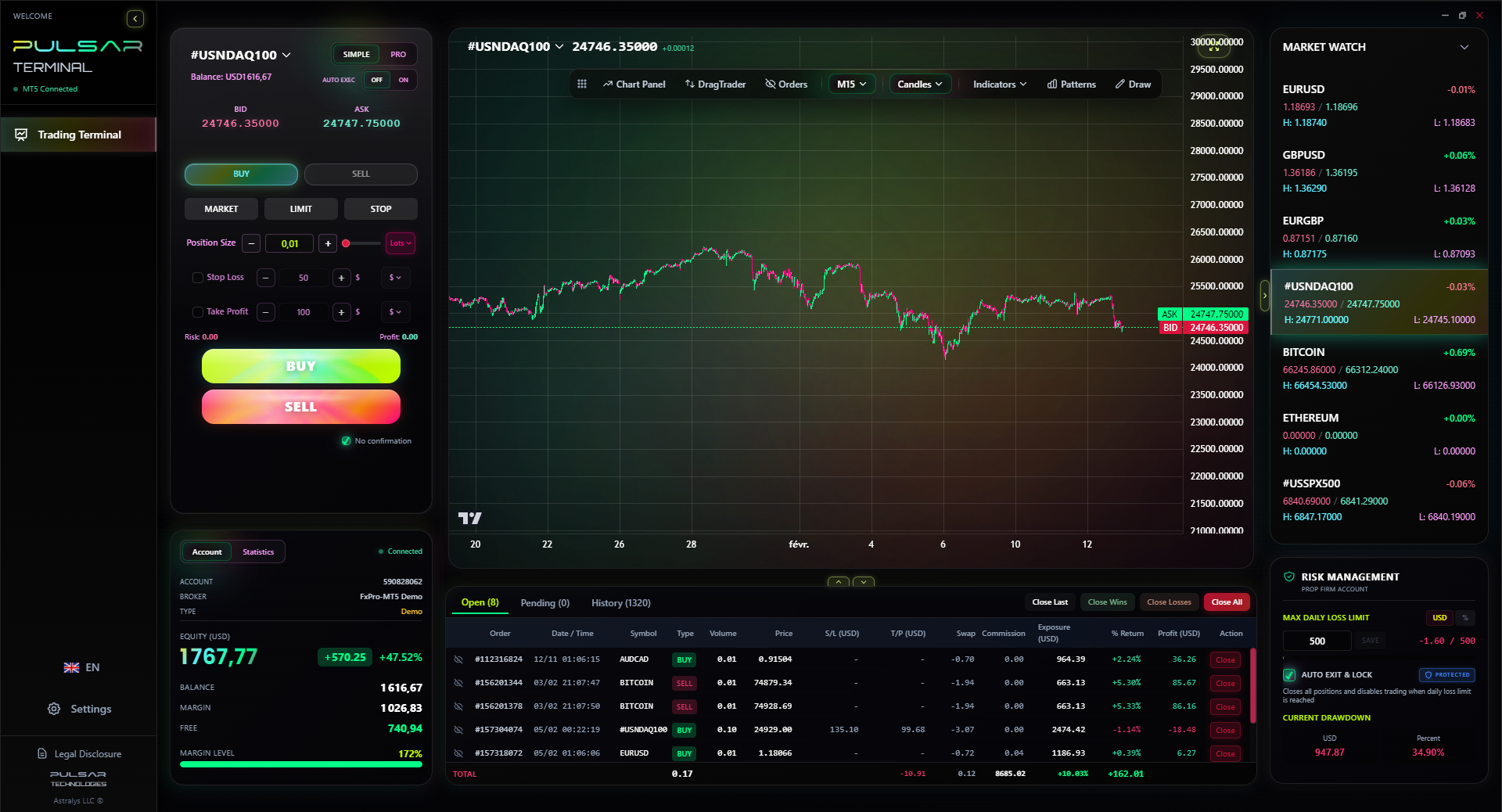
Managing multiple trades and precise stop-loss levels is critical under FSCA rules, and Pulsar Terminal's drag-and-drop order and multi-TP/SL tools on MT5 make executing your technical plan effortless.
Pulsar Terminal
Das All-in-One MT5-Tool: Drag-and-Drop-Orders, Multi-TP/SL, Trailing Stop, Grid Trading, Volume Profile und Prop-Firm-Schutz. Täglich von 1.000+ Tradern genutzt.
“Our 30:1 use cap is a gift. It forces discipline.”
Instead of searching for the perfect forex technical analysis pdf, create the only one that matters: your personal trading journal. This is where you turn experience into edge.
What to Record for Every Trade:
- Date, Pair, Direction (Buy/Sell)
- Entry Price, Stop Loss, Take Profit
- Position Size (in lots or units)
- The Technical Setup: (e.g., "Bought at 50 EMA bounce on H4, RSI oversold"). Attach a screenshot!
- Result (Pips & Rands): Profit/Loss.
- Emotions & Notes: Were you nervous? Did you break your rules? "FOMO buy after missing first entry" is a valuable note.
I use a simple Google Sheet. One tab for trades, another for weekly summaries. Every Sunday, I review. I ask: Which setups worked best? Did I lose more on scalping or swing trading? What was my win rate?
After 3 months of journaling in 2023, I spotted a brutal truth: 80% of my losses came from trades I entered after 10pm. I was tired, impulsive, and trading off 5-minute charts. My solution? I now shut down my platform at 9pm. That single insight from my journal probably saved my account.
Your journal is your personalized technical analysis manual. It tells you what works for you, in your market, with your psychology. No generic PDF can do that.
💡 Winstons Tipp
If you wouldn't know where your stop loss is without looking at the screen, you aren't trading. You're gambling with a fancy chart as a backdrop.
Alright, you've got a framework. Where do you go from here?
1. Open a Demo Account: If you haven't already, open a demo account with an FSCA broker. Practice your chart setup, draw your lines, test your 1% risk rule. Do this for at least 2-3 months of simulated market conditions. Don't rush.
2. Study One Pair Deeply: Pick EUR/USD or USD/ZAR. Learn everything about it. What time does it move with London? When is it quiet? What's its average daily range? Become a specialist before you become a generalist.
3. Use Trusted, Localized Sources:
- The FSCA Website: Check their FAIS database to verify your broker is licensed. This is step one.
- Broker-Specific Education: Brokers like IG and Khwezi Trade have decent educational hubs tailored to their platforms.
- For Charting Depth: Go beyond the basics. Learn about the Volume Profile tool to see where most trading activity happens - it's a game-changer for finding true support/resistance.
4. Start Small for Real: When you go live, start with a micro account. XM allows a $5 minimum. That's not to make money, it's to feel the emotional weight of real P&L moving. The technical analysis you did on demo will feel different when real Rand is on the line.
Remember, technical analysis isn't about predicting the future. It's about identifying high-probability scenarios and managing risk when you're wrong. In South Africa, with our unique market dynamics, that means adjusting global strategies to local realities. Build your system, journal relentlessly, and let the 30:1 use be the guardrail that keeps you in the game long enough to learn. Good luck.
FAQ
Q1Where can I find a good, free forex technical analysis PDF for South Africans?
Honestly, I wouldn't bother searching. Most free PDFs are lead magnets that are too generic. Instead, use the free education sections on FSCA-regulated broker websites (like IG or FP Markets) and focus on building your own knowledge system with a trading journal. The most valuable 'PDF' is the one you create from your own trade records and screenshots.
Q2How do I adjust a technical strategy for the high spreads on ZAR pairs?
You have two main adjustments. First, add the average spread to your entry buffer. If you want to buy at R18.00 and the spread is 12 pips, place your buy limit at R18.0012. Second, your profit targets must be significantly wider. Aim for swings of 150-300 pips, not 30-50. A tight scalp strategy that works on EUR/USD will be eaten alive by costs on USD/ZAR.
Q3Is MetaTrader 4 or 5 better for technical analysis in SA?
Both are excellent and universally available. MT4 is simpler and rock-solid, with thousands of free indicators. MT5 has more timeframes (like 2-hour, 3-hour), a better economic calendar, and more built-in indicators. I prefer MT5 for the extra tools, but you can't go wrong with MT4. The key is that any SA broker you choose will support one or both.
Q4What's the biggest mistake South African traders make with technical analysis?
Applying strategies meant for major currency pairs directly to Rand pairs without adjusting for volatility and spread. The second biggest mistake is ignoring position sizing. They'll see a perfect 'pin bar' on the chart and throw 5% of their account at it, forgetting that even the best setup can fail. Always use a position size calculator.
Q5Can I use automated trading (Expert Advisors) with technical analysis in SA?
Absolutely. MT4/MT5 fully support EAs. Many local traders use them. The caution is the same: any EA must be tested and optimized for our market conditions - especially the 30:1 use and the specific spreads of your SA broker. An EA built for 500:1 use will blow up a 30:1 account if it's not adjusted.
Q6How does FSCA's 30:1 use affect my technical analysis?
It doesn't change your analysis of the charts, but it fundamentally changes your risk management. It limits how much you can borrow, which forces you to take sensible position sizes. When you calculate your trade size based on your stop loss, the 30:1 cap is often the limiting factor, not your account balance. This is a good thing - it prevents catastrophic over-leveraging on a 'sure thing' technical signal.
Prof. Winstons Lektion
Wichtige Erkenntnisse:
- ✓Adjust global strategies for ZAR volatility and spread.
- ✓Never risk more than 1% of your account per trade.
- ✓Your trading journal is your most important analysis tool.
- ✓Use the FSCA 30:1 use as a protective guardrail.
Wie nützlich war dieser Artikel?
Klicken Sie auf einen Stern
Wöchentliche Trading-Einblicke
Kostenlose wöchentliche Analysen & Strategien. Kein Spam.
Über den Autor
David van der Merwe
Schwellenland-Trader
In Johannesburg ansässiger Trader mit 11 Jahren Erfahrung in Schwellenländerwährungen. Spezialisiert auf ZAR-Paare, FSCA-regulierten Handel und Analyse des südafrikanischen Marktes.
Kommentare
Risikohinweis
Der Handel mit Finanzinstrumenten birgt erhebliche Risiken und ist möglicherweise nicht für alle Anleger geeignet. Vergangene Ergebnisse garantieren keine zukünftigen Renditen. Dieser Inhalt dient ausschließlich Bildungszwecken und stellt keine Anlageberatung dar. Führen Sie immer Ihre eigene Recherche durch, bevor Sie handeln.
Das könnte Sie auch interessieren

Cara Trading Forex Sukses: 7 Prinsip dari Trader Profesional
Cara trading forex sukses dengan 7 prinsip trader pro: manajemen modal, disiplin, journal trading, backtest. Data nyata, bukan janji profit palsu.
Jam Trading Forex Terbaik untuk Trader Indonesia: Panduan Lengkap dengan Tabel Waktu
Panduan jam trading forex untuk trader Indonesia. Tabel 4 sesi dunia, jam emas 20:00-00:00, sesi mana yang harus dihindari. Data akurat + tips dari trader berpengalaman.
Top 5 Sàn Forex Uy Tín Nhất 2026: Review Jujur dari Trader Indonesia
Top 5 sàn forex uy tín 2026 untuk trader Indonesia. Review jujur: spread, deposit, withdraw, dukungan lokal. Exness, XM, IC Markets & lebih.
Pulsar Terminal herunterladen
Alle diese Rechner sind in Pulsar Terminal mit Echtzeit-Daten Ihres MT5-Kontos integriert.
Pulsar Terminal herunterladen