


Here's a fact that might surprise you: over 70% of new traders in South Africa fail their first login.

David van der Merwe
Schwellenland-Trader ·  South Africa
☕ 12 Min. Lesezeit
Was Sie lernen werden:
- 1Why Your Login Matters More Than You Think
- 2Choosing a Regulated South African Broker: The FSCA Filter
- 3The Step-by-Step Login and Verification Process
- 4Navigating MT4/MT5 After You Log In
- 5Common Login Issues (And How to Fix Them)
- 6Security Best Practices Beyond the Password
- 7From Login to First Trade: A Sane Checklist
Here's a fact that might surprise you: over 70% of new traders in South Africa fail their first login. Not their first trade - their first login. They get stuck on verification, confused by platform choices, or worse, they log into an unregulated broker's platform without realizing it. That login screen is your first line of defense. This guide isn't about fancy strategies; it's about getting you safely through the door and set up properly, so you can focus on what matters: trading.
When you hear 'forex trading log in,' you probably picture just typing a username and password. I did too, back in 2012. That mindset cost me R5,000 in a single afternoon. I'd logged into a platform offered by a 'broker' with slick marketing but questionable regulation. The trade execution was painfully slow, the spreads were huge, and when I tried to withdraw my remaining capital, it was a nightmare. The login was the gateway to that whole mess.
Your login credentials are the keys to your trading kingdom. They protect your capital, your personal data, and your access to the markets. In South Africa, with the FSCA keeping a watchful eye, using a regulated broker's platform isn't just advice - it's your primary safety net. That FSCA license number you verify before you even create an account? That's your first trade, and it's a winning one.

Warning: Never, ever use the same password for your trading account that you use for your email, social media, or online banking. If a broker's database is compromised (it happens), you don't want hackers getting a universal key to your life. Use a unique, strong password and enable two-factor authentication (2FA) the moment you see the option.
“Over 70% of new traders in South Africa fail their first login. Not their first trade - their first login.”
Before you even see a login screen, you need to pick the right venue. This is where most beginners trip up. They see ads promising '500:1 use!' or 'zero spread on USD/ZAR!' and jump in without checking the fine print. The FSCA caps use at 30:1 for retail traders for a reason - to protect you from yourself. Any broker offering more to South African residents is operating outside the rules, and your money won't be safe.
The FSCA License Check
Your first step is always the FSCA's public register. It's a bit clunky, but it's free. Go there, type in the broker's company name or their claimed FSP number. If they're legit, you'll see their status, what they're licensed for, and any past regulatory actions. Don't just trust the badge on their website; verify it yourself. I once found a broker using an expired FSP number from a completely different company. That five-minute check saved me a fortune.
Understanding the Local Nuance: Trading the Rand
Here's a critical local rule many miss: as a South African resident, you generally cannot speculate against the Rand (ZAR) for physical delivery through an online broker. Want to buy US dollars hoping the Rand weakens? You need a bank or authorized dealer. However, trading USD/ZAR as a CFD (Contract for Difference) is perfectly normal and offered by most regulated brokers. You're trading the price movement, not taking delivery of the currency. Knowing this distinction before you log in prevents confusion later.
Broker Platforms and Your Login
Most brokers here offer MetaTrader 4 (MT4) or MetaTrader 5 (MT5). Your login details for the broker's website (where you manage deposits) are often separate from your trading server login (for MT4/MT5). You'll typically get two sets of credentials: a 'Member Area' login and a 'Trading Account' login. Keep them straight. A good broker like IC Markets or Pepperstone makes this process clear.

Example: Let's compare two scenarios for a R10,000 account trading EUR/USD:
- Broker A (FSCA Regulated): Spread of 0.8 pips. Cost per standard lot: ~R12. Your funds are segregated.
- Broker B (Unregulated): Spread of 2.5 pips. Cost per standard lot: ~R37.5. Your funds are potentially co-mingled with the broker's operating capital. The login to Broker B is cheaper in terms of friction (maybe less verification), but every single trade you make after logging in is more expensive and riskier.

💡 Winstons Tipp
Your first login is a test. If the broker makes it too easy - no proper verification, instant access to high use - that's not a feature. It's a flashing red warning sign. The good guys make you prove you're real.
“That FSCA license number you verify before you create an account? That's your first trade, and it's a winning one.”
Alright, you've picked a regulated broker. Now, the real 'forex trading log in' process begins. It's not instant. If it is, be very suspicious. Proper FSCA-regulated brokers must follow strict KYC (Know Your Customer) and AML (Anti-Money Laundering) rules. This means proving you are who you say you are.
Stage 1: Website Registration
You'll enter basic info: name, SA ID number, email, phone number. Use your real, legal details. I tried using a nickname once early on, and it delayed my verification by a week while they untangled it. They'll ask for your tax residency (yes, SARS needs to know about your trading profits) and your trading experience. Be honest about being a beginner. It might affect your default use, which is a good thing.
Stage 2: The Verification Grind
This is the part people hate, but it's a sign of a secure broker. You'll need to upload clear, color copies or photos of:
- Your SA ID Book or Smart Card: Front and back.
- Proof of Residence: A utility bill (Eskom, municipal water) or bank statement from the last 3 months with your name and address. A cellphone bill usually won't cut it.
- Proof of Payment: If you deposit from your bank account, a screenshot of the successful EFT showing your name and the broker's details. This links your funding source to your identity.
My pro tip? Do this on a computer, not your phone. The upload quality is better, and you can see what you're doing. This process can take from a few hours to 2 business days. Don't pester support after 30 minutes; use the time to study a scalping strategy or learn about the MACD indicator.
Stage 3: Your First Real Login
Once verified, you'll get your official credentials. You'll log into the broker's client portal. This is your command center. Here, you'll:
- Review your approved use (max 30:1).
- Deposit funds. Start small. R2,000 is a perfectly sane amount to learn with.
- Generate your trading platform login (MT4/MT5). The portal will create a server name, login ID, and a 'investor' password for you. Copy these carefully.

Pro Tip: When you get your MT4/MT5 login, the first thing you should do after logging in is change the default 'investor' password from the platform itself (Tools > Options > Server). This adds another layer of security, especially if you ever use a VPS or trade on a public computer.
“That FSCA license number you verify before you create an account? That's your first trade, and it's a winning one.”
You're in. The charts are flashing, and it's tempting to just click 'buy.' Don't. The first session after a successful forex trading log in should be for setup, not trading. I learned this the hard way by jumping into a GBP/USD trade before I even knew how to set a stop-loss. That cost me 3% of my account in minutes.
Essential First Settings
- Check the Spread: Right-click on the market watch window, select 'Spread.' This shows you the live bid/ask difference. Compare it to what the broker advertised. For major pairs, anything under 1.0 pip on a standard account is decent.
- Set Up a Default Trade Template: Before you place a single trade, configure a default order. Go to Tools > Options > Trade. Set your default lot size to something tiny, like 0.01 (a micro lot). Enable 'Show stop-loss and take-profit lines.' This forces you to consider risk on every trade.
- Understand the Trade Window: When you click 'New Order,' a window pops up. This is where the rubber meets the road. You'll see:
- Symbol: The pair you're trading (e.g., EURUSD).
- Volume: Your lot size. Use our position size calculator to determine this based on your risk, don't guess.
- Stop Loss & Take Profit: Enter these in pips or price. Always set a stop loss. I don't care how confident you are.
- Type: 'Instant Execution' or 'Pending Order.' Start with Instant.
Your First Practice Trade
Fund a demo account with virtual Rands first. I insist on this. Log into the demo platform (it's the same process) and place 20-30 practice trades. Get used to the mechanics: opening, modifying, closing. See how the price moves relative to your stop-loss. Understand what a pip definition really means in Rand terms. Only then should you switch to your live login.
This is also where you realize the limitations of vanilla MT4/MT5. Placing a trailing stop or managing a trade with multiple take-profit levels is clunky. It's one of the reasons I started looking for better tools.
💡 Winstons Tipp
Before you ever log into a live account, log into a demo and place 50 trades. Not to make fake money, but to make every possible mistake. Misclick an order? Great. Forget a stop-loss? Perfect. Do it here, where it's free.
“The first session after a successful login should be for setup, not trading. I learned this the hard way.”
It won't always be smooth. Here are the headaches you'll likely face and how to solve them without panicking.
- 'Invalid Account' on MT4/MT5: This is the most common one. You're probably trying to log into the wrong server. Your broker will give you a specific server name (e.g., 'ICMarkets-SouthAfrica-01'). The dropdown in MT4 has dozens. You must select the exact one. If you can't find it, use the broker's 'MT4/MT5 Configuration' file, which auto-sets the server.
- Forgotten Password: Don't just mash the 'Login' button. Use the 'Forgot Password' link on the broker's website client portal. Resetting your trading platform password is usually done from within that client portal, not from MT4 itself.
- Account Blocked After Multiple Failed Attempts: Security feature. It usually unlocks after 15-30 minutes. If it doesn't, contact support. Have your client ID ready.
- Deposit Not Reflecting After Login: You did an EFT, logged in, but the balance is zero. First, EFTs in SA can take a few hours, even if it says 'instant.' Second, did you deposit into the correct beneficiary account with the correct reference? Check your portal for a 'Deposit History' section. If it's been over 4 business hours, then contact support with your proof of payment.
- Platform Feels 'Slow' or Prices Seem Off: This could be a slow internet connection, or you could be logged into a demo server by mistake. Check the server name. Also, during high volatility (like SARB interest rate announcements), spreads widen and execution slows. That's normal, not a scam.
A clean login and a stable platform are the foundation. Once that's sorted, you can think about advanced execution. For example, a proper swing trading plan often involves scaling out of positions, which is a hassle on basic MT4.
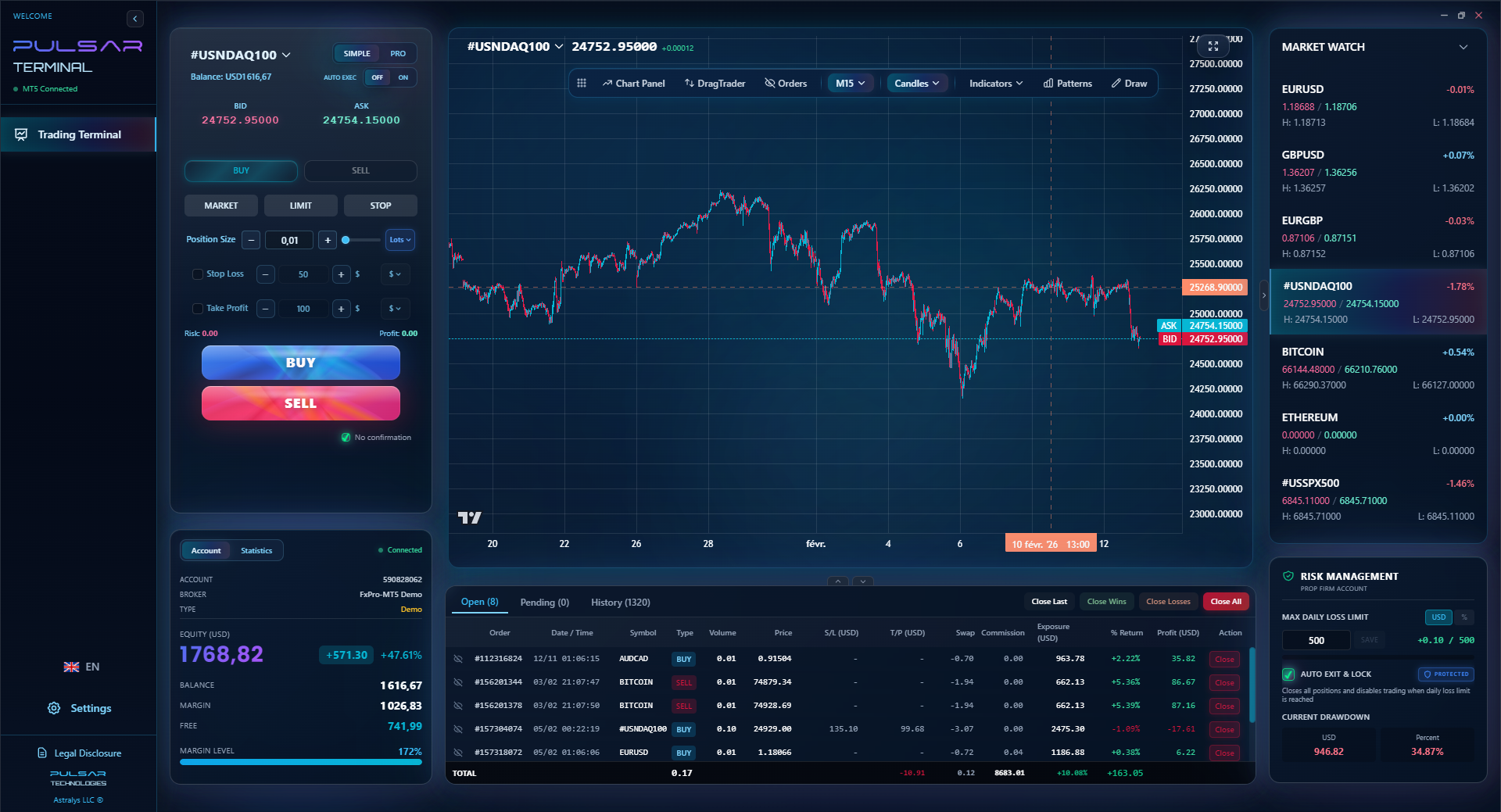
Once you're logged in and trading, managing complex orders like trailing stops or multi-level take-profits on basic MT4 is clunky; Pulsar Terminal adds that professional-grade control directly onto your MT5 platform.
Pulsar Terminal
Das All-in-One MT5-Tool: Drag-and-Drop-Orders, Multi-TP/SL, Trailing Stop, Grid Trading, Volume Profile und Prop-Firm-Schutz. Täglich von 1.000+ Tradern genutzt.
“The first session after a successful login should be for setup, not trading. I learned this the hard way.”
Logging in safely is a habit, not a one-time event. Here’s how to build that habit.
- Two-Factor Authentication (2FA): If your broker offers it (and they should), turn it on. It links your login to an app on your phone like Google Authenticator. Even if someone gets your password, they can't get in without your phone.
- Secure Your Device: Don't trade on public Wi-Fi. Ever. Use a VPN if you must. Keep your computer's antivirus and operating system updated. A keylogger on your PC makes the strongest password useless.
- Beware of Phishing: You might get an email that looks like it's from your broker: 'Security Alert! Click here to verify your account!' Check the sender's email address carefully. Never click links in unsolicited emails. Always type your broker's website URL directly into your browser to log in.
- Log Out: Especially if you're on a shared computer. Just closing MT4 doesn't always log you out. Use File > Login or right-click the connection icon in the terminal window to log out properly.
- Monitor Your Account: Log in regularly, not just to trade, but to check your account history, running trades, and deposit/withdrawal status. Early detection of anything weird is key.
Remember, the goal isn't just to access the markets; it's to protect the ZAR you're putting on the line. A single careless login on a compromised computer can wipe out an account faster than a bad trade. I've seen it happen. Treat your trading login with the same seriousness as your online banking login, because functionally, that's exactly what it is.
💡 Winstons Tipp
Security isn't paranoia. Using 2FA is like putting a second lock on your trading account door. The few seconds it adds to your login is nothing compared to the months of grief it can save you.
“Treat your trading login with the same seriousness as your online banking login, because functionally, that's exactly what it is.”
Let's tie this all together. Here’s your pre-flight checklist before you place that first live trade.
- Broker Vetted: FSCA license verified on the public register. use confirmed as 30:1 or less.
- Account Verified: ID, Proof of Residence, and Proof of Payment uploaded and approved.
- Funds Deposited: Small, sensible amount (e.g., R2,000 - R5,000) cleared and showing in client portal.
- Trading Platform Installed: MT4/MT5 downloaded from your broker's website (not a random site).
- Logged In Successfully: Connected to the correct live trading server with your unique credentials.
- Platform Configured: Default lot size set to micro (0.01), stop-loss visibility enabled.
- Demo Practice Completed: At least 20 practice trades executed in a demo environment. You understand how to open, modify, and close orders.
- Risk Plan Defined: You know what percentage of your account you'll risk per trade (1-2% is standard). You've used the position size calculator.
- Security Enabled: Unique password set, 2FA activated on client portal if available.
- First Trade Planned: You're not logging in to 'see what happens.' You have a specific pair in mind (maybe start with EUR/USD for its liquidity), a clear reason for the trade, and predefined stop-loss and take-profit levels.
If you can tick all these boxes, your forex trading log in was successful. You're not just in the platform; you're in the game, prepared, and protected. Now the real work - and the real learning - begins. Good luck, and trade safe.
FAQ
Q1I'm a South African. Can I trade USD/ZAR with a forex broker?
Yes, but with a crucial distinction. You cannot buy US dollars for physical delivery through an online broker to speculate on the Rand. However, you can trade USD/ZAR as a CFD (Contract for Difference) with FSCA-regulated brokers. You're trading the price movement, not taking delivery of the currency. This is a common and legal practice.
Q2How long does broker verification take in South Africa?
With a reputable FSCA-regulated broker, verification typically takes between 2 and 48 hours during business days. Delays usually happen if your documents are blurry, don't match the information you provided, or if you submit a cellphone bill instead of a proper utility bill or bank statement. Doing it right the first time speeds everything up.
Q3I logged into MT4 but my deposit isn't showing. What's wrong?
First, confirm the EFT has cleared from your bank. Then, ensure you are logged into the correct LIVE trading server, not a demo server. Your funds are managed in the broker's client portal. The balance only appears in MT4 once you're connected to the server where your live account exists. If it's still missing after 4 business hours, contact support with your proof of payment.
Q4What's the difference between my website login and my MT4 login?
They are two separate systems. Your website (or client portal) login is for administrative tasks: deposits, withdrawals, account verification, and generating your MT4 credentials. Your MT4 login (server, login ID, investor password) is used solely to connect to the trading platform to execute trades and view charts. You need both.
Q5Is a wider spread on USD/ZAR normal for South African traders?
Yes, absolutely. USD/ZAR is considered an exotic pair with lower liquidity than majors like EUR/USD. Wider spreads are normal and reflect the higher cost of trading that instrument. You might see spreads of 20-50 pips or more during volatile periods, compared to under 1 pip for EUR/USD. Always check the live spread before entering a trade on exotics.
Q6I failed my login too many times and my account is blocked. What now?
This is a standard security lockout. Wait 15-30 minutes and try again, making absolutely sure you have the correct server, login ID, and password (check for caps lock). If it remains locked, do not keep trying. You must contact your broker's support team directly. They will verify your identity and unlock it for you.
Q7Are my profits from forex trading taxable in South Africa?
Yes. The South African Revenue Service (SARS) views net profits from forex trading as income. You are required to declare these profits in your annual tax return. It's wise to keep detailed records of all your trades, deposits, and withdrawals from the moment you start. Consider consulting a tax professional familiar with trading income.
Prof. Winstons Lektion
Wichtige Erkenntnisse:
- ✓Always verify the FSCA license on the official register, not just the broker's website.
- ✓Your MT4 login server must be exact; 'Invalid Account' usually means wrong server.
- ✓Use a unique password and enable 2FA immediately after account creation.
- ✓Practice on a demo with the exact same login process before going live.
- ✓USD/ZAR CFD trading is legal; physical Rand speculation through brokers is not.
Wie nützlich war dieser Artikel?
Klicken Sie auf einen Stern
Wöchentliche Trading-Einblicke
Kostenlose wöchentliche Analysen & Strategien. Kein Spam.
Über den Autor
David van der Merwe
Schwellenland-Trader
In Johannesburg ansässiger Trader mit 11 Jahren Erfahrung in Schwellenländerwährungen. Spezialisiert auf ZAR-Paare, FSCA-regulierten Handel und Analyse des südafrikanischen Marktes.
Kommentare
Risikohinweis
Der Handel mit Finanzinstrumenten birgt erhebliche Risiken und ist möglicherweise nicht für alle Anleger geeignet. Vergangene Ergebnisse garantieren keine zukünftigen Renditen. Dieser Inhalt dient ausschließlich Bildungszwecken und stellt keine Anlageberatung dar. Führen Sie immer Ihre eigene Recherche durch, bevor Sie handeln.
Das könnte Sie auch interessieren

Cara Trading Forex Sukses: 7 Prinsip dari Trader Profesional
Cara trading forex sukses dengan 7 prinsip trader pro: manajemen modal, disiplin, journal trading, backtest. Data nyata, bukan janji profit palsu.
Jam Trading Forex Terbaik untuk Trader Indonesia: Panduan Lengkap dengan Tabel Waktu
Panduan jam trading forex untuk trader Indonesia. Tabel 4 sesi dunia, jam emas 20:00-00:00, sesi mana yang harus dihindari. Data akurat + tips dari trader berpengalaman.
Top 5 Sàn Forex Uy Tín Nhất 2026: Review Jujur dari Trader Indonesia
Top 5 sàn forex uy tín 2026 untuk trader Indonesia. Review jujur: spread, deposit, withdraw, dukungan lokal. Exness, XM, IC Markets & lebih.
Pulsar Terminal herunterladen
Alle diese Rechner sind in Pulsar Terminal mit Echtzeit-Daten Ihres MT5-Kontos integriert.
Pulsar Terminal herunterladen