


Let's clear up the biggest misconception right now: you cannot trade forex directly on Robinhood in the United States.
James Mitchell
Senior Trading-Analyst
☕ 11 Min. Lesezeit
Was Sie lernen werden:
- 1The Robinhood Forex Reality Check
- 2Why It's Complicated: US Forex Regulations Explained
- 3Your Real Alternatives: Legitimate US Forex Brokers
- 4The Nuts and Bolts: Costs, use, and What to Expect
- 5How to Set Up Your First Real Forex Account
- 6Mistakes I Made (So You Don't Have To)
- 7The Future of Forex Trading in the US
Let's clear up the biggest misconception right now: you cannot trade forex directly on Robinhood in the United States. I've seen so many new traders, lured by the app's clean interface and zero-commission stock trading, assume they can jump into EUR/USD or GBP/JPY with the same ease. It's a costly assumption. While Robinhood offers limited currency exposure in a roundabout way, it's not a forex trading platform. If you're serious about trading currencies, you need to understand this distinction and know where to go instead. I learned this the hard way, and this guide will save you the frustration and lost opportunity I experienced.
Here's the straight talk: Robinhood is not a forex broker. Its regulatory framework, business model, and platform design are built around equities, options, and crypto. The complex, heavily regulated world of spot forex trading is a different beast entirely.
What Robinhood does offer its Gold subscribers (costing $5/month) is the ability to trade a handful of major currency ETFs and a few direct currency pairs like EUR/USD. But calling this 'forex trading' is like calling a kiddie pool the ocean. The execution, spreads, and overall experience are built for casual exposure, not active trading.
I made this mistake early on. I funded my Robinhood Gold account, saw the EUR/USD ticker, and placed a trade. The spread was massive - often 10-15 pips wide when the real market was at 1-2. My attempt at a quick scalping strategy was dead on arrival because the cost to enter and exit was prohibitive. The platform also lacked basic order types crucial for forex, like trailing stops or multiple take-profit levels. It was a $200 lesson in platform-fit.

Warning: Trading currency ETFs on Robinhood is not the same as trading the forex market. You're trading a fund's price, not the direct interbank currency rate. This adds layers of tracking error and different liquidity dynamics.
The bottom line? If your goal is to set a long-term, buy-and-hold position on the US dollar versus the Euro, Robinhood's offering might suffice. If you want to trade forex - reacting to news, using use, managing risk with precision - you need a real forex broker.

💡 Winstons Tipp
The spread isn't a fee you see, but it's a tax you pay on every trade. If your strategy aims for 5-pip profits but the spread is 3, you've already given up 60% of your potential. Know your broker's typical spread for your chosen pair before you ever place an order.
The main reason Robinhood steers clear is the regulatory thicket. In the US, forex isn't the wild west. It's one of the most tightly controlled retail trading spaces globally, governed by the CFTC and the NFA. These rules exist to protect you, but they also create high barriers for platforms.
Let's break down the key rules that shape every real US forex broker:
- use Caps: This is the big one. For major pairs like EUR/USD, your max use is 1:50. For minors and exotics, it's 1:20. Compare that to 1:500 or even 1:1000 offshore, and you see why US traders sometimes feel handicapped. It forces more conservative position size calculations, which isn't a bad thing.
- FIFO Rule: First-In, First-Out. You must close your oldest position in a currency pair first. This kills a common hedging technique where you'd open opposing trades to manage risk.
- No Hedging: Directly related to FIFO, you simply cannot hold a buy and a sell position on the same pair at the same time.
- No CFDs: Contracts for Difference, popular in Europe and the UK, are completely off-limits for US retail traders.
- Broker Capital Requirements: A Retail Foreign Exchange Dealer (RFED) must maintain at least $20 million in net capital. This is why the list of US brokers is short - it's incredibly expensive to operate.
These rules make offering a compliant, competitive forex product a massive undertaking. For a company like Robinhood, building a separate, regulated forex division from scratch likely doesn't justify the cost versus focusing on their core equities and crypto business.
“Robinhood is not a forex broker. Calling its currency offering 'forex trading' is like calling a kiddie pool the ocean.”
So, if not Robinhood, where do you go? The field is small but filled with established, heavily regulated players. I've traded with most of them over the years. Here’s a practical comparison based on my experience.
| Broker | My Experience & Key Detail | Minimum Deposit | Key Platform Offerings |
|---|---|---|---|
| OANDA | My go-to for years. Reliable execution, $0 minimum deposit, and a fantastic API for algo traders. Their spreads are variable but competitive. | $0 | OANDA Trade, MT4, TradingView |
| FOREX.com | Powerful for serious charting and research. Their advanced platforms have depth. I used them when I needed deep liquidity for larger swing trading positions. | $100 | FOREX.com platforms, MT4, MT5 |
| tastyfx (formerly IG US) | Excellent for low, transparent pricing. Their raw spreads + commission model can be cheaper for high-volume traders. I found their education top-notch. | $0 | tastyfx platform, MT4 |
| Trading.com | A newer entrant with a slick MT5-based platform. Good for traders who want MT5's advanced features out of the box. | $100 | MT5 (heavily customized) |
Choosing Your Platform: MT4, MT5, or Proprietary?
This is a personal choice that will define your workflow.
- MetaTrader 4 (MT4): The veteran. It feels like home. The charting is solid, the expert advisor (EA) environment for automation is vast, and every broker supports it. Most of my early automated strategies were built here. However, it's getting long in the tooth and doesn't handle trading other asset classes well.
- MetaTrader 5 (MT5): The successor. It's more powerful - faster, more timeframes, a built-in economic calendar, and a better backtester. If you're starting fresh, I'd lean towards MT5. The only catch is that not all US brokers offer it; FOREX.com and Trading.com do. A good MT5 companion app can supercharge its order management, which is a weak point.
- Proprietary Platforms (OANDA Trade, tastyfx platform): These are designed for simplicity and integration. OANDA's platform is incredibly intuitive for manual trading. tastyfx's platform is built for order flow and clarity. They often lack the deep customizability of MT4/5 but make up for it in user experience.
My advice? Open a demo account with two brokers. Try MT5 on one and the broker's own platform on the other. Your comfort with the tools is half the battle.
Let's talk numbers, because this is where the rubber meets the road. Your profitability hinges on understanding the real costs of trading in the US.
The Two Main Pricing Models:
- Spread-Only: The broker's profit is built into the difference between the bid and ask price. This is simple but can be expensive during low liquidity. The EUR/USD spread might be 1.2 pips instead of 0.8.
- Raw Spread + Commission: You get a tighter raw spread (e.g., 0.2 pips on EUR/USD) but pay a commission per lot traded (e.g., $5 per 100k round turn). This is often cheaper for active traders.

Example: On a $10,000 position (0.1 lots) in EUR/USD:
- Spread-Only (1.2 pips): Cost = 0.00012 (pip value) * $10,000 = $1.20 to enter the trade.
- Raw + Commission (0.2 pips + $5/rt): Spread cost = 0.00002 * $10,000 = $0.20. Plus $5 commission per 100k, so for 0.1 lots it's $0.50. Total cost = $0.70. The commission model saved $0.50 on that single trade. Scale that up over hundreds of trades, and it matters.
use: The Double-Edged Sword The 1:50 use limit feels restrictive if you've heard stories from traders in other jurisdictions. I used to resent it. Then I blew up an offshore account using 1:200 use. The US limit forced me to develop discipline. With 1:50 on a major pair, a 2% move against you will trigger a margin call. That's still a huge move. It teaches you that position size is your primary risk tool.
Minimum Deposits: Don't let this stop you. Brokers like OANDA and tastyfx with $0 minimums let you start small. Fund an account with $500, trade 0.01 lots (1k units), and learn the platform and your emotions without catastrophic risk. I started my first real forex account with $300. It was the best education money I ever spent.
💡 Winstons Tipp
With US use limits, your position size is your main control. A 2% loss on a 1:50 leveraged trade is a 100% loss of your margin. Always use a position size calculator. Never let a single trade risk more than 1-2% of your account.
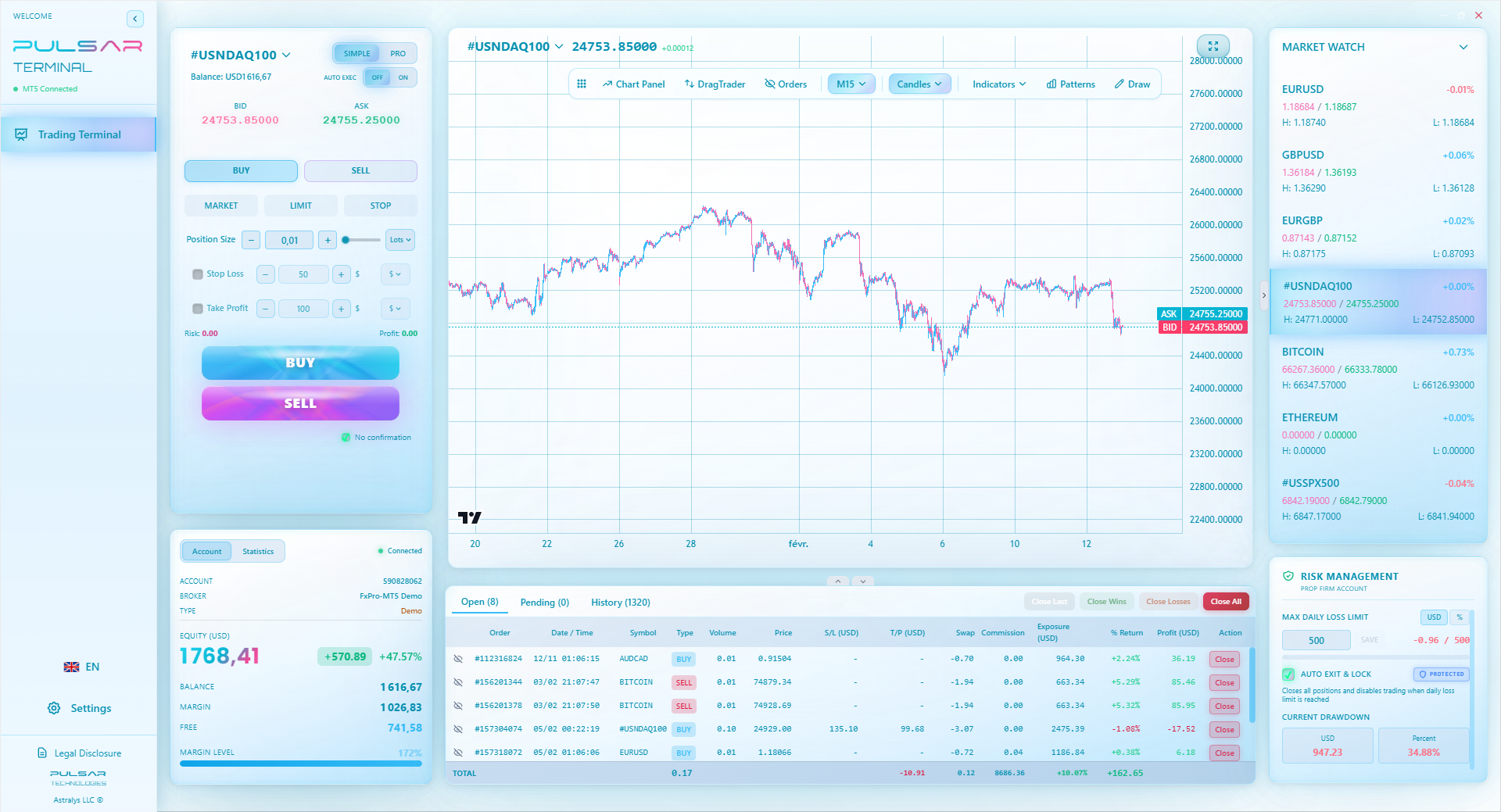
Managing multiple take-profit levels and trailing stops manually on MT5 is clunky, but tools like Pulsar Terminal automate this directly on your chart.
Pulsar Terminal
Das All-in-One MT5-Tool: Drag-and-Drop-Orders, Multi-TP/SL, Trailing Stop, Grid Trading, Volume Profile und Prop-Firm-Schutz. Täglich von 1.000+ Tradern genutzt.
“The US use limit forced me to develop discipline. I used to resent it, then I blew up an offshore account using 1:200.”
Ready to move beyond the Robinhood question? Here's my step-by-step, based on doing this a dozen times.
- Pick Your Broker: Based on the table above, choose one that fits your style. If you're a chartist, prioritize MT5 access. If you want simplicity, go with a proprietary platform. I recommend starting with OANDA or tastyfx for the $0 minimum.
- Open a Demo Account FIRST: Do not skip this. Trade the demo for at least two weeks. Practice entering orders, setting stops, and using the charting tools. Get a feel for the spreads and execution speed. It's free and useful.
- The Application Process: It's more involved than Robinhood. Expect to provide your Social Security Number, employment info, and answer questions about your trading experience and financial situation. This is standard KYC (Know Your Customer). It usually takes 1-3 business days for approval.
- Funding: Most brokers accept ACH bank transfers (free) and wire transfers (may have fees). Debit/credit card funding is sometimes available but may have limits. Start with a small, comfortable amount.
- Download and Configure Your Platform: Once funded, download MT4/5 or log into the web platform. Set up your charts. I always start with a simple layout: a candlestick chart with a 50 and 200 EMA, and maybe the MACD indicator or RSI below. Hide all the clutter.
- Execute Your First Trade: Start obscenely small. I'm talking a 0.01 lot trade. Your goal for the first ten trades isn't profit. It's to flawlessly execute your plan: enter, place your stop-loss and take-profit, and manage the trade without panic.

Pro Tip: When you open your live account, immediately set your maximum use to below the broker's default. If they offer 1:50, set it to 1:30 in your account settings. This self-imposed limit is an extra layer of psychological protection against over-leveraging on a bad day.
Let's get vulnerable. My journey from Robinhood's simplicity to real forex trading was paved with errors. Here are the big ones.
Mistake 1: Underestimating the Spread. Coming from commission-free stock trading, I ignored the spread as a 'tiny difference.' In forex, it's your primary transaction cost. I'd scalp for 5-pip profits using a strategy that required a 1-pip spread, only to find my broker's spread was 3 pips at that moment. I was fighting a 60% handicap from the start. Always know the typical spread for your pair and your broker.
Mistake 2: Misusing use. Even at 1:50, it's easy to get greedy. Early on, I put on a USD/JPY trade with my full account margin. A 40-pip move (less than 0.4%) wiped out 20% of my account. It was a correct directional call, but my size was suicidal. Now, I never risk more than 1-2% of my account on any single trade, no matter how 'sure' I am.
Mistake 3: Platform Hopscotch. I spent months bouncing between FOREX.com's platform, MT4, and MT5, constantly re-learning where buttons were. It destroyed my consistency. Pick one platform and stick with it for at least six months. Learn its shortcuts, its quirks, and make it an extension of your thinking.
Mistake 4: Ignoring the News. Forex is driven by macroeconomics. I once held a long EUR/USD position into a Federal Reserve interest rate announcement, thinking my technical analysis would hold. The pair dropped 80 pips in 10 seconds on the news. I learned to always check an economic calendar. If a major news event is due, I either close my positions or widen my stops dramatically.
“Your goal for the first ten trades isn't profit. It's to flawlessly execute your plan without panic.”
Where is all this heading? The landscape is evolving, even if Robinhood stays on the sidelines.
Regulatory Trends: The NFA is getting stricter on marketing. You'll see less of the 'get rich quick' ads and more emphasis on risk disclosures. This is good for the industry's health. Enforcement of the existing use and hedging rules will remain ironclad.
Technology is the Game (Even if I Can't Say 'Game-Changer'): AI and machine learning tools are moving from backend broker systems to front-end trader aids. Expect more platforms to offer AI-powered market scans or pattern recognition alerts in 2026 and beyond. The best human traders will use these as tools, not crutches.
Mobile-First is Here to Stay: Over 80% of new traders start on mobile. Every serious broker's mobile app now has near-desktop functionality. You can analyze charts, manage trades, and set alerts all from your phone. My first profitable trade on OANDA was from my mobile app while I was waiting for a coffee.
Market Outlook for 2026: Expect volatility. With the Fed potentially easing policy, the US dollar could soften, making pairs like EUR/USD and XAU/USD (gold) interesting plays. The key will be adapting to a market that's reacting to shifting interest rate differentials rather than just one dominant central bank.
The bottom line? The US forex market is mature, safe, and professional. It's not the easiest path to quick profits, and the regulations see to that. But for a trader who wants to engage with the world's largest financial market through reputable channels, the tools and brokers are there, waiting for you to log on.
FAQ
Q1Can I trade forex at all on Robinhood?
Not in the way a forex trader understands it. Robinhood Gold offers trading in a few major currency pairs (like EUR/USD) and currency ETFs, but with wide spreads, limited order types, and a platform not designed for active currency trading. It's for casual, long-term exposure, not technical analysis or short-term strategies.
Q2What is the best alternative to Robinhood for forex trading in the US?
For beginners, OANDA or tastyfx are excellent starting points due to their $0 minimum deposit and user-friendly platforms. For more advanced charting and MT5 access, FOREX.com is a strong choice. The 'best' depends on whether you prioritize low costs, a specific platform like MT4/5, or educational resources.
Q3Why is use so low for US forex traders?
The CFTC and NFA cap retail use at 1:50 for majors and 1:20 for minors to protect traders from catastrophic losses. While it feels restrictive, it enforces discipline. High use is the fastest way to blow up an account, and US regulators have decided the protection is worth the limitation.
Q4What's the difference between trading a currency ETF and forex?
A currency ETF (like UUP for the US dollar) is a fund that tracks a currency's value. You're trading a stock on an exchange. Forex is the direct, over-the-counter trading of the currency pair itself. Forex offers direct pricing, much higher liquidity, the ability to use use, and 24-hour trading during the week. ETFs have management fees, trade only during stock market hours, and their price can deviate from the actual spot rate.
Q5How much money do I need to start forex trading with a US broker?
You can start with as little as $100, and some brokers like OANDA have no minimum. However, with low US use, you need to manage expectations. A $100 account trading 0.01 lots is a realistic learning vehicle. A more practical starting balance for applying basic risk management is $500-$1,000.
Q6Is MetaTrader 4 (MT4) or MetaTrader 5 (MT5) better for US traders?
MT5 is the more modern, powerful platform with more timeframes and a better backtester. If your US broker offers it (like FOREX.com), MT5 is the better choice for starting fresh. MT4 is still fantastic and universally supported, but it's legacy technology. Your choice may depend on which platform your chosen broker provides.
Prof. Winstons Lektion
Wichtige Erkenntnisse:
- ✓Robinhood does not support real forex trading; it's for casual currency exposure only.
- ✓US use is capped at 1:50 (majors) and 1:20 (minors) for your protection.
- ✓Real US forex brokers include OANDA, FOREX.com, and tastyfx.
- ✓The spread is your primary cost; understand it before you trade.
- ✓Start with a demo account and trade 0.01 lots to learn the platform.
Wie nützlich war dieser Artikel?
Klicken Sie auf einen Stern
Wöchentliche Trading-Einblicke
Kostenlose wöchentliche Analysen & Strategien. Kein Spam.
Über den Autor
James Mitchell
Senior Trading-Analyst
In New York ansässig mit über 9 Jahren Trading-Erfahrung. Fokus auf Haupt-USD-Paare, Prop-Firm-Challenges und die US-Regulierungslandschaft.
Kommentare
Risikohinweis
Der Handel mit Finanzinstrumenten birgt erhebliche Risiken und ist möglicherweise nicht für alle Anleger geeignet. Vergangene Ergebnisse garantieren keine zukünftigen Renditen. Dieser Inhalt dient ausschließlich Bildungszwecken und stellt keine Anlageberatung dar. Führen Sie immer Ihre eigene Recherche durch, bevor Sie handeln.
Das könnte Sie auch interessieren

Cara Trading Forex Sukses: 7 Prinsip dari Trader Profesional
Cara trading forex sukses dengan 7 prinsip trader pro: manajemen modal, disiplin, journal trading, backtest. Data nyata, bukan janji profit palsu.
Jam Trading Forex Terbaik untuk Trader Indonesia: Panduan Lengkap dengan Tabel Waktu
Panduan jam trading forex untuk trader Indonesia. Tabel 4 sesi dunia, jam emas 20:00-00:00, sesi mana yang harus dihindari. Data akurat + tips dari trader berpengalaman.
Top 5 Sàn Forex Uy Tín Nhất 2026: Review Jujur dari Trader Indonesia
Top 5 sàn forex uy tín 2026 untuk trader Indonesia. Review jujur: spread, deposit, withdraw, dukungan lokal. Exness, XM, IC Markets & lebih.
Pulsar Terminal herunterladen
Alle diese Rechner sind in Pulsar Terminal mit Echtzeit-Daten Ihres MT5-Kontos integriert.
Pulsar Terminal herunterladen